Others

CPD calls for tax justice, FDI reform, review of US trade deal
Centre for Policy Dialogue (CPD) on Saturday urged major reforms in tax collection, business climate, trade deals and foreign investment management, warning that without evidence-based decisions and strong accountability, Bangladesh’s post-election economic transition could be at risk.
CPD said Bangladesh must urgently overhaul its revenue system, ease the cost of doing business, review recently signed trade agreements and strengthen foreign direct investment (FDI) facilitation to ensure sustainable growth and smooth graduation from Least Developed Country (LDC) status.
Presenting the study titled ‘New Government’s Priorities in Addressing Socio-economic Challenges: Introducing Knowledge-based Decision Making in the Executive and Legislative Process’ at its Dhanmondi office, CPD Research Director Dr Khondaker Golam Moazzem highlighted structural weaknesses in Sections 3, 4, 5 and 6 of the report covering revenue mobilisation, business environment, trade policy and FDI.
Tax-GDP Ratio
CPD said Bangladesh’s tax-to-GDP ratio has fallen to approximately 6.8 percent, the lowest in South Asia, significantly weakening fiscal capacity at a time of rising development needs.
The newly elected government has pledged to raise the ratio to 10 percent in the medium term and 15 percent by 2035. But CPD cautioned that revenue sustainability would remain uncertain without prioritising tax justice and plugging systemic leakages.
The study identified ‘leaking revenue’ as the weakest area across all decision-making indicators.
To address regressivity and inefficiency, CPD recommended consolidating the current eight VAT slabs into a simplified three-tier structure: standard, reduced and zero rates, with a long-term transition toward a two-tier system.
It also proposed eliminating tax exemptions for non-essential services, including exclusive clubs and stock market-related entities, and phasing out tax cut incentives for fossil fuel-based power producers.
Mandatory digital tax return submission, establishment of a digital tax dispute resolution system within 30–45 days and performance-based corporate tax incentives were among the key recommendations.
CPD further suggested linking revenue gains from VAT rationalisation to direct transfers for low-income households instead of broad reduced-rate exemptions.
Business Environment
The report noted that Bangladesh’s business environment continues to suffer from transport-logistics bottlenecks, unreliable utilities, regulatory complexity, corruption, weak human capital alignment and fragile banking systems.
It warned that corruption in administrative processes remains the most severe constraint to ensuring an enabling business environment.
Despite digital reforms such as the partial launch of “BanglaBiz” and activation of the Bangladesh Single Window system, CPD found that transparency and accountability remain weak.
The study recommended full backend digital integration across agencies under a unified document management framework to eliminate duplication of business licensing requirements.
It also called for establishing both a Tax Ombudsman and a Banking Ombudsman to address grievances and strengthen institutional accountability.
CPD raises concerns over power overcapacity, pushes for 'no new fossil' fuel policy
In the financial sector, CPD flagged high non-performing loans (NPLs) and limited SME access to financing as major barriers.
Although reforms such as the Bank Resolution Ordinance 2025 and Deposit Protection Ordinance 2025 were introduced, the think tank said credit allocation decisions lack transparency and efficient implementation.
It urged Bangladesh Bank to innovate credit assessment models, develop inclusive SME financing options with lower collateral requirements and exercise caution in interest rate reduction to avoid inflationary pressures.
US-Bangladesh Trade Agreement
CPD raised serious concerns over the recently signed “Agreement on Reciprocal Trade” between Bangladesh and the United States, saying several clauses may restrict Bangladesh’s trade policy autonomy.
The study alleged that the agreement includes discriminatory provisions relating to import licensing, technical standards and digital trade.
According to CPD, Bangladesh would be required to gradually eliminate tariffs on US-origin goods while facing potential additional tariffs if deemed non-compliant.
The report also claimed that Bangladesh would not be allowed to impose digital service taxes on US companies or introduce customs duties on electronic transmissions.
Other provisions cited include restrictions on retaliatory VAT measures, limitations on agreements with third countries that conflict with US standards and preferential access for certain US goods.
CPD warned that such clauses could severely jeopardise Bangladesh’s smooth transition strategy (STS) for LDC graduation, particularly in negotiating balanced free trade agreements (FTAs) and economic partnership agreements (EPAs).
It urged the government to withdraw from the agreement before formal notification exchange and revisit other deals, including the EPA with Japan, particularly provisions related to duty-free LNG imports that may delay energy transition.
FDI Reform
CPD identified six major structural challenges in attracting and retaining foreign investment, including fragmented approvals, policy unpredictability, institutional overlap, slow dispute resolution, land access bottlenecks and weak data systems.
The report said investment approvals remain sequential rather than parallel, even after the launch of BanglaBiz offering over 100 services and fast-track foreign loan approvals up to USD 10 million for export-oriented firms.
CPD recommended mandatory API-based integration among the Bangladesh Investment Development Authority (BIDA), National Board of Revenue, Registrar of Joint Stock Companies, Customs, BEZA and BEPZA to ensure simultaneous processing and real-time tracking.
The think tank called for converting profit repatriation commitments — including the 30-working-day resolution target — into binding legal standards through legislative amendments.
It also proposed designating specialised commercial benches within the High Court within 180 days and establishing a full-fledged International Commercial Court within 24 months.
To enhance transparency, CPD recommended creating a unified national FDI monitoring dashboard linked to the government’s target of raising FDI to 2.5 percent of GDP, with quarterly public reporting.
A national readiness audit of economic zones, including litigation-free land and confirmed utility capacity, should be completed within 180 days, the study added.
Dr Moazzem said that raising tax revenue, reducing business costs, negotiating trade agreements and attracting FDI must be guided by knowledge-based decision-making and parliamentary oversight.
He stressed that without structural reforms in fiscal governance, regulatory transparency and institutional accountability, policy initiatives may remain fragmented and ineffective.
“The new government has a strong electoral mandate. The challenge is to translate it into evidence-based, transparent and accountable decision-making,” he said.
CPD’s findings come as the government prepares to implement its first 180-day priority agenda following the February 12 national election.
6 days ago
Poet Mohon Raihan to receive Bangla Academy Literary Award on March 2
Poet Mohon Raihan will be awarded Bangla Academy Literary Award on Monday.
The award will be handed over at 11am at Bangla Academy, said a PID handout on Saturday.
Although poet Mohon Raihan was nominated for this year’s Bangla Academy Literary Award in the poetry category the Academy withheld his award without any prior notice.
On February 23, the Academy released the list of awardees, which had included Raihan’s name under poetry.
However, he did not receive the award after allegations against him led to a last-minute review, officials and the poet told several media outlets.
Eight distinguished citizens and one organisation on Thursday received the Ekushey Padak this year in recognition of their outstanding contributions to various fields.
Prime Minister Tarique Rahman handed over the Ekushey Padak 2026, the country’s second highest civilian award, to the recipients and their representatives at a ceremony held at the Osmani Memorial Auditorium in the morning.
The Ekushey Padak is awarded for significant contributions to various fields, including the Language Movement, the Liberation War, arts, journalism, literature and education.
6 days ago
PM Tarique works on holiday, urges faster manifesto action
Prime Minister Tarique Rahman attended office on Saturday, although it was a public holiday, and called on officials to gear up the implementation process of the government’s election manifesto.
The move, similar to last week’s holiday appearance, signals his push to maintain momentum in delivering key policy priorities.
Tarique Rahman arrived at the Prime Minister’s Office (PMO) in Tejgaon at 10:15am, said his Additional Press Secretary Atikur Rahman Rumon.
He said the Prime Minister left his Gulshan residence in the morning and went to his office in Tejgaon, where he held a meeting with officials and staff members.
During the meeting, Tarique Rahman sought their cooperation in implementing his election manifesto, Rumon added.
Prime Minister’s advisers Mirza Abbas, Ismail Zabiullah, Humayun Kabir, Rashed Al Mahmud Titumir, Brig Gen (retd) ATM Shamsul Islam and Zahedur Rahman were present, along with Principal Secretary ABM Abdus Sattar.
The additional press secretary said the Prime Minister is scheduled to attend an iftar hosted by Bangladesh Jamaat-e-Islami at the Bangladesh-China Friendship Conference Center in the afternoon.
PM shares warm moments with children after Jum'a prayers at Banani
Tarique Rahman assumed office as Prime Minister on February 17. Since then, he has been attending office every Saturday despite the weekly government holiday.
Last Saturday, he worked at the PMO in Tejgaon for the first time.
6 days ago
CPD raises concerns over power overcapacity, pushes for 'no new fossil' fuel policy
The Centre for Policy Dialogue (CPD) on Saturday urged the government to halt new fossil fuel-based power projects, revise what it called inflated demand projections and bolster parliamentary oversight to put Bangladesh’s power and energy sector on a fiscally sustainable and climate-aligned path
CPD said Bangladesh’s power and energy sector is at risk of fiscal stress, stranded assets and stalled renewable energy transition due to overestimated demand projections, fossil fuel lock-in and weak regulatory transparency.
Presenting a research paper titled 'New Government’s Priorities in Addressing Socio-economic Challenges: Introducing Knowledge-based Decision Making in the Executive and Legislative Process' at CPD’s Dhanmondi office, CPD Research Director Khondaker Golam Moazzem outlined a series of structural weaknesses in the sector and recommended urgent reforms within the first 180 days of the new government.
The study identified 'Power and Energy: Reviving for Energy Transition' as the seventh priority sector and found that procedural transparency, accountability, and implementation efficiency remain the weakest pillars of decision-making in this sector.
CPD noted that existing master plans project electricity demand to reach 40-50 gigawatts (GW) by 2040, while independent estimates suggest a more realistic requirement of around 30 GW.
The study warned that inflated GDP-demand linkages, rather than actual industrial consumption data, have been used to justify aggressive expansion targets. This could lead to massive surplus capacity that would be 'difficult to undo', increasing fiscal burdens through long-term contractual obligations.
Spatial planning mismatch was also highlighted, with Dhaka receiving disproportionately high projections compared to emerging industrial hubs such as Chattogram and Sylhet.
CPD recommended that Bangladesh Power Development Board (BPDB) and Power Cell adopt rigorous econometric forecasting methods and subject revised projections to independent validation and parliamentary review.
The report underscored the structural burden of capacity payments to independent power producers (IPPs), even for idle plants. Despite recent tariff hikes reaching Tk 8.95 per unit in 2024 — fiscal stress persists.
According to the study, plant-by-plant payment details and the rationale behind tariff adjustments lack transparency, while public hearings by the Bangladesh Energy Regulatory Commission (BERC) have often been bypassed.
CPD recommended introducing a 'No Electricity, No Pay' clause in future Power Purchase Agreements (PPAs) to eliminate unconditional capacity charges. It also called for renegotiation of rigid 'take-or-pay' contracts, though acknowledging the legal complexity involved.
The think tank warned of growing dependence on imported LNG and coal, raising concerns about stranded assets and fiscal instability.
It said long-term price volatility impacts are systematically downplayed and that insufficient assessment has been conducted regarding risks associated with new LNG terminals and coal-based infrastructure.
CPD proposed adopting a clear 'No New Fossil Fuel-Based Power Generation' policy and urged reassessment of planned coal projects, including Matarbari Phase 2, through parliamentary debate to ensure fiscal and climate accountability.
The study also called for scaling up regional power trading with Nepal and Bhutan to import hydropower and balance solar intermittency.
While the interim government approved the Renewable Energy Policy 2025, CPD observed that grid absorption capacity for variable renewable energy (VRE) remains capped at 20%, and smart grid implementation has been deferred to 2040-2050.
Private renewable energy developers face bureaucratic hurdles in securing grid interconnection approvals, the report said.
CPD recommended that Power Grid Bangladesh (PGB) conduct a technical grid stress test to determine upgrades required to absorb at least 30% renewable energy by 2030.
It also proposed establishing an Independent System Operator (ISO) to separate grid management from BPDB and ensure institutional neutrality.
A 'Resource-to-Grid Data Hub' integrating real-time renewable energy potential mapping across districts should be developed under parliamentary monitoring, the study added.
In the primary energy segment, CPD highlighted a persistent daily gas shortage of around 1,200 million cubic feet per day (mmcfd), with total demand at 3,800 mmcfd against supply of just over 2,600 mmcfd, including LNG imports.
The report argued that increasing LNG imports alone would deepen financial burdens and recommended prioritising domestic gas exploration instead.
It stressed that overemphasis on new LNG infrastructure and domestic coal exploration reflects weaknesses in evidence-based analysis and stakeholder engagement.
A central theme of the CPD study is embedding knowledge-based decision-making in both executive and legislative processes.
The report called on the Parliamentary Standing Committee on Power and Energy to review all major generation, fuel mix and procurement decisions to ensure statutory compliance and transparency.
It noted that suspension of the Quick Enhancement of Electricity and Energy Supply (Special Provision) Act 2010 by the interim government is a positive step toward restoring competitive procurement and judicial oversight.
CPD, however, warned that without institutional restructuring, real-time data transparency and structured parliamentary scrutiny, reform efforts may remain partial.
Immediate and Long-term Priorities
For the next 180 days, CPD recommended:
1. No approval of new fossil fuel-based power plants
2. Independent validation of revised demand projections
3. Introduction of “No Electricity, No Pay” clauses in future contracts
4. Engagement with export-oriented industries in designing a National Solar Rooftop Programme
5. Institutionalising parliamentary review of all major sectoral decisions
Beyond 180 days, the study proposed grid modernisation, establishment of an Independent System Operator, zonal energy audits, smart grid pilots, and legislative-backed accountability frameworks.
Moazzem said the success of the new government would depend on its ability to align fiscal prudence, climate commitments and energy security through transparent, evidence-driven policymaking.
“Without structural reforms and parliamentary oversight, the sector risks repeating past mistakes of overcapacity, high tariffs and fiscal stress,” Moazzem added.
6 days ago
Dhaka’s air quality 4th worst in the world this morning
Dhaka, the overcrowded capital city of Bangladesh, has ranked 4th on the list of cities with the worst air quality with an AQI index of 188 at 9:26 am on Saturday.
Dhaka’s air was classified as ' unhealthy', according to the air quality and pollution city ranking.
Pakistan’s Lahore, India’s Delhi and Nepal’s Kathmandu occupied the first, second and third spots in the list, with AQI scores of 308, 263 and 190 respectively.
When the AQI value for particle pollution is between 101 and 150, air quality is considered ‘unhealthy for sensitive groups’, between 150 and 200 is ‘unhealthy’, between 201 and 300 is said to be 'very unhealthy', while a reading of 301+ is considered 'hazardous', posing serious health risks to residents.
The AQI, an index for reporting daily air quality, informs people how clean or polluted the air of a certain city is and what associated health effects might be a concern for them.
Dhaka's air quality remains ‘unhealthy’
The AQI in Bangladesh is based on five pollutants: particulate matter (PM10 and PM2.5), NO2, CO, SO2, and ozone.
Dhaka has long been grappling with air pollution issues. Its air quality usually turns unhealthy in winter and improves during the monsoon.
7 days ago
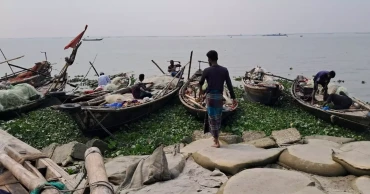
Govt bans fishing in Padma-Meghna for 2 months to protect jatka
The government has imposed a two-month ban on catching all types of fish, including hilsa, in the Padma River and Meghna River from Saturday midnight to boost hilsa production and conserve jatka.
The restriction will remain in force from March 1 to April 30, during which fishing, sale, transport and stocking of fish in the designated river stretches are prohibited. Authorities warned that strict action will be taken against violators.
District Fisheries Officer Mohammad Fakhrul Islam said a nearly 70-km sanctuary has been declared from Satnal in Matlab Uttar upazila to Char Bhairabi in Haimchar via Chandpur Sadar. About 47,000 registered fishermen will refrain from fishing during the period.
To support affected fishermen, 39,400 of them will receive VGF rice assistance—40 kg per month for four months (February to May), totaling 160 kg per person.
However, several fishermen along the Meghna riverbanks said the food aid is insufficient to run their families and urged the government to provide additional cash support during the ban period.
Chandpur Sadar Senior Fisheries Officer Mirza Omar Faruk said district and upazila task forces will enforce the ban and conduct mobile courts against illegal jatka fishing.
Naval Police SP Syed Mosfiqul Rahman said river patrols will remain active throughout the ban, and legal action will be taken under fisheries laws against offenders.
District Administrator Md Nazmul Islam Sarker called on all stakeholders to cooperate in conserving jatka, while hilsa researcher Dr Anisur Rahman stressed that protecting jatka today will ensure higher hilsa production in the future.
7 days ago

New DSCC Administrator Salam unveils drive to make South Dhaka a ‘clean city’
Newly appointed administrator of Dhaka South City Corporation (DSCC) Abdus Salam on Friday pledged to transform the capital’s southern zone into a 'clean city', calling on residents to actively cooperate in maintaining sanitation and civic discipline.
“Household and shop wastes must be kept at designated places from where city corporation workers will collect it. If more than Tk 100 is charged for collecting waste from any house, the approval of the contractor concerned will be cancelled,” he said.
The made the remarks while speaking briefly before an iftar programme organised by Ward No. 24 of BNP’s Dhaka South city unit at Lalbagh Hridoy Party Centre.
Referring to directives from Prime Minister Tarique Rahman, Salam said efforts have already begun to transform both Dhaka South City Corporation and Dhaka North City Corporation into clean and green cities.
He sought full cooperation from city dwellers to make Dhaka a cleaner and better liveable city.
Emphasising the preservation of Old Dhaka’s heritage, the new administrator said its traditional food culture and historic sites must be protected.
PM shares warm moments with children after Jum'a prayers at Banani
“We have to plan in such a way that local and foreign visitors feel encouraged to visit these historic places in Old Dhaka,” the administrator said, adding that the south city corporation will take initiatives in this regard.
Salam also warned that there would be no compromise against extortion, mugging and drug-related crimes in the capital.
“Those involved in crimes like extortion and mugging will not be spared, no matter which party they belong to or how powerful they are,” Salam said.
Stating that mosquito infestation has increased in Dhaka, he said the corporation will strengthen its drives to control mosquitoes and prevent the spread of dengue.
7 days ago
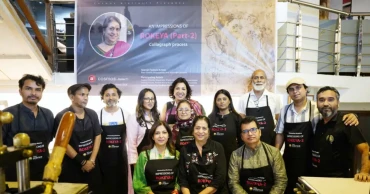
Ekushey Padak winner Rokeya Sultana’s printmaking workshop begins at Cosmos Atelier71
A three-day printmaking workshop titled “Impressions of Rokeya–2”, conducted by eminent artist Rokeya Sultana, began on Friday at Cosmos-Atelier71 at Cosmos Centre in the city.
The workshop was inaugurated in the presence of Rokeya Sultana, Professor of the Department of Printmaking under the Faculty of Fine Arts at the University of Dhaka, who received the Ekushey Padak in 2025 for her contribution to painting.
Director of COSMOS-Atelier71 Tehmina Enayet, Executive Editor of United News of Bangladesh Nahar Khan, artists, students, and art enthusiasts were also present at the inauguration.
Speaking on the occasion, Tehmina Enayet said Rokeya Sultana has long been closely associated with COSMOS-Atelier71, not only as an artist but also as a mentor and collaborator. She said the idea of organising the workshop emerged shortly after Rokeya’s return from abroad and was arranged within a very short time due to the enthusiastic response from participants.
Rokeya Sultana, in her address, expressed gratitude to the organisers and participants. She said the workshop was designed particularly for those outside the formal printmaking discipline to introduce them to the creative possibilities of the medium. Describing printmaking as a “search of the mind,” she highlighted the freedom of expression and experimentation the process allows.
During the workshop, Rokeya introduced participants to the collagraph process—a versatile printmaking technique where textured printing plates are created by attaching materials such as paper, fabric, leaves, sand, string, and cardboard onto a rigid base. The plates can be printed using both relief and intaglio methods, producing richly textured and expressive images.
Rokeya Sultana is a distinguished name in Bangladesh’s contemporary art scene. A former chairperson of the Department of Printmaking at the University of Dhaka, she has exhibited her works widely at home and abroad. She earned her Bachelor of Fine Arts from the University of Dhaka and a Master of Fine Arts from Visva-Bharati University, Shantiniketan, India. Her works are noted for strong narratives, sensual exploration, and abstract compositions.
“My Ekushey Padak salutes the strength of Bangladeshi women:” Rokeya Sultana
7 days ago

Media freedom to be ensured by defining scope of accountability: Information Minister
Information Minister Zahir Uddin Swapan on Friday said the government will ensure the highest level of media freedom by clearly defining the scope of accountability through consultations with journalists and all relevant stakeholders.
“The aim is to guarantee unrestricted access to information for the people while determining accountability based on the opinions of journalists and other stakeholders,” he told reporters after a meeting with district-level government officials at the Barishal Circuit House in the morning.
The minister said the government wants to bring the overall media system under a modern management framework, acknowledging that the information ministry was established at a time when technology-based media did not exist.
“We have yet to fully adapt to the new media ecosystem driven by modern technology. The rapid expansion of technology-based media requires adjustments that could not be achieved earlier,” he said.
He added that the government would gradually ensure free flow of information to the public by holding discussions with all concerned as part of its policy-making process.
Information Minister calls for transparent family card distribution in Barishal
Earlier, the minister distributed grant cheques of the BRTA among victims of road accidents. A total of Tk 21.7 million was distributed among 61 beneficiaries.
Barishal Deputy Commissioner Khairul Alam Sumon and other government officials were present at the programme.
7 days ago
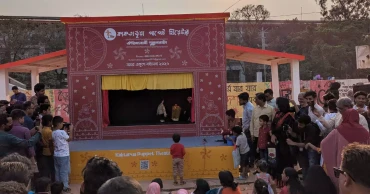
Children enchanted by puppet show as Boi Mela comes alive on day 2
Children watched the puppet show with wide-eyed fascination as the second day of the Amar Ekushey Book Fair began in a lively atmosphere amid their cheerful presence.
The fairgrounds gained a different level of vibrancy from the morning, with a strong presence of young visitors on the weekly holiday, Friday.
The second day of the Amar Ekushey Book Fair, Bangla language and literature’s largest celebration, started in the morning with a variety of events. The day’s formal proceedings began at 9:30am at the Bangla Academy premises with a children’s drawing competition, followed by a recitation contest at 10:30am.
The fair opened to visitors at 11:00am, and the designated ‘Children’s Hour’(Shishu prohor) continued until 1:00pm. During this time, the Bangla Academy grounds buzzed with drawing and recitation activities. Tomorrow’s Children’s Hour will feature music.
One of the major attractions of Children’s Hour was an educational puppet show that captivated young audiences. Near the Muktomancha inside Suhrawardy Udyan, the ‘Kaktaruya Puppet Theatre: Traditional Puppet Show’ has been set up. Through the performances, children are being taught various educational messages, like reading books, avoiding excessive mobile gaming, and eating green vegetables.
However, the absence of the popular ‘Sisimpur’ segment, a fixture in previous years, has created some disappointment among children. Still, the alternative puppet show has managed to keep them entertained.
After Children’s Hour ended at 1:00pm, the number of visitors of all ages gradually increased. On the ground, however, there was not much crowd in front of the stalls before evening. Many stalls at the Bangla Academy premises and Suhrawardy Udyan are still not fully ready; construction and book arrangement work were seen ongoing in several stalls.
This year’s fair has been shortened to 18 days due to various considerations. With Ramadan approaching, vendors are somewhat concerned about visitor turnout and sales. However, they remain hopeful that sales will increase once stall preparations are complete and the holiday mood intensifies.
Publishers said holidays are extremely important for them. Like previous years, they expect good sales on Fridays and Saturdays, though there is some concern about the impact of Ramadan.
Boi Mela 2026 to be held spanning Dec-Jan in view of election, Ramadan
According to the fair schedule, the event runs daily from 2:00pm to 9:00pm, while on holidays it remains open from 11:00am to 9:00pm. Children’s Hour is being observed every Friday and Saturday from 11:00am to 1:00pm.
Meanwhile, the main stage of the fair hosts thematic seminars daily from 3:00pm to 4:00pm, followed by cultural programmes from 4:00pm to 5:00pm.
7 days ago