Others

8 diagnostic centres fined in Barishal
Eight diagnostic centres and hospitals in Barishal city were fined a total of Tk 2.82 lakh during a joint drive on Tuesday for using expired reagents and operating without required licences.
The daylong drive was conducted in the Band Road area adjacent to Sher-e-Bangla Medical College Hospital, led by Deputy Director of the National Consumer Rights Protection Directorate Apurba Adhikari.
According to officials, the district office of the National Security Intelligence (NSI) first gathered confidential information about irregularities at several diagnostic labs. Based on the findings, authorities carried out long-term surveillance and, with approval from higher authorities, informed the consumer rights body, leading to the joint operation.
During the drive, Al-Aqsa Hospital and Diagnostic Centre was fined Tk 40,000, Health Aid Medical Services Tk 10,000, Nova Medical Services Tk 10,000 and Islamiya Digital Diagnostic Centre Tk 45,000.
Besides, Barishal City General Hospital was fined Tk 20,000, Gain Diagnostic and Physiotherapy Centre Tk 7,000, New Babylon Medical Services Tk 50,000 and Rongdhonu Diagnostic Centre Tk 1 lakh.
Officials from the NSI Barishal district office, along with personnel from the Consumer Rights Protection Directorate’s district and divisional offices and members of the city police reserve force, took part in the drive.
1 month ago

Top terror Titon shot dead in city
A listed top terror was shot to death in the New Market area of the capital on Tuesday evening.
The deceased was identified as Khandokar Noyeem Ahmed Titon, 59, son of KM Fakhruddin. He was the brother-in-law of another notorious criminal Sanjidul Islam Emon, said Mohammad Ayub, officer-in-charge of New Market Police Station.
He used to live at Sultanganj under Hazaribagh Police Station in the capital.
Titon was ranked second on the list of 23 top criminals prepared by the government in 2001.
Police suspect he was killed following a conflict among rival criminal groups, saying they are trying to identify those involved in the murder.
The incident took place around 7:50pm in front of the Shaheed Shahnewaz Hostel near Dhaka University.
The victim was taken to Dhaka Medical College Hospital (DMCH) after the gun attack, where doctors declared him dead.
A passerby, Mezbah, who took the victim to the hospital, said two unidentified attackers arrived on a motorcycle and opened fire on Titon in front of Gate No. 1 of the hostel.
“They shot him multiple times, including in the head, arm and under the armpit, before fleeing the scene,” he said.
Titon was found lying in a pool of blood and was rushed to the DMCH, where he was declared dead around 8:27pm.
Inspector Md Faruk, in-charge of the DMCH police camp, said he was brought to the hospital with bullet injuries from the New Market area. “He was declared dead by the on-duty doctor.”
1 month ago

Ex-Biman MD gets bail in child housemaid torture case
A Dhaka court on Tuesday granted bail to former Managing Director and CEO of Biman Bangladesh Airlines, Shafiqur Rahman, in a case filed over the alleged torture of a child domestic worker.
Dhaka’s Third Additional Metropolitan Sessions Judge Moin Uddin Chowdhury granted him bail on a bond of Tk 5,000 until submission of the police report.
Defense lawyer Khorshed Alam applied for the bail.
Biman suspends flights to 6 Middle East destinations amid regional tension
The case was filed on February 1 by Golam Mostafa, the father of the victim, against Shafiqur Rahman, his wife Bithi, and two domestic helps- Rupali Khatun and Sufia Begum.
Following the case, all the accused were arrested.
On February 2, a court rejected their bail petitions and sent them to jail.
Later, police took them on remand for questioning.
According to the case statement, the accused had been looking for a young girl to take care of a child at their residence in Uttara Sector 9 and allegedly promised to bear the cost of her future marriage.
The complainant sent his daughter to work at their home in June last year. He last visited her on November 2 but was not allowed to meet her again afterwards.
On January 31, Bithi informed him over the phone that his daughter was ill and asked him to take her back. When he brought her home, he found severe injuries on her hands and other parts of the body, and she was unable to speak properly.
As the accused failed to give a satisfactory explanation, the girl was admitted to Shaheed Tajuddin Ahmad Medical College Hospital in Gazipur.
The victim later told her father that she had been subjected to repeated abuse at the house, including physical assault and being burned with heated kitchen tools, according to the case statement.
1 month ago
Bangladesh sees no existence of militancy now: Home Minister
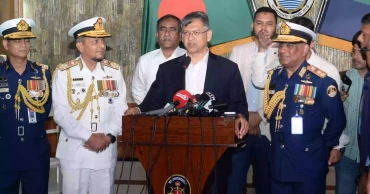
Home Minister Salahuddin Ahmed on Tuesday said that there is currently no existence of militancy in Bangladesh, alleging that the term had been used as a political tool by the previous “fascist” government.
Some extremist or radical groups exist in every country, but the government has remained vigilant to keep them under control, he said.
The minister made the remarks while responding to a question from reporters after attending a programme marking the 31st Raising Day of the Bangladesh Coast Guard at its headquarters in the city's Agargaon on Tuesday.
Replying to another question, Salahuddin Ahmed said the process of gradually withdrawing army personnel deployed under “In Aid to Civil Power” has already begun.
“We are in a phase of gradual withdrawal. It is not possible to withdraw the entire force suddenly,” he said, adding that the number of deployed troops will soon be reduced to a very limited level.
He also said that necessary precautionary measures, in line with standard operating procedures (SOPs), will remain in place to ensure the security of key point installations (KPIs).
On increasing the members' number of the Coast Guard, the minister said a policy decision has been taken to raise its manpower from the present 5,000 to 10,000 to ensure security in coastal and riverine areas.
He added that the force will be further strengthened with modern logistics, advanced training and necessary facilities.
Highlighting evolving challenges, the minister said criminals are increasingly using digital technologies to carry out their activities, making it essential for the Coast Guard to enhance its technological capabilities.
“To face these threats, the force must be equipped with modern assets and improved technical skills,” he said, adding that steps will be taken to increase budgetary allocation and implement structural reforms.
Responding to a query about misconduct within law enforcement agencies, he said allegations against any member are investigated through the respective force’s internal intelligence wing, and actions are taken under existing military or departmental laws. “This is a regular process,” he added.
Senior officials from the Ministry of Home Affairs and the Coast Guard were present at the briefing.
1 month ago

Rooppur NPP enters fuel loading phase, Bangladesh joins nuclear club
Bangladesh has entered a new phase of its nuclear energy journey as fuel loading began at Unit 1 of the Rooppur Nuclear Power Plant (NPP), marking a key step toward commissioning the country’s first nuclear power facility.
The plant is being built under the general contractor and designer Engineering Division of State Atomic Energy Corporation Rosatom.
Posts, Telecommunications and Information Technology and Science and Technology Fakir Mahbub Anam gave symbolic permission to load nuclear fuel into the first power unit of the Rooppur NPP on Tuesday, with Rosatom Director General Alexey Likhachev also present at the ceremony, said a Rosatom press release.
The fuel loading phase is part of the key commissioning stage of the unit.
1 month ago

Telecom towers must be declared critical national infrastructure: BMPCA
The Bangladesh Mobile Phone Consumers’ Association (BMPCA) on Tuesday called for sweeping reforms of the country's mobile tower infrastructure, warning that the recurring collapse of towers during even minor natural disasters reflects deep-seated failures in policy, construction standards and regulatory oversight that collectively imperil emergency services, economic activity and public safety.
In a press statement, BMPCA President Mohiuddin Ahmed said telecommunications towers must be legally designated as critical national infrastructure rather than treated purely as commercial assets, urging the government and Bangladesh Telecommunication Regulatory Commission (BTRC) to enforce mandatory structural safety audits and overhaul the regulatory framework governing tower companies.
BMPCA urges lower call rates, end to call drops
"The breakdown of communications networks means emergency services, the economy and public safety all come under threat simultaneously," he said.
The association outlined a seven-point reform agenda. On structural resilience, it demanded that all tower designs comply with international standards for wind load and seismic tolerance, with urgent audits and reconstruction of ageing or structurally deficient towers.
Heavy-duty towers should be mandatorily deployed in coastal and high-risk zones, it said.
On regulatory enforcement, BMPCA called on the BTRC to make periodic tower safety audits compulsory and to impose stringent service-level agreements on tower companies (TowerCos), with penalties, including fines and licence suspension, for non-compliance.
It also pressed for guaranteed backup power, a minimum of 24 to 72 hours of battery and generator capacity at each tower site along with expanded use of solar energy, particularly in rural areas.
The organisation recommended that the telecom sector be formally classified as a critical service with priority access to fuel supplies during crises.
On network redundancy, it advocated for greater infrastructure sharing among operators, fibre route redundancy and the activation of emergency roaming or network-sharing arrangements during disasters.
For disaster preparedness, the body recommended pre-positioning deployable Cell on Wheels (COW) units, formulating advance contingency plans for disaster-prone areas and conducting regular drills and simulation exercises.
It further called for mandatory soil testing prior to tower installation, routine inspections through local administration and a crackdown on substandard or unauthorised tower construction.
On consumer protection, the BMPCA demanded compensation or bill adjustments for subscribers affected by service disruptions and the provision of free or priority communications during emergencies.
1 month ago

11.89 lakh Rohingyas now in Bangladesh: Foreign Minister
Foreign Minister Dr Khalilur Rahman on Tuesday told Parliament that the number of Rohingyas displaced from Myanmar and currently sheltered in Bangladesh stands at some 11.89 lakh.
“According to the UNHCR report dated April 13, 2026, the current number of Rohingya community people displaced from Myanmar, a country bordering Bangladesh, is 11,89,213 (in Bangladesh),” he said, while replying to a starred question from treasury bench member Emran Ahmed Chowdhury (Sylhet-6).
Earlier, Speaker Hafiz Uddin Ahmad, Bir Bikram, tabled the question-and-answer session at the outset of the House sitting that began at 3:00pm.
Noting that the government believes in a peaceful solution to the Rohingya crisis, Dr Khalilur focused on the visionary leadership of late president Ziaur Rahman to complete repatriation of all the 200,000 Rohingyas who arrived in Bangladesh in 1978 and the successful leadership of former prime minister Khaleda Zia to send back 236,000 out of 250,000 Rohingyas arrived in 1992.
In the same trend, diplomatic initiatives are underway under the leadership of Prime Minister Tarique Rahman to safely send the Rohingya people back to their home country at the earliest possible time on the basis of mutual understanding, he added.
“Using our previous successful experiences, we have undertaken a multi-faceted diplomatic effort in the light of our election manifesto. We have continued our diplomatic engagement with the international community to find a sustainable solution to this crisis,” said the Foreign Minister.
Besides, Bangladesh continues to provide its moral and diplomatic support in international judicial processes, particularly the ongoing judicial process at the International Court of Justice (ICJ), to ensure Myanmar's accountability for this humanitarian disaster, he said.
Referring to a genocide case against Myanmar, which is currently pending at the International Court of Justice, he said, “The case has already reached an important stage - written and oral hearings have been completed and several countries have participated in it. The court's verdict is expected soon,” he said.
Although Bangladesh is not formally a party to the case, it has played a significant role through the OIC and has been providing various forms of assistance, including financial assistance, he added.
The International Criminal Court (ICC) is conducting an investigation into crimes against humanity committed against the Rohingya, he said, adding that an arrest warrant has been sought against Myanmar’s top leadership over allegations including forced displacement and persecution.
“Bangladesh is fully cooperating with this investigation, including providing evidence,” he said.
He also mentioned Bangladesh’s active support to the UN-established Independent Investigative Mechanism for Myanmar, which is collecting evidence of serious international crimes.
Besides, he said, an arrest warrant issued against senior Myanmar officials in a case filed in Argentina the principle of universal jurisdiction marked another important step toward ensuring accountability.
“The clear stand of the government is that the only sustainable solution to the Rohingya crisis is to ensure their safe, voluntary and dignified repatriation to their home country, Myanmar,” he said.
He said Bangladesh strongly supports the ongoing international judicial process to establish justice for the atrocities and human rights violations committed against the Rohingyas.
Bangladesh is providing necessary assistance to international courts and various investigative processes so that those responsible can be held accountable, he went on.
“Overall, Bangladesh has maintained a steadfast position and active activities on the Rohingya issue to fulfill its humanitarian responsibilities, establish international justice, and ensure a lasting and peaceful solution,” said the Foreign Minister.
1 month ago

Govt committed to maintaining law and order: Home Minister
Home Minister Salahuddin Ahmed on Tuesday told Parliament that the government is committed to maintaining the law and order situation and has undertaken a series of comprehensive and coordinated measures to ensure it across the country.
“The present democratic government remains firmly committed to maintaining law and order in the country and Bangladesh Police has undertaken plans to materialise the various goals of maintaining law and order and are implementing a range of operational strategies in line with government directives,” he said in response to a starred tabled question from independent lawmaker elected from Brahmanbaria-2 Rumeen Farhana.
“Based on intelligence inputs, regular and special drives are being conducted to recover illegal arms, explosives and narcotics, and legal actions are being taken accordingly,” he said.
He added, “Checkposts have been set up at key points on roads and highways and both day and night patrols have been strengthened to prevent criminal activities.”
Visible police patrols alongside enhanced intelligence surveillance are being carried out to prevent theft, robbery and mugging, he added..
“Community engagement has been strengthened through beat policing, community policing and open house day programmes to ensure public participation in maintaining law and order,” said the minister.
The minister also said that modern technology is being increasingly used to combat crime. “Installation of CCTV cameras at important locations and the use of information technology are helping identify criminals and bring them to justice,” he said.
He further informed the House that capacity building of police personnel is ongoing through modern training at home and abroad.
The Case Data Management System (CDMS) is being used to store records of cases and crimes, which is assisting investigation processes,he added.
1 month ago

Coast Guard manpower to be increased to 10,000, process underway: Home Minister
The process to increase the manpower of Bangladesh Coast Guard to 10,000 is currently underway, Home Minister Salahuddin Ahmed said on Tuesday.
He made the remarks while speaking as the chief guest at a programme marking the 31st founding anniversary and Coast Guard Day 2026 at the Coast Guard headquarters in Agargaon in the capital.
The minister said the Bangladesh Coast Guard has become a symbol of trust in ensuring the security of the country’s maritime and coastal areas.
Established in 1995 under the visionary leadership of then prime minister Begum Khaleda Zia with the motto “Guardian at Sea,” the force is being developed into a modern and capable organisation through various government initiatives, he added.
Coast Guard has been actively engaged in preventing drug smuggling, curbing human trafficking, combating piracy, and protecting forest and fisheries resources in the Sundarbans, said the minister.
Over the past year, the force conducted 29 successful drives in the Sundarbans, arresting 35 pirates and recovering a large cache of illegal arms and timber, he added.
On modernization of Coast Guard, the minister said three surveillance drones have recently been added to the force.
Construction of one multi-role response vessel and two offshore patrol vessels is progressing with funding from JICA and plans are also in place to procure bulletproof high-speed boats through Khulna Shipyard and to add helicopters and maritime surveillance systems in the future, said the minister.
Director General of Bangladesh Coast Guard Rear Admiral Md Ziaul Haq delivered the welcome speech, while Senior Secretary of the Home Ministry Manjur Morshed Chowdhury spoke as a special guest.
During the event, the minister awarded a total of 14 Coast Guard personnel for their bravery and service.
1 month ago

Comprehensive steps taken to enhance airport security: Home Minister
Home Minister Salahuddin Ahmed on Tuesday told Parliament that the government has taken a series of comprehensive initiatives to further strengthen security at the country’s international airports.
“Overall security at the country’s international airports has already been ensured. However, Bangladesh Police has taken a number of plans and is implementing them to further enhance security,” he said in response to a starred tabled question from ruling party lawmaker elected from Noakhali-5 Mohammed Fakhrul Islam in Parliament.
He said checkpoints have been set up at entry and exit points as well as other important places while police patrols have been intensified in airport areas.
The minister said a multi-layered security system has been introduced to ensure effective protection, and necessary actions are being taken based on intelligence inputs to prevent any ill attempt.
He said security services are being strengthened through coordinated efforts and information sharing among police, intelligence agencies and airport authorities.
Highlighting surveillance system, Salahuddin said, “Police surveillance has been increased to prevent theft and snatching incidents, CCTV cameras have been installed at important places and modern information technology is being used to ensure overall security.”
He further said modern equipment and advanced technology are being used, adding, “Scanning system has been strengthened to ensure that no prohibited items can enter airport premises.”
The minister also said special training programmes are being conducted to combat terrorism, ensure cyber security and handle emergency situation effectively.
He said security has also been reinforced through the introduction of technology-based modern baggage systems, expansion of immigration counters, installation of advanced scanning machines, manpower increase and reorganization, and the use of body-worn cameras.
“Strict monitoring has been put in place to prevent passenger harassment, and help desks have been introduced at airports to assist travellers,” he added.
1 month ago