Others

2 East West University students injured in lightning strike at DU campus
Two students of East West University suffered injuries due to a lightning strike in the Aparajeyo Bangla area of Dhaka University on Sunday.
The injured are Sufia Akhter, 22, and Farah Akhter, 22.
Agnila Swarnali, a classmate of the injured, said that while passing through the Aparajeyo Bangla area of Dhaka University during the rain this afternoon, lightning rendered them unconscious.
Later, they were taken to Dhaka Medical College Hospital.
Md Faruk, Inspector-in-charge of the Dhaka Medical College Hospital Police Camp, said that two students were brought to the hospital unconscious after being struck by lightning in the Dhaka University area.
They are currently undergoing treatment at the Medicine Department.
Meanwhile, at least eight people were killed by lightning strikes in Gaibandha, Bogura, Thakurgaon and Sirajganj districts on Sunday.
Among the deceased, five people died in Gaibandha and one each in Bogura, Thakurgaon and Sirajganj.
1 month ago

At least 9 killed in lightning strikes across multiple districts
At least nine people were killed by lightning strikes in Gaibandha, Bogura, Thakurgaon, Sirajganj and Natore districts on Sunday.
Among the deceased, five people died in Gaibandha and one each in Bogura, Thakurgaon, Sirajganj, and Natore.
In Gaibandha, five people were killed by lightning strikes in Phulchhari, Saghata and Sundarganj upazilas of the district on Sunday afternoon.
The deceased were identified as Mizanur Rahman, Manik Mia, Nambar Ali, Fuad and Rafi.
Deputy Commissioner Masudur Rahman Mollah said Fuad and Rafi were children, as well as cousins.
Dhopadanga Union Parishad Chairman Mokhlesur Rahman Mondal said that the two cousins, Fuad and Rafi, were struck while playing in the verandah of a house in South Dhopadanga village.
Locals rushed them to Gaibandha General Hospital, where doctors declared them dead.
Farmer Manik Mia was killed by lightning while working in a field in Phulchhari upazila.
Another victim, Nambar Ali, a farmer from Saghata upazila, also died in a lightning strike, said the DC.
Sundarganj Upazila Nirbahi Officer Iffat Jahan Tuli said she was informed about the two deaths in Dhopadanga.
Meanwhile in Thakurgaon, a 40-year-old woman died after being struck by lightning in Pirganj upazila of the district.
2 East West University students injured in lightning strike at DU campus
The deceased was identified as Selina Akhter, wife of Md. Rashidul Islam, a resident of Niamatpur village of Saidpur union in the upazila.
Selina died while working near her house in the evening, said Pirganj Police Station OC Mazharul Islam.
Meanwhile, various villages in Thakurgaon district were devastated by a two-day Kalboishakhi storm on Saturday and Sunday.
In Bogura, a 35-year-old farmer named Sumon was killed in Gabtoli upazila.
He had gone to bring back a goat from a nearby field during sudden heavy rain when lightning struck him, killing him on the spot.
An unnatural death (UD) case was filed in this regard.
In Sirajganj, another farmer died after being struck by lightning while working in a field next to his home in Tarash upazila.
Deceased Abdul Hamid, 50, was the son of late Gafur Ali of Betrashin village in the upazila.
Tarash Police Station Inspector (Investigation) Shaha Alam said police visited the spot and legal action will be taken in this incident.
A day labourer was killed after being struck by lightning in Singra upazila of Natore.
The victim, Somrat Hossain, 26, was the son of Saja Fakir of Nagardala village in Shahjadpur upazila of Sirajganj.
He had come to Natore to work as a paddy harvester.
Somrat was struck by lightning while working in a paddy field in the Thengapakuria area of Dahiya union in the Chalan Beel region of Singra upazila.
His co-workers rescued him and took him to Natore Sadar General Hospital, where doctors declared him dead.
Former chairman of Dahiya Union Shariful Islam confirmed the matter, citing local residents.
Police in all affected areas visited the sites and said legal procedures are underway.
1 month ago
Government working to make tax collection system more user-friendly: NBR Chairman
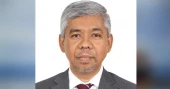
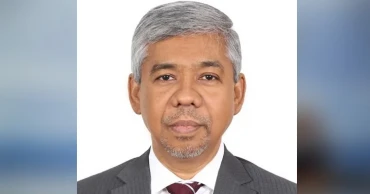
The Chairman of National Board of Revenue (NBR), Abdur Rahman Khan, on Sunday said the government is working to modernize the tax system to make it more user-friendly and efficient for taxpayers.
The NBR chief made the remarks while speaking as the chief guest at a pre-budget discussion for the fiscal year FY 2026–27, organized by the Institute of Cost and Management Accountants of Bangladesh (ICMAB) at the Ruhul Quddus Auditorium of the institution in the capital on Sunday.
“We always prioritize constructive proposals and suggestions. To simplify the tax process, the government is improving the mechanism for refunding overpaid taxes,” the Chairman said. He added that an initiative has been taken to link bank account information with the e-tax return system to increase taxpayer participation and transparency.
Mahtab Uddin Ahmed, Chairman of the ICMAB Seminar and Conference Committee and former President of the institute, delivered the welcome address, emphasizing the importance of integrated discussions in formulating effective economic policies.
During the event, experts highlighted several critical areas for tax and VAT reforms. Former NBR Member (Tax) Ranjan Kumar Bhowmik discussed tax policy reforms, while NBR First Secretary (VAT Policy) Mashiur Rahman spoke on proposed VAT exemptions and structural changes. Md. Mohiman, CEO of MM & Co., presented on the Tax Verification System (TVS) and other technical aspects of tax compliance.
ICMAB President Kauser Alam stressed that to achieve a sustainable and inclusive budget, the government must focus on increasing the tax-to-GDP ratio, expanding the tax net, and ensuring stability in the financial sector to create a favorable environment for both domestic and foreign investment.
1 month ago
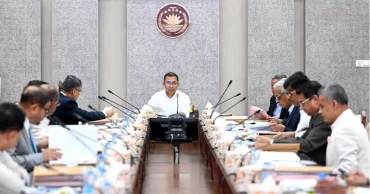
ECNEC okays 14 projects worth Tk 13,445 crore
The Executive Committee of the National Economic Council (ECNEC) on Sunday approved 14 development projects with a total estimated cost of Tk 13,445.41 crore.
These projects aim to improve infrastructure, healthcare, and economic stability across the country.
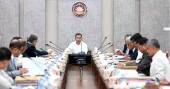
The decision was made at an ECNEC meeting held at the Cabinet Division conference room in Dhaka. The meeting was chaired by Prime Minister Tarique Rahman.
Of the projects, five are new, five have been revised and four have been given more time to complete.
Out of the total cost, Tk 8,089.56 crore will come from government funds, Tk 5,340.26 crore from loans, and Tk 15.59 crore from the organisations involved.
Major projects include “Expanding Access to Integrated Health Care for the Urban Population” under the Ministry of Health and Family Welfare, and a revised “Customs Modernization and Infrastructure Development Project (1st Revision)” under the Ministry of Finance.
In the fisheries and livestock sector, a revised project on “Eradication of PPR Disease and Control of Foot-and-Mouth Disease (3rd Revision)” was also approved.
The transport sector received significant focus with five projects approved under the Road Transport and Bridges Ministry.
These are Construction of five climate-resilient bridges in Mymensingh division, Border road construction project (Rangamati, Khagrachhari and Bandarban hill districts), Phase-2, Upgrading Bairagirpul (Barishal)–Tumpchar–Bauphal (Patuakhali) regional highway (Z-8910) (1st revised), Upgrading Barishal–Bhola–Laxmipur national highway (N-809) from Barishal (Char Kauwa) to Laxmmipur via Bhola (Ilisha ferry ghat) (1st revised) and Construction of Goma Bridge over the Rangamati River at the 14th km of the Barishal (Dinarer Pul)–Lakshmipasha–Dumki road (1st revised)”.
Among these, a decision has been taken to form an investigation committee with the Cabinet Secretary as the convener to investigate why the duration of three projects among the five has been extended five times.
The Local Government Division received approval for four projects.
The projects are Resilient Infrastructure for Adaptation & Vulnerability Reduction (RIVER) Project (1st Revision), Construction of housing for sanitation workers under Chattogram City Corporation (1st revised), Infrastructure development of Dhaka South City Corporation (2nd revised), and Emergency water supply in Dhaka city.
The ECNEC also approved two important railway projects, including Maintenance and rehabilitation of railway tracks in the western zone of Bangladesh Railway (Phase-1) and Construction of a broad-gauge railway line from Madhukhali to Magura via Kamarkhali (1st revision)”.
Local Government, Rural Development and Cooperatives Minister Mirza Fakhrul Islam Alamgir, Finance and Planning Minister Amir Khosru Mahmud Chowdhury, Home Minister Salahuddin Ahmed, Road Transport and Bridges, Railways and Shipping Minister Shaikh Rabiul Alam, among others, attended the meeting.
1 month ago
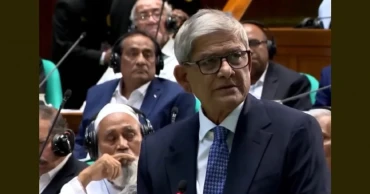
Perpetrators of Netrakona MP attack must be punished: Fakhrul
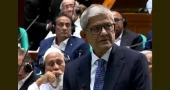
Local Government, Rural Development and Co-operatives Minister Mirza Fakhrul Islam Alamgir on Sunday told Parliament that perpetrators behind the attack on Jamaat MP Masum Mustafa in Netrakona must be identified and brought to justice.
“The real perpetrators must be identified and punished,” he said, pointing at the opposition lawmaker, Masum Mustafa, who raised the issue in the House and sought security for himself, his family and activists in his Netrakona-5 constituency.
Calling the incident “very unfortunate,” the minister said, “We all have strongly condemned the incident and felt deeply saddened by it,” he said.
Fakhrul said the Leader of the House (Prime Minister Tarique Rahman) has assured him a fair investigation would be ensured in this incident.
The minister said nine people have already been arrested in connection with the attack and further action would be taken following a proper investigation.
Speaker Hafiz Uddin Ahmad, Bir Bikram, who was chairing the House, also termed the attack on a member of parliament very unfortunate and said the entire House was united in demanding strict action against the actual culprits.
“The whole Parliament is in agreement that stern action should be taken and the minister (Mirza Fakhrul) has already said that the real offenders must be arrested. You should wait to see the outcome,” the Speaker told Masum Mustafa.
Earlier, the Jamaat lawmaker said he came under an attack on Friday evening in Purbadhala when his vehicle was vandalised and he was besieged at a filling station.
He told Parliament that while returning after work, he stopped at the filling station due to a large number of vehicles and later went to a mosque there for Maghrib prayers.
During that time a group he described as terrorists posing as BNP activists attacked his vehicle, he said.
The Jamaat lawmaker alleged the attackers later attempted to find him inside the mosque, threatened to kill him and tried to break down the mosque door with weapons, but worshippers resisted and locked the doors.
Mustafa claimed professional killers were deployed to assassinate him and said had the worshippers failed to resist, Parliament might have had to bring a condolence motion for him and the MPs might have to observe one-minute silence instead.
Seeking protection, the lawmaker appealed to the Speaker, the Prime Minister and the Home Minister to ensure security for himself, his family and party activists in his constituency.
1 month ago
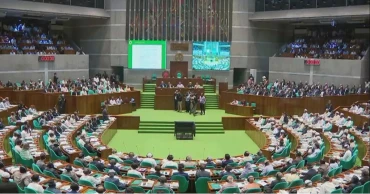
10-member special committee formed to address energy situation
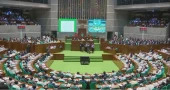
Parliament on Sunday formed a 10-member special committee with a 30-day tenure to submit a report with recommendations for addressing the country’s energy situation stemming from the Middle East crisis.
The committee, headed by Power and Energy Minister Iqbal Hassan Mahmood Tuku (as the chairman), was formed under the rule 266 of the rules of procedure after Chief Whip Nurul Islam Moni placed a proposal for the formation of the body in the House.
The joint committee was constituted with five members each from the treasury bench and the opposition bench.
The five members from the treasury bench are Power, Energy and Mineral Resources Minister Iqbal Hassan Mahmood Tuku, State Minister Anindya Islam Amit, and BNP MPs ABM Ashraf Uddin Nizan (Laxmipur-4), Moinul Islam Khan (Manikganj-2) and Miah Nuruddin Ahmad Apu (Shariatpur-3).
The five members from the opposition bench are Jamaat lawmakers Md Saiful Alam (Dhaka-12), Md Nurul Islam (Chapainawabganj-3) and Md Abdul Baten (Dhaka-16), NCP MP Md Abul Hasnat (Cumilla-4) and Khilafat Majlis lawmaker Mohammed Abul Hasan (Sylhet-5).
On April 23, Prime Minister Tarique Rahman proposed in Parliament the formation of a 10-member joint committee seeking five names from the opposition to work together on ‘rational solutions’ to the country’s ongoing energy problem.
He also proposed five names from the government side for the committee.
Hours later on the same day, Leader of the Opposition Shafiqur Rahman in the House proposed five MPs from his side for a 10-member joint committee.
1 month ago

Female DU student found dead; teacher, friend in custody for questioning
A female student of Dhaka University was found hanging at her residence in the city’s Badda area on Sunday, prompting police to take a university teacher and another student into custody for questioning.
The deceased was identified as Munira Mahzabin Mimo, a Master’s student of the Department of Theatre and Performance Studies from the 2019-20 academic session. Daughter of Mohammad Golam Mostafa of Shibchar upazila in Madaripur, she used to live with her family at Uttar Badda.
Sub-Inspector Fatema Siddiqa Soma of Badda Police Station said they recovered Mimo’s body around 9:30am on information and sent it to Dhaka Medical College Hospital (DMCH) morgue for autopsy.
According to preliminary information, investigators found a note and some information on her mobile phone that mentioned a teacher. Based on that, police took the teacher into custody for questioning.
One of her close friends, also a student, was also taken into custody for questioning.
1 month ago
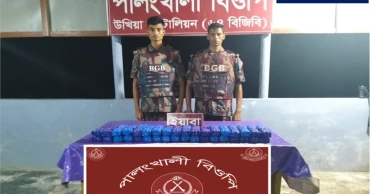
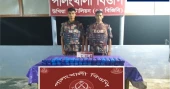
140,000 Yaba pills seized in Cox’s Bazar
Border Guard Bangladesh (BGB) has recovered 1,40,000 Yaba pills from the Palangkhali border in Ukhia upazila of Cox's Bazar.
Based on a secret source, a patrol team of Ukhia Battalion (64 BGB) took position in Guiza Canal area of Baharpara and challenged a suspected drug smuggler entering Bangladesh from Myanmar.
Sensing the presence of BGB, the person quickly fled towards Myanmar leaving behind a bag he was carrying, said a BGB press release.
The Yaba pills worth Tk 4.20 crore were recovered from packets inside plastic bags.
Intelligence surveillance has been increased to identify and arrest the escaped drug smuggler, Ukhia Battalion Commander Lt. Col. Md. Zahirul Islam said.
1 month ago
Govt committed to boosting jute sector capacity: Minister
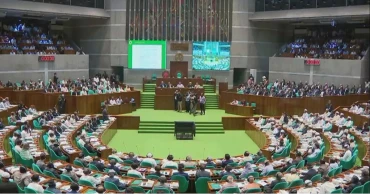
Textiles and Jute Minister Khandaker Abdul Muktadir on Sunday told Parliament that the government remains committed to enhancing the overall capacity of the jute sector and meeting growing global demand for jute products.
“Through diversification of jute products, modernisation of technology, skills development and expansion of export markets, the government’s commitment to strengthening the jute sector and meeting global demand remains steadfast,” he said.
The Minister said this while replying to a scripted question from ruling party lawmaker Mohammed Enamul Hoque (Chattogram-12) in the House.
The parliamentary session resumed at 3:25pm after a two-day recess with Speaker Hafiz Uddin Ahmad, Bir Bikram.
Rejecting the notion that jute and jute goods have lost their past glory, Muktadir said such an assumption is inconsistent with reality, as global emphasis on environmental protection and sustainable development has significantly increased demand for jute as a natural and biodegradable fiber.
He said new prospects have emerged in the international market for jute and jute products, particularly amid growing preference for environment-friendly alternatives to plastic.
“As one of the world’s leading jute-producing countries, Bangladesh has been undertaking multifaceted initiatives to capitalise on this opportunity,” he said.
Highlighting government steps to develop the sector, the minister said jute mills in the country are striving to meet both international and domestic demand according to their existing capacities.
To expand the use of jute goods in the domestic market, he said, the government has taken steps to effectively implement the Mandatory Use of Jute Packaging Act, 2010.
So, the use of jute packaging in wrapping certain products has increased, significantly expanding domestic demand, he added.
The minister said the government is continuing various policy supports to boost production capacity of jute mills and ensure product quality and diversification.
In this regard, regular dialogues and consultation meetings are being held with the Bangladesh Jute Mills Association and Bangladesh Jute Spinners Association to identify problems, challenges and prospects and determine necessary actions.
Muktadir also said initiatives have been taken to update the Jute Act, 2017 and the National Jute Policy, 2018 in a timely manner to make the sector more competitive and sustainably developed in line with changing global markets and technological advancements.
1 month ago
Recommended primary teacher candidates stage protest at Shahbagh
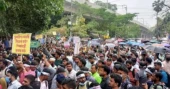
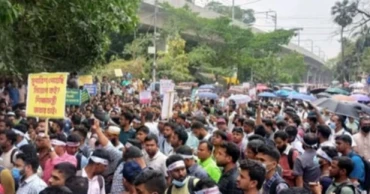
Recommended candidates of Primary Assistant Teacher Recruitment–2025 stage protests on Sunday morning in front of the National Museum at Shahbagh, demanding the immediate issuance of their appointment letters.
At the beginning of the demonstration, the protesters attempted to block the main intersection, said witnesses.
As police intervened, after which they staged a sit-in in front of the museum.
Later, a 10-member delegation went to the Ministry of Education for discussions.
The protesters said they will continue their sit-in until their demand is met and they receive appointment letters.
The final results published on February 8 recommended over 14,384 candidates for appointment with district-wise lists issued by the Directorate of Primary Education.
However, the candidates said that despite completing police verification, medical examinations, and other required procedures, appointment letters have not yet been issued even after more than two months.
A candidate from Sunamganj said, “We are feeling very uncertain and mentally stressed over the delay in appointment letters. If our demand is not met immediately, we may launch a tougher programme.”
State Minister for Primary and Mass Education Bobby Hajjaj wrote on his Facebook account that he has spoken with the delegation and assured that the matter will be addressed seriously.
1 month ago