USA

Survivors say trauma from abusive Native American boarding schools stretches across generations
Donovan Archambault was 11 years old in 1950 when he was sent from the Fort Belknap Indian Reservation in Montana to a government-backed Native American boarding school in Pierre, South Dakota, where abusive staff forced him to abandon his community's language and customs.
Archambault emerged bitter from the experience and said he drank alcohol for more than two decades before he finally pulled his life together, earning a master's degree in education and serving as chairman of the Fort Belknap tribes.
“It was probably the most brutal time of my whole life," Archambault recalled Sunday, “and it all stemmed from the trauma we suffered in the Pierre Indian School.”
Decades after the last Native American boarding schools stopped receiving federal money, the traumas inflicted by the abusive institutions are getting belated attention through a series of listening sessions hosted by federal officials across the U.S.
For over 150 years, Indigenous children were taken from their communities and forced into the boarding schools, which systematically abused students to assimilate them into white society. Religious and private institutions ran many of the schools and received federal funding as partners in government programs to “civilize” Indigenous students.
Sunday's event at Montana State University in Bozeman was the last of 12 stops on the “Road to Healing” tour by Interior Secretary Deb Haaland, a member of Laguna Pueblo in New Mexico who has prioritized examining the trauma caused by the schools.
The U.S. enacted laws and policies in 1819 to support the schools and some continued to operate through the 1960s. An investigative report released last year by the Interior Department identified 408 government-backed schools in 37 states or then-territories, including Alaska and Hawaii.
The schools renamed children from Native American to English names, organized them into military drills and compelled them to do manual labor such as farming, brick-making and working on the railroad system, according to federal officials. At least 500 children died at the schools, according to the report — a figure that's expected to increase dramatically as research continues.
One of Haaland’s deputies, Rosebud Sioux member Wizipan Garriott, has described boarding schools as part of a long history of injustices against his people that began with the widespread extermination of their main food source — bison, also known as buffalo.
Tribes also lost their land base and were forced onto reservations sometimes far from their homelands.
Victims and survivors of the schools have shared tearful recollections of their experience during prior listening sessions in Oklahoma, South Dakota, Michigan, Arizona, Alaska and other states.
They told stories of being punished for speaking their native language, getting locked in basements and their hair being cut to stamp out their identities. They were sometimes subjected to solitary confinement, beatings and withholding food. Many left the schools with only basic vocational skills that gave them few job prospects, officials said.
Myrna Burgess, a Northern Cheyenne elder, said Sunday that she and her classmates faced escalating punishments for speaking their home language. First time they'd get hit with a stick on the back of the hand. After a second offense they'd have to turn their hand over, to get hit on the palm. A third offense brought a strike to the head, she said.
“That was child abuse right there, but no one ever went to jail,” she said.
Archambeault said many of his classmates did not survive long enough to tell their stories and instead became victims of suicide, alcohol and violence that he traces back to the treatment they received at school.
A second investigative report is expected in coming months. It will focus on burial sites, the schools’ impact on Indigenous communities and also try to account for federal funds spent on the troubled program.
Montana had 16 of the schools — including on or near the Crow, Blackfeet, Fort Peck and Fort Belknap reservations. Most shut down early last century. Others were around recently enough that their former students are still alive.
A Native American boarding school school in the town of St. Ignatius on the Flathead Reservation was open until at least 1973. In southeastern Montana the Tongue River Boarding School operated under various names until at least 1970, when the Northern Cheyenne Tribe contracted it as a tribal school, according to government records.
The St. Labre school at the edge of the Northern Cheyenne continues to operate but has not received federal money in more than a century, according to government records.
The National Native American Boarding School Healing Coalition has tallied an additional 113 schools not on the government list that were run by churches and with no evidence of federal support. By 1926, more than 80% of Indigenous school-age children — some 60,000 children — were attending boarding schools that were run either by the federal government or religious organizations, according to the coalition.
The coalition's executive director, Samuel Torres, said Haaland's tour was a positive first step in addressing the schools' legacy. Next, he said, Congress must approve proposals to establish a truth and reconciliation commission, where survivors could continue airing their stories and the federal government's role in the abuse could be further documented.
“Boarding schools lasted over 150 years. It's going to take more than a couple of years of investigation,” Torres said. “It's going to require generations. But this is where it has to start.”
2 years ago

Federal judge reimposes limited gag order in Donald Trump's 2020 election interference case
The federal judge overseeing Donald Trump's 2020 election interference case in Washington on Sunday reimposed a narrow gag order barring him from making public comments targeting prosecutors, court staff and potential witnesses.
The reinstatement of the gag order was revealed in a brief notation on the online case docket Sunday night, but the order itself was not immediately available, making it impossible to see the judge’s rationale or the precise contours of the restrictions.
U.S. District Judge Tanya Chutkan, who is presiding over the federal case charging Trump with plotting to overturn the results of the 2020 election, had temporarily lifted the gag order as she considered the former president's request to keep it on hold while he challenges the restrictions on his speech in higher courts.
But Chutkan agreed to reinstate the order after prosecutors cited Trump's recent social media comments about his former chief of staff they said represented an attempt to influence and intimidate a likely witness in the case.
Read: Trump campaign reports raising more than $7 million after Georgia booking
The order is a fresh reminder that Trump's penchant for incendiary and bitter rants about the four criminal cases that he's facing, though politically beneficial in rallying his supporters as he seeks to reclaim the White House, carry practical consequences in court. Two separate judges have now imposed orders mandating that he rein in his speech, with the jurist presiding over a civil fraud trial in New York issuing a monetary fine last week.
A request for comment was sent Sunday to a Trump attorney, Todd Blanche. Trump in a social media post late Sunday acknowledged that the gag order was back in place, calling it “NOT CONSITUTIONAL!”
Trump's lawyers have said they will seek an emergency stay of the order from the U.S. Circuit Court of Appeals for the D.C. Circuit. The defense has said Trump is entitled to criticize prosecutors and “speak truth to oppression."
Trump has denied any wrongdoing in the case. He has made a central part of his 2024 campaign for president vilifying special counsel Jack Smith and others involved the criminal cases against him, casting himself as the victim of a politicized justice system.
Read: Trump is set to surrender at a Georgia jail on charges he sought to overturn his 2020 election loss
Prosecutors have said Trump's verbal attacks threaten to undermine the integrity of the case and risk inspiring his supporters to violence.
Smith's team said Trump took advantage of the recent lifting of the gag order to “send an unmistakable and threatening message” to his former chief of staff, Mark Meadows, who was reported by ABC News to have received immunity to testify before a grand jury.
The former president mused on social media about the possibility that Meadows would give testimony to Smith in exchange for immunity. One part of the post said: “Some people would make that deal, but they are weaklings and cowards, and so bad for the future our Failing Nation. I don’t think that Mark Meadows is one of them but who really knows?”
In a separate case, Trump was fined last week $10,000 after the judge in his civil fraud trial in New York said the former president had violated a gag order.
2 years ago

Major US Muslim group moves Virginia banquet over bomb and death threats
A national Muslim civil rights group said Thursday it is moving its annual banquet out of a Virginia hotel that received bomb and death threats possibly linked to the group's concern for Palestinians caught in the Israel-Hamas war.
The Council on American-Islamic Relations, or CAIR, canceled plans to hold its 29th annual banquet on Saturday at the Marriott Crystal Gateway in Arlington, just across the Potomac River from Washington, D.C.
“In recent days, according to the Marriott, anonymous callers have threatened to plant bombs in the hotel’s parking garage, kill specific hotel staff in their homes, and storm the hotel in a repeat of the Jan. 6th attack on the U.S. Capitol if the events moved forward,” CAIR said in a statement.
The group had used the hotel for a decade, the statement said. But it will now move the banquet to an undisclosed location with heightened security.
Arlington police said in an email that the department was investigating a Thursday morning report from the hotel that it received anonymous phone calls, “some referencing threats to bomb,” regarding the CAIR event.
Emails seeking comment from the FBI, which CAIR said also is investigating, and the Marriott hotel chain were not immediately answered late Thursday night.
A separate banquet planned for Oct. 28 in Maryland is being cancelled and will be merged with Saturday's event, CAIR said.
The threats came after CAIR updated banquet programming to focus on human rights issues for Palestinians. The group has started an online campaign urging members of Congress to promote a ceasefire in Gaza.
“We strongly condemn the extreme and disgusting threats against our organization, the Marriott hotel and its staff," CAIR National Executive Director Nihad Awad, who is Palestinian American, said in a statement. “We will not allow the threats of anti-Palestinian racists and anti-Muslim bigots who seek to dehumanize the Palestinian people and silence American Muslims to stop us from pursuing justice for all.”
Hamas militants from the blockaded Gaza Strip stormed into nearby Israeli towns on Oct. 7, which coincided with a major Jewish holiday. The attack killed hundreds of civilians. Since then, Israel has launched airstrikes on Gaza, destroying entire neighborhoods and killing hundreds of Palestinian civilians.
There have been concerns the war will inspire violence in the U.S. Last week, police in major cities increased patrols, authorities put up fencing around the U.S. Capitol and some schools closed. But law enforcement officials stressed there were no credible threats in the U.S.
2 years ago

Major US Muslim civil rights group cancels Virginia banquet over bomb and death threats
A national Muslim civil rights group said Thursday it is moving its annual banquet out of a Virginia hotel that received bomb and death threats possibly linked to the group's concern for Palestinians caught in the Israel-Hamas war.
The Council on American-Islamic Relations, or CAIR, canceled plans to hold its 29th annual banquet on Saturday at the Marriott Crystal Gateway in Arlington, just across the Potomac River from Washington, D.C. The group, who has used the hotel for a decade, will imove the banquet to an undisclosed location with heightened security, the group's statement said.
"In recent days, according to the Marriott, anonymous callers have threatened to plant bombs in the hotel's parking garage, kill specific hotel staff in their homes, and storm the hotel in a repeat of the Jan. 6th attack on the U.S. Capitol if the events moved forward," the statement said.
Also read: US military shoots down missiles and drones as it faces growing threats in volatile Middle East
Arlington police said in an email that the department was investigating a Thursday morning report from the hotel that it received anonymous phone calls, "some referencing threats to bomb," regarding the CAIR event.
Emails seeking comment from the FBI, which CAIR said also is investigating, and the Marriott hotel chain were not immediately answered late Thursday night.
A separate banquet planned for Oct. 28 in Maryland also was cancelled and will be merged with Saturday's event, CAIR said.
The threats came after CAIR updated banquet programming to focus on human rights issues for Palestinians. The group has started an online campaign urging members of Congress to promote a ceasefire in Gaza.
"We strongly condemn the extreme and disgusting threats against our organization, the Marriott hotel and its staff," CAIR National Executive Director Nihad Awad, who is Palestinian American, said in a statement. "We will not allow the threats of anti-Palestinian racists and anti-Muslim bigots who seek to dehumanize the Palestinian people and silence American Muslims to stop us from pursuing justice for all."
Also read: As Israel readies troops for ground assault, Gaza awaits urgently needed aid from Egypt
Hamas militants from the blockaded Gaza Strip stormed into nearby Israeli towns on Oct. 7, which coincided with a major Jewish holiday. The attack killed hundreds of civilians. Since then, Israel has launched airstrikes on Gaza, destroying entire neighborhoods and killing hundreds of Palestinian civilians.
There have been concerns the war will inspire violence in the U.S. Last week, police in major cities increased patrols, authorities put up fencing around the U.S. Capitol and some schools closed. But law enforcement officials stressed there were no credible threats in the U.S.
2 years ago

US eases oil, gas and gold sanctions on Venezuela after electoral roadmap signed
In response to Venezuela’s government and a faction of its opposition formally agreeing to work together to reach a series of basic conditions for the next presidential election, the U.S. agreed Wednesday to temporarily suspend some sanctions on the country's oil, gas and gold sectors.
Tuesday's agreement between President Nicolás Maduro’s administration and the Unitary Platform came just days before the opposition holds a primary to pick its candidate for the 2024 presidential election.
The U.S. Treasury issued a six-month general license that would temporarily authorize transactions involving Venezuela's oil and gas sector, another that authorizes dealings with Minerven — the state-owned gold mining company — and it removed the secondary trading ban on certain Venezuelan sovereign bonds.
Read: Gazans find nowhere is safe during Israel’s relentless bombing
The ban on trading in the primary Venezuelan bond market remains in place, Treasury says.
Brian E. Nelson, Treasury's under secretary for terrorism and financial intelligence, said the U.S. welcomes the signing of the electoral roadmap agreement but “Treasury is prepared to amend or revoke authorizations at any time, should representatives of Maduro fail to follow through on their commitments.”
“All other restrictions imposed by the United States on Venezuela remain in place, and we will continue to hold bad actors accountable. We stand with the Venezuelan people and support Venezuelan democracy,” he said.
Read: Egypt, Jordan fear Israel could force permanent expulsion of Palestinians into their countries
Secretary of State Antony Blinken said the U.S. and the international community “will closely follow implementation of the electoral roadmap, and the U.S. government will take action if commitments under the electoral roadmap and with respect to political prisoners are not met.”
2 years ago
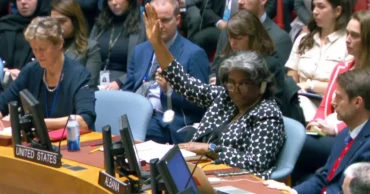
US vetoes Security Council resolution calling for ‘humanitarian pauses’ in Gaza
The United States on Wednesday vetoed a UN Security Council resolution that would have called for “humanitarian pauses” to deliver lifesaving aid to millions in Gaza.
The failure by the Security Council to make its first public intervention on the Israel-Gaza crisis followed the rejection of a Russian-backed draft on Monday evening.
Also read: Gaza's doctors struggle to save hospital blast survivors as Middle East rage grows
The US Ambassador to the United Nations Linda Thomas-Greenfield explained her country’s veto in the Council chamber saying, “This resolution did not mention Israel’s right of self-defence.”
“Israel has the inherent sight of self-defence as reflected in Article 51 of the UN Charter,” she added, noting that the right was reaffirmed by the Council in previous resolutions on terrorist attacks, “this resolution should have done the same.”
While 12 of the Council’s 15 members voted in favour of the resolution, sponsored by Brazil, one (United States) voted against, and two (Russia, and the United Kingdom) abstained.
Also read: After blast kills hundreds at Gaza hospital, Hamas and Israel trade blame as rage spreads in region
Prior to the vote, Russia proposed two amendments for an immediate, durable and full ceasefire, and to stop attacks against civilians. Both proposals were rejected by the Security Council.
Russian Ambassador to the UN, Vassily Nebenzia said, “the time for diplomatic metaphors is long gone.”
Anyone who did not support Russia’s draft resolution on this issue bears responsibility for what happens, he said.
The current draft “has no clear call for a ceasefire” and “will not help to stop the bloodshed”.
The ambassador said Russia’s amendments proposed a call to end indiscriminate attacks on civilians and infrastructure in Gaza and the condemnation of the imposition of the blockade on the enclave; and adding a new point for a call for a humanitarian ceasefire.
“If these are not included in the current draft, it would not help to address the human situation in Gaza and polarize positions of the international community,” he said.
Also read: Giving birth in a war zone: Around 50,000 women in Gaza are pregnant
The United Kingdom also abstained from voting in the resolution saying that the text needed to be clearer on Israel’s inherent right to self-defence, and because it ignored the fact that “extremist group” Hamas, which controls Gaza, is using Palestinian civilians as human shields.
“They [Hamas] have embedded themselves in civilian communities and made the Palestinian people their victims too,” said UK Ambassador to the UN, Barbara Woodward.
Despite vetoing the resolution, The US ambassador said Washington will continue to work closely with all Council members on the crisis.
“Yes, resolutions are important, and yes, this Council must speak out. But the actions we take must be informed by the facts on the ground and support direct diplomacy that can save lives,” Ambassador Linda Thomas-Greenfield said.
Also read: Israel bombs Gaza region where civilians were told to seek refuge
2 years ago

Failure of single component caused Washington seaplane crash that killed 10, NTSB says
U.S. investigators have confirmed that a mechanical issue caused the seaplane crash that killed 10 people off an island in Washington state last year.
The National Transportation Safety Board, which investigated the Sept. 4, 2022, crash, said Thursday that a single component of a critical flight control system failed, causing an unrecoverable, near-vertical descent into Puget Sound's Mutiny Bay near Whidbey Island.
About 85% of the aircraft was recovered from the ocean floor several weeks after the crash.
NTSB investigators examining the wreckage found that a component called an actuator, which moves the plane's horizontal tail and controls the airplane's pitch, had become disconnected. That failure would have made it impossible for the pilot to control the airplane.
Evidence showed the failure happened before the crash, not as a result of it, investigators concluded.
The plane was a de Havilland Canada DHC-3 Otter turboprop operated by Renton-based Friday Harbor Seaplanes. It was headed to the Seattle suburb of Renton from Friday Harbor, a popular tourist destination in the San Juan Islands, when it abruptly fell into Mutiny Bay and sank. The pilot and all nine passengers died.
Read: Airplane crash in Gulf of Mexico leaves 2 dead, 1 missing
Witnesses said, and video showed, that the plane had been level before climbing slightly and then falling, the NTSB said.
“The Mutiny Bay accident is an incredibly painful reminder that a single point of failure can lead to catastrophe in our skies,” NTSB Chair Jennifer Homendy said in a news release.
Weeks after the crash, the NTSB said the cause appeared to be the disconnected actuator and issued a recommendation that all operators of the DHC-3 planes immediately inspect that part of the flight control system. In early November, the FAA issued an emergency directive to operators mandating the inspections, The Seattle Times reported.
The NTSB in its final report recommends that the Federal Aviation Administration and Transport Canada require operators of those planes to install a secondary locking feature, so “this kind of tragedy never happens again,” Homendy said.
Read: Ukrainian airplane crashes near Iran's capital, killing 176
Friday Harbor Seaplanes didn’t immediately respond to an email seeking comment on Thursday.
Those who died in the crash include pilot Jason Winters, Sandy Williams of Spokane, Washington; Ross Mickel, his pregnant wife Lauren Hilty and their child Remy Mickel, of Medina, Washington; Joanne Mera of San Diego; Patricia Hicks of Spokane, Washington; Rebecca and Luke Ludwig, of Excelsior, Minnesota; and Gabrielle Hanna of Seattle.
Lawsuits have been filed in King County Superior Court by the family members of the victims against the aircraft’s charter operator, Friday Harbor Seaplanes; as well as the DHC-3 Otter manufacturer, de Havilland Aircraft of Canada; and the plane’s certificate holder, Viking Air — saying they are responsible for the deaths.
Nate Bingham, who is representing the Ludwigs’ families, said the plane crashed because of “an antiquated design with a single point of failure.”
Read more: Domestic airplane skids off runway at Nepal's int'l airport, no casualties
The companies have not responded to requests for comment about the lawsuits. Northwest Seaplanes said last year it was “heartbroken” over the crash and was working with the FAA, NTSB and Coast Guard.
2 years ago

What to do with 1.1 million bullets seized from Iran? US ships them to Ukraine
Russia has long turned to Iranian-made drones to attack Ukraine. Now Ukrainian forces will be using bullets seized from Iran against Russia troops.
A U.S. Navy ship seized the 1.1 million rounds off of a vessel that was being used by Iran’s Islamic Revolutionary Guard Corps to arm Houthi rebels in Yemen’s civil war in violation of a U.N. Security Council resolution.
Those 7.62 mm rounds have now been transferred to Ukraine, U.S. Central Command said Wednesday. The much-needed ammunition has been sent at a time when continued U.S. financial support for Kyiv’s fight to defend itself remains in question.
The 7.62 mm ammunition is the standard round for Soviet-era Kalashnikov assault rifles and their many derivatives. Ukraine, as a former Soviet republic, still relies on the Kalashnikov for many of its units.
“With this weapons transfer, the Justice Department’s forfeiture actions against one authoritarian regime are now directly supporting the Ukrainian people’s fight against another authoritarian regime. We will continue to use every legal authority at our disposal to support Ukraine in their fight for freedom, democracy, and the rule of law,” Attorney General Merrick Garland said in a statement.
Read: Biden says there’s ‘not much time’ to keep aid flowing to Ukraine and Congress must ‘stop the games’
The U.S. Navy’s Mideast-based 5th Fleet and its allies have intercepted numerous ships believed to be transporting weapons and ammunition from Iran to Yemen in support of the Iranian-backed Houthis. This is the first time that the seized weaponry has been handed over to Ukraine, Central Command spokeswoman Capt. Abigail Hammock said.
This shipment was seized by Central Command naval forces in December off of a vessel the command described as a “stateless dhow," a traditional wooden sailing ship, that was being used by the Islamic Revolutionary Guard Corps to arm the Houthis.
A fragile cease-fire is in place in Yemen after the almost decadelong war, but Iran has continued to supply the Houthis with lethal aid, Lt. Gen. Alexus G. Grynkewich, head of U.S. Air Forces Central, told reporters on Wednesday. He said this was a major threat to Yemen finding a durable peace.
U.S. Central Command said the U.S. “obtained ownership of these munitions on July 20, 2023, through the Department of Justice’s civil forfeiture claims against Iran’s Islamic Revolutionary Guard Corps.”
A United Nations arms embargo has prohibited weapons transfers to the Houthis since 2014. Iran insists it adheres to the ban, even as it has long been transferring rifles, rocket-propelled grenades, missiles and other weaponry to the Houthis via the sea.
Read: Ukraine aid is dropped from government funding bill raising questions about future US support
Independent experts, Western nations and U.N. experts have traced components seized aboard detained vessels back to Iran.
Iran's mission to the United Nations did not immediately respond to a request for comment on Wednesday.
Even though the shipment of more than 1 million rounds of small arms ammunition is substantial, it pales in comparison with the amount that the U.S. has already sent to Ukraine since Russia invaded in February 2022, much of which has already been used in the intense ground battle.
The U.S. has provided more than 300 million rounds of small arms ammunition and grenades as part of the almost $44 billion in military aid it has sent to help Ukraine.
Further U.S. funding for Ukraine's war was not included in a stopgap measure that prevented a government shutdown last weekend. With the ouster of Republican House Speaker Kevin McCarthy, it was unclear whether the future leader will be able to generate enough support from the party’s hard-liners, who have opposed sending more money to Ukraine.
Read more: Mexico's president slams US aid for Ukraine and sanctions on Venezuela and Cuba
2 years ago

Speaker McCarthy ousted in historic House vote, as scramble begins for a Republican leader
Speaker Kevin McCarthy was voted out of the job Tuesday in an extraordinary showdown — a first in U.S. history, forced by a contingent of hard-right conservatives and throwing the House and its Republican leadership into chaos.
It’s the end of the political line for McCarthy, who has said repeatedly that he never gives up, but found himself with almost no options remaining. Neither the right-flank Republicans who engineered his ouster nor the Democrats who piled on seem open to negotiating.
McCarthy told lawmakers in the evening he would not run again for speaker, putting the gavel up for grabs. Next steps are highly uncertain with no obvious successor to lead the House Republican majority. Action is halted in the House until next week, when Republicans try to elect a new speaker.
“I may have lost this vote today, but as I walk out of this chamber I feel fortunate to have served," McCarthy said at a press conference at the Capitol, alternating between upbeat assessment of his speakership and angry score-settling of those who ousted him.
Still, he said, “I wouldn't change a thing.”
McCarthy’s chief rival, Rep. Matt Gaetz of Florida, orchestrated the rare vote on the obscure “motion to vacate,” and pushed ahead swiftly into a dramatic afternoon roll call.
While McCarthy enjoyed support from most Republicans in his slim majority, eight Republican detractors — many of the same hard-right holdouts who tried to stop him from becoming speaker in January — essentially forced him out.
Stillness fell as the presiding officer gaveled the vote closed, 216-210, saying the office of the speaker “is hereby declared vacant.”
Moments later, a top McCarthy ally, Rep. Patrick McHenry, R-N.C., took the gavel and, according to House rules, was named speaker pro tempore, to serve in the office until a new speaker is chosen.
The House then briskly recessed as lawmakers met privately to discuss the path forward.
It was a stunning moment for McCarthy, a punishment fueled by growing grievances but sparked by his weekend decision to work with Democrats to keep the federal government open rather than risk a shutdown.
But in many ways, McCarthy's ouster was set in motion when, in deal-making with hard-right holdouts at the start of the year, he agreed to a series of demands — including a rules change that allowed any single lawmaker to file the motion to vacate.
As the House fell silent, Gaetz, a top ally of Donald Trump, rose to offer his motion.
Leaders tried to turn it back, but the vote was 218-208, with 11 Republicans against tabling the motion, a sign of trouble to come.
The House then opened a floor debate unseen in modern times, and Republicans argued publicly among themselves for more than an hour.
“It's a sad day,” Republican Rep. Tom Cole of Oklahoma said as debate got underway, urging his colleagues not to plunge the House Republican majority "into chaos."
But Gaetz shot back during the debate, "Chaos is Speaker McCarthy."
Read: US Speaker Pelosi's husband attacked, beaten by intruder
As the fiery debate dragged on, many of the complaints against the speaker revolved around his truthfulness and his ability to keep the promises he has made.
Almost alone, Gaetz led his side of the floor debate, criticizing the debt deal McCarthy made with President Joe Biden and the vote to prevent a government shutdown, which conservatives opposed as they demanded steeper spending cuts.
But a long line of McCarthy supporters stood up for him, including Rep. Jim Jordan, R-Ohio, a leader of the conservative Freedom Caucus, who said, “He has kept his word.” Rep. Garret Graves, R-La., waved his cellphone, saying it was “disgusting” that hard-right colleagues were fundraising off the move in text messages seeking donations.
McCarthy, of California, insisted he would not cut a deal with Democrats to remain in power — not that he could have relied on their help even if he had asked.
Democratic leader Hakeem Jeffries said in a letter to colleagues that he wants to work with Republicans, but he was unwilling to provide the votes needed to save McCarthy.
“It is now the responsibility of the GOP members to end the House Republican Civil War,” Jeffries said, announcing the Democratic leadership would vote for the motion to oust the speaker.
White House press secretary Karine Jean-Pierre said Biden “hopes the House will quickly elect a Speaker.” Once that happens, she said, "he looks forward to working together with them."
Senate Republican leader Mitch McConnell issued a statement thanking McCarthy for "what is often a thankless role.
Read: Biden says there’s ‘not much time’ to keep aid flowing to Ukraine and Congress must ‘stop the games’
At the Capitol, both Republicans and Democrats met privately ahead of the historic afternoon vote.
Behind closed doors, McCarthy told fellow Republicans: Let’s get on with it.
McCarthy invoked Republican Speaker Joseph Cannon, who more than 100 years ago confronted his critics head-on by calling their bluff and setting the vote himself on his ouster. Cannon survived that takedown attempt, which was the first time the House had actually voted to consider removing its speaker. A more recent threat against John Boehner in 2015 didn't make it to a vote but led him to early retirement.
Gaetz was in attendance, but he did not address the room.
Across the way in the Capitol, Democrats lined up for a long discussion and unified around one common point: McCarthy cannot be trusted, several lawmakers in the room said.
“I think it’s safe to say there’s not a lot of good will in that room for Kevin McCarthy,” said Rep. Richard Neal, D-Mass.
“At the end of the day, the country needs a speaker that can be relied upon,” said Rep. Adam Schiff, D-Calif. "We don’t trust him. Their members don’t trust him. And you need a certain degree of trust to be the speaker.”
Removing the speaker launches the House Republicans into chaos heading into a busy fall when Congress will need to fund the government again or risk a mid-November shutdown.
Typically, top leaders would be next in line for the job, but Majority Leader Steve Scalise is battling cancer and Majority Whip Tom Emmer, like any potential candidate, may have trouble securing the vote. Another leading Republican, Rep. Elise Stefanik of New York, is also a Trump ally.
One of McHenry's first acts in the temporary position was to oust Speaker Emerita Nancy Pelosi from her honorary office at the Capitol while she was away in California to pay tribute to Sen. Dianne Feinstein.
“No matter who is going to be the speaker, the challenges still remain," Scalise said. “But I think the opportunity is there to continue moving forward.”
Asked if he was physically up to the job, Scalise said, “I feel great.”
It took McCarthy himself 15 rounds in January over multiple days of voting before he secured the support from his colleagues to gain the gavel.
Read more: Attorney General Garland says in interview he'd resign if Biden asked him to take action on Trump
Trump, the former president who is the Republican front-runner in the 2024 race to challenge Biden, complained about the chaos. “Why is it that Republicans are always fighting among themselves," he asked on social media.
Asked about McCarthy's ouster as he exited court in New York, where he is on trial for business fraud, Trump did not respond.
One key McCarthy ally, Rep. Marjorie Taylor Greene, R-Ga., who is also close with Trump, took to social media urging support for “our speaker.”
Republicans left the chamber in a daze, totally uncertain about next steps. “I honestly don’t know,” said Rep. Debbie Lesko, R-Ariz. “This is a total disaster.”
Many had lined up to hug McCarthy, some to shake his hand.
Democrats, who have bristled at McCarthy's leadership — cajoling them one minute, walking away from deals the next — said they were just holding back, waiting for Republicans to figure out how to run the House.
Rep, Don Bacon, R-Neb., the leader of a centrist group, said the only option was to leave the eight hardliners behind and try to work across the aisle. “We’re going to stay with Kevin,” he said. “He told us earlier he’ll never quit.”
But McCarthy made it clear Tuesday night that he would not try to win back the job.
2 years ago

Generations of students remember 1968 massacre in march through Mexico City
Chanting in unison, students marched through downtown Mexico City on Monday evening, marking 55 years since the military massacred hundreds of students in Tlatelolco plaza.
Enrique Treviño Taudres survived the massacre and now marches every year with the Pro Democratic Freedoms 68 Committee. “People know a lot and forget easily,” he said, adding that the memory of Tlatelolco holds important lessons for modern Mexico.
As many as 300 people were massacred at a student protest in Tlatelolco plaza on Oct. 2, 1968, in what the Mexican government initially reported as the lawful suppression of a violent riot just 10 days before the Summer Olympics’ Opening Ceremony in Mexico City.
Since then military reports have revealed at least 360 government snipers were stationed on rooftops around the square. They opened fire and, in the ensuing chaos, the military members posted round the square began shooting peaceful protesters and students.
“Look, it’s a commemoration of that day but it is also a call to the current students, the current young people to be aware of the reality,” said Treviño. “The best example that we grandparents can give young people is that we were conscientious and committed young people. We took to the streets.”
Adolfo Cruz, a tourism student in the city, marched on Monday for the first time. “Part of this is remembering all our deceased companions because it’s thanks to them we have the right to march today,” Cruz said. “We also want to change things."
Mexican students today still find themselves the victims of violence and organized crime. In 2018 three university students in the western city of Guadalajara were killed by a gang and their bodies dissolved in acid. Infamously, 43 students were abducted and murdered in southern Mexico in 2014, the victims of an attack which implicated municipal, state and national authorities.
October 2nd, said Cruz, “is a commemoration, but it’s also for the rights of all students,” in a country where there are still “many difficulties” across the education system.
After the massacre in 1968, 25 people were officially reported dead, but later investigations identified 44 remains. Successive government inquiries have never shown exactly how many died, but eyewitnesses claimed bodies were carted away from the square and estimates range that over 300 were killed.
The Mexican government acknowledged the massacre was a “state crime”on its 50th anniversary in 2018.
Earlier on Monday, interim head of Mexico City’s government Martí Bartes spoke about the historical ramifications of the tragedy.
“'68 is so strong because it transformed political culture from below,” he said from the Plaza of the Three Cultures, where the protest began in 1968. “'68 transformed universities, massively expanded higher education, incorporated new critical thinking into the social sciences, generated activists, opened the doors to new ideas such as feminism or sexual diversity.”
A rainy Monday night marked the end of a run of protests in Mexico’s capital: from the anniversary of the 43 abducted students in southern Mexico last Tuesday, to a march for abortion rights Thursday. Since last week, monuments have been hiding behind blue barricades across the city and the Marabunta Brigade, a group trained to keep protestors safe, has been busy.
Monday evening was Mario Romero’s 20th protest as a member of the brigade but, he said, he was not tired, or afraid.
“I like to come out because things need to change, but nothing changes," he said.
2 years ago