USA
How Biden leaves wiggle room to opt against reelection bid
President Joe Biden exudes confidence as the next race for the White House approaches.
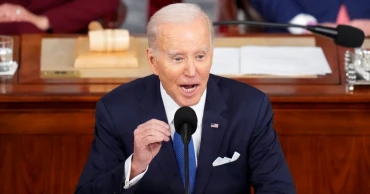
During last month's State of the Union address, he lured unruly Republicans into agreeing with him that federal entitlements should be protected. He's intensified travel outside Washington, trumpeting job-creation in Wisconsin and steep federal health care spending to Florida seniors while touting a trillion-dollar public works package that he says can do everything from revitalize Baltimore's port to easing train tunnel congestion under the Hudson River.
And he used spy-thriller tactics to sweep into war-scarred Ukraine.
For most presidents, these are powerful elements to include as the centerpiece of a reelection campaign — pledging to protect people and the economy at home and democracy in the heart of Europe. But with the famously fickle 80-year-old Biden stopping short of officially declaring his 2024 candidacy, he's leaving just enough room to back out of a race and focus instead on using such moves to cement his legacy.
“I look at Biden from the outside, as a historian, and say, ‘Boy, if he stepped away now, his place in history is secure and extraordinarily positive,’” said Jeffrey Engel, director of the Center for Presidential History at Southern Methodist University in Dallas. “That’s how a normal person thinks about these things. That’s not how a president thinks about these things.”
Those close to Biden insist he's not legacy shopping and that he will announce a campaign, likely after the first quarter campaign fundraising period ends this month. The party has cleared a path for Biden's renomination with rivals from his left, including Sens. Bernie Sanders of Vermont and Elizabeth Warren of Massachusetts, pledging to support the president's reelection.
Bestselling self-help author Marianne Williamson is formally launching a primary challenge to Biden on Saturday that's largely being shrugged off by the party.
The Democratic National Committee has unanimously expressed “our full and complete support” for Biden's reelection. Party leaders aren't planning primary debates, arguing there's no longer enough time to even build out a debate schedule that would pit Biden against Williamson or anyone else.
In an interview last week with The Associated Press, first lady Jill Biden said there was “pretty much” nothing left for the president to do but pick a time and place to announce his reelection bid.
“How many times does he have to say it for you to believe it?” she asked.
Also Read: Supreme Court weighs Biden student loan plan worth billions
Still, there are signals that even if the prevailing assumption among most Democrats is that Biden will seek another term, the decision isn't yet final. Even Jill Biden was more muted in subsequent interviews when assessing her husband's political future.
“It’s Joe’s decision,” she told CNN, noting that she's personally “all for it.”
“If he’s in, we’re there," she added. "If he wants to do something else, we’re there too.”
After the AP interview, the president joked to ABC that he needed to call his wife “to find out” if he was running again.
His intention “has been from the beginning to run," the president told the network. "But there’s too many other things we have to finish in the near term before I start a campaign.”
While Biden's standing among Democratic officials is solid, actual voters seem more wary. A recent poll from the AP-NORC Center for Public Affairs Research found just 37% of Democrats want Biden to seek a second term, down from 52% in the weeks before last year’s midterm elections.
Biden's age has been a leading concern since the early days of his first campaign. Already the oldest president in U.S. history, he'd be 86 by the end of a second term, should he win one.
If Biden were to eschew a run, the biggest question is whether the party could quickly coalesce around someone else. Much of the initial focus would shift to Vice President Kamala Harris, who has already said that she expects to remain on a Biden ticket in 2024. But she was notably in South Carolina this week, promoting the administration's efforts to expand broadband access.
The state is politically significant, however, after Democrats moved South Carolina's primary to the front of their primary calendar at Biden's behest.
Other Democrats outside Washington have worked to gingerly build national profiles without offending Biden. They include California Gov. Gavin Newsom, who has positioned himself as a foil to Republican Florida Gov. Ron DeSantis, seen as a leading alternative to former President Donald Trump in the 2024 GOP presidential primary.
While Biden's plans are under intense scrutiny, the Republican presidential field has also been slow to form. So far, there are just three official entrants — Trump, former United Nations ambassador Nikki Haley and entrepreneur Vivek Ramaswamy. Others, including former Vice President Mike Pence, ex-Secretary of State Mike Pompeo and South Carolina Sen. Tim Scott, may join in the coming months. Some, such as DeSantis, could wait until late summer to officially announce their campaigns.
For his part, Biden has a history of dithering. He agonized over whether to seek the presidency in 2004 and 2016 before ultimately deciding to sit out those races. Both times, he noted that he essentially spent so long deciding that he'd run out of time to be successful in a campaign, rather than really saying he didn't want to run.
“He's notoriously slow on campaign decisions,” said Andrew Feldman, a Democratic strategist who interned on Biden’s 2008 presidential campaign and worked as part of an advance staffer team during his vice presidency. “None of this should be a surprise.”
Feldman said Biden is “always thinking about his legacy” but also "thinking about getting results for the American people.”
“I think legacy and results and reelection are very much intertwined," he said.
As far as legacy goes, Biden aides concede that future governing will likely never be as easy as when Democrats controlled Congress during the administration's first two years. The president's now continually low approval ratings may also never climb back to where they were when he first took office, they admit.
But the president's advisers counter that there is no real Democratic alternative capable of defeating Trump or another top Republican like DeSantis. That's not to say Biden doesn't think about his place in history. In 2021, the president took careful notes during an Oval Office meeting with historians that stretched more than two hours — though those discussions focused more on threats to American democracy than Biden's personal legacy.
“This is a guy who essentially grew up in politics, has been involved at high levels of politics as senator, vice president and then president for many decades," said Allan Lichtman, a distinguished professor of history at American University in Washington. “He’s someone who is especially concerned with his legacy.”
3 years ago

Trump can be sued for Jan. 6 riot harm, Justice Dept. says
Former President Donald Trump can be sued by injured Capitol Police officers and Democratic lawmakers over the Jan. 6, 2021, insurrection at the U.S. Capitol, the Justice Department said Thursday in a federal court case testing Trump's legal vulnerability for his speech before the riot.
The Justice Department told a Washington federal appeals court in a legal filing that it should allow the lawsuits to move forward, rejecting Trump’s argument that he is immune from the claims.
The department said it takes no position on the lawsuits’ claims that the former president’s words incited the attack on the Capitol. Nevertheless, Justice lawyers told the court that a president would not be protected by “absolute immunity” if his words were found to have been an “incitement of imminent private violence.”
"As the Nation’s leader and head of state, the President has 'an extraordinary power to speak to his fellow citizens and on their behalf,' they wrote. “But that traditional function is one of public communication and persuasion, not incitement of imminent private violence.”
The brief was filed by lawyers of the Justice Department's Civil Division and has no bearing on a separate criminal investigation by a department special counsel into whether Trump can be criminally charged over efforts to undo President Joe Biden's victory in the 2020 presidential election ahead of the Capitol riot. In fact, the lawyers note that they are not taking a position with respect to potential criminal liability for Trump or anyone else.
Trump’s lawyers have argued he was acting within the bounds of his official duties and had no intention to spark violence when he called on thousands of supporters to “march to the Capitol” and “fight like hell” before the riot erupted.
“The actions of rioters do not strip President Trump of immunity,” his lawyers wrote in court papers. "In the run-up to January 6th and on the day itself, President Trump was acting well within the scope of ordinary presidential action when he engaged in open discussion and debate about the integrity of the 2020 election."
A Trump spokesperson said Thursday that the president “repeatedly called for peace, patriotism, and respect for our men and women of law enforcement" on Jan. 6 and that the courts “should rule in favor of President Trump in short order and dismiss these frivolous lawsuits.”
The case is among many legal woes facing Trump as he mounts another bid for the White House in 2024.
A prosecutor in Georgia has been investigating whether Trump and his allies broke the law as they tried to overturn his election defeat in that state. Trump is also under federal criminal investigation over top secret documents found at his Florida estate.
In the separate investigation into Trump and his allies' efforts to keep the Republican president in power, special counsel Jack Smith has subpoenaed former Vice President Mike Pence, who has said he will fight the subpoena.
Trump is appealing a decision by a federal judge in Washington, who last year rejected efforts by the former president to toss out the conspiracy civil lawsuits filed by the lawmakers and police officers. U.S. District Judge Amit Mehta ruled that Trump’s words during a rally before the violent storming of the U.S. Capitol were likely “words of incitement not protected by the First Amendment.”
“Only in the most extraordinary circumstances could a court not recognize that the First Amendment protects a President’s speech,” Mehta wrote in his February 2022 ruling. “But the court believes this is that case.”
One of the lawsuits, filed by Rep. Eric Swalwell, D-Calif., alleges that “Trump directly incited the violence at the Capitol that followed and then watched approvingly as the building was overrun.” Two other lawsuits were also filed, one by other House Democrats and another by officers James Blassingame and Sidney Hemby.
The House Democrats' lawsuit cites a federal civil rights law that was enacted to counter the Ku Klux Klan’s intimidation of officials. The cases describe in detail how Trump and others spread baseless claims of election fraud, both before and after the 2020 presidential election was declared, and charge that they helped to rile up the thousands of rioters before they stormed the Capitol.
The lawsuits seek damages for the physical and emotional injuries the plaintiffs sustained during the insurrection.
Even if the appeals court agrees that Trump can be sued, those who brought the lawsuit still face an uphill battle. They would need to show there was more than fiery rhetoric, but a direct and intentional call for imminent violence, said Laurie Levenson, a Loyola Law School professor and former federal prosecutor.
“We are really far away from knowing that even if the court allows the lawsuit to go forward whether they would be successful,” she said. “Even if the court says hypothetically you can bring an action against a president, I think they're likely to draw a line that is very generous to the president's protected conduct.”
In its filing, the Justice Department cautioned that the “court must take care not to adopt rules that would unduly chill legitimate presidential communication” or saddle a president with burdensome and intrusive lawsuits.
“In exercising their traditional communicative functions, Presidents routinely address controversial issues that are the subject of passionate feelings," the department wrote. "Presidents may at times use strong rhetoric. And some who hear that rhetoric may overreact, or even respond with violence."
3 years ago

Jury quickly finds Murdaugh guilty of murder of wife, son
South Carolina attorney Alex Murdaugh was convicted of murder Thursday in the shooting deaths of his wife and son in a case that chronicled the unraveling of a powerful Southern family with tales of privilege, greed and addiction.
The jury deliberated for less than three hours before finding Murdaugh guilty of two counts of murder at the end of a six-week trial that pulled back the curtain on the once-prominent lawyer’s fall from grace.
Murdaugh, 54, faces 30 years to life in prison without parole for each murder charge when court is scheduled to reconvene for sentencing at 9:30 a.m. Friday.
After the verdict was read, Judge Clifton Newman denied a defense motion to declare a mistrial, saying “the evidence of guilt is overwhelming.”
Murdaugh, who wore a dress shirt and jacket, appeared stoic with a slight grimace as the verdict was read. Once the hearing ended, Murdaugh was handcuffed and led out of the courtroom by two sheriff’s deputies.
His 52-year-old wife, Maggie, was shot four or five times with a rifle and their 22-year-old son Paul was shot twice with a shotgun at the kennels near their rural Colleton County home on June 7, 2021.
Prosecutors didn’t have the weapons used to kill the Murdaughs or other direct evidence like confessions or blood spatter. But they had a mountain of circumstantial evidence, led by a video locked on the son's cellphone for more than a year — video shot minutes before the killings that witnesses testified captured the voices of all three Murdaughs.
Defense attorney Jim Griffin told reporters the Murdaugh team was disappointed in the outcome but had no further comment until sentencing.
The state’s legal team emerged from the courthouse to a celebratory atmosphere. South Carolina Attorney General Alan Wilson thanked the prosecution for the past six weeks of late nights spent at a local hotel.
“It was all worth it. Because we got to bring justice and be a voice for Maggie and Paul Murdaugh,” Wilson said. “Today’s verdict proved that no one — no matter who you are in society — is above the law,” he added, a line met with applause from spectators.
Through more than 75 witnesses and nearly 800 pieces of evidence, jurors heard about betrayed friends and clients, Murdaugh’s failed attempt to stage his own death in an insurance fraud scheme, a fatal boat crash in which his son was implicated, the housekeeper who died in a fall in the Murdaugh home, the grisly scene of the killings and Bubba, the chicken-snatching dog.
In the end, Murdaugh’s fate appeared sealed by the cellphone video taken by his son Paul, who he called “Little Detective” for his knack for finding bottles of painkillers in his father’s belongings after the lawyer had sworn off the pills.
Testimony culminated in Murdaugh’s appearance on the witness stand, when he admitted stealing millions from clients and lying to investigators about being at the dog kennels where the shootings took place but steadfastly maintained his innocence in the deaths of his wife and son.
“I did not kill Maggie, and I did not kill Paul. I would never hurt Maggie, and I would never hurt Paul — ever — under any circumstances,” Murdaugh said.
Murdaugh had told police repeatedly after the killings that he was not at the kennels and was instead napping before he went to visit his ailing mother that night. Murdaugh called 911 and said he discovered the bodies when he returned home.
But in his testimony, Murdaugh admitted joining Maggie and Paul at the kennels, where he said he took a chicken away from a rowdy yellow Labrador named Bubba — whose name Murdaugh can be heard saying on the video — before heading back to the house shortly ahead of the fatal shootings.
Murdaugh lied about being at the kennels for 20 months before taking the stand on the 23rd day of his trial. He blamed his decadeslong addiction to opioids for making him paranoid, creating a distrust of police. He said that once he went down that path, he felt trapped in the lie.
“Oh, what a tangled web we weave. Once I told a lie — I told my family — I had to keep lying,” he testified.
Prosecutor Creighton Waters grilled Murdaugh about what he repeatedly called the lawyer’s “new story” of what happened at the kennels, walking him moment by moment through the timeline and assailing his “fuzzy” memory of certain details, like his last words to his wife and son.
A state agent also testified that markings on spent cartridges found around Maggie Murdaugh’s body matched markings on fired cartridges at a shooting range elsewhere on the property, though the defense said that kind of matching is an inexact science.
Alex Murdaugh comes from a family that dominated the local legal scene for decades. His father, grandfather and great-grandfather were the area’s elected prosecutors for more than 80 years and his family law firm grew to dozens of lawyers by suing railroads, corporations and other big businesses.
The now-disbarred attorney admitted stealing millions of dollars from the family firm and clients, saying he needed the money to fund his drug habit. Before he was charged with murder, Murdaugh was in jail awaiting trial on about 100 other charges ranging from insurance fraud to tax evasion.
Prosecutors told jurors that Murdaugh was afraid all of his misdeeds were about to be discovered, so he killed his wife and son to gain sympathy to buy time to cover his tracks.
Waters commended the jurors for seeing through what he described as more lies by Murdaugh.
“We had no doubt that when we had a chance to present our case in the court of law that they would see through the one last con that Alex Murdaugh was trying to pull. And they did,” Waters said after the verdict.
Murdaugh’s lawyers will almost certainly appeal the conviction based on the judge allowing evidence of the financial crimes, which they contend were unrelated to the killings and were used by prosecutors to smear Murdaugh’s reputation.
3 years ago

US to send more ammo, folding armored bridges to Ukraine
The U.S. is expected to announce a new package of military aid for Ukraine Friday, including —for the first time — eight armored vehicles that can launch bridges and allow troops to cross rivers or other gaps, U.S. officials said Thursday.
The officials said the total cost of the package will be about $400 million and will also include large amounts of ammunition, such as rockets for the High Mobility Artillery Rocket Systems. It comes just a week after the one-year anniversary of Russia’s invasion of Ukraine, and as Ukrainian forces are preparing for a spring offensive.
Officials spoke on condition of anonymity because the aid package has not yet been publicly announced.
Read more: US, Russia hold highest-level talks since Ukraine invasion
The so-called Armored Vehicle Launched Bridge is a portable, 60-foot folding metal bridge that is carried on top of a tank body. Providing that system now could help Ukrainian troops as they launch the expected offensive, and make it easier for troops to cross rivers to get to Russian forces.
Including this latest package, the U.S. has now provided more than $32 billion in military aid to Ukraine. The vehicle bridges and ammunition in the package will be taken from Pentagon stocks through the presidential drawdown authority, so they will be able to be delivered quickly to the warfront.
The aid will also include an undisclosed amount of rounds for howitzers, other ammunition, demolition munitions and other equipment to clear obstacles, spare parts and equipment for vehicle maintenance and repair.
Read more: Two Americans arrested on charges of selling tech to Russia
The announcement comes on the heels of a brief meeting Thursday between U.S. Secretary of State Antony Blinken and Russian Foreign Minister Sergey Lavrov at a meeting of top diplomats from the Group of 20 nations in New Delhi. It was the highest-level in-person talk between the two countries since Russia’s invasion of Ukraine. But there was no indication of any movement toward easing the intense tensions between the two nations.
Blinken said he told Lavrov the U.S. would continue to support Ukraine for as long as it takes.
Lavrov, who did not mention speaking with Blinken when he held a news conference after the meeting, told reporters Moscow would continue to press its action in Ukraine.
The war had largely slowed to a grinding stalemate during the winter months, but both sides are expected to be preparing to launch offensives in the spring.
3 years ago

Two Americans arrested on charges of selling tech to Russia
WASHINGTON, Mar 3 (AP/UNB) — The Justice Department on Thursday arrested two Kansas men on allegations that the pair illegally exported aviation-related technology to Russia and provided repair services for the equipment.
Cyril Gregory Buyanovsky and Douglas Robertson are charged with conspiracy, exporting controlled goods without a license, falsifying and failing to file electronic export information, and smuggling goods in violation of U.S. law.
The charges come as the U.S. has drastically ramped up sanctions and financial penalties on Russia since its invasion of Ukraine began on Feb. 24, 2022. Along with thousands of sanctions on people and firms, export controls on the Kremlin are meant to limit access to computer chips and other products needed to equip a modern military.
The Justice Department says Buyanovsky and Robertson owned and operated KanRus Trading Co., which allegedly supplied aircraft electronics to Russian companies and provided repair services for equipment used in Russian-manufactured aircraft.
The indictment says that since 2020, they conspired to evade U.S. export laws by concealing and misstating the true end users and destinations of their exports and by shipping equipment through third-party countries.
They face up to 35 years in prison if convicted. Lawyers for Buyanovsky and Robertson couldn’t be identified from the provided documents, and the Justice Department didn’t immediately respond to a request for their information.
The FBI and the Commerce Department’s Office of Export Enforcement are investigating the case.
Matthew S. Axelrod, assistant secretary for export enforcement at the Commerce Department’s Bureau of Industry and Security, said at an American Bar Association event in Miami Thursday that state actors like Russia, China, Iran and North Korea are trying to “take advantage of rapid advances in technology,” adding that sensitive technologies being sent to these countries are “top of our list from an enforcement perspective.”
Since the anniversary of the Russian invasion of Ukraine, U.S. officials have said they would increase enforcement and sanctions on people and entities that assist Russia in the procurement of weaponry and technology that would bolster its military.
3 years ago

US man arrested trying to bring homemade explosive onto plane
A Pennsylvania man faces federal criminal charges after he checked in a suitcase with an explosive device hidden in the lining on a flight to Florida, authorities said Wednesday.
Marc Muffley, 40, is charged with possessing an explosive in an airport and possessing or attempting to place an explosive or incendiary device on an aircraft, according to a criminal complaint.
Prosecutors allege that the material was found in a suitcase Muffley had checked in Monday at Lehigh Valley International Airport to Allegiant Air Flight 201, which was bound for Orlando Sanford International Airport in Florida.
After an alert during security screening, the bag was examined and found hidden in the lining was a “circular compound” about three inches in diameter encased in a wax-like paper and clear plastic wrap.
An FBI bomb technician X-rayed the compound and concluded that it contained a granular powder consistent with a “commercial grade firework” and “suspected to be a mixture of flash powder and the dark granulars that are used in commercial grade fireworks.”
Attached to it was a “quick fuse” similar to a candle wick — apparently part of the original manufacture of the compound — as well as a “hobby fuse” that burns more slowly and appeared to have been added after the manufacture, authorities said.
Authorities said they concluded that both the black powder and flash powder “are susceptible to ignite from heat and friction and posed a significant risk to the aircraft and passengers,” according to the criminal complaint.
The baggage also contained “a can of butane, a lighter, a pipe with white powder residue, a wireless drill with cordless batteries, and two GFCI outlets taped together with black tape,” authorities said.
GFCI outlets are a type of circuit breaker.
Authorities said Muffley was paged over the airport’s public address system and shortly thereafter he was seen leaving the airport. He was traced to a Lansford address where he was arrested by the FBI late Monday night.
Officials said he remains in custody pending a probable cause hearing and detention hearing Thursday at 1:30 p.m. in Allentown, with Muffley attending via videoconference. A message was left Wednesday for Muffley’s federal public defender, Timothy Wright.
3 years ago

White House: No more TikTok on gov’t devices within 30 days
The White House is giving all federal agencies 30 days to wipe TikTok off all government devices, as the Chinese-owned social media app comes under increasing scrutiny in Washington over security concerns.
The Office of Management and Budget calls the guidance, issued Monday, a “critical step forward in addressing the risks presented by the app to sensitive government data.” Some agencies, including the Departments of Defense, Homeland Security and State, already have restrictions in place; the guidance calls on the rest of the federal government to follow suit within 30 days.
The White House already does not allow TikTok on its devices.
“The Biden-Harris Administration has invested heavily in defending our nation’s digital infrastructure and curbing foreign adversaries’ access to Americans’ data,” said Chris DeRusha, the federal chief information security officer. “This guidance is part of the Administration’s ongoing commitment to securing our digital infrastructure and protecting the American people’s security and privacy.”
The guidance was first reported by Reuters.
Also Read: TikTok banned on all Canadian government mobile devices
Congress passed the “No TikTok on Government Devices Act” in December as part of a sweeping government funding package. The legislation does allow for TikTok use in certain cases, including for national security, law enforcement and research purposes.
TikTok spokesperson Brooke Oberwetter said Monday: “The ban of TikTok on federal devices passed in December without any deliberation, and unfortunately that approach has served as a blueprint for other world governments. These bans are little more than political theater.”
House Republicans are expected to move forward Tuesday with a bill that would give Biden the power to ban TikTok nationwide. The legislation, proposed by Rep. Mike McCaul, looks to circumvent the challenges the administration would face in court if it moved forward with sanctions against the social media company.
Also Read: China says TikTok ban reflects US insecurities
If passed, the proposal would allow the administration to ban not only TikTok but any software applications that threaten national security. McCaul, the chairman of the House Foreign Relations Committee, has been a vocal critic of the app, saying it is being used by the Chinese Communist Party to “manipulate and monitor its users while it gobbles up Americans’ data to be used for their malign activities.”
“Anyone with TikTok downloaded on their device has given the CCP a backdoor to all their personal information. It’s a spy balloon into your phone,” the Texas Republican said in a statement Monday.
Sen. Bob Menendez, D-N.J., his counterpart in the Senate, did not shut down the idea of the chamber taking up a proposal that would empower Biden to take action against TikTok, saying it was “certainly something to consider.”
Oberwetter said: “We hope that when it comes to addressing national security concerns about TikTok beyond government devices, Congress will explore solutions that won’t have the effect of censoring the voices of millions of Americans.”
TikTok, owned by ByteDance Ltd., remains extremely popular and is used by two-thirds of teens in the U.S. But there is increasing concern that Beijing could obtain control of American user data that the app has obtained.
The company has been dismissive of the ban for federal devices and has noted that it is developing security and data privacy plans as part of the Biden administration’s ongoing national security review.
Canada also announced Monday that it is banning TikTok from all government-issued mobile devices. The European Union’s executive branch said last week it has temporarily banned TikTok from phones used by employees as a cybersecurity measure.
3 years ago

Wall Street drifts on last day of what’s been a tough month
Stocks are drifting lower Tuesday as Wall Street closes out what’s been a tough February.
The S&P 500 was 0.2% lower in early trading. The Dow Jones Industrial Average was down 121 points, or 0.4%, at 32,767, as of 9:36 a.m. Eastern time, while the Nasdaq composite was 0.2% lower.
After a hot start to the year bolstered by hopes that inflation was on the way down, Wall Street has slammed into reverse this month. A stream of data has shown inflation and the overall economy are remaining more resilient than expected. That’s forced investors to raise their forecasts for how high the Federal Reserve will take interest rates and how long it will keep them there.
High rates can drive down inflation, but they also raise the risk of a recession down the line because they slow the economy. They also hurt prices for stocks and other investments.
After earlier this year hoping that the Fed could soon pause its aggressive hikes to interest rates, and maybe even begin cutting them late this year, traders have come around to believe the Fed’s long insistence that it plans to take rates higher for longer to ensure the job is done on inflation. Many now see the Fed taking its key overnight interest rate up to at least 5.25%, if not higher, and keeping them there through the end of the year.
The Fed’s rate is currently set in a range of 4.50% to 4.75% after starting last year at virtually zero.
The heightened expectations for rates have sent yields jumping in the bond market this month. The yield on the 10-year Treasury rose to 3.96% from 3.92% late Monday. It helps set rates for mortgages and other loans that shape the economy’s health, and it’s near its highest level since November.
The two-year yield, which moves more on expectations for Fed action, rose to 4.82% from 4.78%. It’s near its highest level since 2007.
Such rate worries have caused the S&P 500’s gain for the year to more than halve. It was up as much as 8.9% in early February, the day before a report showed that U.S. employers hired nearly a third of a million more people in January than expected.
Such strength is good news for the economy and calms fears about a recession hitting imminently. But the Fed worries it could also feed into upward pressure on inflation, which has not been coming down as quickly and as smoothly as hoped.
Now the S&P 500 is hanging onto a gain of 3.5% for the year.
All these worries have come across a backdrop of falling earnings. S&P 500 companies are in the midst of reporting their first decline in profits from year-earlier levels since 2020, when the pandemic was choking the economy, according to FactSet.
Most companies have already reported their results for the last three months of 2022, but several big-name retailers are still on the schedule for this week.
Among them was Target, which on Tuesday reported better profit and revenue than expected for the latest quarter. But it also echoed some other retailers in giving a cautious forecast for upcoming results as U.S. households contend with still-high inflation. Target rose 2.6%.
3 years ago

Supreme Court weighs Biden student loan plan worth billions
The Supreme Court is taking up a partisan legal fight over President Joe Biden's plan to wipe away or reduce student loans held by millions of Americans.
The high court, with its 6-3 conservative majority, is hearing arguments on Tuesday in two challenges to the plan, which has so far been blocked by Republican-appointed judges on lower courts.
Arguments are scheduled to last two hours but likely will go much longer. The public can listen in on the court’s website.
Twenty-six million people have applied, and 16 million have been approved to have up to $20,000 in federal student loans forgiven, the Biden administration says. The program is estimated to cost $400 billion over 30 years.
“I’m confident the legal authority to carry that plan is there,” Biden said on Monday, at an event to mark Black History Month.
The president, who once doubted his own authority to broadly cancel student debt, first announced the program in August. Legal challenges quickly followed.
Also Read: Cheapest countries for Bangladeshi students for higher studies
Republican-led states and lawmakers in Congress, as well as conservative legal interests, are lined up against the plan as a clear violation of Biden's executive authority. Democratic-led states and liberal interest groups are backing the Democratic administration in urging the court to allow the plan to take effect.
Without it, loan defaults would dramatically increase when the pause on loan payments ends no later than this summer, the administration says. Payments were halted in 2020 as part of the response to the coronavirus pandemic.
The administration says a 2003 law, commonly known as the HEROES Act, allows the secretary of education to waive or modify the terms of federal student loans in connection with a national emergency. The law was primarily intended to keep service members from being worse off financially while they fought in wars in Afghanistan and Iraq.
Nebraska and other states that sued say the plan is not necessary to keep the rate of defaults roughly where it was before the pandemic. The 20 million borrowers who have their entire loans erased would get a “windfall” that will leave them better off than they were before the pandemic, the states say.
Dozens of borrowers came from across the country to camp out near the court on a soggy Monday evening in hopes of getting a seat for the arguments. Among them was Sinyetta Hill, who said that Biden's plan would erase all but about $500 of the $20,000 or so she has in student loans.
“I was 18 when I signed up for college. I didn’t know it was going to be this big of a burden. No student should have to deal with this. No person should have to deal with this,” said Hill, 22, who plans to study law after she graduates from the University of Wisconsin-Milwaukee in May.
Biden's plan could meet a frosty reception in the courtroom. The court's conservatives have been skeptical of other Biden initiatives related to the pandemic, including vaccine requirements and pauses on evictions. Those were billed largely as public health measures intended to slow the spread of COVID-19.
The loan forgiveness plan, by contrast, is aimed at countering the economic effects of the pandemic.
The national emergency is expected to end May 11, but the administration says the economic consequences will persist, despite historically low unemployment and other signs of economic strength.
In addition to the debate over the authority to forgive student debt, the court also will confront whether the states and two individuals whose challenge also is before the justices have the legal right, or standing, to sue.
Parties generally have to show that they would suffer financial harm and benefit from a court ruling in their favor. A federal judge initially found that the states would not be harmed and dismissed their lawsuit before an appellate panel said the case could proceed.
Of the two individuals who sued in Texas, one has student loans that are commercially held and the other is eligible for $10,000 in debt relief, not the $20,000 maximum. They would get nothing if they win their case.
A decision is expected by late June.
3 years ago

5 dead, including patient, in medical flight crash in USA
All five people aboard a medical transport flight, including a patient, were killed in a plane crash Friday night in a mountainous area in northern Nevada.
The Lyon County Sheriff’s office said authorities began receiving calls about the crash near Stagecoach, Nevada, around 9:15 p.m. and found the wreckage two hours later. Stagecoach, a rural community home to around 2,500 residents, is about 45 miles (72 kilometers) southeast of Reno.
Care Flight, which provides ambulance service by plane and helicopter, said the dead included the pilot, a flight nurse, a flight paramedic, a patient and a patient’s family member.
Barry Duplantis, president and CEO of the company, said Saturday afternoon that relatives of all five victims had been notified, the Reno Gazette Journal reported. “We send our deepest condolences to their families,” Duplantis said.
The crash occurred amid a winter storm warning issued by the National Weather Service in Reno for large swaths of Nevada, including parts of Lyon County.
The weather service said it was expecting heavy snow, wind gusts of up to 65 mph (105 kph) and periods of whiteout conditions between 4 a.m. Friday and 4 a.m. Sunday.
“It’s a pretty mountainous region,” Lyon County Sgt. Nathan Cooper said. “Especially with the weather being the way it is right now, it’s not very good.”
Also Read: Flight data, voice recorders retrieved from Nepal site after deadly plane crash
The National Transportation Safety Board said Saturday morning on Twitter that it is sending a seven-member team of investigators to the crash site. The NTSB is expected release more information Sunday at a news conference.
Care Flight identified the downed aircraft as a Pilatus PC-12 airplane. Federal Aviation Administration records show the aircraft was manufactured in 2002.
The company said in a statement that it is halting flights to focus on helping responding agencies, team members and the families.
3 years ago