USA

Ian evacuees return to mud, death toll rises to 101
Rotting fish and garbage lie scattered in Sanibel Island’s streets. On the mainland, debris from washed-away homes is heaped in a canal like matchsticks. Huge shrimp boats sit perched amid the remains of a mobile home park.
“Think of a snow globe. Pick it up and shake it — that’s what happened,” said Fred Szott.
For the past three days, he and his wife Joyce have been making trips to their damaged mobile home in Fort Myers, cleaning up after Hurricane Ian slammed into Florida’s Gulf Coast.
As for the emotional turbulence, he says: “You either hold on, or you lose it.”
The number of storm-related deaths rose to at least 101 on Thursday, eight days after the storm made landfall in southwest Florida. According to reports from the Florida Medical Examiners Commission, 92 of those deaths were in Florida. Five people were also killed in North Carolina, three in Cuba and one in Virginia.
Ian is the second-deadliest storm to hit the mainland U.S. in the 21st century behind Hurricane Katrina, which left more than 1,800 people dead in 2005. The deadliest hurricane ever to hit the U.S. was the Great Galveston Hurricane in 1900 that killed as many as 8,000 people.
Residents of Florida’s devastated barrier islands are starting to return, assessing the damage to homes and businesses despite limited access to some areas. Pamela Brislin arrived by boat to see what she could salvage.
Brislin had stayed through the storm, but is haunted by what happened afterward. When she checked on a neighbor, she found the woman crying. Her husband had passed away, his body laid out on a picnic table until help could arrive. Another neighbor’s house caught fire. The flames were so large that they forced Breslin to do what the hurricane could not — flee with her husband and a neighbor’s dog.
Ian, a Category 4 storm with sustained winds of 150 miles per hour (240 kilometers per hour), unleashed torrents of rain and caused extensive flooding and damage. The deluge turned streets into gushing rivers. Backyard waterways overflowed into neighborhoods, sometimes by more than a dozen feet (3.5 meters), tossing boats onto yards and roadways. Beaches disappeared, as ocean surges pushed shorelines far inland. Officials estimate the storm has caused billions of dollars in damage.
The broken causeway to Sanibel Island might not be passable until the end of the month. Officials on the island had ordered a complete curfew after the storm passed, allowing search and rescue teams to do their work. That meant residents who evacuated were technically blocked from returning.
The city of about 7,000 started allowing residents back from 7 a.m. to 7 p.m. on Wednesday. City manager Dana Souza told residents in a Facebook Live stream that he wished the municipality had resources to provide transportation but that, for now, residents would have to arrange visits by private boat.
Pine Island is closer to the mainland than Sanibel, and temporary repairs to its causeway were finished on Wednesday.
But the island was hit hard by the storm. Cindy Bickford’s house is still standing. Much of the damage was from flooding, which left a thick layer of rancid muck on her floors. She’s hopeful that a lot can be salvaged.
“We’ll tear the home apart so we can live in it,” said Bickford, who wore a T-shirt that said “Relax,” “Refresh” and “Renew.”
“It’s not our stuff we’re worried about. It’s our community. Pine Island is extremely close-knit,” said Bickford, who arrived Thursday for the first time.
Jay Pick said the island still feels cut off from the outside, and a bit chaotic.
“People are trying to do the right thing and help people, and yet other people are stepping up and taking their gas cans and stealing generators,” he said.
Florida Gov. Ron DeSantis, at a news conference Thursday in the Sarasota County town of Nokomis, praised the widespread restoration of running water through the storm-hit zone and the work toward restoring power. Some 185,000 customers remain without electricity, down from highs above 2.6 million across the state.
He said rescue workers have conducted around 2,500 missions, particularly on barrier islands on the Gulf coast as well as in inland areas that have seen intense flooding. More than 90,000 structures have been inspected and checked for survivors, he said.
He said residents areas devastated by the hurricane had been showing great resilience over the past week.
President Joe Biden toured some of Florida’s hurricane-hit areas on Wednesday, surveying damage by helicopter and then walking on foot alongside DeSantis. The Democratic president and Republican governor pledged to put political rivalries aside to help rebuild homes, businesses and lives. Biden emphasized at a briefing with local officials that the effort could take years.
3 years ago

US imposes more sanctions on Iran over Mahsa Amini's death
The U.S. on Thursday imposed more sanctions on Iranian government officials in response to the death of 22-year-old Mahsa Amini, as protests have embroiled dozens of Iranian cities for weeks and evolved into the most widespread challenge to Iran’s leadership in years.
U.S. Treasury's Office of Foreign Assets Control designated seven high-ranking leaders for financial penalties due to the shutdown of Iran’s internet, repression of speech and violence inflicted on protesters and civilians. Iran's interior and communications ministers and several law enforcement leaders were targeted for sanctions.
Secretary of State Antony Blinken said the sanctions demonstrate the “United States stands with the brave citizens and the brave women of Iran who right now are demonstrating to secure their basic rights.”
And Brian Nelson, Treasury’s undersecretary for terrorism and financial intelligence, said in announcing the sanctions that “the rights to freedom of expression and of peaceful assembly are vital to guaranteeing individual liberty and dignity.”
U.S. support of freedom in Iran, however, further undermines efforts to salvage the languishing 2015 Iran nuclear deal, known as the Joint Comprehensive Plan of Action, or JCPOA, would provide Tehran with billions in sanctions relief in exchange for the agreeing to roll back its nuclear program..
How the administration can credibly side with a protest movement while hoping to strike a nuclear deal with a regime it accuses of engaging in human rights abuses is a question that has resonated through the halls of Congress.
“President Biden simply cannot offer the prospect of sanctions relief and de facto legitimize a regime that is ruthlessly gunning down its own citizens in the street,” said Marjan Keypour Greenblatt, director of a network of activists that promotes human rights in Iran and a nonresident scholar with the Middle East Institute’s Iran Program.
Amini was detained in September by the morality police, who said she didn’t properly cover her hair with the mandatory Islamic headscarf, known as the hijab. She collapsed at a police station and died three days later.
Her death set off protests in dozens of cities across the country of 80 million people, with young women marching in the streets and publicly cutting off their hair in the most widespread challenge to Iran’s leadership since the 2009 Green Movement protests drew millions to the streets.
The government has responded with a fierce crackdown. An Associated Press tally of reports in state-run and state-linked media shows there have been at least 1,900 arrests connected to the protests.
And while state television last suggested at least 41 people had been killed in the demonstrations as of Sept. 24. an Oslo-based group called Iran Human Rights estimates at least 154 people have been killed.
Amini's death has drawn a host of U.S. actions against the government and its leaders.
The morality police and the leaders of other Iranian law enforcement agencies were hit with one round of sanctions, and on Sept. 23, the Treasury Department announced that it would allow American tech firms to expand their business in Iran, where most internet access has been cut off in response to the protests.
Agency officials said an updated general license authorizes tech firms to offer more social media and collaboration platforms, video conferencing and cloud-based services.
“We’re going to continue to impose further costs on the perpetrators of this violence,” White House press secretary Karine Jean-Pierre said Tuesday afternoon.
Before Amini’s death, U.S. sanctions on Iran have accelerated in recent months.
Firms from Iran, China, India, the United Arab Emirates and elsewhere that the Biden administration says have been involved in shipping sanctioned Iranian oil around the world have also seen penalties.
3 years ago

US national debt surpasses $31 trillion: Treasury report
The nation’s gross national debt has surpassed $31 trillion, according to a U.S. Treasury report released Tuesday that logs America’s daily finances.
Edging closer to the statutory ceiling of roughly $31.4 trillion — an artificial cap Congress placed on the U.S. government’s ability to borrow — the debt numbers hit an already tenuous economy facing high inflation, rising interest rates and a strong U.S. dollar.
And while President Joe Biden has touted his administration’s deficit reduction efforts this year and recently signed the so-called Inflation Reduction Act, which attempts to tame 40-year high price increases caused by a variety of economic factors, economists say the latest debt numbers are a cause for concern.
Owen Zidar, a Princeton economist, said rising interest rates will exacerbate the nation’s growing debt issues and make the debt itself more costly. The Federal Reserve has raised rates several times this year in an effort to combat inflation.
Zidar said the debt “should encourage us to consider some tax policies that almost passed through the legislative process but didn’t get enough support,” like imposing higher taxes on the wealthy and closing the carried interest loophole, which allows money managers to treat their income as capital gains.
“I think the point here is if you weren’t worried before about the debt before, you should be — and if you were worried before, you should be even more worried,” Zidar said.
The Congressional Budget Office earlier this year released a report on America’s debt load, warning in its 30-year outlook that, if unaddressed, the debt will soon spiral upward to new highs that could ultimately imperil the U.S. economy.
In its August Mid-Session Review, the administration forecasted that this year’s budget deficit will be nearly $400 billion lower than it estimated back in March, due in part to stronger than expected revenues, reduced spending, and an economy that has recovered all the jobs lost during the multi-year pandemic.
In full, this year’s deficit will decline by $1.7 trillion, representing the single largest decline in the federal deficit in American history, the Office of Management and Budget said in August.
Maya MacGuineas, president of the Committee for a Responsible Federal Budget said in an emailed statement Tuesday, “This is a new record no one should be proud of.”
“In the past 18 months, we’ve witnessed inflation rise to a 40-year high, interest rates climbing in part to combat this inflation, and several budget-busting pieces of legislation and executive actions,” MacGuineas said. “We are addicted to debt.”
A representative from the Treasury Department was not immediately available for comment.
Sung Won Sohn, an economics professor at Loyola Marymount University, said “it took this nation 200 years to pile up its first trillion dollars in national debt, and since the pandemic we have been adding at the rate of 1 trillion nearly every quarter.”
Predicting high inflation for the “foreseeable future,” he said, “when you increase government spending and money supply, you will pay the price later.”
3 years ago

US drops traveler health notices for individual countries
The federal government is scrapping another of its responses to the pandemic.
On Monday, the U.S. Centers for Disease Control and Prevention dropped its country-by-country COVID-19 travel health notices that it began issuing early in the pandemic.
The reason: Fewer countries are testing for the virus or reporting the number of COVID-19 cases. That limits the CDC’s ability to calculate travelers' risk, according to the agency.
CDC spokeswoman Kristen Nordlund said the agency will only post a travel health notice for an individual country if a situation such as a troubling new variant of the virus changes CDC travel recommendations for that country.
The CDC still recommends that travelers remain up to date on vaccines and follow recommendations found on its international travel page.
That page divides countries into three categories – practice usual precautions, enhanced precautions or avoid nonessential travel.
Restrictions such as testing and quarantine requirements greatly slowed international travel earlier in the pandemic, but many countries eventually lifted those rules for fully vaccinated and boosted people to increase tourism.
In early 2020, before vaccines were available, the United States barred people who had recently been in any of more than three dozen countries. In 2021, the U.S. instead began requiring people to test negative for COVID-19 shortly before boarding planes to the U.S. That rule too was eventually dropped.
3 years ago

Ian leaves 47 dead in Florida; focus turns to rescue, recovery
Rescuers evacuated stunned survivors on a large barrier island cut off by Hurricane Ian and Florida's death toll climbed sharply, as hundreds of thousands of people were still sweltering without power days after the monster storm rampaged from the state's southwestern coast up to the Carolinas.
Florida, with nearly four dozen reported dead, was hit hardest by the Category 4 hurricane, one of the strongest to make landfall in the United States. Flooded roadways and washed-out bridges to barrier islands left many people isolated, amid limited cellphone service and a lack of basic amenities such as water, electricity and the internet.
Florida Gov. Ron DeSantis said Saturday that multibillionaire businessman Elon Musk was providing some 120 Starlink satellites to “help bridge some of the communication issues.” Starlink, a satellite-based internet system created by Musk's SpaceX, will provide high-speed connectivity.
Florida utilities were working to restore power. As of Saturday night, nearly 1 million homes and businesses were still without electricity, down from a peak of 2.67 million.
At least 54 people were confirmed dead: 47 in Florida, four in North Carolina and three in Cuba.
More than 1,000 people were rescued from flooded areas along Florida's southwestern coast alone, Daniel Hokanson, a four-star general and head of the National Guard, told The Associated Press while airborne to Florida.
In Washington, the White House announced that President Joe Biden and first lady Jill Biden would travel to Florida on Wednesday. But a brief statement did not release any details of the planned visit to the state.
The bridge to Pine Island, the largest barrier island off Florida’s Gulf Coast, was destroyed by the storm, leaving it accessible only by boat or air. The volunteer group Medic Corps, which responds to natural disasters worldwide with pilots, paramedics and doctors, went door-to-door asking residents if they wanted to be evacuated.
Some flew out by helicopter, and people described the horror of being trapped in their homes as water kept rising.
“The water just kept pounding the house and we watched, boats, houses — we watched everything just go flying by,” Joe Conforti said, fighting back tears. He said if it wasn’t for his wife, who suggested they get up on a table to avoid the rising water, he wouldn’t have made it: “I started to lose sensibility, because when the water’s at your door and it’s splashing on the door and you’re seeing how fast it’s moving, there’s no way you’re going to survive that.”
River flooding posed a major challenge at times to rescue and supply delivery efforts. The Myakka River washed over a stretch of Interstate 75, forcing a traffic-snarling highway closure for a while before officials said later Saturday that it could be reopened.
While swollen rivers have crested or are near cresting, the levels aren’t expected to drop significantly for days, National Weather Service meteorologist Tyler Fleming said.
Elsewhere, South Carolina's Pawleys Island, a beach community roughly 75 miles (115 kilometers) up the coast from Charleston, was also hit hard. Power remained knocked out to at least half the island Saturday.
Eddie Wilder, who has been coming to Pawleys Island for more than six decades, said it was “insane” to see waves as high as 25 feet (7.6 meters) wash away a landmark pier near his home.
“We watched it hit the pier and saw the pier disappear,” he said. “We watched it crumble and and watched it float by with an American flag.”
Wilder's house, located 30 feet (9 meters) above the shoreline, stayed dry inside.
In North Carolina, the storm downed trees and power lines. Two of the four deaths in the state were from storm-related vehicle crashes, and the others involved a man who drowned when his truck plunged into a swamp and another killed by carbon monoxide poisoning from a generator in a garage.
At Port Sanibel Marina in Fort Myers, Florida, the storm surge pushed several boats and a dock onshore. Charter captain Ryan Kane said his vessel was so badly damaged that he was unable to use it to help rescue people, and now it will be a long time before he can take clients fishing again.
“There’s a hole in the hull. It took water in the motors. It took water in everything,” he said, adding: “You know, boats are supposed to be in the water, not in parking lots."
3 years ago

Focus new Russia sanctions on oil revenue, arms supplies: US
Future sanctions over President Vladimir Putin’s invasion of Ukraine must focus on depriving Putin of what he needs to fund and fight the war: revenue from Russia’s oil and gas sales and access to global supply networks to replenish his military, two architects of the Biden administration’s sanctions campaign told lawmakers on Wednesday.
While calling for stronger action against Russia, the State and Treasury department officials appearing before the Senate Foreign Relations Committee faced complaints from both Democrats and Republicans that the first rounds of sanctions did not hit Moscow as hard or fast as the administration had forecast.
“What we were told was these were going to be the toughest sanctions ever on a country. That they were going to have certain impacts,” said Sen. Jeanne Shaheen, a New Hampshire Democrat, recounting early predictions from administration officials that the sanctions would plunge the country into recession, send the value of the ruble plunging, and trigger unrest among Russians. "And we have not seen the full impact that was described to us.
“The frustration is we know that while we're playing the long game, Ukrainians are dying,” Shaheen added.
Putin has vowed to press his offensive in Ukraine despite battlefield losses to motivated and NATO-supplied Ukrainian forces. Within the past week, Russia has started calling up hundreds of thousands of civilian men to replenish its depleted forces in Ukraine and held sham referendums in Russian-occupied territory, as an expected prelude to claiming those lands for Russia.
In response to those referendums, the U.S. and its allies are preparing new sanctions that White House press secretary Karine Jean-Pierre said Wednesday would impose a “severe economic cost on Russia when they move forward with annexation.”
Senators and the two Biden administration officials — Elizabeth Rosenberg, an assistant Treasury secretary, and James O'Brien, head of the State Department's sanction coordination office — focused Wednesday on additional penalties aimed at making it impossible for Russia to keep prosecuting the war.
Adroit financial management by Russian officials and, above all, billions of dollars of windfall profits from oil and gas exports have buffered the impact of the sanctions imposed by the United States and about 30 other nations. Sanctions so far have targeted Russia's financial institutions, businesses, military and high-tech industries, and thousands of officials and other members of the Russian elite.
Rosenberg told lawmakers that Russia should be in fiscal deficit by the end of the year. But Russia's currency is managing far better than the U.S. projected, and its inflation and stock market troubles aren't out of line with other countries', in a rough year overall for the world's economy, Sen. Mitt Romney, a Utah Republican, pointed out.
“It wasn't as crippling as we thought on Russia,” Romney said of the international sanctions, which, with arms supplies for Ukraine, form the core of the West's support for Ukraine. That might serve as a cautionary lesson when the U.S. considers sanctions in the future, Romney argued.
Rosenberg stressed that the U.S. should be “laser-focused” on starving Russia of the energy profits that are keeping the war and its economy going. Russia is a leading global exporter of oil and natural gas.
U.S. and European officials are rushing to complete plans for a system of price caps on Russian maritime oil exports. The system would be designed to keep Russian oil on the world market, to avoid driving up prices even higher, while forcing down the price that Russia gets for its exports.
Next in importance, the sanctions officials said, was doubling down on the global arms procurement networks Russia is using to replenish its weapons and technology for the war in Ukraine. Already, Russia is fielding older and older equipment on the battlefield, turning to Iran for drones, and, reportedly, cannibalizing commercial high-tech to keep military hardware running, O'Brien said.
Lawmakers and the sanctions officials also talked of better coordinating existing U.S. and European Union sanctions to close loopholes, of unspecified future measures against Russia's “soft power,” and of sanctions on human rights abusers in the Russian military.
“We appreciate what you do,” Sen. James Risch, an Idaho Republican and ranking member of the committee, told the sanctions organizers. “We want you to double your efforts in this regard. Because you're the ones that can really help bring this thing to an end.”
3 years ago

Tropical Storm Ian strengthens, emergency declared in Florida
Gov. Ron DeSantis declared a state of emergency for all of Florida on Saturday as Tropical Storm Ian gains strength over the Caribbean and is forecast to become a major hurricane within days as it tracks toward the state.
DeSantis had initially issued the emergency order for two dozen counties on Friday. But he expanded the warning to the entire state, urging residents to prepare for a storm that could lash large swaths of Florida.
“This storm has the potential to strengthen into a major hurricane and we encourage all Floridians to make their preparations,” DeSantis said in a statement. “We are coordinating with all state and local government partners to track potential impacts of this storm.”
President Joe Biden also declared an emergency for the state, authorizing the Department of Homeland Security and the Federal Emergency Management Agency, or FEMA, to coordinate disaster relief efforts and provide assistance to protect lives and property. The president postponed a scheduled Sept. 27 trip to Florida due to the storm.
The National Hurricane Center said Ian was forecast to rapidly strengthen in the coming days before moving over western Cuba and toward the west coast of Florida and the Florida Panhandle by the middle of next week. The agency said Floridians should have hurricane plans in place and advised residents to monitor updates of the storm's evolving path.
It added that Ian was forecast to become a hurricane on Sunday and a major hurricane by late Monday or early Tuesday. Ian on Saturday evening had top sustained winds of 45 mph (75 kph) as it swirled about 230 miles (370 kilometers) south of Kingston, Jamaica.
John Cangialosi, a senior hurricane specialist at the Miami-based hurricane center, said it wasn't yet clear exactly where Ian will hit hardest in Florida. He said the state's residents should begin preparing for the storm, including gathering supplies for potential power outages.
“Too soon to say if it's going to be a southeast Florida problem or a central Florida problem or just the entire state,” he said. “So at this point really the right message for those living in Florida is that you have to watch forecasts and get ready and prepare yourself for potential impact from this tropical system.”
In Pinellas Park, near Tampa, people were waiting in line at a Home Depot when it opened at 6 a.m., the Tampa Bay Times reported. Manager Wendy Macrini said the store had sold 600 cases of water by the early afternoon and ran out of generators.
People also were buying up plywood to put over their windows: “Better to have it and not need it than to need it and not have it,” Matt Beaver, of Pinellas Park, told the Times.
The governor's declaration frees up emergency protective funding and activates members of the Florida National Guard, his office said. His order stresses that there is risk for a storm surge, flooding, dangerous winds and other weather conditions throughout the state.
Elsewhere, powerful post-tropical cyclone Fiona crashed ashore early Saturday in Nova Scotia in the Atlantic Canada region. The storm washed houses into the sea, tore rooftops off others and knocked out power to the vast majority of two Canadian provinces with more than 500,000 customers affected at the storm's height.
Fiona had transformed from a hurricane into a post-tropical storm late Friday, but it still had hurricane-strength winds and brought drenching rains and huge waves. There was no confirmation of fatalities or injuries.
3 years ago

Official held in Vegas reporter killing facing loss of job
A local elected official got court-appointed attorneys during his arraignment Tuesday in the stabbing death of a Las Vegas investigative journalist who wrote articles critical of him and his managerial conduct.
Robert Richard Telles, the Clark County public administrator, also was hit with a lawsuit aimed at stripping him of his elected position heading the county office that handles the assets of people who die without a will or family contacts. Court action could take several weeks. Telles, 45, is a Democrat whose term ends Dec. 31.
In court, he stood with shackles on his wrists, waist and ankles while a Las Vegas judge told him he was charged with the “unlawful, senseless and heinous murder” on Sept. 2 of veteran Las Vegas Review-Journal staff writer Jeff German.
Telles spoke only to acknowledge that he understood the criminal charge. He was not told in court about the civil lawsuit, which Clark County District Attorney Steve Wolfson later described for reporters in a courthouse hallway.
It was not immediately clear if Telles had a lawyer representing him in that case. A court date was not immediately set.
“Mr. Telles has been in custody,” said Wolfson, also a Democrat. “He’s unable to perform his duties ... so we’re seeking his removal from office.”
Clark County officials said following Telles’ arrest that he had been banned from county offices pending a review of his position as an elected official. He has remained on the county payroll.
In court, a judge scheduled an Oct. 26 hearing of evidence to determine if Telles should stand trial in state court on the murder charge. His plea would be entered at that time.
Wolfson has said he will determine in coming weeks whether Telles will face the death penalty. German was 69, and prosecutors added an age enhancement to the charge against Telles.
Edward Kane, a veteran deputy public defender now representing Telles in the murder case, told the judge that Telles would not immediately seek bail and that a determination would be made whether Telles can afford his own attorney.
Telles’ salary is about $120,000, with another $50,000 in benefits, according to records kept by the website Transparent Nevada.
Kane and colleague David Lopez-Negrete declined outside court to comment. The judge let attorney Travis Shetler withdraw from Telles’ case.
Telles no longer had bandages on his forearms on Tuesday. He was hospitalized briefly after his arrest for treatment of injuries to his arms that police at the time said were self-inflicted.
He is accused in a criminal complaint of “lying in wait” for German, who authorities say was stabbed seven times. German lived alone, and his body was found the following day.
Telles was arrested several days later, after police asked for public help to identify a person seen wearing an orange work shirt and a wide-brim straw hat toting a shoulder bag and walking toward German’s home on the morning of Sept. 2. Police also released images of a distinctive SUV seen near German’s home that was driven by a person wearing an orange shirt.
A Review-Journal photographer snapped photos Sept. 6 of Telles washing the same type of vehicle in his driveway.
Police allege that Telles shut off his cellphone and waited in a vehicle outside German’s home until the attack. It was characterized as a planned response to articles that German wrote about “turmoil and internal dissension” in Telles’ office.
Telles lost the Democratic party primary in June after articles in May aired claims of administrative bullying, favoritism and Telles’ relationship with a subordinate staffer. County lawmakers appointed a consultant to address complaints about leadership in his office.
German was widely respected for his tenacity, and his colleagues said he was working on follow-up reports about Telles and the public administrator’s office when he was killed.
A Las Vegas judge on Sept. 8 called the police report describing the attack “chilling” and said it described German “fighting for his life.” She spoke of apparent defense wounds on German’s arms and said DNA believed to be from Telles was found under German’s fingernails.
Police reported finding items at Telles’ home including blood-stained shoes and a straw hat that had been cut into pieces. They said they did not immediately find the weapon used to kill German.
Although police said security video showed Telles near German’s home, Wolfson said authorities do not have video showing the attack.
The Nevada Press Association has announced that German will be inducted this Saturday into the Nevada Newspaper Hall of Fame.
German joined the Review-Journal in 2010 after more than two decades at the rival Las Vegas Sun, where he was a columnist and reporter covering courts, politics, labor, government and organized crime.
Telles grew up in El Paso, Texas, and lived in Colorado before moving to Las Vegas. He worked as a heating and air conditioning technician and graduated in 2014 from law school at the University of Nevada, Las Vegas. He practiced probate and estate law before he was elected public administrator in 2018, replacing a three-term predecessor.
Court and police records show that Robert Telles was arrested at home in Las Vegas during a domestic violence investigation in February 2020. He was accused of grabbing his wife in a “‘bear-hug’ position” and of resisting efforts by two police officers to handcuff him. During his arrest, Telles was recorded on police body-worn cameras acknowledging that he had been drinking alcohol and repeatedly identifying himself as a public official.
The case was dismissed and closed in March 2021 after Telles paid a $418 fine, attended counseling and stayed out of trouble.
In a jailhouse interview on Friday with the Review-Journal, Telles acknowledged “mistakes” including alcohol abuse and his 2020 arrest, but denied hurting his wife or children. He refused to answer questions about German’s killing.
3 years ago

1st Monkeypox death in US confirmed by LA County health officials
A Los Angeles County resident with a compromised immune system has died from monkeypox, local health officials announced Monday. It's believed to be the first U.S. fatality from the disease.
The Los Angeles County Department of Public Health announced the cause of death, and a spokesperson said it was confirmed by an autopsy. The patient was severely immunocompromised and had been hospitalized. No other information on the person was released.
The Centers for Disease Control and Prevention tracks cases and has not confirmed any U.S. deaths from the disease. LA County officials say they worked with the CDC on their case.
Also read: US may expand monkeypox vaccine eligibility to men with HIV
A CDC spokesperson confirmed the cooperation but did not immediately respond when asked if this was the first U.S. death.
Texas public health officials on Aug. 30 reported the death of a person who had been diagnosed with monkeypox. The person was severely immunocompromised and their case is under investigation to determine what role monkeypox may have played in their death.
Monkeypox is spread through close skin-to-skin contact and prolonged exposure to respiratory droplets. It can cause a rash, fever, body aches and chills. Relatively few people require hospitalizations and only a handful of deaths worldwide have been directly linked to the disease.
Also read: WHO: Monkeypox cases drop 21%, reversing month-long increase
The CDC recommends the monkeypox vaccine for people who are a close contact of someone who has disease; people who know a sexual partner was diagnosed in the past two weeks; and gay or bisexual men who had multiple sexual partners in the last two weeks in an area with known virus spread. Shots are also recommended for health care workers at high risk of exposure.
Also read: WHO: Monkeypox cases drop 21%, reversing month-long increase
The United States has the most cases globally, with 21,985 confirmed, according to the CDC. California has recorded the most cases nationally, with more than 4,300. Black people and Latinos have been disproportionately infected.
A recent decline in cases, combined with an uptick in vaccinations, has encouraged the White House as officials promise to ramp up vaccination offerings at LGBTQ Pride festivals around the country in the coming weeks.
3 years ago
Threat from Western fires persists despite favorable weather
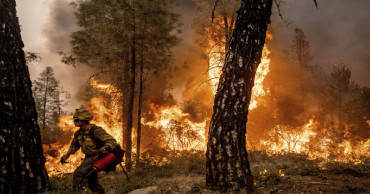
Firefighters made progress against a huge Northern California wildfire that was still growing and threatening thousands of mountain homes on Sunday, while crews also battled major blazes that blanketed large swaths of Oregon and Washington in smoke.
The Mosquito Fire in foothills east of Sacramento spread to nearly 65 square miles (168 square kilometers), with 10% containment, according to the California Department of Forestry and Fire Protection, or Cal Fire.
“Cooler temperatures and higher humidity assisted with moderating some fire activity,” but higher winds allowed the flames to push to the north and northeast, according to a Cal Fire incident report Sunday.
More than 5,800 structures in Placer and El Dorado counties were under threat and some 11,000 residents of communities including Foresthill and Georgetown were under evacuation orders.
In Southern California, cooler temperatures and rain brought respite to firefighters battling the massive Fairview Fire about 75 miles (121 kilometers) southeast of Los Angeles after sweltering heat last week.
Read: Storm’s fierce winds complicate California wildfire fight
The 44-square-mile (114-square-kilometer) blaze was 45% contained Sunday. The fire has destroyed at least 30 homes and other structures in Riverside County. Two people died while fleeing flames last Monday.
A helicopter assisting with operations in the Fairview Fire crashed in a residential backyard while attempting to land at a local airport Saturday afternoon, fire officials said. Injuries to the pilot and two others were not critical.
The southern part of the state welcomed the cooler weekend weather as a tropical storm veered off the Pacific Coast and faded, helping put an end to blistering temperatures that nearly overwhelmed the state’s electrical grid.
Thunderstorms and the risk of flooding persisted in mountainous areas of greater Los Angeles on Sunday. But after Hurricane Kay made landfall in Mexico last week it quickly was downgraded and weakened further until it largely disappeared, forecasters said.
To the north, remnants of Kay caused flooding Saturday that stranded about 40 vehicles and closed a stretch of State Route 190 in Death Valley National Park. The park was still cleaning up from floods five weeks ago that closed many key roads.
In Washington state, fire officials were scrambling to secure resources in the battle against a blaze sparked Saturday in the remote Stevens Pass area that sent hikers fleeing and forced evacuations of mountain communities. There was no containment Sunday of the Bolt Creek Fire, which had scorched nearly 12 square miles (31 square kilometers) of forestland about an hour and a half east of Seattle.
“The fire will continue to advance in areas that will be unstaffed. With limited resources, only point protection will be in place while resources continue to mobilize to the fire,” said a Sunday morning incident report.
California's Mosquito Fire has covered a large portion of the Northern Sierra region with smoke. California health officials urged people in affected areas to stay indoors where possible. Organizers of the Tour de Tahoe canceled the annual 72-mile (115-km) bicycle ride scheduled Sunday around Lake Tahoe because of the heavy smoke from the blaze — more than 50 miles (80 km) away. Last year’s ride was canceled because of smoke from another big fire south of Tahoe.
Read: 2 killed in Northern California wildfire: Sheriff
The Mosquito Fire’s cause remained under investigation. Pacific Gas & Electric said unspecified “electrical activity” occurred close in time to the report of the fire on Tuesday.
Scientists say climate change has made the West warmer and drier over the last three decades and will continue to make weather more extreme and wildfires more frequent and destructive. In the last five years, California has experienced the largest and most destructive fires in state history.
And the rest of the West hasn’t been immune. There were at least 18 large fires burning in Oregon and Washington, leading to evacuations and targeted power outages near Portland as the challenge of dry and windy conditions continued in the region.
Sprawling areas of western Oregon choked by thick smoke from the fires in recent days were expected to see improved air quality on Sunday thanks to a returning onshore flow, Oregon Public Broadcasting reported.
South of Portland, more than 3,000 residents were under new evacuation orders because of the 134-square-mile (347-square-kilometer) Cedar Creek Fire, which has burned for over a month across Lane and Deschutes counties. Firefighters were protecting remote homes in Oakridge, Westfir and surrounding mountain communities.
According to the Northwest Interagency Coordination Center, this weekend there were more than 400 square miles (1,035 square kilometers) of active, uncontained fires and nearly 5,000 people on the ground fighting them in the two northwestern states.
3 years ago