Others
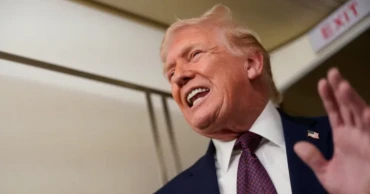
Trump says US military weighing strong options as Iran protests intensify
U.S. President Donald Trump said on Sunday that Washington is evaluating “strong options” in response to ongoing protests in Iran, including potential military action.
“We’re looking at it very seriously. The military is looking at it, and we’re looking at some very strong options. We’ll make a determination,” Trump told reporters aboard Air Force One late Sunday while traveling from Florida to Washington.
Trump added that Iran had reached out following his threats, seeking to negotiate, and that a “meeting is being set up.” However, he cautioned that the United States might have to act before any meeting takes place.
His remarks came as Iranian leaders issued stern warnings against foreign intervention. Parliament Speaker Mohammad Baqer Qalibaf said, “In the case of an attack on Iran, the occupied territories [Israel], as well as all U.S. bases and ships, will be our legitimate target.”
The unrest in Iran began on December 28 when merchants at Tehran’s Grand Bazaar closed their shops following a steep fall in the Iranian rial. The demonstrations rapidly spread nationwide, initially fueled by economic grievances over rising living costs and quickly evolving into broader opposition against the clerical establishment that has governed Iran since the 1979 Islamic Revolution.
Iranian state media reported that at least 109 security personnel have been killed during the unrest. Authorities have not confirmed the number of civilian casualties, though opposition activists abroad estimate that hundreds of protesters may have died.
A nationwide internet blackout has persisted for more than 72 hours, according to monitoring organizations, making independent verification of events increasingly difficult.
The unrest coincides with Trump’s assertive foreign policy moves, including the abduction of Venezuelan President Nicolás Maduro and discussions over acquiring Greenland through purchase or force.
A U.S. official told Reuters that Trump is scheduled to meet with senior advisers on Tuesday to discuss the country’s options in Iran. Reports in the Wall Street Journal indicated that measures under consideration include targeted military strikes, deployment of secret cyber capabilities, expansion of sanctions, and provision of online support to antigovernment groups.
Trump also said he plans to engage with billionaire Elon Musk to explore restoring internet services in Iran. “He’s very good at that kind of thing, he’s got a very good company,” Trump told reporters, referring to Musk’s SpaceX, which operates the Starlink satellite internet system currently used in Iran.
In addition to Iran, Trump addressed his administration’s plans for Greenland and Venezuela. On Greenland, he urged the Danish Arctic territory to “make a deal” and stated, “we are talking about acquiring it, not making a short-term deal.” Regarding Venezuela, Trump confirmed a scheduled meeting with opposition leader María Corina Machado on Tuesday or Wednesday.
With inputs from ALJAZEERA
1 month ago
With Cuban ally Maduro ousted, Trump urges Cuba to make a ‘deal’
President Donald Trump on Sunday issued a stark warning to the government of Cuba, saying the Caribbean island must negotiate with the United States “before it is too late” after Cuba’s long-standing source of Venezuelan oil and money was cut off amid Washington’s takeover of Venezuelan oil supplies following Nicolás Maduro’s ouster.
Trump took to social media to declare that Cuba, which has historically depended on Venezuelan support, will receive “no more oil or money … ZERO!”, and urged Havana to seek a deal with Washington.
The move comes as U.S. forces continue to seize tankers in the Caribbean in an effort to control Venezuela’s oil production, refining and distribution, reshaping energy flows in the region.
Hours after Trump’s post, Cuban President Miguel Díaz-Canel responded on social media, accusing the United States of lacking moral authority to criticise Cuba and defending his country’s record.
The Cuban government also said that 32 of its military personnel were killed in the U.S. operation that led to Maduro’s capture; the troops were in Caracas under a longstanding agreement between Havana and Caracas.
Trump described the end of Venezuelan support as part of a broader shift in the region, asserting that Venezuela no longer needs protection from past leaders and that the United States — “the most powerful military in the world” — will now safeguard its interests.
Trump’s aggressive rhetoric and policy escalation reflect growing U.S. pressure on Cuba, which has faced decades of U.S. sanctions and is grappling with severe economic shortages, including long power blackouts and supply disruptions.
1 month ago
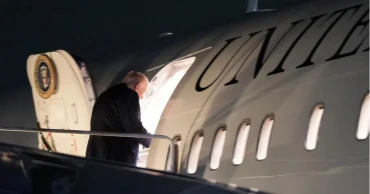
Trump says he may bar ExxonMobil from Venezuelan oil efforts
President Donald Trump said Sunday he is “inclined” to exclude ExxonMobil from participating in Venezuela’s oil sector after its chief executive expressed serious doubts about investing in the country following the removal of former President Nicolás Maduro.
Speaking to reporters as he left West Palm Beach, Florida, Trump said he was disappointed with Exxon’s response during a meeting with major U.S. oil company leaders and warned the company may be kept out of U.S.-led reconstruction and investment plans. “I didn’t like Exxon’s response,” he said. “They’re playing too cute.”
At the White House meeting Friday, Exxon’s CEO Darren Woods described Venezuela as “uninvestable” under its current legal and commercial conditions and said significant changes would be needed before his company could commit to investment.
Trump has been pushing U.S. oil firms to help revive Venezuela’s beleaguered energy industry since Maduro’s ouster, telling executives they would work directly with the United States rather than the Venezuelan government.
On Friday, Trump also signed an executive order aimed at safeguarding Venezuelan oil revenues held in U.S. Treasury accounts from judicial seizure, saying allowing such actions could damage U.S. efforts to stabilise the country’s economy.
The administration is framing its involvement in Venezuela’s oil sector as an economic priority, including control over sales of millions of barrels of previously sanctioned crude and encouraging U.S. companies to invest in rebuilding the infrastructure.
1 month ago
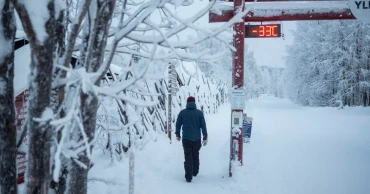
Thousands stranded in northern Finland as severe cold disrupts flights
Thousands of tourists were stranded in northern Finland on Sunday after flights at Kittilä airport were canceled due to severe cold.
The temperature at the airport dropped to minus 37 degrees Celsius (minus 34.6 degrees Fahrenheit) on Sunday morning, after several days of similar frigid weather, making de-icing of aircraft and other operations difficult, Finland's national public broadcaster Yle reported.
The deep freeze is expected to continue in Kittilä, which is located in Finnish Lapland in the sparsely populated north, on Monday, when the Finnish Meteorological Institute predicts temperatures of almost minus 40 C (minus 40 F).
Finns are generally used to frosty winter temperatures but this year's cold, which has affected wide regions of northern, central and eastern Europe, is more severe than in other years.
Heavy snowfall, high winds and icy roads have made travel difficult in parts of Europe.
In Germany, train passengers were still experiencing long delays and cancellations Sunday after rail operator Deutsche Bahn shut down all service in the north of the country on Friday due to strong snowfall.
Authorities announced that all schools would remain closed and switch to online classes on Monday in North Rhine-Westphalia, the country's most populous western state, after forecasts of icy roads across the region.
In the Baltic countries of Estonia and Lithuania, drivers were asked to postpone all nonessential travel because of expected blizzards, while neighboring Latvia issued a snow alert for the west of the country.
1 month ago
Greenland mining hurdles challenge Trump’s rare earth ambitions
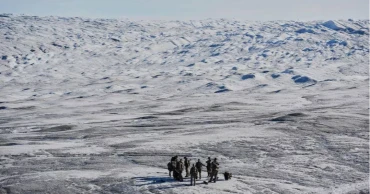
Greenland’s remote location, harsh climate and lack of basic infrastructure have so far prevented the development of any commercial mine for rare earth elements, raising doubts over President Donald Trump’s push to secure control of the Arctic island as part of his strategy to break China’s dominance in the global supply chain.
Trump has made rare earths a priority after China sharply restricted exports following U.S. tariffs imposed last spring. The Trump administration has invested hundreds of millions of dollars and taken stakes in several companies, while the president has renewed his call to wrest control of Greenland from Denmark.
“We are going to do something on Greenland whether they like it or not,” Trump said on Friday.
However, experts say Greenland may not be able to produce rare earths for many years, if at all. Although the island is believed to hold around 1.5 million tons of rare earth deposits, most projects remain at an early exploration stage. Analysts say Trump’s interest may be driven more by geopolitical concerns over Russian and Chinese influence in the Arctic than by the immediate need for minerals such as neodymium and terbium, which are used in electric vehicles, wind turbines, robots and fighter jets.
“The fixation on Greenland has always been more about geopolitical posturing than a realistic supply solution,” said Tracy Hughes, founder of the Critical Minerals Institute.
Trump acknowledged the strategic angle, saying Washington does not want Russia or China expanding their presence in the region.
Mining experts say Greenland’s remoteness, lack of roads and railways, need for local power generation and shortage of skilled manpower make large-scale mining extremely difficult. Environmental risks also pose major challenges in the fragile Arctic ecosystem, where toxic chemicals used in processing and the presence of radioactive uranium could threaten Greenland’s growing tourism industry.
Geologists note that Greenland’s rare earths are locked in complex rock formations known as eudialyte, from which no profitable extraction method has yet been developed.
Industry specialists argue the United States should instead focus on more advanced mining projects in the U.S. and allied countries such as Australia, which are closer to commercial production.
Although some companies have announced plans to build pilot plants in Greenland, analysts say they remain far from opening a full-scale mine and would need to raise hundreds of millions of dollars.
With more than 90 percent of the world’s rare earths currently coming from China, experts warn that securing alternative supplies will take years and require sustained investment in more accessible and economically viable projects.
1 month ago
Iran warns US troops and Israel will be targeted if America strikes over protests
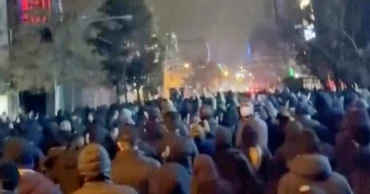
Nationwide protests challenging Iran’s theocracy continued into Sunday in Tehran and the country’s second-largest city, Mashhad, crossing the two-week mark as violence linked to the demonstrations has killed at least 116 people, activists said.
With internet services cut and phone lines largely shut down, monitoring the protests from abroad has become increasingly difficult. However, the U.S.-based Human Rights Activists News Agency reported that the death toll has continued to rise, while at least 2,600 people have been detained.
Amid the unrest, Iran’s parliament speaker warned that the U.S. military and Israel would be considered “legitimate targets” if America attacks the Islamic Republic, following threats by President Donald Trump. Mohammad Bagher Qalibaf made the warning as lawmakers rushed the dais in parliament, chanting: “Death to America!”
Observers abroad fear that the information blackout could embolden hard-liners within Iran’s security forces to carry out a violent crackdown, despite Trump’s warning that he is willing to strike Iran to protect peaceful demonstrators.
Trump voiced support for the protesters on social media, writing that “Iran is looking at FREEDOM, perhaps like never before. The USA stands ready to help!!!” The New York Times and The Wall Street Journal, citing anonymous U.S. officials, reported Saturday night that Trump had been presented with military options for a strike on Iran, but had not yet made a final decision.
The U.S. State Department also issued a warning, saying: “Do not play games with President Trump. When he says he’ll do something, he means it.”
Parliament rallies
Iranian state television broadcast the parliamentary session live. Qalibaf, a hard-liner and former presidential candidate, delivered a speech praising police and Iran’s paramilitary Revolutionary Guard, particularly its volunteer Basij force, for having “stood firm” during the protests.
“The people of Iran should know that we will deal with them in the most severe way and punish those who are arrested,” Qalibaf said.
He went on to directly threaten Israel, which he referred to as “the occupied territory,” as well as the U.S. military, raising the possibility of preemptive action.
“In the event of an attack on Iran, both the occupied territory and all American military centers, bases and ships in the region will be our legitimate targets,” Qalibaf said. “We do not consider ourselves limited to reacting after the action and will act based on any objective signs of a threat.”
It remains unclear how serious Iran is about launching a strike, particularly after its air defenses were badly damaged during the 12-day war with Israel in June. Any decision to go to war would rest with Iran’s 86-year-old Supreme Leader Ayatollah Ali Khamenei.
The U.S. military has said its forces in the Middle East are positioned “across the full range of combat capability to defend our forces, our partners and allies and U.S. interests.” Iran targeted U.S. forces at Al Udeid Air Base in Qatar in June, while the U.S. Navy’s 5th Fleet is based in Bahrain.
Israel is also closely monitoring the situation. An Israeli official, speaking on condition of anonymity, said Prime Minister Benjamin Netanyahu spoke overnight with U.S. Secretary of State Marco Rubio on issues including Iran.
Protests in Tehran and Mashhad
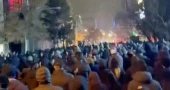
Videos circulating online, likely transmitted via Starlink satellite connections, showed demonstrators gathering in Tehran’s northern Punak neighborhood. Authorities appeared to have blocked streets as protesters waved lit mobile phones, banged on metal and set off fireworks.
Other footage showed demonstrators marching peacefully and drivers honking car horns in support.
“The pattern of protests in the capital has largely taken the form of scattered, short-lived and fluid gatherings, shaped by the heavy presence of security forces and increased field pressure,” the Human Rights Activists News Agency said. It added that surveillance drones and security deployments around protest sites indicated ongoing monitoring.
In Mashhad, around 725 kilometers northeast of Tehran, footage showed protesters confronting security forces, with burning debris and overturned dumpsters blocking roads. Mashhad is home to the Imam Reza shrine, the holiest site in Shiite Islam, giving the protests there particular significance for Iran’s theocracy.
Protests were also reported in Kerman, about 800 kilometers southeast of Tehran.
Iranian state television on Sunday sent correspondents to various cities to show calm streets, displaying date stamps on screen. Tehran and Mashhad were not included. The broadcaster also aired images of pro-government demonstrations in Qom and Qazvin.
Ali Larijani, a senior security official, appeared on state television accusing some demonstrators of “killing people or burning some people, which is very similar to what ISIS does.” State TV also aired funerals of slain security personnel and reported that six more had been killed in Kermanshah.
More demonstrations planned
Iran’s exiled Crown Prince Reza Pahlavi, who called for protests on Thursday and Friday, urged demonstrators to return to the streets on Sunday. He asked protesters to carry Iran’s old lion-and-sun flag and other national symbols from the era of the shah to “claim public spaces as your own.”
Pahlavi’s ties with Israel have drawn criticism in the past, particularly after last year’s 12-day war. While some protesters have chanted in support of the shah, it remains unclear whether this reflects backing for Pahlavi or simply nostalgia for the period before the 1979 Islamic Revolution.
The protests began on Dec. 28 following the collapse of the Iranian rial, which is now trading at more than 1.4 million to the dollar, as the economy suffers under international sanctions linked in part to Iran’s nuclear program. The demonstrations have since intensified into a broader challenge to Iran’s theocratic system.
1 month ago
Record snowfall blankets Moscow after 56 years
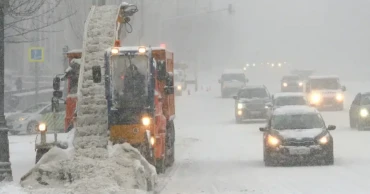
Russia's capital Moscow on Friday experienced the heaviest snowfall in 56 years, with 42 percent of the monthly average precipitation recorded in just 24 hours.
"The snowstorm that hit central Russia on Friday brought record-breaking snowfall, paralyzing ground and air traffic across the region," said Evgeny Tishkovets, a leading specialist at the Phobos Weather Center, a private weather forecasting service.
"Moscow's main weather station at the Exhibition Centre of the National Economy logged 22 millimeters of precipitation in a single day, equivalent to 42 percent of the monthly norm. Overnight, the snow eased off, with an additional 2 millimeters of light snow falling by morning," Tishkovets said.
Moscow's Sheremetyevo International Airport reported that over 1 million cubic meters of snow had been cleared from its premises in the past 24 hours.
As of 12:00 p.m. local time (09:00 GMT) on Saturday, 78 flights at Moscow's four major airports had been delayed by more than two hours, while 35 others were canceled, Russia's Ministry of Transport said.
All four airports resumed full operations by noon.
Moscow Railway estimated that around 70,000 cubic meters of snow had been removed from the city's railway infrastructure over the past 24 hours.
1 month ago
Iran cuts global communications as protests mount
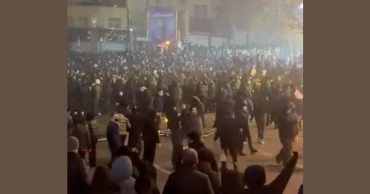
Just after 8 p.m. Thursday, Iran's theocracy pulled the plug and disconnected the Islamic Republic's 85 million people from the rest of the world.
Following a playbook used both in demonstrations and in war, Iran severed the internet connections and telephone lines that connect its people to the vast diaspora in the United States, Europe and elsewhere. Until now, even while facing strict sanctions over the country's nuclear program, Iranians still could access mobile phone apps and even websites blocked by the theocracy, using virtual private networks to circumvent restrictions.
Thursday's decision sharply limits people from sharing images and witness accounts of the nationwide protests over Iran's ailing economy that have grown to pose the biggest challenge to the government in years. It also could provide cover for a violent crackdown after the Trump administration warned Iran's government about consequences for further deaths among demonstrators.
As the country effectively goes dark, loved ones abroad are frantic for any scrap of news, especially as Iran’s attorney general warned on Saturday that anyone taking part in protests will be considered an “enemy of God,” a death-penalty charge
“You can’t understand our feelings. My brothers, my cousins, they will go on the street. You can’t imagine the anxiety of the Iranian diaspora,” said Azam Jangravi, a cybersecurity expert in Toronto who opposes Iran's government. “I couldn’t work yesterday. I had meetings but I postponed them because I couldn’t focus. I was thinking of my family and friends.”
Her voice cracked as she added: “A lot of people are being killing and injured by the Islamic Republic of Iran, and we don’t know who.”
Even Starlink is likely being jammed
This is the third time Iran has shut down the internet from the outside world. The first was in 2019, when demonstrators angry about a spike in government-subsidized gasoline prices took to the streets. Over 300 people reportedly were killed.
Then came the protests over the 2022 death of Mahsa Amini following her arrest by the country’s morality police over allegedly not wearing her hijab, or headscarf, to the liking of authorities. A monthslong crackdown killed more than 500 people.
While the connectivity offered by Starlink played a role in the Amini demonstrations, the deployment of its receivers is now far greater in Iran. That's despite the government never authorizing Starlink to function, making the service illegal to possess and use.
A year ago, an Iranian official estimated tens of thousands of Starlink receivers in the Islamic Republic, a figure that Los Angeles-based internet freedom activist Mehdi Yahyanejad said sounded right.
While many receivers likely are in the hands of business people and others wanting to stay in touch with the outside world for their livelihoods, Yahyanejad said some are now being used to share videos, photos and other reporting on the protests.
“In this case, because all those things have been disrupted, Starlink is playing the key for getting all these videos out,” Yahyanejad said.
However, Starlink receivers are facing challenges. Since its 12-day war with Israel last June, Iran has been disrupting GPS signals, likely in a bid to make drones less effective. Starlink receivers use GPS signals to position themselves to connect to a constellation of low-orbit satellites.
Amir Rashidi, director of digital rights and security at the Miaan Group and an expert on Iran, said that since Thursday he had seen about a 30% loss in packets being sent by Starlink devices — basically units of data that transmit across the internet. In some areas of Iran, Rashidi said there had been an 80% loss in packets.
“I believe the Iranian government is doing something beyond GPS jamming, like in Ukraine where Russia tried to jam Starlink,” Rashidi said. He suggested Iran may be using a mobile jammer, like it did in previous decades to disrupt satellite television receivers.
The International Telecommunication Union, a United Nations agency, has called on Iran to stop jamming in the past.
Meanwhile, Iran has been advocating at the ITU for Starlink service to the country to be stopped.
Help ‘needs to come soon’
It appears that the majority of information coming out of Iran since Thursday night is being transmitted via Starlink, which is now illegal. That carries dangers for those possessing the devices.
“It’s really hard to use it because if they arrest a person, they can execute the person and say this person is working for Israel or the United States,” Jangravi said.
Not using it, however, means the world knows even less about what's happening inside Iran at a pivotal moment.
“This sort of nonviolent protest is not sustainable when the violence (by security forces) is so extreme," Yahyanejad said. “Unless something changes in the next two or three days, these protests can die down, too. If there’s any help, it needs to come soon.”
1 month ago
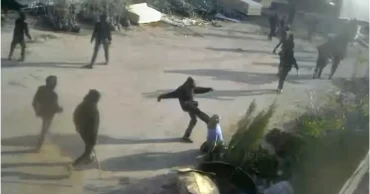
Video shows armed men beating a Palestinian in Israeli-occupied West Bank
Dozens of masked men armed with sticks beat and injured a Palestinian in the Israeli-occupied West Bank when they attacked a plant nursery, according to people who saw the attack and video footage obtained by The Associated Press.
Video filmed by security cameras shows men dressed mostly in black, faces covered, with several hitting and kicking a man on the ground.
Two witnesses who are members of the family that owns the facility said Israeli settlers beat 67-year-old Basim Saleh Yassin as he was trying to flee the German-Palestinian-run nursery in the northern West Bank village of Deir Sharaf. Both spoke on condition of anonymity for fear of reprisal.
Workers fled when they saw the settlers coming on Thursday but Yassin is deaf and couldn’t hear the warnings to leave, one family member said.
The witnesses said Yassin was in the hospital with broken bones in his hand and other injuries to his face, chest and back. Four cars at the nursery were burned.
The attack is the latest in rising Israeli settler violence in the West Bank, where assaults increased during the Palestinian olive harvest in October and have continued. Israeli authorities have done little beyond issuing occasional condemnations of the violence.
Prime Minister Benjamin Netanyahu has called the perpetrators “a handful of extremists” and urged law enforcement to pursue them for “the attempt to take the law into their own hands.” But rights groups and Palestinians say the problem is far greater than a few bad actors, and attacks have become a daily phenomenon across the territory.
Israel's army said it dispatched soldiers to the Shavei Shomron junction — close to the area of Thursday's attack — following reports of dozens of masked Israelis vandalizing property. The army said it apprehended three suspects who were taken to police for questioning. It said security forces condemn violence of any kind.
According to one of the family members who own the nursery, it was the third time in a year that the facility was attacked. The previous incident was in September and cost the business more than $600,000 as offices and facilities were damaged, he said.
In the video of Thursday's attack, Yassin runs from a group of masked people before falling to the ground.
One man kicks him and another hits him twice with what appears to be a stick. Yassin stays on his knees as he's struck again and then places his hands on the ground. As the men are leaving, one kicks him in the head while others strike him again until he's seen lying on the pavement.
Israel captured the West Bank, east Jerusalem and Gaza — areas claimed by the Palestinians for a future state — in the 1967 war. It has settled over 500,000 Jews in the West Bank.
Settlements are widely considered illegal under international law. Last month, Israel’s Cabinet approved a proposal for 19 new Jewish settlements in the West Bank as the government pushes ahead with a construction binge that further threatens the possibility of a Palestinian state.
And Israel has cleared the final hurdle before starting construction on a contentious settlement project near Jerusalem that would effectively cut the West Bank in two, according to a government tender reported this month.
1 month ago

Trump threatens to take Greenland by force
US President Donald Trump has warned that the United States could take control of Greenland “one way or another,” arguing that the Danish self-governing territory is critical to American strategic interests in the Arctic.
Speaking to reporters at the White House on Friday during a meeting with oil industry executives, Trump said Washington must act to prevent Russia or China from gaining a foothold in Greenland. He accused Denmark of failing to adequately protect the surrounding waters, a claim that Greenlandic leaders have rejected.
“We’re going to do something with Greenland whether they like it or not,” Trump said, adding that allowing Russia or China to move into the territory would make them direct U.S. neighbors. “I’d rather make a deal the easy way. But if that doesn’t happen, we’ll do it the hard way.”
Trump’s remarks have fueled concerns following recent U.S. actions in Venezuela, including military strikes and the detention of President Nicolás Maduro, prompting questions about how far Washington might go regarding Greenland.
Earlier Friday, Greenland’s foreign minister said the territory itself should take charge of any discussions with the United States, as American pressure over Greenland continues to grow. Vivian Motzfeldt said Greenland should lead talks with U.S. Secretary of State Marco Rubio, rather than leaving negotiations solely to Denmark.
“When it comes to Greenland, it should be Greenland speaking directly with the United States,” Motzfeldt said, according to Danish broadcaster DR. She argued that Greenland should be able to engage diplomatically with other countries independently, even while remaining part of the Danish kingdom.
Motzfeldt noted that Greenland and Denmark share many values and policies, but said direct dialogue with Washington would be appropriate. She declined to say whether she would prefer to meet Rubio without Denmark’s foreign minister, Lars Løkke Rasmussen, emphasizing that the talks would still be held jointly.
She added that Greenland is working toward eventual statehood, which would include control over its own foreign policy, but acknowledged that current legal frameworks still require coordination with Denmark.
NATO concerns and Arctic security
Rubio met with NATO Secretary General Mark Rutte on Friday as the alliance seeks to ease tensions by highlighting its efforts to strengthen security in the Arctic. A NATO spokesperson said the discussions focused on the region’s strategic importance and ongoing efforts to enhance military capabilities in the High North.
Danish Prime Minister Mette Frederiksen has warned that any U.S. military action to seize Greenland could threaten the future of NATO itself.
However, NATO’s top military commander in Europe, U.S. General Alexus Grynkewich, downplayed fears of an alliance crisis. Speaking to reporters in Finland, he said NATO remains fully prepared to defend all member territory and that tensions have not affected military cooperation.
“I don’t see us anywhere near a crisis,” Grynkewich said, adding that NATO forces remain ready to protect “every inch” of allied land.
Motzfeldt expressed cautious optimism ahead of next week’s talks with Rubio, stressing that the outcome remains uncertain. She said Greenland and the United States depend on each other strategically and called for rebuilding relations based on mutual trust.
“Greenland needs the United States, and the United States needs Greenland,” she said. “That relationship must be handled responsibly.”
Source: AL Jazeera
1 month ago