Others

A crush at the opening ceremony of the Indian Ocean Island Games in Madagascar kills at least 12
At least 12 people died in a crush at a stadium in Madagascar on Friday as sports fans gathered for the opening ceremony of the Indian Ocean Island Games, local media reported.
The reports said Prime Minister Christian Ntsay announced the deaths. He said around 80 others had been injured, 11 of them critically.
Madagascar President Andry Rajoelina was at the ceremony at Mahamasina Stadium in the capital, Antananarivo, and asked the crowd to observe a few moments of silence for the dead, the reports said.
UN Security Council, minus China and Russia, condemns Myanmar military's killing of civilians
The stadium, which is built to hold around 41,000 people, has been the site of deadly crushes before. One person died and at least 37 were injured in a crush ahead of a qualifying game for the African Cup of Nations soccer tournament between Madagascar and Senegal in 2018. In 2019, at least 15 people died in a stampede at a music concert at the stadium.
A bus hits a van and catches fire in Pakistan, killing 20 people and injuring 11 others
The Indian Ocean Island Games is a multi-sports event featuring nations from the region. Athletes from Comoros, Maldives, Mautirtius, Mayotte, Reunion and Seychelles also compete at the games.
2 years ago

COP28 UAE Presidency will host critical climate talks alongside an ambitious and inclusive two-week thematic program.
Taking place at Expo City Dubai from 30 November to 12 December, COP28 UAE will focus on fast-tracking a just, orderly and equitable energy transition; fixing climate finance; putting nature, lives and livelihoods at the heart of climate action; and mobilizing for the most inclusive COP.
The COP28 UAE Presidency has announced an ambitious and inclusive two-week thematic program for the conference to deliver on four key goals alongside the negotiations process and as part of the critical Global Stocktake response.
COP28 UAE will take place at Expo City Dubai from November 30-December 12, 2023.
The Conference is expected to convene over 70,000 participants, including heads of state, government officials, international industry leaders, private sector representatives, academics, experts, youth, and non-state actors, said a media release.
Designed to drive action and implement policy, finance, and technology solutions across these priorities, the innovative two-week thematic program was developed in consultation with stakeholders including civil society, NGOs, youth, and Indigenous Peoples. A six-week open consultation on the thematic areas and sequencing was held in which stakeholders were invited to submit feedback – the first such approach taken by a COP Presidency.
Kicking off with a two-day World Climate Action Summit, during which the first-ever Global Stocktake response will be presented to world leaders with the COP Presidency seeking commitments and accountability, the program also features new individual thematic days that respond to global challenges.
For the first time at a COP forum, COP28 will dedicate a day to Health, Relief, Recovery, and Peace, with a high level climate health ministerial, among other thematic activities.
COP28 will also be the first to focus on the role of trade in tandem with finance and it will be the COP that brings leaders together from across all levels of government and society – from the local mayors to global leaders– to work towards cleaner, greener, safer cities for current and future generations.
All thematic days throughout the two weeks will be underpinned with an inclusive approach that prioritizes frontline communities and focuses on how finance, technology and innovation can drive solutions.
More detailed information about each thematic day will be released in the weeks and months ahead, as the COP28 Presidency continues to ramp up preparations for this year’s meeting at Expo City Dubai.
Read: COP28 President-designate calls on international community to deliver on climate finance
Below are the key themes and events for each day:
• 30 November: COP28 UAE opens to the world at Expo City, Dubai.
• 1-2 December: World Climate Action Summit – These two days will see heads of state and world leaders come together to tackle the most pressing climate issues in dialogue with leaders from civil society, business, youth, Indigenous Peoples’ organizations and others. Typically, the summit helps to firm up the ambition for the remainder of the COP. For COP28, it will go further; it is where the first-ever Global Stocktake response and the urgency of the situation faced will be presented, and the COP Presidency will seek accountability from the highest levels of global governance on a way forward.
• 3 December: Health/Relief, Recovery, and Peace – Climate change is already impacting human health across the planet, from the quality of the air we breathe to the water we drink and the places that provide us with shelter. It is also a major cause for displacement of vulnerable communities, leading to increased fragility which can compromise peace. This day, a first for COPs, will explore ways to provide relief to those affected while strengthening resilience and recovery leading to increased stability.
• 4 December: Finance/Trade/Gender Equality/Accountability – Neither global financial systems that control and impact access and affordability of climate finance nor international trade networks, are working effectively and equitably. It is widely acknowledged that leaders of the global institutions and countries that govern these systems must accelerate and be accountable for an overhaul. An example of this is freeing up access to international finance and trade to support the implementation of adaptation and mitigation solutions without restrictions such as high interest rates that the poorest countries cannot afford. This is necessary to create fairer and more equal conditions for the world – and especially the most climate vulnerable countries from the Global South – to meet collective climate targets. This day will focus on moving this work forward while championing the importance of gender equality across the full climate spectrum.
•5 December: Energy and Industry / Just Transition / Indigenous Peoples – The world needs to decarbonize rapidly while continuing to progress economically. It is critical that this development happens sustainably and inclusively to support lives and livelihoods while protecting the planet. This day will focus on how the world can accelerate the energy transition while ensuring it is just. The energy needed for day-to-day life must remain affordable but become cleaner, and jobs must be retained but expand as green technologies emerge and provide increased and equitable access to opportunities. The day will look at the broad spectrum of solutions from deploying renewable energy at scale and how hydrogen can support this, to decarbonizing the energy of today through carbon capture technologies and rapidly reducing methane emissions from oil and gas. It will also focus on heavy-emitting industry including steel, cement, and aluminium. Indigenous Peoples are stewards of 80% of our planet’s biodiversity and Indigenous Peoples Day will recognize the importance of their intergenerational knowledge, practices, and leadership in climate action. The day will also strengthen their role in the just transition, reinforcing the urgency of a fully inclusive, all-of-society approach.
Read: COP28 UAE Presidency: Leading economists set out crucial next steps to reform int’l climate financing
•6 December: Multilevel Action, Urbanization, and Built Environment/Transport – It is not often that leaders representing all levels of governance, from the local to the global, come together. This day will provide a rare opportunity for mayors and governors, ministers and parliamentarians, and global business and civil society leaders to work together to accelerate climate action solutions across society in every form. This will include exploring how greener urban mobility systems can be designed to withstand and adapt to climate change while supporting the transition to low carbon built environments and infrastructure, and redesigning our systems of production and consumption to minimize waste. In addition, this day will showcase how all of these solutions contribute to safer, healthier and greener cities for current and future generations.
• December: Rest Day
• 8 December: Youth, Children, Education, and Skills – Children and youth are facing disproportionate risks and impacts from climate change as the generation who will inherit a planet with tougher conditions in which to live and prosper but which was not responsible for contributing to the problem. This day seeks to empower children and youth to shape the outcomes of COP28 and beyond and provide them with clear, defined, accessible opportunities to be a leading part of the solutions proposed at every level.
• 9 December: Nature, Land Use, and Oceans – Our world’s climate and its biodiversity are inextricably interconnected, one cannot exist without the other. Mitigating both crises must therefore be integrated. In a landmark win for nature, a 30 x 30 biodiversity goal was adopted by world leaders at the CBD COP15 – to protect at least 30 percent of the planet's land and water by 2030. Contributing to the goal, this day will focus on delivering climate and nature co-benefits. This includes co-designing approaches to land use and oceans conservation with local and Indigenous Peoples to protect and manage biodiversity hotspots and natural carbon sinks.
• 10 December: Food, Agriculture, and Water – Climate change is creating severe pressure and risks for the food, agricultural and water systems that ensure human wellbeing. At the same time, these systems are also key contributors to climate change: one third of all human-made GHG emissions derive from agri-food systems, and 70% of fresh water consumed worldwide is used for agricultural production. This day will focus on how to fix this, from scaling up regenerative agriculture and water-food systems that support habitat restoration and conservation and increase food security, to implementing stronger, fairer integrated governance between states and corporations, farmers and producers.
Read more: COP28 UAE Presidency: Leading economists to drive progress on int’l finance reforms
• 11-12 December: Final Negotiations – On the final two days of COP28, there will be no thematic days to avoid extensive programming when the negotiation text is often being closed.
2 years ago
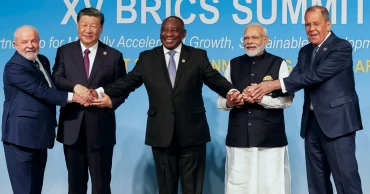
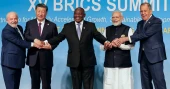
Iran, Saudi Arabia and Egypt are among 6 nations set to join the BRICS economic bloc
Iran and Saudi Arabia are among six nations invited Thursday (August 24, 2023) to join the BRICS bloc of developing economies.
United Arab Emirates, Argentina, Egypt and Ethiopia are also set to join the bloc from 2024.
The announcement was made at the BRICS summit in Johannesburg by South African President Cyril Ramaphosa, whose country is the current BRICS chair.
Also read: China to support Bangladesh in joining BRICS: XI tells Hasina during talks
BRICS is currently made up of the emerging economies of Brazil, Russia, India, China and South Africa. Those five members agreed at this week's summit to expand the bloc.
It's the second time that BRICS has decided to expand. The bloc was formed in 2009 by Brazil, Russia, India and China. South Africa was added in 2010. The BRICS bloc represents around 40% of the world's population and contributes more than a quarter of global GDP.
Three of the group's other leaders are attending the summit and were present alongside Ramaphosa for the announcement, including Brazilian President Luiz Inácio Lula da Silva, Indian Prime Minister Narendra Modi and Chinese President Xi Jinping.
Also read: BRICS: China, Russia and other emerging economies turn to main summit agenda in South Africa
Russian President Vladimir Putin did not travel to the summit after the International Criminal Court issued an arrest warrant for him in March for the abduction of children from Ukraine. He has participated in the summit virtually, while Russia was represented at the announcement in Johannesburg by Foreign Minister Sergey Lavrov.
2 years ago
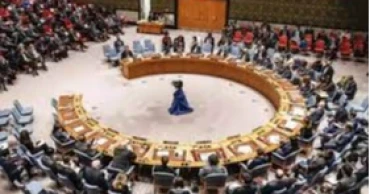
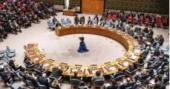
UN Security Council, minus China and Russia, condemns Myanmar military's killing of civilians
Members of the U.N. Security Council – minus China and Russia – condemned the “unrelenting violence” and killing of civilians in Myanmar and again urged its military rulers to stop attacks, release ousted leader Aung San Suu Kyi and respect human rights.
Thirteen of the 15 council members on Wednesday backed a joint statement that said there had been “insufficient progress” on implementing the first-ever Security Council resolution on Myanmar that was adopted last December. In that 12-0 vote, China and Russia, which have ties to the military that seized power from Suu Kyi’s elected civilian government in February 2021, abstained along with India whose two-year term on the council has ended.
Bangladesh urges OIC for efforts to send Rohingya back home in Myanmar
Britain’s deputy U.N. ambassador James Kariuki read the statement, flanked by diplomats from the other countries, after the council was briefed at a closed meeting by U.N. humanitarian chief Martin Griffiths on his recent visit to Myanmar and by Assistant Secretary-General Khaled Khiari on efforts to resolve the crisis.
The statement reiterates demands from the December 2022 council resolution that still require implementation: the immediate release of all “arbitrarily detained” prisoners including ousted leader Suu Kyi and president Win Myint, restoring democratic institutions, respecting human rights and “the democratic will of the people,” and upholding the rule of law.
It also calls for the full implementation of the plan by the 10-member Association of Southeast Asian Nations that Myanmar’s rulers agreed to in April 2021 but have made little progress in fulfilling. It includes an immediate cessation of violence, a dialogue among all parties mediated by an ASEAN envoy who is also to visit Myanmar and meet all parties. Envoys have visited but not been allowed to meet Suu Kyi.
The 13 council members said the military’s actions have left over 18 million people in Myanmar in need of humanitarian assistance – over 15 million of them without regular access to adequate food – and 2 million people displaced.
Investigators say Myanmar's military is committing increasingly brazen war crimes
Members also expressed ongoing concern about the plight of nearly a million Rohingya Muslims who fled Buddhist-majority Myanmar following a military crackdown in northern Rakhine state in August 27 to Bangladesh and other countries. They urged Myanmar “to address the fundamental causes of the crisis and restore the rights of Rohingya.” Almost all Rohingyas are denied citizenship and their movements are restricted.
At the council meeting, diplomats discussed a report this month by U.N. independent investigators who said Myanmar’s military and affiliated militias are committing increasingly frequent and brazen war crimes.
The Independent Investigative Mechanism for Myanmar, established in 2018 by the Geneva-based U.N. Human Rights Council, said it also found strong evidence during the year ending in June of the indiscriminate and disproportionate targeting of civilians with bombs, mass executions of people detained during military operations, and large-scale burning of civilian houses.
Nicholas Koumjian, head of the investigative group, said: “Our evidence points to a dramatic increase in war crimes and crimes against humanity in the country, with widespread and systematic attacks against civilians, and we are building case files that can be used by courts to hold individual perpetrators responsible.”
Myanmar atrocities, impunity must end: UN
U.S. Ambassador Linda Thomas-Greenfield cited the group’s report in a statement saying “the regime’s horrific atrocities must stop.” Given the military’s “intransigence and continued human rights abuses,” she said the Security Council needs to take action beyond last December resolution.
Myanmar’s U.N.-accredited ambassador, Kyaw Moe Tun, who represented the Suu Kyi government, urged the council to adopt a resolution banning the supply of weapons, jet fuel, and financial flows to the military.
“The people of Myanmar demand the removal of the military from politics and the establishment of a civilian, federal, democratic union," he said.
2 years ago
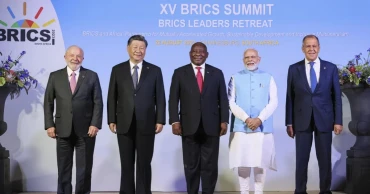
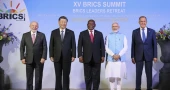
BRICS: China, Russia and other emerging economies turn to main summit agenda in South Africa
Leaders of some of the developing world’s most important economies turned Wednesday to the main business of their summit in South Africa, a day after a speech by Russian President Vladimir Putin gave the gathering an anti-Western tinge that officials had been hoping to avoid.
The BRICS group of emerging economies made up of Brazil, Russia, India, China and South Africa are debating whether to expand their bloc and allow in new members more than a decade after it came into existence.
Read: BRICS Summit 2023 unveils potential geopolitical paradigm shift: Modern Diplomacy
More than 20 countries have formally applied to join the group, officials say, with Saudi Arabia one of the most significant.
Four of the bloc’s leaders are in Johannesburg for the group’s first in-person meeting since the COVID-19 pandemic, including Chinese President Xi Jinping. Putin is not attending after an International Criminal Court arrest warrant for him over the war in Ukraine complicated his travel to South Africa, but he was participating virtually.
The Russian leader used a 17-minute pre-recorded speech aired on the opening day of the summit on Tuesday to lambast the West over the war in Ukraine and the financial sanctions placed on Russia as punishment for its invasion.
Read: Russia, China look to advance agendas at BRICS summit of developing countries in South Africa
He said a critical deal allowing Ukraine to move grain out of its Black Sea ports that Russia halted last month would not be reinstated unless Russian conditions are met.
In the buildup to the three days of talks in Johannesburg, BRICS officials had pushed back at suggestions the bloc was taking an anti-Western turn under the influence of Russia and China. Putin’s address put the deteriorating geopolitical climate at the center of the gathering.
Xi added to that in a speech that was read out by a Chinese government minister and alluded to the U.S.-China economic friction and warned of the “abyss of a new Cold War.”
Xi, Brazilian President Luiz Inácio Lula da Silva, Indian Prime Minister Narendra Modi and South African President Cyril Ramaphosa began talks over dinner at a luxury estate in suburban Johannesburg on Tuesday night, officials said, ahead of the summit’s main day of discussions on Wednesday. Foreign Minister Sergey Lavrov represented Russia in person, while Putin also participated in those dinner discussions virtually.
There appears to be momentum for expansion, with all five leaders backing the move in principle, although the exact criteria new members might need to meet to join must still be ironed out.
BRICS is a consensus-based organization and all five member countries must agree before any expansion.
Read: 7th China-South Asia Expo kicks off in China's Yunnan
The bloc has sometimes failed to put into action any coherent policy, largely because of the disparate economic and political priorities of its members and the increasing rivalry between China and India - the globe’s most populous countries and the developing world’s economic powerhouses.
Alongside expansion, there’s also talk by the BRICS members of adopting a broad economic policy that seeks a move away from U.S. dollar-based trade within the bloc.
The group’s stated intention to move away from the world’s dominant currency won’t take down the dollar overnight — and it’s yet to see any concrete agreements to implement the idea.
According to calculations by Federal Reserve researchers, 96% of trade in the Americas from 1999 to 2019 was invoiced in dollars, and 74% of trade in Asia. Everywhere else outside Europe, 79% of trade was done in dollars, underlining its status as the world’s de facto currency.
Read: Russia's Putin attends BRICS summit in South Africa remotely while facing war crimes warrant
Still, the dominant dollar is one of a growing number of gripes in the developing world. Many in the Global South also view international institutions like the U.N., the World Bank and the International Monetary Fund as not serving their interests.
China and Russia are more than happy to take advantage of that sentiment for their own agendas, analysts say. But they also note that the fact that more than 20 developing-world countries have applied to join BRICS and at least another 20 have expressed interest shows some of the bloc’s talk of an unfair global setup has hit home with many.
“Whatever the achievements of the BRICS bloc, its very existence and the queue of developing economies trying to join show a much broader unhappiness in the Global South with the current global order,” said Cobus van Staden of the China Global South Project, which tracks China’s engagement with developing world countries. “Whether that unhappiness will cause them to rally around China is a different issue.”
2 years ago
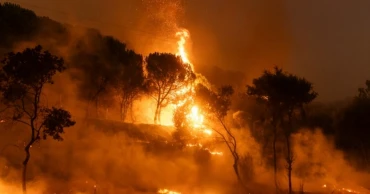
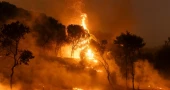
18 bodies found in Greece as firefighters battle wind-driven wildfires across the country
Firefighters on Tuesday found the burnt bodies of 18 people believed to have been migrants who had crossed the Turkish border into an area of northeastern Greece where wildfires have raged for days.
The discovery near the city of Alexandroupolis came as hundreds of firefighters battled dozens of wildfires across the country amid gale-force winds. On Monday, two people died and two firefighters were injured in separate fires in northern and central Greece.
With their hot, dry summers, southern European countries are particularly prone to wildfires. Another major blaze has been burning across Tenerife in Spain's Canary Islands for a week, although no injuries or damage to homes was reported.
European Union officials have blamed climate change for the increasing frequency and intensity of wildfires in Europe, noting that 2022 was the second-worst year for wildfire damage on record after 2017.
In Greece, police activated the country’s Disaster Victim Identification Team to identify the 18 bodies, which were found near a shack in the Avantas area, fire department spokesman Ioannis Artopios said.
A bus hits a van and catches fire in Pakistan, killing 20 people and injuring 11 others
“Given that there have been no reports of a missing person or missing residents from the surrounding areas, the possibility is being investigated that these are people who had entered the country illegally,” Artopios said.
Alexandroupolis is near the border with Turkey, along a route often taken by people fleeing poverty and conflict in the Middle East, Asia and Africa and seeking to enter the European Union.
Greek President Katerina Sakellaropoulou expressed sorrow at the deaths in a statement.
“We must urgently take effective initiatives to ensure that this bleak reality does not become the new normality,” she added, referring to the recurrent wildfires.
Avantas, like many nearby villages and settlements, had been under evacuation orders, with push alerts in Greek and English sent to all mobile phones in the region.
Death toll from devastating Maui fire reaches 101, Hawaii governor says
The fire service said it was investigating the causes of the blazes, in coordination with the police and secret service. In recent days, several people have been arrested or fined for accidentally starting fires.
But the discovery of the 18 bodies triggered a backlash by some who accused migrants of starting fires.
Late Monday, police said they detained three men in Alexandroupolis suspected of kidnapping and illegally holding 13 migrants. One of the suspects was a man seen in video posted on social media shutting a group of migrants in a trailer and accusing them of “intending to burn us,” a statement from national police headquarters said.
Fire breaks out at Ctg garment factory
Government spokesman Pavlos Marinakis issued a statement condemning vigilante acts.
Overnight, a massive wall of flames raced through forests toward Alexandroupolis, prompting authorities to evacuate eight more villages and the city’s hospital as flames reddened the sky.
Deputy Health Minister Dimitris Vartzopoulos, speaking on Greece’s Skai television, said smoke and ash in the air around the hospital were the main reasons behind the decision to evacuate the facility.
The coast guard said patrol boats and private vessels evacuated an additional 40 people by sea from beaches near Alexandroupolis.
In the northeastern Evros border region, a fire was burning through forest in a protected national park, with satellite imagery showing smoke blanketing much of northern and western Greece.
New fires broke out in several parts of the country Tuesday, including in woodland northwest of Athens and an industrial area on the capital's western fringes.
Small explosions echoed from the industrial area of Aspropyrgos as flames reached warehouses and factories. Authorities shut down a highway and ordered the evacuation of nearby settlements.
With firefighting forces stretched to the limit, Greece appealed for help from the European Union’s civil protection mechanism.
Five water-dropping planes from Croatia, Germany and Sweden, and a helicopter, 58 firefighters and nine water tanks from the Czech Republic flew to Greece Tuesday, while 56 Romanian firefighters and two aircraft from Cyprus arrived Monday. French firefighters helped tackle a blaze on the island of Evia on Monday.
“We are mobilizing actually almost one-third of the aircraft we have in the rescEU fleet,” said EU spokesman Balazs Ujvari.
The fire risk level for several regions, including the wider Athens area, was listed as “extreme” for a second day Tuesday. Authorities banned public access to mountains and forests in those regions until at least Wednesday morning and ordered military patrols.
In Spain, firefighters battled to control a wildfire burning for a week on the popular Canary Islands tourist destination of Tenerife. It is estimated that the blaze, which has scorched 150 square kilometers (59 square miles), has already burnt a third of Tenerife’s woodlands.
More than 12,000 people were evacuated during the past week. Authorities said Tuesday that 1,500 have been able to return to their homes. Authorities have described the fire as the worst in decades on the Atlantic archipelago.
Large parts of Spain were under alert for wildfires as temperatures exceeded 38 degrees Celsius (100 degrees Fahrenheit). While Spain’s south often has extremely high temperatures, the country's weather agency issued an alert for the northern Basque Country, where temperatures were forecast to reach 42 degrees Celsius (107 degrees Fahrenheit) Wednesday.
Greece's deadliest wildfire killed 104 people in 2018, at a seaside resort near Athens that residents had not been warned to evacuate. Authorities have since erred on the side of caution, issuing swift mass evacuation orders whenever inhabited areas are threatened.
Last month, a wildfire on the island of Rhodes forced the evacuation of some 20,000 tourists. Days later, two air force pilots were killed when their water-dropping plane crashed while diving low to tackle a blaze on Evia.
In Italy, authorities evacuated 700 people from homes and a campsite on the Tuscan island of Elba after a fire broke out late Monday, while in Turkey authorities evacuated nine villages in the northwestern Canakkale province. Turkish media also said that authorities reduced maritime traffic in the Dardanelles Strait in case firefighting vessels need to be deployed to the area.
According to the Italian Society of Environmental Geology, more than 1,100 fires in Europe this summer have consumed 2,842 square kilometers (about 1,100 square miles), well above an average of 724 fires a year recorded from 2006-2022. The fires have removed wooded areas capable of absorbing 2.5 million tons of carbon dioxide a year.
“When we add the fires in Canada, the United States, Africa, Asia and Australia to those in Europe, it seems that the situation is getting worse every year,″ said SIGEA president Antonello Fiore.
2 years ago

Cyprus rescues 115 Syrian migrants aboard 3 separate boats over the last three days
Cyprus police on Monday rescued 18 Syrian migrants after their boat started taking on water some 3.5 miles off the Mediterranean island nation's southeastern coast.
Police said the 11 men, three unescorted minors, one woman and her three children had set sail from Tartus, Syria and were brought ashore aboard a police patrol vessel.
State-run Cyprus News Agency reported that the woman and her children were taken to the hospital after one of the kids had fainted. The migrants' boat reportedly sank.
The remaining 14 migrants were taken to a reception center on the western fringes of the capital, Nicosia. A 23-year-old man was taken into custody on suspicion of facilitating illegal entry, police said.
The latest rescue comes after police rescued another 97 Syrian migrants aboard two boats over the last 72 hours.
Police said they intercepted on Sunday a 40-foot boat with 57 men, six women and 23 children aboard some 14 miles off the island's southeastern coast. All 86 people, who departed from Lebanon, were taken ashore by a police patrol vessel and transported to the reception center.
Four men aged between 18-30 were detained, and face charges of facilitating the illegal entry of migrants, police said.
On Saturday, police intercepted another small boat with 11 migrants aboard some six miles off Cyprus' southeastern tip. The 10 men and one unescorted minor had departed from Lebanon aboard their 11-foot boat, according to police. Three men aged between 31-47 were also detained.
Cyprus' Interior Ministry had noted an increase in seaborne arrivals of Syrian migrants in recent months, although asylum applications have dropped significantly as a result of government actions to deter such arrivals, especially from sub-Saharan Africa.
According to official figures, asylum applications in June and July reached a combined 1,285 this year – less than a third than the same period last year.
To discourage more migrant arrivals, the Cypriot government decided to exclude migrants who arrived after Jan. 1st of this year from eligibility for relocation to another EU country.
2 years ago

BRICS leaders to discuss expansion as Global South countries line up to join
The upcoming 2023 BRICS summit logo features a sun that beams light in five colors: green, blue, orange, red and yellow, representing the current five members of the group.
This year's summit, to be held in South Africa from Aug. 22 to 24, champions the theme "Partnership for Mutually Accelerated Growth, Sustainable Development and Inclusive Multilateralism."
That spirit, BRICS officials say, has sparked the interest of some 40 countries from the Global South in joining the group.
GROWING INTEREST
At the forthcoming summit, leaders are expected to discuss the BRICS group's expansion, including the admission criteria and the guiding principles, Carlos Maria Correa, executive director of the South Center, told Xinhua in a recent interview.
"Twenty-two countries have formally approached BRICS countries to become full members. There's an equal number of countries that have been informally asking about becoming BRICS members," said Anil Sooklal, South Africa's BRICS ambassador.
Read: PM Hasina off to South Africa to attend the 15th BRICS Summit in Johannesburg
Algeria is among the latest countries to show their interest. "We officially applied to join the BRICS group, and we sent a letter asking to be shareholder members in the bank (New Development Bank)," Ennahar TV, an Arabic broadcaster, quoted Algerian President Abdelmadjid Tebboune as saying on July 22.
According to Mainichi Shimbun, a Japanese daily, Saudi Arabia, the United Arab Emirates, Nigeria and other oil-producing countries have also made applications. Once approved, the BRICS members will cover over half of the world's oil and gas resources.
"Many countries in the Global South have sought to come together in order to work towards a more just and inclusive world order ... BRICS inspires many countries to come together again in order to advance this vision," said Kenneth Creamer, a senior lecturer at the University of the Witwatersrand, during a recent interview with Xinhua.
CHARM OF BRICS
In June this year, French President Emmanuel Macron once voiced his intention to attend the upcoming summit following his talks with South Africa's International Relations and Cooperation Minister Naledi Pandor.
This is where the charm of BRICS lies. The bloc has become a positive, stable and constructive force in international affairs.
Read: Russia, China look to advance agendas at BRICS summit of developing countries in South Africa
Several emerging economies, for instance, are financially distressed due to the IMF's stringent economic policies, said Deutsche Welle, Germany's state-owned broadcaster. It noted that the New Development Bank and the BRICS Contingent Reserve Arrangement could support economies with payment difficulties.
"The New Development Bank is the most prominent achievement. It's also led to some increased trade between the countries, and won some international attention," said Daniel Bradlow, a University of Pretoria professor who has studied the group.
Above all, BRICS defends multipolarity and multilateralism, Cuban President Miguel Diaz-Canel said. By doing so, "BRICS countries are countering the concept of the Cold War and opening up the possibility of a more equitable and just international order that benefits the world."
"In an increasingly polarised world, BRICS is creating an enabling avenue for countries to fashion a more inclusive political and economic order," said Cavince Adhere, a Kenyan international relations scholar.
Many countries are tired of the United States' virtual domination of the global economy for decades, the Spanish website Rebelion said. Failure to comply with Washington's directives results in sanctions and financial blackmail.
BROADER PROSPECTS
With potential members down the road, cross-border trade within the group would become more efficient and catch the eye of more investors. The prospect of a BRICS-issued currency is a possibility.
Read: BRICS Summit: Hasina, Modi likely to hold meeting on the sidelines
"Its members would likely be able to produce a wider range of goods than any existing monetary union," said Foreign Policy, an American news publication, while remarking on the prospective currency. "Because each member of the BRICS grouping is an economic heavyweight in its own region, countries around the world would likely be willing to do business in the hypothetical money."
As Bangladesh, Egypt, the United Arab Emirates and Uruguay were added as new members of the BRICS New Development Bank, there's bound to be even fairer and more accessible international trade as the four countries lie on three continents.
"For new entrants, being part of BRICS could expand their diplomatic influence and open up lucrative trade and investment opportunities," the Washington Post said in a recent article.
In an interview with the TASS news agency, Nozipho Mxakato-Diseko, South Africa's permanent representative to the United Nations in Geneva, said BRICS is happy to accept new members who express interest in joining.
"BRICS is committed to upholding multilateralism, reforming the global governance system and has consistently advocated for the developing countries to be fairly treated in the international arena," Gerald Mbanda, an Africa-China cooperation expert, told Xinhua.
"This is the reason I believe that the BRICS is undoubtedly an avenue for accelerated growth with increased trade and investment opportunities," Mbanda said.
2 years ago

Powerful Hurricane Hilary heads for Mexico's Baja. Rare tropical storm watch issued for California
Hurricane Hilary churned off Mexico's Pacific coast Friday as a powerful Category 4 storm threatening to unleash torrential rains on the mudslide-prone border city of Tijuana before heading into Southern California as the first tropical storm there in 84 years.
Forecasters warned the storm could cause extreme flooding, mudslides and even tornadoes across the region.
Hilary grew rapidly in strength early Friday before losing some steam, with its maximum sustained winds clocked at 130 mph (215 kph) in the evening, after falling from 145 mph (230 kph). Nevertheless, it was forecast to still be a hurricane when approaching Mexico’s Baja California peninsula on Saturday night and a tropical storm when approaching Southern California on Sunday.
Hurricane Ian: Florida’s death toll climbs to 27
Hilary was already disrupting life.
Major League Baseball rescheduled three Sunday games in Southern California, moving them to Saturday as part of split-doubleheaders. The National Park Service closed Joshua Tree National Park and Mojave National Preserve to keep people from becoming stranded amid flooding. Cities across the region, including in Arizona, were offering sandbags to safeguard properties against floodwaters.
No tropical storm has made landfall in Southern California since Sept. 25, 1939, according to the National Weather Service. The watch was posted for a wide swath of Southern California from the coast to interior mountains and deserts. The U.S. National Hurricane Center warned of potential threats to life and property.
Hurricane Bonnie weakens, heads out into Pacific
The latest forecast pointed to Hilary making landfall along a sparsely populated area of the Baja peninsula Sunday, about 200 miles (330 kilometers) south of the Pacific port city of Ensenada.
As it moves north, it could bring heavy rains to Tijuana. Mayor Montserrat Caballero Ramirez said the city was tracking the storm closely and clearing out storm drains.
Pamela could be hurricane again as it makes Mexico landfall
The sprawling border metropolis of 1.9 million people is particularly at risk of landslides and flooding, in part because of its hilly terrain. Shacks are perched on cliffs with little vegetation to hold soil in place. In addition, dozens of people live under tarps on the streets and in canals in flood zones, including migrants who arrive daily from various parts of the world.
The city was setting up four shelters in high-risk zones and warning residents in risky zones, Caballero Ramirez said.
“We are a vulnerable city being on one of the most visited borders in the world and because of our landscape," she said.
Mexico issued a tropical storm watch for parts of mainland Mexico and put 18,000 soldiers on alert.
On Friday evening, Hilary was centered about 310 miles (495 kilometers) south-southwest of Cabo San Lucas, near the southern tip of the Baja peninsula. It was moving northwest at 12 mph (19 kph) and was expected to turn more toward the north.
Some Cabo San Lucas schools were being prepared as temporary shelters, said Flora Aguilar, a city official.
In La Paz, the picturesque capital of Baja California Sur state on the Sea of Cortez, police patrolled closed beaches to keep swimmers out of the whipped-up surf. Schools were shut down in five municipalities.
It was increasingly likely that Hilary would reach California early Monday while still at tropical storm strength, though widespread rain was expected to begin as early as Saturday, the National Weather Service’s San Diego office said.
Hurricane officials said the storm could bring heavy rainfall to the southwestern United States, dumping 3 to 6 inches (8-15 centimeters) in places, with isolated amounts of up to 10 inches (25 centimeters), in portions of southern California and southern Nevada.
“Two to three inches of rainfall in Southern California is unheard of” for this time of year, said Kristen Corbosiero, a University of Albany atmospheric scientist who specializes in Pacific hurricanes. “That’s a whole summer and fall amount of rain coming in probably six to 12 hours.”
The region could face once-in-a-century rains and there is a good chance Nevada will break its all-time rainfall record, said meteorologist Jeff Masters of Yale Climate Connections and a former government in-flight hurricane meteorologist.
President Joe Biden said the Federal Emergency Management Agency had pre-positioned staff and supplies in the region.
“I urge everyone, everyone in the path of this storm, to take precautions and listen to the guidance of state and local officials,” Biden told reporters Friday at Camp David, where he is meeting with the leaders of Japan and South Korea.
Deputies with the Los Angeles Sheriff's Department announced warnings over public address systems and urged homeless people living in riverbeds and other potentially dangerous areas to move into shelters before the storm hits.
Authorities in the city were also helping arrange food, cots and shelters for people who needed them, officials said at an afternoon news conference.
Janice Hahn, chair of the Los Angeles County Board of Supervisors, said planning had been underway for several days, which included evacuation plans for the tourist destination of Santa Catalina Island, off the coast.
“I don’t think any of us — I know me particularly — never thought I’d be standing here talking about a hurricane or a tropical storm,” Hahn said.
Officials in Southern California were also re-enforcing sand berms, built to protect low-lying coastal communities against winter surf, like in Huntington Beach, which dubs itself as “Surf City USA."
In nearby Newport Beach, Tanner Atkinson waited in a line of vehicles for free sandbags at a city distribution point.
“I mean a lot of people here are excited because the waves are gonna get pretty heavy," Atkinson said. "But I mean, it’s gonna be some rain, so usually there’s some flooding and the landslides and things like that.”
SpaceX delayed the launch of a satellite-carrying rocket from a base on California’s central coast until at least Monday. The company said conditions in the Pacific could make it difficult for a ship to recover the rocket booster.
Storms don’t usually hit Southern California because prevailing winds usually push them either due west into open ocean or northeastward into Mexico and other parts of the U.S. Southwest, according to experts.
“Almost all of them just go out to sea. That’s why we never hear about them,” said Kerry Emanuel, a hurricane professor at Massachusetts Institute of Technology.
That's unlikely to happen with Hilary mostly because of a high pressure heat dome that is expected to bring triple digit heat indices in the Midwest and block the eastern turn, Masters said.
2 years ago

After Israeli raids, Palestinian police struggle in militant hotbed, reflecting region on the brink
Last month, after the biggest Israeli military raid on a Palestinian refugee camp in the occupied West Bank in years, Palestinians turned their wrath on their own security forces.
They unleashed gunfire, firebombs and pipe bombs at Palestinian security buildings in an outpouring of rage against the Palestinian Authority’s failure to protect them from the devastating July 3 raid and a long-running, deeply unpopular security alliance with Israel.
“The horrible events of that night reminded us of the lead-up to the Hamas coup in Gaza,” the head of police in Jenin, Brig. Gen. Azzam Jebara, said at a ceremony this week for officers who defended a police station from rampaging protesters. “It was a warning.”
Scarred by the Hamas militant group’s violent takeover of Gaza from Palestinian President Mahmoud Abbas’ forces in 2007, the Palestinian Authority has cooperated with Israel to suppress Islamist militant groups and keep the secular nationalist Fatah party in power in the West Bank. Hamas is both a major threat to Israel and the biggest rival to Fatah.
The July unrest exposed Palestinians’ seething resentment toward their semi-autonomous government and forced a reckoning for their beaten-down security forces, who in their blue camouflage uniforms have come to embody the tensions tearing at Palestinian society. Widely derided for working with Israel, the forces remain a symbol of Palestinian hopes for statehood.
Seeking to regain trust during a lull in Israeli military raids, Palestinian police have stepped up a campaign to restore order in the city of Jenin, long a bastion of crime adjacent to the militarized refugee camp.
Read more: Taliban official says women lose value if their faces are visible to men in public
But the force's efforts to seize cars, cash and drugs have also revealed their limits. Unable to protect their people from radical Jewish settler attacks and near-daily Israeli military raids across the West Bank, Palestinian security forces described a law enforcement system on the brink of collapse.
“If we think we’re establishing control now, we’re fooling ourselves,” said Ibrahim Abahre, deputy head of Preventive Security, a domestic intelligence agency, in Jenin. “At any moment, the Israeli army could enter and everything could explode.”
Since the spring of last year, militants from the Jenin refugee camp, where Palestinian forces have lost control, have carried out dozens of shooting attacks in the West Bank and Israel. Israeli soldiers have repeatedly raided the camp to kill and capture suspected militants.
Read more: Pakistan arrests 129 Muslims after mob attacks on churches and homes of minority Christians
On July 3, Israeli special forces entered the camp under the cover of drone strikes, killing 12 Palestinians, at least eight of them militants, wounding dozens and leaving a trail of destruction. An Israeli soldier was also killed in the operation, which recalled one of the biggest battles of the second Palestinian uprising over 20 years ago.
Nearly 180 Palestinians have been killed by Israeli fire across the West Bank in 2023, almost half of them affiliated with militant groups, according to a tally by The Associated Press. It’s the territory's highest death toll in nearly two decades. Palestinian attacks on Israelis have killed 27 people this year.
Israel says its incursions are counterterrorism efforts prompted by the reluctance of Palestinian security forces to intervene against militants.
“There is a line to how many Israelis can be killed while the Palestinians work out their internal struggles,” said an Israeli military official, speaking on condition of anonymity because he was not authorized to talk to reporters. “At some point, we just have to go in.”
Palestinians accuse Israel of trying to undermine their security efforts.
“They want to embarrass us,” said acting Jenin governor Kamal Abu al-Rub. The Israeli raids, Palestinian officials say, have inflamed tensions, stoked anger toward the Palestinian Authority and inspired more militancy.
“We understand the Palestinian Authority has lost power,” said Maj. Gen. Akram Rajoub, a longtime security commander and former Jenin governor. “But we are trying to control the chaos that erupts when Israel invades. Chaos is what undermines respect for the authority.”
Read more: Niger's neighbours running out of options as defence chiefs meet to discuss potential military force
In the camp, independent fighters drawn from a new generation of frustrated Palestinians have emerged from factions like Fatah, Hamas and Palestinian Islamic Jihad. Militants say they've seen the Palestinian Authority, which promised them statehood, morph into a subcontractor for the Israeli occupation that can barely pay salaries or provide municipal services.
“Abbas can have his politics. My specialty is resistance,” said 32-year-old Abu Suleiman, who served as a major in the security forces before being suspended for his militant activity.
“Everything the Palestinian Authority does is in Israel’s interest,” he added from his living room, its shattered windows taped shut, walls pockmarked from July's raid. He gave only his nom de guerre because he is wanted by the Israeli military.
At the funeral last month for those killed in the raid, jostling crowds shouted insults at senior officials from the ruling Fatah party and chased them out of the camp. “Collaborators!" they chanted — a reference to Palestinian intelligence coordination with Israel.
“It was a natural, collective response to say, ‘wake up. Your job is to defend and protect us here, and you have failed,’” said 51-year-old Nidal Naghnagheyeh, the head of a committee running social support programs in the camp.
A week after the raid, 87-year-old Abbas visited the camp for the first time in over a decade to display solidarity. Palestinian security forces began to rebuild their presence in Jenin — a bid to show they can impose order without Israeli interference. Israel's army scaled back its operations in the camp to allow for that, the Israeli military official said.
Palestinian authorities have deployed 1,000 new security officers from Abbas' presidential guard across the city of Jenin. They have set up checkpoints to catch criminals who long have taken refuge in the city. Militants are lying low, officials say, rather than shooting in the air and showing off their M-16s in the streets.
In the weeks since, police say they've seized scores of stolen cars from the streets, confiscated hundreds of narcotic pills and arrested 364 criminals, including over a dozen wanted in cold murder cases. Authorities are preparing to inaugurate a local prison.
Vendors without permits have been expelled from Jenin’s outdoor market and sent outside the city center.
But the law-and-order campaign does not extend to the territory's greatest source of instability — the Jenin refugee camp. Police say they won’t disarm gunmen wanted by Israel or make arrests in the camp, underscoring the complexity of the security situation.
But even the stepped-up police tactics have rankled gunmen, who drive stolen cars to commit shooting attacks, carry smuggled weapons and own unlicensed vegetable stands. Last month the mayor, who helped devise the Jenin market makeover, narrowly escaped when peddlers angry about losing their income opened fire on his car.
“At night we face the Israeli army and during the day the Palestinian Authority is now after us,” Abu Suleiman said, adding that he had been stopped this week by plainclothes Palestinian police and almost opened fire, mistaking the men for undercover Israeli soldiers. “At some point, hell will break loose."
Jebara, the police chief, said authorities' failure to dismantle militant groups is tantamount to the failure of the Palestinian national project, which officers like him had hoped they were building.
“I joined the police force 21 years ago because I wanted to be accountable to my people, to impose sovereignty on our own land,” he said. “Now Israeli settlements have killed our state. Where does that leave us?”
2 years ago