others

After a hard fight to clear militants, Israeli soldiers find a scene of destruction, slain children
Trudging down a cul-de-sac turned to rubble, an Israeli army commander stopped in front of one scorched home, its front wall blown wide open. Look at what Hamas militants have done, he said, to this close-knit community that only days ago brimmed with life.
“Children in the same room and someone came and killed them all. Fifteen girls and teenagers, they put (them) in the same room, threw in a hand grenade and it’s over,” Maj. Gen. Itai Veruv said.
’This is a massacre. It’s a pogrom,” he said, recalling the brutal attacks on Jews in Eastern Europe in the 19th and early 20th century.
Israel-Hamas war: Why India’s Congress is facing backlash over ‘support for Palestine’
The Israeli military led a group of journalists, including an Associated Press reporter, on a tour of this village a few miles from Israel’s fortified border with Gaza on Wednesday, following an extended battle to retake it from militants. Before Israeli forces prevailed, the attackers killed more than 100 residents, Israeli officials said.
Be’eri, a settlement of a little more than 1,000 people, is one of more than 20 towns and villages ambushed early Saturday as part of a sweeping assault launched from the embattled Palestinian enclave.
Protests by pro-Israel and pro-Palestinian demonstrators span the world as war escalates
Before the attack, Be’eri — started by Zionist settlers two years before the country itself was founded — was known for its industriousness, including a large printing plant that turns out Israeli driver’s licenses. Now it has become a horrific symbol of the war with Hamas, which authorities say has so far left about 1,200 dead in Israel and about 1,100 in Gaza.
Veruv, who had retired from the military until he was recalled Saturday to lead forces fighting to regain control of towns that were attacked, said Hamas fighters had taken up entrenched positions in the ruins, hiding in small groups before surprising Israeli soldiers as they went from house to house.
“Every time that we thought we cleaned the area and everything was silent, suddenly another 12 or another 20 got out,” he said.
What to know on fifth day of latest Israel-Palestinian war
Standing in front of the two-story stucco home where he said militants killed teenagers with a grenade, he said soldiers had found the bodies of other residents with their wrists tied together. During the short visit, a reporter saw gaping holes smashed in the side of some homes and torched cars. Framed family photos lay amid the ruins, along with a children’s backpack.
Outside, items brought by the militants hinted at meticulous preparation. Prayer rugs and extra shoes lay scattered on the ground, not far from a toothbrush, containers full of medicine and rifle magazines. A pair of Toyota pickups, one with a machine gun mount in the bed, also remain.
By the time reporters were brought in a little before sunset Wednesday, rescue crews had removed the bodies of most of the residents who were killed. But the corpses of several militants remained and the odor of death was overpowering.
“We will hit Gaza. We will hit Hamas. And we will destroy,” Veruv said.
2 years ago

Protests by pro-Israel and pro-Palestinian demonstrators span the world as war escalates
From Bangladesh to Las Vegas and Brazil to Rome, demonstrations by supporters of Israel and the Palestinians were held around the world as people took to the streets to expresses their views and often outrage as the war escalated between Israel and Hamas militants.
Read: What to know on fifth day of latest Israel-Palestinian war
Demonstrators have taken to the streets of Rome, Barcelona, Brasilia, Buenos Aires, Vancouver and other cities and towns to show support for one side or the other. In San Francisco and other cities, demonstrators from the opposing sides faced off across main streets.
2 years ago

More human remains recovered from submersible that imploded, killing 5, Coast Guard says
The Coast Guard has recovered remaining debris, including presumed human remains, from a submersible that imploded on its way to explore the wreck of the Titanic, killing all five onboard, deep beneath the Atlantic Ocean's surface, officials said Tuesday.
The Coast Guard said that the recovery and transfer of remaining parts was completed last Wednesday, and a photo showed the intact aft titanium endcap of the 22-foot (6.7-meter) vessel. Additional presumed human remains were carefully recovered from within Titan’s debris and transported for analysis by U.S. medical professionals, the Coast Guard said.
Read: New report confirms record-high greenhouse gases, global sea level, ocean heat in 2022
The salvage mission conducted under an agreement with the U.S. Navy was a follow-up to initial recovery operations on the ocean floor roughly 1,600 feet (488 meters) away from the Titanic, the Coast Guard said.
The new materials were offloaded at an unnamed port.
The Coast Guard previously said it recovered presumed human remains along with parts of the Titan after the debris field was located at a depth of 12,500 feet (3,800 meters).
Read: Least researched Indian Ocean becoming geopolitically, commercially more important: Bangladesh
Investigators believe the Titan imploded as it made its descent into deep North Atlantic waters on June 18.
The multiday search mounted after Titan went silent captured attention around the world. The submersible was attempting to view the British passenger liner that sank in 1912.
The Coast Guard’s Marine Board of Investigation said investigators from the U.S. National Transportation Safety Board and the Transportation Safety Board of Canada joined the salvage expedition, and the Coast Guard is coordinating with international investigative agencies to schedule a joint review of the evidence to determine the next steps for forensic testing.
The Marine Board of Investigation, meanwhile, will continue its analysis and witness interviews ahead of a public hearing on the tragedy, officials said Tuesday.
Read: Indian Ocean Conference: US wants to see regional architecture solidify to realise potential of region
OceanGate, the operator of the vessel, has since gone out of business. Among those killed in the implosion was Stockton Rush, the submersible’s pilot and CEO of the company.
2 years ago

Australian-Chinese journalist detained for 3 years in China returns to Australia
A Chinese-Australian journalist who was convicted on murky espionage charges and detained in China for three years has returned to Australia, Prime Minister Anthony Albanese said Wednesday.
Cheng Lei has reunited with her two children in Melbourne, Albanese said. The 48-year-old Lei worked for the international department of China's state broadcaster CCTV.
Read: Bangladesh youth delegation visits China
“Her matter was concluded through the legal processes in China,” Albanese told reporters.
Her return comes ahead of Albanese's planned visit to Beijing this year on a date yet to be announced.
Read: China accuses Taiwan's government of using economic and trade issues to seek independence
Albanese’s government has been lobbying for the release of Cheng and another Chinese-Australian held in China since 2019, Yang Hengjun.
2 years ago

What to know on fifth day of latest Israel-Palestinian war
The war between Israel and the militant group Hamas raged for a fifth day on Wednesday, as Israeli warplanes hammered neighborhood after neighborhood in the Gaza Strip, reducing buildings to rubble and sending people scrambling to find safety.
Humanitarian groups pleaded for the creation of corridors that would allow them to deliver aid, saying hospitals were overwhelmed with wounded people and running out of supplies.
Israel has stopped entry of food, fuel and medicines into Gaza in response to Hamas' bloody incursion into Israel on Saturday. The sole remaining access from Egypt shut down Tuesday after airstrikes hit near the border crossing.
The war, which has claimed at least 2,100 lives on both sides, is expected to escalate. New exchanges of fire over Israeli’s northern borders with militants in Lebanon and Syria on Tuesday pointed to the risk of an expanded regional conflict.
The Israeli military said more than 1,200 people, including 155 soldiers, have died in Israel since Saturday’s incursion. In Gaza, 900 people have been killed, including 260 children and 230 women, according to authorities there. Israel says hundreds of Hamas fighters are among them. Thousands have been wounded on both sides.
Read: Palestinians scramble for safety as Israel pounds sealed-off Gaza Strip to punish Hamas
In Israel and beyond, the families of more than 150 people kidnapped by Hamas and other militant groups feared for the lives of their loved ones. The armed wing of Hamas has warned it will kill one of the hostages every time Israel’s military bombs civilian targets in Gaza without warning.
Here are some key takeaways from the war:
WHAT ELSE IS HAPPENING ON THE GROUND?
A looming question is whether Israel will launch a ground assault into Gaza — a 40-kilometer-long (25-mile) strip of land wedged among Israel, Egypt and the Mediterranean Sea that is home to 2.3 million people and has been governed by Hamas since 2007.
Israel stepped up its offensive on Tuesday, expanding the mobilization of reservists to 360,000. Israel’s military said it had regained effective control over areas Hamas attacked in its south and of the Gaza border.
In a new tactic, Israel is warning civilians to evacuate neighborhood after neighborhood, and then inflicting devastation, in what could be a prelude to a ground offensive. On Tuesday, the military told residents of the al-Daraj neighborhood to evacuate. New explosions soon rocked it and other areas, continuing into the night.
Fighter jets returned multiple times to another neighborhood, al-Furqan, striking 450 targets in 24 hours, the Israeli military said.
More than 137,000 Palestinians were packed into United Nations shelters, and the World Health Organization reported that the medical supplies it had pre-positioned in seven Gaza hospitals were already used up.
The head of Doctors Without Borders for the Palestinian Territories said he was concerned the humanitarian medical group's team in Gaza would soon run out of medical supplies.
WHAT HAS BEEN THE RESPONSE FROM THE U.S. AND OTHER NATIONS?
U.S. President Joe Biden on Tuesday again condemned the attack by Hamas, calling it an act of “pure unadulterated evil.”
“In this moment, we must be crystal clear: We stand with Israel. We stand with Israel,” he said.
Read: What to know as war between Israel and Hamas rages on for a fourth day
Biden warned adversaries not to take advantage of the crisis. “I have one word: Don’t. Don’t.”
U.S. Secretary of State Antony Blinken is traveling to Israel on an urgent mission to show support for Israel, the State Department said Tuesday.
Biden and Vice President Kamala Harris spoke by phone earlier on Tuesday with Israeli Prime Minister Benjamin Netanyahu to discuss the situation on the ground.
The Ford carrier strike group has arrived in the far Eastern Mediterranean, within range to provide a host of air support or long-range strike options for Israel if requested, but also to boost the U.S. military presence to prevent the now 4-day-old war with Hamas from spilling over into a more dangerous regional conflict, a U.S. official told The Associated Press on Tuesday.
The official spoke on the condition of anonymity to discuss the arrival ahead of an official announcement.
Turkish President Recep Tayyip Erdogan has criticized Israel’s blockade of Gaza, saying cutting off electricity and water is against the Palestinians’ human rights.
Speaking at a joint news conference with Austrian Chancellor Karl Nehammer on Tuesday, Erdogan criticized U.S. plans to send an aircraft carrier to the region, saying the deployment could lead to “massacres.”
President Abdel Fattah el-Sissi of Egypt, whose government maintains ties with Israel and Hamas, on Tuesday called for a cease-fire in the war.
WHAT ARE SOME OF THE WAR'S RIPPLE EFFECTS?
The war threatened to delay or derail a country-by-country diplomatic push by the United States to improve relations between Israel and its Arab neighbors.
The so-called normalization push, which began under former President Donald Trump’s administration and was branded as the Abraham Accords, is an ambitious effort to reshape the region and boost Israel’s standing in historic ways. But critics have warned that it skips past Palestinian demands for statehood.
U.S. Secretary of State Antony Blinken said the Hamas attacks may have been driven in part by a desire to scuttle the United States’ most ambitious part of the initiative: the sealing of diplomatic relations between rivals Israel and Saudi Arabia.
The Middle East’s two greatest powers share a common enemy in Iran, a generous military and financial sponsor of Hamas.
Read: Israel strikes downtown Gaza City and mobilizes 300,000 reservists as war enters fourth day
WHAT IS THE STATUS OF FOREIGN CITIZENS IN ISRAEL?
Foreign governments tried to determine how many of their citizens were dead, missing or in need of medical help or flights home from Israel.
U.S. President Joe Biden has confirmed that 14 U.S. citizens have been killed and that Americans are among the hostages captured by Hamas. White House National Security Adviser Jake Sullivan said Tuesday that at least 20 U.S. citizens are unaccounted for.
Russia has reported the deaths of four citizens, while France says at least eight of its citizens were killed. Germany, meanwhile, has opened an investigation into the kidnappings of German citizens.
Eighteen Thais were feared dead based on reports from employers, Thai Foreign Ministry spokesperson Kanchana Patarachoke said Tuesday.
The Austrian government said three Austrian-Israeli dual citizens may be among the people kidnapped by Hamas during its attack on Israel. Italy's foreign minister said an Italian-Israeli couple living on the Be'eri Kibbutz had been missing since the incursion and were “probably taken hostage.”
WHAT PROMPTED HAMAS' ATTACK ON ISRAEL?
Hamas, which seeks Israel’s destruction, says it is defending Palestinians’ right to freedom and self-determination.
But the devastation following Hamas' surprise attack on Saturday has sharpened questions about its strategy and objectives. Hamas officials have said they planned for all possibilities, including a punishing Israeli escalation. Desperation has grown among Palestinians, many of whom see nothing to lose under unending Israeli control and increasing settlements in the West Bank, a 16-year-long blockade in Gaza and what they see as the world’s apathy.
On Tuesday, the militant group rejected U.S. President Joe Biden's latest condemnation of its attack on Israel, calling it a cover-up for what they view as criminal acts by Israel in Gaza and other occupied territories.
“We, in the Hamas movement, call on the American administration to review its biased position, and to move away from the policy of double standards when it comes to the Zionist occupation, and we affirm the right of our Palestinian people to defend themselves, their land, and their Islamic and Christian sanctities ... until their legitimate aspirations ... are achieved to establish a Palestinian state with its capital (in) Jerusalem.”
In addition to citing long-simmering tensions, Hamas officials cite a long-running dispute over the sensitive Al-Aqsa Mosque that is sacred to both Muslims and Jews. Competing claims over the site, known to Jews as the Temple Mount, have spilled into violence before, including a bloody 11-day war between Israel and Hamas in 2021.
Tensions between Israel and the Palestinians escalated with recent violent Palestinian protests. In negotiations with Qatar, Egypt and the United Nations, Hamas has pushed for Israeli concessions that could loosen the blockade on the Gaza Strip and help halt a worsening financial crisis.
2 years ago

104-year-old woman dies days after making a skydive
Dorothy Hoffner, a 104-year-old Chicago woman whose recent skydive could see her certified by Guinness World Records as the oldest person to ever jump from a plane, has died.
Hoffner's close friend, Joe Conant, said she was found dead Monday morning by staff at the Brookdale Lake View senior living community. Conant said Hoffner apparently died in her sleep on Sunday night.
Conant, who is a nurse, said he met Hoffner — whom he called Grandma at her request — several years ago while he was working as a caregiver for another resident at the senior living center. He said she had amazing energy and remained mentally sharp.
Taylor Swift turns out to see Travis Kelce, Kansas City Chiefs play Chicago Bears
“She was indefatigable. She just kept going," he said Tuesday. “She was not someone who would take naps in the afternoon, or not show up for any function, dinner or anything else. She was always there, fully present. She kept going, always.”
On Oct. 1, Hoffner made a tandem skydive that could land her in the record books as the world's oldest skydiver. She jumped out of a plane from 13,500 feet (4,100 meters) at Skydive Chicago in Ottawa, Illinois, 85 miles (140 kilometers) southwest of Chicago.
“Age is just a number,” Hoffner told a cheering crowd moments after landing. It was not her first time jumping from a plane — that happened when she was a spry 100 years of age.
Conant said he was working through paperwork to ensure that Guinness World Records certifies Hoffner posthumously as the world's oldest skydiver, but he expects that will take some time. The current record was set in May 2022 by 103-year-old Linnéa Ingegärd Larsson of Sweden.
Conant said Hoffner didn't skydive to break a record. He said she had so thoroughly enjoyed her first jump that she just wanted to do it again.
Woman killed, toddler son among 3 others shot standing on sidewalk on Chicago's South Side
“She had no intention of breaking the record. And she had no interest in any publicity or anything. She wasn't doing it for any other reason than she wanted to go skydiving,” he said.
Skydive Chicago and the United States Parachute Association celebrated Hoffner in a joint statement Tuesday.
“We are deeply saddened by Dorothy’s passing and feel honored to have been a part of making her world-record skydive a reality.
3 pedestrians injured in apparent hit-and-run collision outside Chicago White Sox stadium
“Skydiving is an activity that many of us safely tuck away in our bucket lists. But Dorothy reminds us that it’s never too late to take the thrill of a lifetime. We are forever grateful that skydiving was a part of her exciting, well-lived life,” they said.
Conant said Hoffner worked for more than four decades as a telephone operator with Illinois Bell, which later became AT&T, and retired 43 years ago. The lifelong Chicago resident never married, and Conant said she had no immediate family members.
A memorial service for Hoffner will be held in early November.
“She was a dear friend who was an inspiration,” Conant said.
2 years ago

Palestinians scramble for safety as Israel pounds sealed-off Gaza Strip to punish Hamas
Israeli warplanes hammered the Gaza Strip neighborhood by neighborhood Tuesday, reducing buildings to rubble and sending people scrambling to find safety in the tiny, sealed-off territory now suffering severe retaliation for the deadly weekend attack by Hamas militants.
Humanitarian groups pleaded for the creation of corridors to get aid into Gaza and warned that hospitals overwhelmed with wounded people were running out of supplies. Israel has stopped entry of food, fuel and medicines into Gaza, and the sole remaining access from Egypt shut down Tuesday after airstrikes hit near the border crossing.
The war, which has claimed at least 1,900 lives on both sides, is expected to escalate. The weekend attack that Hamas said was retribution for worsening conditions for Palestinians under Israeli occupation has inflamed Israel's determination to crush the group's hold in Gaza. New exchanges of fire over Israel's northern borders with militants in Lebanon and Syria on Tuesday pointed to the risk of an expanded regional conflict.
5 things to know as Israel declares war on Hamas following attack
Hamas militants stormed into Israel on Saturday morning, slaying hundreds of residents in homes and streets near the Gaza border and bringing gunbattles to Israeli towns for the first time in decades. Hamas and other militant groups in Gaza hold about 150 soldiers and civilians hostage, according to Israel.
Israel stepped up its offensive on Tuesday, expanding the mobilization of reservists to 360,000. Israel’s military said it had regained effective control over areas Hamas attacked in its south and of the Gaza border.
A looming question is whether Israel will launch a ground assault into Gaza — a 40-kilometer-long (25-mile) strip of land wedged among Israel, Egypt and the Mediterranean Sea that is home to 2.3 million people and has been governed by Hamas since 2007.
UN should speak up against Israeli atrocities: Charmonai Pir
Rescue officials in Gaza said “large numbers” of people were still trapped under the remnants of leveled buildings, with rescue equipment and ambulances unable to reach the area.
On Tuesday, a large part of Gaza City’s Rimal neighborhood was reduced to rubble after hours of airstrikes the night before. Residents found buildings torn in half or demolished to mounds of concrete and rebar. Cars were flattened and trees burned out on residential streets transformed into moonscapes.
Palestinian Civil Defense forces pulled Abdullah Musleh out of his basement together with 30 others after their apartment building was flattened.
Israel pounds Gaza neighborhoods, as people scramble for safety in sealed-off territory
“I sell toys, not missiles,’’ the 46-year-old said, weeping. “I want to leave Gaza. Why do I have to stay here? I lost my home and my job."
The Israeli military said it struck hundreds of targets in Rimal, an upscale district home to ministries of the Hamas-run government, universities, media organizations and the aid agency offices.
In a new tactic, Israel is warning civilians to evacuate neighborhood after neighborhood, and then inflicting devastation, in what could be a prelude to a ground offensive. On Tuesday, the military told residents of the nearby al-Daraj neighborhood to evacuate. New explosions soon rocked it and other areas, continuing into the night.
In all, dozens of fighter jets hit more than 70 targets in the area, according to Israeli military officials, who said Hamas had directed attacks against Israel from the neighborhood.
One blast hit Gaza City's seaport, setting fishing boats aflame.
“There is no safe place in Gaza right now. You see decent people being killed every day,” Gaza journalist Hasan Jabar said after three Palestinian journalists were killed in the Rimal bombardment. “I am genuinely afraid for my life.”
On Tuesday afternoon, Hamas fired barrages of rockets toward the southern Israeli city of Ashkelon and Tel Aviv. There were no immediate reports of casualties. On Tuesday night, a group of militants entered an industrial zone in Ashkelon, sparking a gunbattle with Israeli troops, the military said. Three militants were killed, and troops were searching the area for others.
Israel's new tactics could point to its new objective.
Four previous rounds of Israel-Hamas fighting between 2008 and 2021 all ended inconclusively, with Hamas battered but still in control. This time, Israel’s government is under intense pressure from the public to topple Hamas, a goal considered unachievable in the past because it would require a reoccupation of the Gaza Strip, at least temporarily.
“The objective is for this war to end very differently from all of the previous rounds. There has to be a clear victory,” said Chuck Freilich, a former deputy national security adviser in Israel. "Whatever has to be done to fundamentally change the situation will have to be done,” he said.
The devastation also sharpened questions about Hamas' strategy and objectives. Hamas officials have said they planned for all possibilities, including a punishing Israeli escalation. Desperation has grown among Palestinians, many of whom see nothing to lose under unending Israeli control and increasing settlements in the West Bank, a 16-year-long blockade in Gaza and what they see as the world’s apathy.
Hamas may have been counting on the fight to spread to the West Bank and possibly for Lebanon’s Hezbollah to open a front in the north. Days of clashes between rock-throwing Palestinians and Israeli forces in the West Bank have left 15 Palestinians dead, but Israel has clamped down heavily on the territory, preventing movement between communities. The violence also spread into east Jerusalem, where Israeli police said they killed two Palestinians who hurled stones at police late Tuesday.
Brief exchanges of fire across Israel's northern border have taken place nearly daily. Palestinian militants fired rockets into northern Israel from Lebanon and from Syria on Tuesday, each bringing Israeli artillery and mortar fire in return. But so far they have not escalated.
In hopes of blunting the bombardment in Gaza, Hamas has threatened to kill one Israeli civilian captive any time Israel targets civilians in their homes in Gaza “without prior warning.”
The militants’ attack stunned Israel with a death toll unseen since the 1973 war with Egypt and Syria — and those deaths happened over a longer period of time. It brought horrific scenes of Hamas militants gunning down civilians in their homes, on streets and at a mass outdoor music festival, while dragging men, women and children into captivity.
The Israeli military said more than 1,000 people, including 155 soldiers, have been killed in Israel. In Gaza, 900 people have been killed, including 260 children and 230 women, according to authorities there; Israel says hundreds of Hamas fighters are among them. Thousands have been wounded on both sides.
U.S. President Joe Biden said Tuesday at least 14 U.S. citizens were killed in Hamas’ attack and that Americans are among those being held hostage in Gaza. Biden, who spoke earlier in the day with Prime Minister Benjamin Netanyahu, said “there is no justification for terrorism.”
Biden added an apparent warning to Hezbollah, saying, “To any country, any organization, anyone thinking of taking advantage of the situation, I have one word: Don’t."
The State Department announced that Secretary of State Antony Blinken would travel in the coming days to Israel to deliver a message of solidarity and support.
Hamas responded to Biden, saying his administration should “review its biased position" and "move away from the policy of double standards” over Palestinian rights to defend themselves against Israeli occupation.
The bodies of roughly 1,500 Hamas militants were found on Israeli territory, the military said. It wasn’t clear whether those numbers overlapped with deaths reported by Palestinian authorities. Tens of thousands of people in southern Israel have been evacuated since Sunday.
In Gaza, more than 200,000 people have fled their homes, the U.N. said, the most since a 2014 air and ground offensive by Israel uprooted about 400,000. The vast majority are sheltering in schools run by the U.N. agency for Palestinian refugees. Damage to three water and sanitation sites have cut off services to 400,000 people, the U.N. said.
The U.N.’s World Health Organization said that supplies it had pre-positioned for seven hospitals in Gaza have already run out amid the flood of wounded. The head of the medical aid group Doctors Without Borders said surgical equipment, antibiotics, fuel and other supplies were running out at two hospitals it runs in Gaza.
2 years ago
6.3 magnitude earthquake shakes part of western Afghanistan where earlier quake killed over 2,000
Another strong earthquake shook part of western Afghanistan on Wednesday morning after an earlier quake killed more than 2,000 and flattened whole villages.
The latest 6.3-magnitude earthquake was about 28 kilometers (17 miles) outside Herat, the capital of Herat province, and 10 kilometers (6 miles) deep, according to the U.S. Geological Survey. The epicenter of Saturday's quake was about 40 kilometers (25 miles) northwest of the provincial capital, and several aftershocks have been strong, including another 6.3 magnitude Saturday.
Taliban officials said more than 2,000 had died across Herat after the earlier quakes. They subsequently said the quakes killed and injured thousands but didn't give a breakdown of casualties.
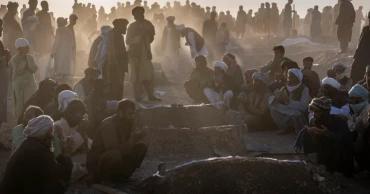
Information on damage from the latest tremor was not immediately available. But there is little left of the villages in the region's dusty hills besides rubble and funerals.
Death toll from strong earthquakes that shook western Afghanistan rises to 2,000
In Naib Rafi, a village that previously had about 2,500 residents, people said almost no one was still alive besides men who were working outside when the quake struck. Survivors worked all day with excavators to dig long trenches for mass burials.
On a barren field in the district of Zinda Jan, a bulldozer removed mounds of earth to clear space for a long row of graves.
“It is very difficult to find a family member from a destroyed house and a few minutes to later bury him or her in a nearby grave, again under the ground,” said Mir Agha, from the city of Herat, who had joined hundreds of volunteers to help the locals.
6.1-magnitude quake hits northwestern Afghanistan -- GFZ
Nearly 2,000 houses in 20 villages were destroyed, the Taliban have said. The area hit by the quakes has just one government-run hospital.
2 years ago

‘Baba is totally fine’: Amartya Sen’s daughter on reports of death
Nandana Sen, the daughter of Nobel Prize winning economist Amartya Sen, on Tuesday took to social media to refute reports of her father’s death.
The rumor of Amartya Sen’s death took the internet by storm after multiple media outlets from around the world reported his demise on Tuesday evening.
Also read: Amartya Sen: World can learn from Bangabandhu’s idea of secularism
Citing a tweet from what appears to be a fake account belonging to another Nobel laureate economist, Claudia Goldin, Times Now was among the first outlets to break the news of his passing followed by several other media including Times of India, Deccan Herald.
Nandana Sen, the daughter of Amartya Sen later posted a picture of them together refuting the reports of her father’s demise.
Also read: "Not proud as an Indian": Amartya Sen's critique of Kashmir move
“Friends, thanks for your concern but it’s fake news: Baba is totally fine. We just spent a wonderful week together w/ family in Cambridge—his hug was as strong as always last night when we said bye! He is teaching 2 courses a week at Harvard, working on his gender book—busy as ever,” she posted on X (formerly Twitter).
Also read: Amartya Sen voices support for Shahidul Alam
2 years ago

What to know as war between Israel and Hamas rages on for a fourth day
Around 1,500 bodies of Hamas militants have been found in Israeli territory, the Israeli military said Tuesday after announcing it had largely gained control in the south and “restored full control” over the border on the fourth day of fighting following an unprecedented surprise attack.
Spokesperson Richard Hecht said no Hamas fighters have crossed into Israel since Monday night, although infiltrations could still be possible. Israel has previously reported 900 soldiers and civilians killed, and Palestinian authorities have reported about 700 deaths in Gaza and the West Bank.
The Israeli government promised Monday to hunt down Hamas fighters and to punish the Gaza Strip following a surprise weekend attack that killed more than 900 people in Israel, including at least 260 at a crowded music festival that became the scene of one of the country’s worst civilian massacres.
During an unprecedented incursion Saturday, militants blew through a fortified border fence and gunned down civilians and soldiers in Israeli communities along the Gaza frontier during a Jewish holiday. Israel struck back with airstrikes, including one that flattened a 14-story tower that held Hamas offices.
Read: Israel strikes downtown Gaza City and mobilizes 300,000 reservists as war enters fourth day
Here are some key takeaways from the war:
WHAT IS HAPPENING ON THE GROUND?
The Israeli military said it had secured the border and had largely gained control in the south after mobilizing 300,000 reservists, raising the question of whether Israel will launch a ground assault into the tiny Mediterranean coastal territory. It would be the first since 2014.
The military said it struck hundreds of Hamas targets overnight into Tuesday in Gaza’s City Rimal neighborhood. Tens of thousands fled their homes as relentless airstrikes leveled buildings, including in Gaza City's residential and commercial district of Rimal and earlier in the southern city of Rafah.
WHAT HAVE BOTH SIDES VOWED TO DO?
Israeli Defense Minister Yoav Gallant said he had ordered a “complete siege” on Gaza and that authorities would cut electricity and block the entry of food and fuel to the Palestinian territory. Military spokesperson Richard Hecht said Tuesday that government and civilian ministries, such as Parliament and the social welfare ministry, could be targeted.
Hamas, meanwhile, pledged to kill one Israeli civilian captive any time Israel targets civilians in the Gaza Strip without warnings. Hamas and other militants in Gaza say they are holding more than 130 soldiers and civilians taken from inside Israel.
Prime Minister Benjamin Netanyahu declared in a televised announcement Monday that the offensive against Hamas in the Gaza Strip “has only started.”
“What we will do to our enemies in the coming days will reverberate with them for generations,” Netanyahu said.
WHAT HAS BEEN THE RESPONSE FROM THE U.S. AND OTHER NATIONS?
Asian countries were working to ensure the safety of their citizens who were still in conflict areas Tuesday, with Japan’s top government spokesperson pledged to do the utmost to protect the safety of a small number of Japanese citizens in the conflict area, condemning Hamas and Palestinian militants over their attacks on citizens.
Eighteen Thais are feared dead based on reports from employers, while the numbers of those injured and abducted stand at 9 and 11 in the fourth day of the latest Israel-Hamas war, Thai Foreign Ministry spokesperson Kanchana Patarachoke said Tuesday. The first batch of 15 evacuees is scheduled to board a flight to arrive in Thailand on Thursday. Thai Ambassador to Israel Pannabha Chandraramya said the embassy is in touch with Israeli authorities about Thai nationals who have been abducted, but has not been informed of their conditions or whereabouts.
Hong Kong leader John Lee said Tuesday the government had received requests for assistance from 28 Hong Kongers, and 20 of them already left Israel. Authorities will keep in contact with the remaining eight and make arrangements according to their needs, he added. Lee said in his weekly press briefing that the government issued a red outbound travel alert for Israel, becoming the latest government telling its citizens to avoid non-essential travel to the country.
Read: Israel's Netanyahu says offensive against Hamas will 'reverberate' for generations
The U.S. has already begun delivering critically needed munitions and military equipment to Israel, and the Pentagon is reviewing inventories to see what else can be sent quickly to boost its ally in the 3-day-old war with Hamas, a senior Defense Department official said Monday. The official briefed reporters on condition of anonymity to discuss sensitive shipments. The weapons movement came as President Joe Biden announced that the U.S. death toll in the war has gone up to 11.
The leaders of numerous Western nations, including Britain and Germany, have condemned the attacks by Hamas, while Arab nations have urged that the fighting on both sides stop.
Arab foreign ministers plan to convene Wednesday in Cairo at the behest of the Palestinians. Arab League Assistant Secretary-General Hossam Zaki said the ministers would discuss Arab efforts to “stop the Israeli aggression” on Gaza.
Supporters of Israel and backers of the Palestinian cause held competing rallies Sunday in several American cities and Monday in London; Athens, Greece; and France.
WHAT HAVE BEEN SOME OF THE RIPPLE EFFECTS OF THE WAR?
Major airlines have suspended flights in and out of Israel. Scores of arriving and departing flights at Tel Aviv's Ben Gurion International Airport were canceled or delayed, according to the airport’s online flight board, which also showed a steady trickle of flights. Most were operated by Israel’s national airline El Al along with others by regional carriers such as Turkey’s Pegasus Airlines and Greece’s Blue Bird Airways.
American Airlines, United Airlines and Delta Air Lines suspended service as the U.S. State Department issued travel advisories for the region citing potential for terrorism and civil unrest.
WHY DID THE ATTACK TAKE ISRAEL BY SURPRISE?
Israel’s eyes appeared to have been closed in the lead-up to the attack by Hamas, which broke down Israeli border barriers and sent hundreds of militants into Israel.
“This is a major failure,” said Yaakov Amidror, a former national security adviser to Prime Minister Benjamin Netanyahu. “This operation actually proves that the (intelligence) abilities in Gaza were no good.”
Amidror declined to offer an explanation for the failure, saying lessons must be learned when the dust settles.
Rear Adm. Daniel Hagari, the chief military spokesperson, acknowledged the army owes the public an explanation. But he said now is not the time. “First, we fight. Then we investigate,” he said.
Read: The US will send a carrier strike group to the Eastern Mediterranean in support of Israel
Some say it is too early to pin the blame solely on an intelligence fault. They point to a wave of low-level violence in the West Bank that shifted some military resources there and the political chaos roiling Israel over steps by Netanyahu’s far-right government to overhaul the judiciary. The controversial plan has threatened the cohesion of the country’s powerful military.
WHAT PROMPTED THE ATTACK?
Hamas officials cited long-simmering tensions, including a dispute over the sensitive Al-Aqsa Mosque sacred to both Muslims and Jews. Competing claims over the site, known to Jews as the Temple Mount, have spilled into violence before, including a bloody 11-day war between Israel and Hamas in 2021.
In recent years, Israeli religious nationalists — such as Itamar Ben-Gvir, the national security minister — have increased their visits to the compound. Last week, during the Jewish harvest festival of Sukkot, hundreds of ultra-Orthodox Jews and Israeli activists visited the site, prompting condemnation from Hamas and accusations that Jews were praying there in violation of the status quo agreement.
Hamas also has cited the expansion of Jewish settlements on lands Palestinians claim for a future state and Ben-Gvir’s efforts to toughen restrictions on Palestinian prisoners in Israel.
Tensions escalated with recent violent Palestinian protests. In negotiations with Qatar, Egypt and the United Nations, Hamas has pushed for Israeli concessions that could loosen the 17-year blockade on the enclave and help halt a worsening financial crisis.
2 years ago