others

Lost necklace unearthed in Titanic wreck after a century
In a remarkable find, a necklace that had remained hidden for over a century has been uncovered in the Titanic wreckage.
Guernsey-based deep-sea mapping firm Magellan has captured extraordinary images of this precious gold jewelry, adorned with a tooth from a pre-historic shark named Megalodon, reports BBC.
The necklace came into view during the initial comprehensive digital scan of the Titanic conducted by Magellan.
The CEO of Magellan, Richard Parkinson, expressed his awe at the breathtaking nature of this discovery.
However, the team was bound by a UK-US agreement, which strictly prohibits the removal of any artifacts from the wreck. Consequently, they were unable to physically touch the necklace.
Nonetheless, Magellan has devised an alternative plan to unravel the necklace's mysteries.
Leveraging the power of artificial intelligence, they aim to utilize advanced algorithms to trace the descendants of the approximately 2,200 passengers who were aboard the Titanic during its ill-fated voyage.
By analyzing footage and photographs of the passengers, specifically focusing on their facial features and attire when they embarked on the ship, the team hopes to identify the rightful owner of the necklace, it said.
Last summer, Magellan collaborated with Atlantic Productions, who are currently producing a documentary about this ambitious project. Employing submersibles operated remotely from a specialized vessel, the team dedicated over 200 hours to meticulously surveying every nook and cranny of the wreckage. Over 700,000 images were painstakingly captured from various angles, enabling the creation of an exact 3D reconstruction of the historic vessel.
3 years ago

China plans to land astronauts on moon before 2030, another step in what looks like a new space race
China plans to land astronauts on the moon before 2030, which would be another advance in what's increasingly seen as a new space race.
The U.S. aims to put astronauts back on the lunar surface by the end of 2025.
Deputy Director of the Chinese Manned Space Agency Lin Xiqiang confirmed China's goal at a news conference Monday but gave no specific date.
Lin also said China plans to expand its orbiting crewed space station with an additional module. A new three-person crew is scheduled to head to the Tiangong station on Tuesday aboard the Shenzhou 16 craft and will overlap briefly with the three astronauts already aboard.
The fresh crew includes a civilian for the first time. All previous crew members have been in the People's Liberation Army, the military wing of the country's ruling Communist Party.
Gui Haichao, a professor at Beijing's top aerospace research institute, will join mission commander Jing Haipeng and spacecraft engineer Zhu Yangzhu as the payload expert.
China completed the Tiangong space station in November with the third of three modules, centered on the Tianhe living and command module.
China's first manned space mission in 2003 made it the third country after the former Soviet Union and the U.S. to put a person into space.
China built its own station after it was excluded from the International Space Station, largely due to U.S. objections over the Chinese space programs' intimate ties to the PLA.
Space is increasingly seen as a new area of competition between China and the United States — the world's two largest economies and rivals for diplomatic and military influence. The astronauts NASA sends to the moon by the end of 2025 will aim for the south pole where permanently shadowed craters are believed to be packed with frozen water.
Plans for permanent crewed bases on the moon are also being considered by both countries, raising questions about rights and interests on the lunar surface. U.S. law tightly restricts cooperation between the two countries' space programs and while China says it welcomes foreign collaborations, those have thus far been limited to scientific research.
In addition to their lunar programs, the U.S. and China have also landed rovers on Mars and Beijing plans to follow the U.S. in landing a spacecraft on an asteroid.
3 years ago

Suspect arrested in 5 separate shootings in Phoenix metro area that left 4 dead
A suspect has been arrested in connection with five separate shootings in the Phoenix metro area that left four people dead and a woman wounded, authorities said Sunday.
Mesa police said 20-year-old Iren Byers was taken into custody Sunday on suspicion of four counts of first-degree murder and one count of attempted first-degree murder.
A motive for the shootings wasn’t immediately clear, but police said Byers took responsibility for the shootings and told officers where they could find the clothes and gun used in the crimes.
Police said video surveillance footage showed the suspect wearing the clothing reported by witnesses at multiple shooting scenes.
The names of the victims were being withheld Sunday until relatives could be notified. It was unclear Sunday if Byers has a lawyer yet who could speak on his behalf.
Police said officers were dispatched around 10:30 p.m. Friday to a Mesa park and found a 41-year-old man dead at the scene.
While still at the park, police reported hearing shots being fired nearby and searched the area and later found a 36-year-old woman with serious injuries. She remains in stable condition at a hospital.
Police said they received a call about a body near a Mesa bus station around 1 a.m. Sunday.
They said officers discovered a 41-year-old man dead at the scene and then another dead man just after 2 a.m.
Authorities said all of the victims had gunshot wounds. They also said shell casings recovered from the shooting scenes were all linked to the same 9mm handgun, including a fatal shooting Friday afternoon in Phoenix.
Details of the Phoenix shooting haven’t been released yet.
3 years ago

Russia launched 'largest drone attack' on Ukrainian capital before Kyiv Day; 1 killed
Ukraine's capital was subjected to the largest drone attack since the start of Russia's war, local officials said, as Kyiv prepared to mark the anniversary of its founding on Sunday (May 28, 2023). At least one person was killed.
Russia launched the "most massive attack" on the city overnight Saturday with Iranian-made Shahed drones, said Serhii Popko, a senior Kyiv military official. The attack lasted more than five hours, with air defense reportedly shooting down more than 40 drones.
A 41-year-old man was killed and a 35-year-old woman was hospitalized when debris fell on a seven-story nonresidential building and started a fire, Kyiv Mayor Vitali Klitschko said.
Ukraine's air force said that Saturday night was also record-breaking in terms of Shahed drone attacks across the country. Of the 54 drones launched, 52 were shot down by air defense systems.
Read more: Russian prime minister says pressure from West is strengthening ties with China
In the northeastern Kharkiv province, regional Gov. Oleh Syniehubov said a 61-year-old woman and a 60-year-old man were killed in two separate shelling attacks.
Kyiv Day marks the anniversary of Kyiv's official founding. The day is usually celebrated with live concerts, street fairs, exhibitions and fireworks. Scaled-back festivities were planned for this year, the city's 1,541st anniversary.
The timing of the drone attacks was likely not coincidental, Ukrainian officials said.
"The history of Ukraine is a long-standing irritant for the insecure Russians," Ukraine's chief presidential aide, Andriy Yermak, said on Telegram.
Read more: The cyber gulag: How Russia tracks, censors and controls its citizens
"Today, the enemy decided to 'congratulate' the people of Kyiv on Kyiv Day with the help of their deadly UAVs (unmanned aerial vehicles)," Popko also wrote on the messaging app.
Local officials in Russia's southern Krasnodar region said that air defense systems destroyed several drones as they approached the Ilsky oil refinery.
Drone attacks against Russian border regions have been a regular occurrence since the start of the invasion in February 2022, with attacks increasing last month. Earlier this month, an oil refinery in Krasnodar was attacked by drones on two straight days.
Read more: Russia fights alleged incursion from Ukraine for 2nd day, reports more drone attacks
3 years ago

Former US diplomat Henry Kissinger celebrates 100th birthday, still active in global affairs
Former diplomat and presidential advisor Henry Kissinger marks his 100th birthday on Saturday, outlasting many of his political contemporaries who guided the United States through one of its most tumultuous periods including the presidency of Richard Nixon and the Vietnam War.
Born in Germany on May 27, 1923, Kissinger remains known for his key role in American foreign policy of the 1960s and 1970s including eventual attempts to pull the U.S. out of Vietnam, but not before he became inextricably linked to many of the conflict’s most disputed actions.
David Kissinger, writing in The Washington Post on Thursday, said his father’s centenary “might have an air of inevitability for anyone familiar with his force of character and love of historical symbolism. Not only has he outlived most of his peers, eminent detractors and students, but he has also remained indefatigably active throughout his 90s.”
The elder Kissinger will celebrate this week with visits to New York, London and his hometown of Fürth, Germany, David Kissinger wrote.
In recent years Kissinger has continued to hold sway over Washington’s power brokers as an elder statesman. He has provided advice to Republican and Democratic presidents, including the White House during the Trump administration, while maintaining an international consulting business through which he delivers speeches in the German accent he has not lost since fleeing the Nazi regime with his family when he was a teenager.
During eight years as a national security adviser and secretary of state, Kissinger was involved in major foreign policy events including the first example of “shuttle diplomacy” seeking Middle East peace, secret negotiations with China to defrost relations between the burgeoning superpowers and the instigation of the Paris peace talks seeking an end to the Vietnam conflict and the U.S. military’s presence there.
Kissinger, along with Nixon, also bore the brunt of criticism from American allies when North Vietnamese communist forces took Saigon in 1975 as the remaining U.S. personnel fled what is now known as Ho Chi Minh City.
Kissinger additionally was accused of orchestrating the expansion of the conflict into Laos and Cambodia, enabling the rise of the genocidal Khmer Rouge regime that killed an estimated 2 million Cambodians.
Among his endorsements, Kissinger was recognized as a central driver in the period of detente, a diplomatic effort between the U.S. and the Soviet Union beginning in 1967 through 1979 to reduce Cold War tensions with trade and arms negotiations including the Strategic Arms Limitation Talks treaties.
Kissinger remained one of Nixon’s most trusted advisers through his administration from 1969 to 1974, his power only growing through the Watergate affair that brought down the 37th president.
Gerald Ford, who as vice president ascended to the Oval Office following his predecessor’s resignation, awarded Kissinger the Presidential Medal of Freedom in 1977, saying Kissinger “wielded America’s great power with wisdom and compassion in the service of peace.”
Others have accused Kissinger of more concern with power than harmony during his tenure in Washington, enacting realpolitik policies favoring American interests while assisting or emboldening repressive regimes in Pakistan, Chile and Indonesia.
3 years ago

From ashes and debris, iconic Beirut museum reopens 3 years after massive damage from port blast
Lebanon's Sursock Museum has reopened to the public, three years after a deadly explosion in Beirut's port — set off by tons of improperly stored chemicals — reduced many of its treasured paintings and collections to ashes.
The reopening Friday night offered Beirut residents a rare bright spot in a country reeling from a crippling economic crisis that has left around three-quarters of Lebanon's population of 6 million in poverty.
Originally built as a private villa in 1912 on a hilltop overlooking the city's Achrafieh neighborhood, the opulent residence integrated Venetian and Ottoman styles. Its owner, famed Lebanese art collector Nicolas Ibrahim Sursock, bequeathed his beloved home to his people, to be tuned into a contemporary art museum upon his death in 1952.
The museum housed Lebanese art dating back from the late 1800s, including the work of distinguished painter Georges Corm and Fouad Debbas' library of 30,000 photographs — one of the largest private photo collections. The photos are from across the Levant, a region encompassing countries along the eastern Mediterranean, from Turkey to Egypt, from 1830 until the 1960s. In 2008, a seven-year project renovated and expanded the museum, relaunching it in 2015.
But the Aug. 4, 2020 blast in Beirut's port — only about 800 meters (875 yards) away — hit the museum fully front on. Its stained glass windows were shattered, doors were blown out, and almost half the artwork on display was damaged. The explosion ripped through much of Beirut, killing more than 200 people and injuring over 6,000.
The destruction was unprecedented, said museum director Karina El Helou, a level unseen even during Lebanon's 1975-1990 civil war. Seventy percent of the building was badly damaged, as were 66 of the 132 art pieces on display, she said. Glass shards tore through Dutch artist Kees Von Dongen's portrait of Nicolas Sursock.
Two months after the explosion, then-museum director Zeina Arida launched a fundraising campaign, estimating the damages to be around $3 million at the time. The museum eventually raised over $2 million to restore the building and the artwork with support from Italy, France, UNESCO and various private organizations.
The restoration was long and painstaking work. Sursock's portrait was taken to Paris, along with two other art pieces, and restored there. Experts from Lebanon and abroad flocked to the museum to piece together damaged terracotta sculptures and fix tears and scratches that had marred the paintings. Dust and debris from the explosion were carefully removed to bring back the splendor of many items.
"White powder from the blast that we saw everywhere in Beirut even reached our storage room four stories underground," El Helou said. She hopes the reopening will boost the morale of many Lebanese amid the country's economic meltdown — and offer a "safe space" for free expression.
Art is now more important than ever, she added. "In the face of darkness, (artists) fought through art and culture," she said.
Dozens gathered in Sursock's large, tree-lined courtyard on Friday evening, serenaded by a choir and a band performing on the entrance stairs for the reopening. The museum, looking almost exactly as it did before the blast, drew sighs of appreciation. Others remembered how much Beirut has withered since then and how scores of artists have left the country.
"I now hope all the friends of the Sursock who may have left Lebanon in recent years at least come back to visit us," the museum's chairman, Tarek Mitri, told The Associated Press as he greeted guests.
The Sursock Museum was not the only art space damaged in the port explosion and restored in the years since.
Marfa Projects, a gallery close to one of the port's entrances, was eventually rebuilt and reopened. Others, like the Saifi Urban Gardens, a family run hostel that over the years has became a vibrant cultural hub with art studios and an exhibition space, were destroyed and closed for good.
Without financial support, many heritage buildings, including Ottoman-era houses built in the 19th century and damaged in the blast, could ultimately be sold to developers. Lebanon's cash-strapped government has been unable to fund major restoration projects.
Mona Fawaz, professor of urban studies and planning at the American University of Beirut, said the Sursock Museum's ability to raise funds through its networks and management is a valuable lesson for others.
"I think it's good to think of it as potentially one of our rare success stories," Fawaz said.
At Friday's reopening, visitors could view five new exhibitions of both classical and modern art — a testament to Lebanon's artistic and cultural history and the perseverance of its people despite the country's troubled past.
One of the exhibits, titled "Ejecta," is set up in a darkened room where a video and an audio recording reflect on the port blast. Zad Moultaka, the artist behind the installation, said he hoped it would inspire people to turn their dark thoughts about that day into hope for the future.
"Throughout the days of the civil war, we always found a way to rise up," he said.
"But my initial feeling after the blast was doubt. I wondered if we will be able to persevere after what happened," Moultaka added. "It's important today to take this violence and transform it into something positive."
3 years ago
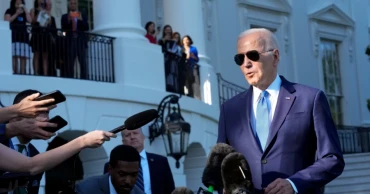
Biden says debt deal 'very close' with default deadline now set at June 5
President Joe Biden said a deal to resolve the government's debt ceiling crisis seemed “very close” late Friday, even as the deadline for a potentially catastrophic default was pushed back to June 5 and seemed likely to drag negotiations between the White House and Republicans into another frustrating week.
The later “X-date,” laid out in a letter from Treasury Secretary Janet Yellen, set the risk of a devastating default four days beyond an earlier estimate. It came as Americans and the world uneasily watched the negotiating brinkmanship that could throw the U.S. economy into chaos and sap world confidence in the nation's leadership.
Yet Biden was upbeat as he left for the Memorial Day weekend at Camp David, declaring, “It's very close, and I'm optimistic.”
With Republicans at the Capitol talking with Biden's team at the White House, the president said: “There’s a negotiation going on. I’m hopeful we’ll know by tonight whether we’re going to be able to have a deal.”
In a blunt warning, Yellen said failure to act by the new date would “cause severe hardship to American families, harm our global leadership position and raise questions about our ability to defend our national security interests.”
Also read: Biden releases new strategy to tackle rise in antisemitism, says 'hate will not prevail'
Anxious retirees and others were already making contingency plans for missed checks, with the next Social Security payments due next week.
Biden and Republican House Speaker Kevin McCarthy seemed to be narrowing on a two-year budget-slashing deal that would also extend the debt limit into 2025 past the next presidential election. After frustrating rounds of closed-door talks, a compromise had appeared to be nearing on Friday.
Republicans have made some headway in their drive for steep spending cuts that Democrats oppose. However, the sides are particularly divided over McCarthy's demands for tougher work requirements on government food stamp recipients that Democrats say is a nonstarter.
Earlier Friday, McCarthy said his Republican debt negotiators and the White House had hit “crunch” time, straining to wrap up an agreement. He left late Friday night without comment.
Any deal would need to be a political compromise, with support from both Democrats and Republicans to pass the divided Congress. Failure to lift the borrowing limit, now $31 trillion, to pay the nation’s incurred bills, would send shockwaves through the U.S. and global economy.
But many of the hard-right Trump-aligned Republicans in Congress have long been skeptical of Treasury's projections, and they are pressing McCarthy to hold out.
As talks pushed into another late night, one of the negotiators, Rep. Patrick McHenry, R-N.C., called Biden’s comments “a hopeful sign.” But he also cautioned that there’s still “sticky points” impeding a final agreement.
While the contours of the deal have been taking shape to cut spending for 2024 and impose a 1% cap on spending growth for 2025, the two sides remain stuck on various provisions.
A person familiar with the talks said the two sides were “dug in” on whether or not to agree to Republican demands to impose stiffer work requirements on people who receive government food stamps, cash assistance and health care aid.
House Democrats have called such requirements for health care and food aid a nonstarter.
Asked if Republicans would relent on work requirements, Republican negotiator Rep. Garret Graves of Louisiana fumed, “Hell no, not a chance."
House Republicans displayed risky political bravado in leaving town for the holiday. Lawmakers are tentatively not expected back at work until Tuesday, but now their return date is uncertain.
“The world is watching,” International Monetary Fund Managing Director Kristalina Georgieva said after meeting Friday with Yellen. “Let’s remember we are now in the 12th hour.”
Weeks of negotiations between Republicans and the White House have failed to produce a deal — in part because the Biden administration resisted negotiating with McCarthy over the debt limit, arguing that the country's full faith and credit should not be used as leverage to extract other partisan priorities.
“We have to spend less than we spent last year. That is the starting point,” said McCarthy.
One idea is to set the topline budget numbers but then add a “snap-back” provision to enforce cuts if Congress is unable during its annual appropriations process to meet the new goals.
On work requirements for aid recipients, the White House is particularly resisting measures that could drive more people into poverty or take their health care, said the person familiar with the talks, who was granted anonymity to describe behind-closed-door discussions.
Over the Republican demand to rescind money for the Internal Revenue Service, it's still an “open issue” whether the sides will compromise by allowing the funding to be pushed into other domestic programs, the person said.
In one potential development, Republicans may be easing their demand to boost defense spending beyond what Biden had proposed in his budget, instead offering to keep it at his proposed levels, according to another person familiar with the talks.
The teams are also eyeing a proposal to boost energy transmission line development from Sen. John Hickenlooper, D-Colo., to facilitate the buildout of an interregional power grid.
They are all but certain to claw back some $30 billion in unspent COVID-19 funds now that the pandemic emergency has officially been lifted.
Meanwhile, McCarthy is feeling pressure from the House's right flank not to give in to any deal, even if it means blowing past the Treasury deadline.
McCarthy said Donald Trump, the former president who is again running for office, told him, “Make sure you get a good agreement.”
Watchful Democrats, though, are also pressing Biden. The top three House Democratic leaders, led by Rep. Hakeem Jeffries, spoke late Thursday with the White House.
McCarthy has promised lawmakers he will abide by the rule to post any bill for 72 hours before voting. The Democratic-held Senate has vowed to move quickly to send the package to Biden’s desk, right before next Thursday's possible deadline.
Meanwhile, Fitch Ratings agency placed the United States’ AAA credit on “ratings watch negative,” warning of a possible downgrade.
The White House has continued to argue that deficits can be reduced by ending tax breaks for wealthier households and some corporations, but McCarthy said he told the president as early as their February meeting that raising revenue from tax hikes was off the table.
While Biden has ruled out, for now, invoking the 14th Amendment to raise the debt limit on his own, Democrats in the House announced they have all signed on to a legislative “discharge” process that would force a debt ceiling vote. But they need five Republicans to break with their party and tip the majority to set the plan forward.
3 years ago

German government denies Scholz comments spurred raids on climate activists
A German government spokesperson on Friday rejected the notion that comments by Chancellor Olaf Scholz criticizing climate activists might have prompted raids against them this week.
Police on Wednesday searched more than a dozen properties across Germany linked to the group Last Generation, seizing assets as part of a probe into its finances. Prosecutors in Munich said they are investigating whether the group constitutes a criminal organization after its repeated road blockades and other protests drew numerous complaints from the public.
Days before the raids, Scholz said he thought it was " completely nutty to somehow stick yourself to a painting or on the street."
Members of Last Generation have hit back, describing the raids as a blow to democracy and accusing Scholz of belittling young people's fears about global warming.
Scholz's spokesperson, Wolfgang Buechner, said he didn't know whether the chancellor had advance knowledge of the raids but that it would be unusual if that were the case.
Asked whether prosecutors in Bavaria could have taken Scholz's comments as a signal to crack down on the group, Buechner strongly rejected the idea.
"It has to be possible for the German chancellor to answer a question about what he thinks of the protests in a plain-spoken way," he said. "I think the chancellor did this in an appropriate way."
Buechner said the German government remains committed to tackling climate change and protesters must abide by the law.
A United Nations spokesperson said Thursday that while governments have a duty to uphold the law, "people also have a fundamental right to demonstrate peacefully to have their voices heard."
"And it is clear that a lot of the progress that we have seen on awareness on climate change and positive movement on climate change is due to the fact that people have been demonstrating peacefully throughout the world," Stéphane Dujarric told reporters in New York
Environmental activists have said they plan further protests in Germany over the coming days.
3 years ago

Belgium, Iran conduct prisoner swap in Oman, freeing aid worker and diplomat convicted in bomb plot
Belgium and Iran conducted a prisoner exchange Friday in Oman, with officials saying Tehran released a Belgian aid worker in exchange for an Iranian diplomat convicted of attempting to bomb a meeting of exiles in France.
The initial announcement by Oman's Foreign Ministry did not identify the prisoners being swapped.
Later Friday, Belgian Prime Minister Alexander De Croo said in a statement that the aid worker, Olivier Vandecasteele, had been freed. Iranian state television later confirmed that the diplomat, Assadollah Assadi, was freed as well.
Oman's Foreign Ministry said that "those released were transferred from Tehran and Brussels to Muscat today, Friday, in preparation for their return to their countries." It added that "the sultanate of Oman appreciated the high positive spirit that prevailed in the talks in Muscat between the Iranian and Belgian sides, and their keenness to settle this humanitarian issue."
De Croo said Vandecasteele was transferred to Oman on Thursday night. He was received by a team of Belgian diplomats and military officials, then was assessed by doctors.
"Olivier spent 455 days in prison in Tehran. In unbearable conditions. Innocent," De Croo wrote. "Olivier Vandecasteele's return to Belgium is a relief. A relief for his family, friends and colleagues."
Oman has long served as an interlocutor for the West with Iran.
In January, Iran sentenced Vandecasteele to a lengthy prison term and 74 lashes after convicting him of espionage in a closed-door trial. He also was fined $1 million. Vandecasteele was arrested in Iran in February 2022 while packing up his belongings, after working with the Norwegian Refugee Council and Relief International in the Islamic Republic from 2015 to 2021, according to Amnesty International.
His family and the Belgian government strongly denied Iran's claims, made without offering evidence, that he was a spy. To make the swap with the Iran diplomat possible, Belgium had adopted in March a controversial prisoner exchange treaty that was upheld by the country's constitutional court.
In 2021, Belgium convicted Assadi of masterminding a thwarted bomb attack against an exiled Iranian opposition group in France and sentenced him to 20 years in prison. Prosecutors tied Assadi to a couple, stopped by the Belgian police and found with 550 grams (1.21 pounds) of TATP explosives and a detonator in 2018. They had been trying to target a meeting in Villepinte, France, of the Mujahedeen-e-Khalq, an exiled Iranian opposition group known as the MEK.
Among dozens of prominent guests at the rally in Villepinte that day were then-President Donald Trump's lawyer, Rudy Giuliani; Newt Gingrich, former conservative speaker of the U.S. House of Representatives; and former Colombian presidential candidate Ingrid Betancourt.
Assadi was arrested a day later in Germany and transferred to Belgium. Belgian intelligence identified him as an officer of Iran's intelligence and security ministry who operated undercover at the Iranian Embassy in Austria. Iran denied Assadi's involvement.
Iran has carried out kidnappings and other plots against dissidents abroad in the past. However, Iranian Foreign Minister Hossein Amirabdollahian referred to Assadi as "an innocent diplomat" in a tweet after his release on Friday. Iranian state television called the case against him "bogus accusations."
In a statement, the MEK condemned Assadi's release, calling it "a shameful ransom to terrorism and hostage-taking."
"This will embolden the religious fascism ruling Iran to continue its crimes in Iran through repression and regional and international terrorism," the group said.
Iran has detained a number of foreigners and dual nationals over the years, accusing them of espionage or other state security offenses and sentencing them following secretive trials in which rights groups say they have been denied due process.
Critics have repeatedly accused Iran of using such prisoners as bargaining chips with the West.
Iran, facing Western sanctions over its rapidly advancing nuclear program, has faced protests in recent months and economic strain. Oman's Sultan Haitham bin Tariq was already scheduled to visit Tehran this weekend before the announced prisoner swap.
3 years ago

Strong earthquake shakes eastern Japan; no tsunami warning
A strong earthquake shook Tokyo and other areas of eastern Japan on Friday, but no tsunami warning was issued.
The magnitude 6.1 quake was centered off the east coast of Chiba Peninsula at a depth of 44.5 kilometers (28 miles), the U.S. Geological Survey said.
Strong shaking was reported in Chiba and Ibaraki prefectures, but the USGS said there was little chance of serious damage or fatalities.
Kyodo News service said no problems were reported at the Tokai No. 2 nuclear power plant in Ibaraki.
A strong earthquake hit central Japan on May 5, killing at least one person and injuring more than 20 others.
Japan is one of the world's most earthquake-prone nations. A massive 2011 quake in the country's northeast caused a devastating tsunami and nuclear plant meltdown.
3 years ago