others

May Day: World’s workers rally, France sees pension anger
PARIS (AP) — People squeezed by inflation and demanding economic justice took to streets across Asia, Europe and the Americas on Monday to mark May Day, in an outpouring of worker discontent not seen since before the worldwide COVID-19 lockdowns.
French police charged at radical protesters and troublemakers smashing bank and shop windows and setting fires as unions pushed the president to scrap a higher retirement age. South Koreans pleaded for higher wages as did others around Latin America. Spanish lawyers demanded the right to take days off. Migrant domestic workers in Lebanon marched in a country plunged into economic crisis.
While May Day is marked worldwide as a celebration of labor rights, this year's rallies tapped into broader frustrations. Climate activists spray-painted a museum in Paris, and protesters in Germany demonstrated against violence targeting women and LGBTQ+ people.
Celebrations were forced indoors in Pakistan, tinged with political tensions as in Turkey, as both countries face high-stakes elections. Russia's war in Ukraine overshadowed scaled-back events in Moscow, where Communist-led May Day celebrations were once massive affairs.
Across the globe, this year’s May Day events unleashed pent-up frustration after three years of COVID-19 restrictions.
Across France, some 800,000 people marched, Interior Minister Gerald Darmanin said. They mobilized against President Emmanuel Macron’s recent move to raise the retirement age from 62 to 64. Organizers see pension reform as a threat to hard-fought worker rights, while Macron argues it's economically necessary as the population ages.
While marchers were largely peaceful, violence by radicals, an ever-present reality at French marches, marred the message, notably in Paris. A Paris police officer was seriously injured by a Molotov cocktail, among 108 officers injured around France, Darmanin said. It wasn't known how many protesters were potentially injured. Clashes also marked protests in Lyon and Nantes.
Read: May Day: Workers trapped between hunger and fear
“Violence is increasingly strong in a society that is radicalizing,” the interior minister said on BFM-TV news station, blaming the ultra-left. He said some 2,000 radicals were at the Paris march.
Tear gas hung over the end point of the Paris march, Place de la Nation, where a huge black cloud lofted high above the trees after radicals set two fuel cans afire outside a building renovation site, police said.
French union members were joined by groups fighting for economic justice, or just expressing anger at what is seen as Macron's out-of-touch, pro-business leadership. Labor activists from abroad were present, among them Hyrwon Chong of the South Korean Metal Workers’ Union.
“Today we see rising inequality throughout the world, terrible inflation," she said, adding that Macron's government was trying "to tear down a pillar of the social system which is the pension system.”
In Northern Macedonia’s capital Skopje, thousands of trade union members protested a recent government decision granting ministers a 78% raise. The minimum monthly wage in one of Europe’s poorest countries, is 320 euros ($350), while the hike will put ministers' wages at around 2,300 euros ($2,530). “We are here, not only (to mark) Labor Day, but also to warn that if there is no social justice, there will be no social peace either," said union leader Jakim Nedelkovski.
In Turkey, police prevented demonstrators from reaching Istanbul’s main square, Taksim, and detained around a dozen of them, independent television station Sozcu reported.
The square has symbolic importance for Turkey’s trade unions after unknown gunmen opened fire on a May Day celebration at Taksim in 1977, causing a stampede that killed dozens. President Recep Tayyip Erdogan’s government has declared Taksim off-limits to protests, though small groups were allowed to enter to lay wreaths at a monument.
In Pakistan, authorities banned rallies in some cities because of a tense security and political atmosphere. In Peshawar, in the restive northwest, labor organizations and trade unions held indoor events to demand better workers’ rights amid high inflation.
Read: Bangladesh observes May Day
Sri Lanka’s opposition political parties and trade unions held workers’ day rallies protesting austerity measures and economic reforms linked to a bailout agreement with the International Monetary Fund. Protesters demanded the government halt moves to privatize state-owned and semi-government businesses. Sri Lanka is facing its worst economic crisis in history and has suspended foreign debt repayments.
In South Korea, tens of thousands of people attended rallies in its biggest May Day gatherings since the pandemic began in early 2020.
“The price of everything has increased except for our wages. Increase our minimum wages!” an activist at a Seoul rally shouted at the podium.
In Tokyo, thousands of labor union members, opposition lawmakers and academics demanded wage increases to offset the impact of rising costs as they recover from damage from the pandemic. They criticized Japanese Prime Minister Fumio Kishida’s plan to double the defense budget, saying the money should be spent on welfare, social security and improving people’s daily lives.
In Indonesia, demonstrators demanded the government repeal a job creation law they argue would only benefit business.
In Taiwan, thousands of workers protested what they call the inadequacies of the self-ruled island’s labor policies, putting pressure on the ruling party before the 2024 presidential election.
Protests in Germany kicked off with a “Take Back the Night” rally organized by feminist and queer groups on the eve of May Day to protest against violence directed at women and LGBTQ+ people. On Monday, thousands more turned out in marches organized by Germany labor unions in Berlin, Cologne and other cities, rejecting recent calls by conservative politicians for restrictions on the right to strike.
More than 70 marches were held across Spain, and powerful unions warned of “social conflict” if low salaries compared to the EU average don’t rise in line with inflation. The Illustrious College of Lawyers of Madrid urged reforms of historic laws that require them to be on call 365 days of the year, regardless of the death of family members or medical emergencies. In recent years, lawyers have tweeted images of themselves working from hospital beds on IV drips to illustrate their plight.
Italy’s far-right premier, Giorgia Meloni, made a point of working on Monday — as her Cabinet passed measures on Labor Day that it contends demonstrates concern for workers. But opposition lawmakers and union leaders said the measures do nothing to increase salaries or combat the widespread practice of hiring workers on temporary contracts. Many young people say they can’t contemplate starting families or even move out of parents’ homes because they only get temporary contracts.
In war-ravaged Ukraine, May Day is associated with Soviet-era celebrations when the country was ruled from Moscow — an era that many want forgotten.
“It is good that we don’t celebrate this holiday like it was done during the Bolshevik times. It was something truly awful,” said Anatolii Borsiuk, a 77-year-old in Kyiv.
Alla Liapkina described the flowers and balloons of Soviet May Day gatherings, but said it’s time to move on. “We live in a new era,'' she said. ‘’We don’t need to go back to such a past.”
In Venezuela, which has suffered rampant inflation for years, thousands of workers demonstrated to demand a minimum wage increase at a time when the majority cannot meet basic needs despite their last increase 14 months ago. “Decent wages and pensions now!” protesters chanted in the capital, Caracas. Many also alluded to U.S. sanctions against the socialist-led government of Nicolás Maduro, chanting, “This is not a blockade, this is looting.”
In Bolivia, leftist President Luis Arce led a Labor Day march in La Paz with a major union and announced a 5% increase in the minimum wage. Arce said his government “is strong because the unions are strong.”
In Brazil, the focus was not only on traditional labor unions but on parttime workers and those in the informal sector, with the government of new leftist President Luiz Inácio Lula da Silva announcing a work group on proposals to regulate that sector after the president recently described those workers as “almost like slaves.”
3 years ago

US ex-security adviser calls for closer ties with Taiwan
A former U.S. national security adviser called for deeper interaction between his country and Taiwan during a visit Saturday to the self-ruled island, which has seen increasing military threats from China.
John Bolton, a potential Republican presidential candidate in 2024, said at a pro-Taiwan independence event in Taipei that national security teams from both sides must develop contingency plans on how to respond to actions Beijing might take, warning it would be too late once an attack occurs.
“And we have to tell China and Russia what the consequences are if they take actions against Taiwan. Not just in the immediate response, but over the longer term, to basically excommunicate China from the international economic system if it did take military actions against Taiwan or attempt to throw a blockade around it," Bolton said.
Bolton, former President Donald Trump's hawkish national security adviser, started his week-long trip to Taiwan on Wednesday. The visit reflects the importance of the island's democracy as an issue in the U.S. presidential election next year amid heightened tensions between Washington and Beijing.
Taiwan and China split in 1949 following a civil war that ended with the Communist Party in control of the mainland. The island has never been part of the People’s Republic of China, but Beijing says it must unite with the mainland, by force if necessary.
The U.S. remains Taiwan’s closest military and political ally, despite the lack of formal diplomatic ties between them. U.S. law requires Washington to treat all threats to the island as matters of “grave concern,” though it remains ambiguous over whether American forces would be dispatched to help defend the island.
Bolton said the backlog of U.S. military sales to Taiwan is estimated to be $19 billion and it needs to be resolved.
“Part of that is a U.S. problem. Our defense industrial base is not as strong as it used to be. We need to improve that for global reasons, but particularly for Taiwan,” he said.
On Friday, the Taiwanese Defense Ministry said China’s military flew 38 fighter jets and other warplanes near Taiwan. That was the biggest such flight display since the large military exercise in which it simulated sealing off the island after the sensitive April 5 meeting between Taiwan President Tsai Ing-wen and U.S. House Speaker Kevin McCarthy. China opposes any exchanges at the official level between Taiwan and other governments.
Later Friday, China’s People’s Liberation Army also issued a protest over the flight of a United States Navy P-8A Poseidon anti-submarine patrol aircraft through the Taiwan Strait, calling it a provocation that the U.S. “openly hyped up." But the U.S. 7th Fleet said Thursday’s flight was in accordance with international law and “demonstrates the United States’ commitment to a free and open Indo-Pacific.”
Bolton is scheduled to join a banquet on Monday organized by the Formosan Association for Public Affairs, a pro-independence organization headquartered in Washington, D.C. Tsai will also attend the event.
3 years ago

Ukraine welcomes EU deal on continued farm exports
Ukraine on Saturday welcomed the European Union’s hard-fought deal to keep farm exports flowing into and through the bloc to world markets, saying that the Middle East and Africa would specifically stand to benefit from it.
Late Friday, the 27-nation EU ended a damaging internal standoff over a destabilizing glut of Ukraine farm imports by granting five eastern member countries the right to temporarily ban the most problematic produce while allowing all farm products to transit onward.
Resolving the issue allows the EU to maintain a unified stance in the face of Russia’s invasion of its neighbor. “We welcome that we resolved this issue,” Ukrainian Finance Minister Sergii Marchenko said at a meeting of EU finance ministers in Stockholm.
Under the deal, Poland, Hungary, Slovakia, Bulgaria and Romania can keep four farm products that make up the overwhelming mass of exports from Ukraine out of their local markets but must guarantee unfettered access to the rest of the bloc.
Since Russia's invasion of Ukraine hampered Black Sea shipments of Ukrainian agricultural products, using the 27-nation bloc as a transportation route has been essential to getting the nation's prized cereal production on to the world.
"We found a wise decision that would help Ukraine to export necessary commodities, food commodities towards African countries, which is so necessary for them,” Marchenko said, adding Middle East nations would equally profit.
Under the deal, the bloc would basically accept the national bans on four of the five main products — wheat, maize, rapeseed, and sunflower seeds — that account for most imports. The EU would also assess whether other products, including sunflower oil, should also be included.
As an added sweetener, the EU provided 100 million euros ($113 million) more in special aid on top of on an initial support package of 56.3 million euros to help farmers in the affected countries.
On Friday, EU nations also tentatively agreed to lift tariffs on Ukraine's grains for another year. The EU lifted duties on Ukrainian grain to facilitate its transport to Africa and the Middle East by other routes after a Russian blockade kept cargo from leaving Ukraine's ports.
Overall, there was acceptance that the lifting of import tariffs had seriously skewed the local markets in nations closest to Ukraine. In Poland, wheat imports went from 2,375 tons in 2021 to 500,008 tons last year. Maize went from 5,863 tons to more than 1.8 million over the same period.
Similar huge increases were also evident in Hungary, Slovakia and Romania.
3 years ago
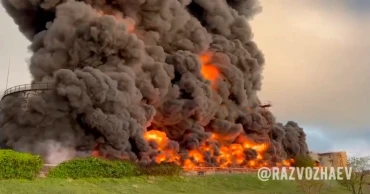
Drone causes fire at Crimea oil reservoir: Russian official
A massive fire erupted at an oil reservoir in Crimea after it was hit by a drone, a Russia-appointed official there reported Saturday.
Mikhail Razvozhayev, the Moscow-installed governor of the Black Sea peninsula's port city of Sevastopol, posted videos and photos of the blaze on his Telegram channel.
Razvozhayev said the fire was assigned the highest ranking in terms of how complicated it will be to extinguish.
He did not say whether the drone he cited as causing the fire was Ukrainian. Russia annexed Crimea from Ukraine in 2014, a move that most of the world considered illegal. Ukrainian President Volodymyr Zelenskyy has said his country is seeking to reclaim the peninsula during Russia's current full-scale invasion.
The incident comes a day after Russia fired more than 20 cruise missiles and two drones at Ukraine, killing at least 23 people. Almost all of the victims died when two missiles slammed into an apartment building. Three children were among the dead.
Razvozhayev said the oil reservoir fire did not cause any casualties and would not hinder fuel supplies in Sevastopol.
The city has been subject to regular attack attempts with drones, especially in recent weeks.
Earlier this week, Razvozhayev reported that the Russian military destroyed a Ukrainian sea drone that attempted to attack the harbor and another one blew up, shattering windows in several apartment buildings, but not inflicting any other damage.
Ukrainian officials did not immediately comment on the oil reservoir fire. After previous attacks on Crimea, Kyiv usually stopped short of openly claiming responsibility but emphasized that the country had the right to strike any target in response to Russian aggression.
3 years ago

Coastguards recover bodies of 41 migrants off Tunisian coast
Coastguards have recovered the dead of 41 migrants off the coast of Tunisia, as the number of people dying trying to reach Europe from Africa continues to rise.
According to a senior official, almost 200 people have drowned in the last ten days, reports BBC.
Tunisian morgues were running out of room, he said, and officials were struggling to keep up with the spike in attempted crossings.
"On Tuesday, we had more than 200 bodies, well beyond the capacity of the hospital, which creates a health problem," said Faouzi Masmoudi, justice official in the port city of Sfax where the central morgue for an area of around a million people is sited.
Also Read: At least 24 migrants die in waters off Tunisia over 2 days
"There is a problem with large numbers of corpses arriving on the shore. We don't know who they are or what shipwreck they came from and the number is increasing."
According the UN's migration agency, a total of roughly 300 individuals died during the previous week and a half, and 824 people have died this year, with those leaving from the Libyan coast are included.
Houssem Eddine Jebabli of the national guard told Reuters, the decomposed condition of the recovered bodies indicated that they had been submerged for several days.
According to him, the total number of fatalities in such a short period was unprecedented.
Tunisia has become a transit point for irregular migrants, primarily from Sub-Saharan Africa, attempting to reach Europe by sea.
The number of migrant deaths at sea has varied, with the UN's Missing Migrants Project reporting that 300 migrants died in the Central Mediterranean in the last 10 days alone.
3 years ago

N. Korea insults Biden, slams defense agreement with Seoul
The powerful sister of North Korea’s leader says her country would stage more provocative displays of its military might in response to a new U.S.-South Korean agreement to intensify nuclear deterrence to counter the North’s nuclear threat, which she insists shows their “extreme” hostility toward Pyongyang.
Kim Yo Jong also lobbed personal insults toward U.S. President Joe Biden, who after a summit with South Korean President Yoon Suk Yeol on Wednesday stated that any North Korean nuclear attack on the U.S. or its allies would “result in the end of whatever regime” took such action.
Biden’s meeting with Yoon in Washington came amid heightened tensions in the Korean Peninsula as the pace of both the North Korean weapons demonstrations and the combined U.S.-South Korean military exercises have increased in a cycle of tit-for-tat.
Since the start of 2022, North Korea has test-fired around 100 missiles, including multiple demonstrations of intercontinental ballistic missiles designed to reach the U.S. mainland and a slew of short-range launches the North described as simulated nuclear strikes on South Korea.
North Korean leader Kim Jong Un is widely expected to up the ante in coming weeks or months as he continues to accelerate a campaign aimed at cementing the North’s status as a nuclear power and eventually negotiating U.S. economic and security concessions from a position of strength.
Also read: U.S. envoy for DPRK to visit S. Korea, Japan amid tension
During their summit, Biden and Yoon announced new nuclear deterrence efforts that call for periodically docking U.S. nuclear-armed submarines in South Korea for the first time in decades and bolstering training between the two countries. They also committed to plans for bilateral presidential consultations in the event of a North Korean nuclear attack, the establishment of a nuclear consultative group and improved sharing of information on nuclear and strategic weapons operation plans.
In her comments published on state media, Kim Yo Jong said the U.S.-South Korean agreement reflected the allies’ “most hostile and aggressive will of action” against the North and will push regional peace and security into “more serious danger.”
Kim, who is one of her brother’s top foreign policy officials, said the summit further strengthened the North’s conviction to enhance its nuclear arms capabilities. She said it would be especially important for the North to perfect the “second mission of the nuclear war deterrent,” in an apparent reference to the country’s escalatory nuclear doctrine that calls for preemptive nuclear strikes over a broad range of scenarios where it may perceive its leadership as under threat.
She lashed out at Biden over his blunt warning that North Korean nuclear aggression would result in the end of its regime, calling him senile and “too miscalculating and irresponsibly brave.” However, she said the North wouldn’t simply dismiss his words as a “nonsensical remark from the person in his dotage.”
“When we consider that this expression was personally used by the president of the U.S., our most hostile adversary, it is threatening rhetoric for which he should be prepared for far too great an after-storm,” she said.
“The more the enemies are dead set on staging nuclear war exercises, and the more nuclear assets they deploy in the vicinity of the Korean Peninsula, the stronger the exercise of our right to self-defense will become in direct proportion to them.”
She called Yoon a “fool” over his efforts to strengthen South Korea’s defense in conjunction with its alliance with the United States and bolster the South’s own conventional missile capabilities, saying he was putting his absolute trust in the U.S. despite getting only “nominal” promises in return.
“The pipe dream of the U.S. and (South) Korea will henceforth be faced with the entity of more powerful strength,” she said.
South Korea’s Unification Ministry, which handles inter-Korean affairs, described her comments as “absurd” and insisted that they convey the North’s “nervousness and frustration” over the allies’ efforts to strengthen nuclear deterrence.
Kim Yo Jong’s comments toward Biden were reminiscent of when her brother called former U.S. President Donald Trump a “mentally deranged U.S. dotard” while they exchanged verbal threats during a North Korean testing spree in 2017 that included flight tests of ICBMs and the North’s sixth nuclear test.
Kim Jong Un later shifted toward diplomacy and held his first summit with Trump in Singapore in June 2018, where they issued aspirational goals for a nuclear-free Korean Peninsula without describing when and how it would occur.
But their diplomacy never recovered from the collapse of their second summit in February 2019 in Vietnam, where the Americans rejected North Korean demands for major sanctions relief in exchange for a limited surrender of their nuclear capabilities.
Kim Yo Jong did not specify the actions the North is planning to take in response to the outcome of the U.S.-South Korea summit.
Kim Dong-yub, a professor at the University of North Korean Studies in Seoul, said the North will likely dial up military exercises involving its purported nuclear-capable missiles to demonstrate pre-emptive strike capabilities. The North may also stage tests of submarine-launched ballistic missile systems in response to the U.S. plans to send nuclear-armed submarines to the South, he said.
Kim Jong Un said this month that the country has built its first military spy satellite, which will be launched at an unspecified date. The launch would almost certainly be seen by its rivals as a banned test of long-range missile technology.
In March, he called for his nuclear scientists to increase production of weapons-grade material to make bombs to put on his increasing range of nuclear-capable missiles, as the North unveiled what appeared to be a new warhead possibly designed to fit on a variety of delivery systems. That raised questions on whether the North was moving closer to its next nuclear test, which U.S. and South Korean officials have been predicting for months.
North Korea has long described the United States’ regular military exercises with South Korea as invasion rehearsals, although the allies described those drills as defensive. Many experts say Kim likely uses his rivals’ military drills as a pretext to advance his weapons programs and solidify his domestic leadership amid economic troubles.
Facing growing North Korean threats, Yoon has been seeking stronger reassurances from the United States that it would swiftly and decisively use its nuclear weapons if the South comes under a North Korean nuclear attack.
His government has also been expanding military training with the U.S., which included the allies’ biggest field exercises in years last month and separate drills involving a U.S. aircraft carrier battle group and advanced warplanes, including nuclear-capable B-52 bombers and F-35 fighter jets.
3 years ago

BBC chief quits amid furor over role in Boris Johnson loan
The chairman of the BBC quit Friday after a report found he failed to disclose a potential conflict of interest over his role in arranging a 2021 loan for Boris Johnson, who was the U.K.'s prime minister at the time.
The publicly funded national broadcaster has been under political pressure after it was revealed that Richard Sharp helped arrange the line of credit weeks before he was appointed to the BBC post on the government’s recommendation.
The 800,000 pound ($1 million) line of credit came from wealthy Canadian businessman Sam Blyth, who was introduced to Johnson by Sharp, a Conservative Party donor. Johnson was the party's leader as well as British prime minister.
Sharp said he was quitting to “prioritize the interests of the BBC” after making an “inadvertent” breach of the rules.
“I feel that this matter may well be a distraction from the corporation’s good work were I to remain in post until the end of my term," he said.
Sharp said he would remain in his BBC role until the end of June while the search for a successor takes place.
A report on the incident by senior lawyer Adam Heppinstall published Friday found Sharp “failed to disclose potential perceived conflicts of interest."
The investigation is the latest uncomfortable episode for the 100-year-old BBC, which is funded by a license fee paid by all households with a television and has a duty to be impartial in its news coverage.
The public broadcaster is frequently a political football, with some members of the Conservative government seeing a leftist slant in its news output and some liberals accusing it of having a conservative bias.
The BBC was engulfed in a storm over free speech and political bias in March when its leading sports presenter, former England soccer player Gary Lineker, criticized the government’s immigration policy on social media.
Lineker was suspended – and then restored after other sports presenters, analysts and Premier League players boycotted the BBC airwaves in solidarity.
3 years ago

Russian missile and drone attack in Ukraine kills 21 people
Russia fired more than 20 cruise missiles and two drones at Ukraine early Friday, killing at least 19 people, almost all of them when two missiles slammed into an apartment building in the center of the country, officials said. Three children were among the dead.
The missile attacks included the first one against Kyiv, Ukraine's capital, in nearly two months, although there were no reports of any targets hit. The city government said Ukraine’s air force intercepted 11 cruise missiles and two unmanned aerial vehicles over Kyiv.
The strikes on the nine-story residential building in central Ukraine occurred in Uman, a city located around 215 kilometers (134 miles) south of Kyiv. Seventeen people died in that attack, according to the capital region's governor, Ihor Taburets. They included two 10-year-old children and a toddler.
Another of the victims was a 75-year-old woman who lived in a neighboring building and suffered internal bleeding from the huge blast's shock wave, according to emergency personnel at the scene.
The Ukrainian national police said 17 people were wounded and three children were rescued from the rubble. Nine were hospitalized.
The bombardment was nowhere near the war's sprawling front lines or active combat zones in eastern Ukraine, where a grinding war of attrition has taken hold. Moscow has frequently launched long-range missile attacks during the 14-month war, often indiscriminately hitting civilian areas.
Ukrainian officials and analysts have alleged such strikes are part of a deliberate intimidation strategy by the Kremlin.
The Russian Defense Ministry said the latest long-range air-launched cruise missiles launched overnight were aimed at places where Ukrainian military reserve units were staying before their deployment to the battlefield.
“The strike has achieved its goal. All the designated facilities have been hit,” Lt. Gen. Igor Konashenkov, the Defense Ministry's spokesperson, said. He didn’t mention any specific areas or residential buildings getting hit.
Survivors of the Uman strikes recounted terrifying moments as the missiles hit when it still was dark outside.
Halyna, a building resident, said she and her husband were covered in glass by the blast. They saw flames outside their window and scrambled out, but first Halyna checked whether her friend in a neighboring apartment was OK.
“I was calling, calling her (on the phone), but she didn’t pick up. I even rang the doorbell, but still no answer,” she told The Associated Press. She used the spare keys from her friend’s apartment and went inside to check on her. She found her lying dead on her apartment floor.
Halyna refused to provide her last name out of security concerns.
Another building resident, Olha Turina, told the AP that glass from the explosion flew everywhere.
Turina, whose husband is fighting on the front lines, said one of her child's classmates was missing.
“I don't know where they are, I don't know if they are alive,” she said. “I don't know why we have to go through all this. We never bothered anyone.”
Three body bags lay next to the building as smoke continued to billow hours after the attack. Soldiers, civilians and emergency crews searched through the rubble outside for more victims, while residents dragged belongings out of the damaged building.
One woman, crying in shock, was taken away by rescue crews for help.
Yulia Norovkova, spokeswoman for emergency rescue crews on the scene, said that local volunteers were helping nearly 150 emergency personnel. Two aid stations, including psychologists, were operating, she said.
A 31-year-old woman and her 2-year-old daughter were also killed in the eastern city of Dnipro in another attack, regional Governor Serhii Lysak said. Four people were also wounded, and a private home and business were damaged.
The attacks came days after President Volodymyr Zelenskyy said that he and Chinese leader Xi Jinping held a “long and meaningful” phone call where Xi said his government will send a peace envoy to Ukraine and other nations.
Ukrainian Foreign Minister Dmytro Kuleba said that Friday’s bombardment showed the Kremlin isn’t interested in a peace deal.
“Missile strikes killing innocent Ukrainians in their sleep, including a 2-year-old child, is Russia’s response to all peace initiatives,” he tweeted. “The way to peace is to kick Russia out of Ukraine.”
Czech President Petr Pavel, on a visit to Ukraine, was unconvinced by the Kremlin’s past denials of responsibility for such bloodshed.
“The number of attacks on civilian targets leads to an only conclusion that it is intentional,” Pavel told Czech media. “It’s a clear plan intended to cause chaos, horrors among the civilian population.”
Shortly after Moscow unleashed the barrage, the Russian Defense Ministry posted a photo on Telegram showing a missile launch and saying, “Right on target.”
The message triggered outrage among Ukrainians on social media and some officials, who viewed it as gloating over the casualties.
“The Ministry of Homicide of the Russian Federation is happy that it hit a residential building with a rocket and killed civilians,” said Andriy Yermak, the head of Ukraine’s presidential office.
In Kyiv, fragments from intercepted missiles or drones damaged power lines and a road in one neighborhood. No casualties were reported.
Ukraine officials said last week that they had taken delivery of American-made Patriot missiles, providing Kyiv with a long-sought new shield against Russian airstrikes, but there was no word on whether the system was used Friday.
The city's anti-aircraft system was activated, according to the Kyiv City Administration. Air raid sirens started at about 4 a.m., and the alert ended about two hours later.
The missile attack was the first on the capital since March 9. Air defenses have thwarted Russian drone attacks more recently.
The missiles were fired from aircraft operating in the Caspian Sea region, according to Ukrainian Armed Forces Commander in Chief Valerii Zaluzhnyi.
Overall, he said, Ukraine intercepted 21 of 23 Kh-101 and Kh-555 type cruise missiles launched, as well as the two drones.
The war largely ground to a halt over the winter, becoming a war of attrition as each side has shelled the other's positions from a distance. Ukraine has been building up its mechanized brigades with armor supplied by its Western allies, who have also been training Ukrainian troops and sending ammunition, as Kyiv eyes a possible counteroffensive.
Meanwhile, the Moscow-appointed mayor of the Russia-held city of Donetsk, Alexei Kulemzin, said a a Ukrainian rocket killed seven civilians in the center of the city Friday. He said the victims died when a minibus was hit.
3 years ago

Sri Lanka governor won’t be allowed to enter US: Blinken
The United States has designated Wasantha Karannagoda, governor of North Western Province in Sri Lanka, pursuant to Section 7031(c) of the Department of State, Foreign Operations, and Related Programs Appropriations Act, 2023, as a result of his involvement in serious violation of human rights while serving as a naval commander. Karannagoda and his wife are ineligible for entering the United States.
“The allegation that Wasantha Karannagoda committed a gross human rights violation, documented by NGOs and independent investigations, is serious and credible. By designating Wasantha Karannagoda, the United States reaffirms its commitment to upholding human rights, ending impunity for human rights violators, acknowledging the suffering of victims and survivors, and promoting accountability for perpetrators in Sri Lanka,” US Secretary of State Antony Blinken said in a press statement released on April 26.
“The bilateral relationship between the United States and the Government of Sri Lanka is based on 75 years of shared history, values, and a commitment to a free and open Indo-Pacific. As we continue to build our bilateral relationship, we are committed to working with the Sri Lankan government on advancing justice, accountability, and reconciliation, including promoting security reform that maintains human rights at the forefront while ensuring Sri Lanka has the resources and training to properly address emerging security concerns,” the statement added.
3 years ago

Biden, Yoon warn N Korea on nukes, unveil deterrence plan
President Joe Biden and South Korea's Yoon Suk Yeol unveiled a new plan Wednesday to counter North Korea’s nuclear threat, with the U.S. leader issuing a blunt warning that such an attack would “result in the end of whatever regime” took such action.
The new nuclear deterrence effort calls for periodically docking U.S. nuclear-armed submarines in South Korea for the first time in decades, bolstering training between the two countries, and more. The declaration was unveiled as Biden hosted Yoon for a state visit at a moment of heightened anxiety over an increased pace of ballistic missile tests by North Korea.
“A nuclear attack by North Korea against the United States or its allies and partners is unacceptable, and will result in the end of whatever regime were to take such an action," Biden said during afternoon Rose Garden news conference with Yoon.
Yoon said that the new commitment by the “righteous alliance” includes plans for bilateral presidential consultations in the event of a North Korean nuclear attack, the establishment of a nuclear consultative group and improved sharing of information on nuclear and strategic weapons operation plans.
“Sustainable peace on the Korean Peninsula does not happen automatically,” Yoon said. He added, “Our two countries have agreed to immediate bilateral presidential consultations in the event of North Korea’s nuclear attack and promised to respond swiftly, overwhelmingly and decisively using the full force of the alliance, including the United States’ nuclear weapons.”
Biden and Yoon aides have been working on details of the plan for months and agreed that “occasional” and “very clear demonstrations of the strength” of U.S. extended deterrence capabilities needed to be an essential aspect of the agreement, according to three senior Biden administration officials who briefed reporters ahead of the announcement.
The officials said the so-called Washington Declaration was designed to allay South Korean fears over the North's aggressive nuclear weapons program and to keep the country from restarting its own nuclear program, which it gave up nearly 50 years ago when it signed the Nuclear Non-Proliferation Treaty. Yoon earlier this year said his country was weighing developing its own nuclear weapons or asking the U.S. to redeploy them on the Korean Peninsula.
The U.S. and South Korea also would coordinate more deeply on nuclear response strategy in the event of the North attacking the South — but operational control of such weapons would remain in U.S. control, and no nuclear weapons are being deployed onto South Korean shores.
“We are not going to be stationing nuclear weapons on the peninsula,” Biden underscored.
Biden said coordination between the U.S. and South Korea remains crucial in the face of increased North Korean threats and blatant violation of international sanctions. The president repeated that the U.S. remains open to “substantial” talks with the North without preconditions.
Rob Soofer, a senior fellow at the Atlantic Council, said the new declaration includes important steps but may not fully address the "underlying dilemma that provokes South Korean angst over the U.S. nuclear umbrella."
“Having the nuclear capabilities to strike North Korea is only part of the deterrence equation — the U.S. must also convince the adversary that it has the will to use these weapons in the face of nuclear retaliation," Soofer said.
The state visit comes as the U.S. and South Korea mark the 70th year of the countries' alliance that began at the end of the Korean War and committed the United States to help South Korea defend itself, particularly from North Korea. Approximately 28,500 U.S. troops are currently based in South Korea.
“Why did they sacrifice their lives for this faraway country and for the people that you’ve never met?” Yoon said of the U.S. troops who served during the war. “That was for one noble cause: to defend freedom.”
The agreement also calls for the U.S. and South Korean militaries to strengthen joint training and better integrate South Korean military assets into the joint strategic deterrence effort. As part of the declaration, South Korea will reaffirm its commitment to the Nuclear Non-Proliferation Treaty, an agreement signed by several major nuclear and non-nuclear powers that pledged their cooperation to stem the spread of nuclear technology, the officials said.
As a candidate for the presidency last year, Yoon pledged to call for the increased deployment of U.S. bombers, aircraft carriers and nuclear submarines to South Korea as he looked to offer a firmer response to the North's threats than his predecessor Moon Jae-in.
In the midst of the Cold War in the late 1970s, U.S. nuclear-armed ballistic missile submarines made frequent port visits to South Korea, sometimes two to three visits per month, according to the Federation of American Scientists. It was a period when the U.S. had hundreds of nuclear warheads located in South Korea.
But in 1991, the United States withdrew all of its nuclear weapons from the Korean Peninsula, and the following year Seoul and Pyongyang signed a joint declaration pledging that neither would “test, manufacture, produce, receive, possess, store, deploy or use nuclear weapons.” But as the North has repeatedly violated the joint declaration over the years, there's been increased support in South Korea for the United States to return nuclear weapons to the country.
One Biden administration official cautioned it is “crystal clear” that there are no plans by the administration for "returning tactical or any other kind of nuclear weapon to the Korean Peninsula.” Instead, administration officials said they envision that the visit of ballistic missile submarines will be followed by the U.S. military more regularly deploying assets such as bombers or aircraft carriers to South Korea.
North Korea’s increasing nuclear threats, along with concerns about China’s military and economic assertiveness in the region, have pushed the Biden administration to expand its Asian alliance. To that end, Biden has thrown plenty of attention at Yoon as well as Japanese Prime Minister Fumio Kishida. Next week, Biden will host Philippine President Ferdinand Marcos Jr. for Oval Office talks.
In the past year, North Korea has been steadily expanding its nuclear arsenal, while China and Russia repeatedly block U.S.-led efforts to toughen sanctions on the North over its barrage of banned missile tests.
The stepped-up testing by North Korea includes the flight-testing of a solid-fuel intercontinental ballistic missile for the first time earlier this month. The recent test is seen as a possible breakthrough in the North’s efforts to acquire a more powerful, harder-to-detect weapon targeting the continental United States.
Biden and Yoon, and their aides, also discussed Russia's ongoing war in Ukraine. The Biden administration has praised South Korea for sending some $230 million in humanitarian aid to Kyiv, but Biden would welcome Seoul taking an even bigger role in helping the Ukrainians repel Russia.
Yoon's visit comes just weeks after the leaks of scores of highly classified documents that have complicated relations with allies, including South Korea. The papers viewed by The Associated Press indicate that South Korea’s National Security Council “grappled” with the U.S. in early March over an American request to provide artillery ammunition to Ukraine.
The documents, which cited a signals intelligence report, said then-NSC Director Kim Sung-han suggested the possibility of selling the 330,000 rounds of 155 mm munitions to Poland, since getting the ammunition to Ukraine quickly was the United States’ ultimate goal.
Asked at the joint news conference if the leak came up in their private talks, Yoon replied, "We are communicating between our two countries.”
Wednesday evening, Biden and first lady Jill Biden honored Yoon and his wife, Kim Keon Hee, at a state dinner at the White House.
3 years ago