Foreign-Affairs
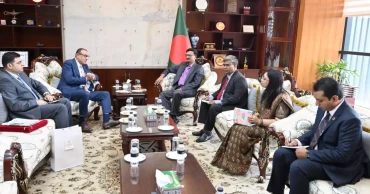
Palestinian Ambassador briefs Bangladesh’s Foreign Affairs Adviser
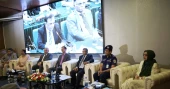
Palestinian Ambassador to Bangladesh Yousef S.Y. Ramadan on Tuesday met Foreign Affairs Adviser Md Touhid Hossain and briefed him on the ongoing genocide in Gaza and West Bank, especially the killing of innocent women and children.
He also focused on the growing concerns and escalation of tensions in the Middle East, resulting in widespread instability in the region and beyond.
The conversation also touched on the challenges faced by Palestinian students who have been unable to take advantage of scholarships offered by universities in Bangladesh due to the ongoing blockade in Gaza.
The Ambassador expressed deep gratitude for Bangladesh’s longstanding support to Palestine in the international platforms and sought for continued support in future, according to the Ministry of Foreign Affairs.
The Foreign Affairs Adviser reiterated Bangladesh’s steadfast support to the Palestinians and their inalienable rights to an independent and viable state based on the pre-1967 borders with East Jerusalem as its capital.
1 year ago

EBL-German Embassy partner to promote climate action
Eastern Bank PLC and the Embassy of the Federal Republic of Germany have entered into a partnership to collaborate on the EBL Climate Change Action Award.
The award will be announced annually with the aim of recognizing and celebrating the best practices by local corporations, manufacturing companies, NGOs, and climate activists who have demonstrated excellence and leadership in implementing climate projects and initiatives.
The joint declaration of intent was signed by German Ambassador Achim Tröster and Managing Director of EBL Ali Reza Iftekhar at the Embassy on Tuesday.
German Ambassador to Bangladesh Achim Tröster said mitigating climate change and adapting to it can only work if governments, private sector and civil society work hand in hand.
This effort needs leadership, innovation and mutual learning by all actors, he said.
"Thus, we very much welcome the Initiative of Eastern Bank PLC. to honor such efforts in Bangladesh. EBL is already a long-standing partner supported by German Development Cooperation´s private sector instruments with loans and technical support. We are happy to intensify this cooperation with this Joint Declaration of Intent.”
EBL’s Managing Director Ali Reza Iftekhar said, “Germany and EBL share a common goal of promoting work to combat climate change challenges impacting Bangladesh."
He said they are delighted to enter into this partnership with the Embassy of the Federal Republic of Germany on our Climate Change Action Award initiative and hope to work together closely to promote the climate cause.
"Through this award we aim to inspire and motivate more actors to join the fight against climate change in Bangladesh.”
The award categories cover a wide range of sectors and themes involving climate change challenges crucial to Bangladesh.
The winners will be selected by a panel of judges, comprised of experts from academia, civil society, media, and international partners like the German Embassy.
The nomination process for the EBL Climate Change Action Award 2024 will be announced soon through newspaper, electronic media and EBL website and social media platforms.
This was EBL’s second partnership. Earlier this year in May, EBL and the U.S. Department of State signed a partnership to collaborate on the EBL Climate Change Action Award.
1 year ago

‘You've called spade a spade’: Palestine Ambassador praises Chief Adviser's UNGA speech
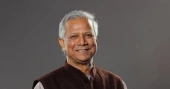
Chief Adviser Prof Muhammad Yunus on Tuesday expressed Bangladesh's continued support for the State of Palestine and its people.
"We will continue to support the cause of the Palestinian people," he said, adding that he hoped they would get their desired independent statehood.
Prof Yunus made the remarks when Ambassador of the State of Palestine Yousef Ramadan paid a courtesy call on him.
Issues of mutual interests, global support for the State of Palestine, the genocide in Gaza, and tension in the Middle East were discussed in the meeting.
Ambassador Ramadan appreciated the Chief Adviser's speech at the United Nations, saying it was timely and shed a much-needed spotlight on the Palestinian issue.
"You've called spade a spade," CA's press wing quoted Ambassador Ramadan as saying.
The Palestine Ambassador said some 60 Palestinian doctors who had received medical education in Bangladesh were now serving patients in Gaza.
He said 200 more Palestinian students were waiting to receive higher education in Bangladesh.
1 year ago
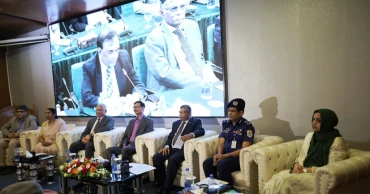
Tourism for Attaining SDGs: Discussants highlight challenges, prospects for Bangladesh
Speakers at a seminar on Monday said Bangladesh boasts a rich array of tourism assets, including forests, beaches, water bodies, hills, wildlife, indigenous cultures, historical and archaeological sites, cultural heritage, folklore, handicrafts, art, and festivals, all of which collectively attract both domestic and international tourists.
Although Bangladesh has identified tourism as a key sector for its national development, it faces significant challenges, they said.
However, the discussants said it is anticipated that with wellplanned strategies and policies, this industry has the potential to make a substantial contribution to the nation’s economy in its pursuit of sustainable development.
Achieving the SDGs requires a comprehensive evaluation of public policies, strategic frameworks, and government initiatives, they said.
The Government of Bangladesh has established three tourism zones, improved facilities at key tourist sites and implemented various policy measures to promote sustainable development through tourism.
To revitalize this industry, innovative and strategic actions are urgently needed. Key challenges such as inadequate infrastructure, lack of security and safety, poor communication and transportation networks, and insufficient hotels, motels, and restaurants are significant barriers to the sustainable growth of the tourism sector, they said.
These gaps in the current tourism framework pose serious threats to its future development and sustainability. Infrastructure improvements and addressing environmental concerns are essential to transform tourism into a major contributor to Bangladesh’s GDP.
Bangladesh Institute of International and Strategic Studies (BIISS) organised the seminar titled “Tourism for Attaining SDGs: Challenges and Prospects for Bangladesh” at the BIISS auditorium.
Foreign Affairs Adviser Md Touhid Hossain graced the seminar as the chief guest.
Nasreen Jahan, Secretary, Ministry of Civil Aviation and Tourism, was present as special guest.
Major General Iftekhar Anis, Director General, BIISS, delivered the welcome address.
Ambassador AFM Gousal Azam Sarker, Chairman, BIISS, chaired the session.
Abu Sufian, Executive Director of Tourism Research & Development, presented the keynotepresentation. A panel discussion followed the Keynote presentation.
The panelists were Dr Sufia Khanom, Senior Research Fellow, BIISS, Md Abu Kalam Siddique, DIG, Tourist Police Bangladesh and Dr Munal Mahbub, Director in Charge, FBCCI.
There was an open discussion session after the panel discussion.
Senior officials from different ministries, diplomatic missions, media, researchers, business people, academia, and representatives from various think tanks and international organisations participated in the seminar.
They presented their opinions, comments, suggestions, and observations during the open discussion session.
1 year ago
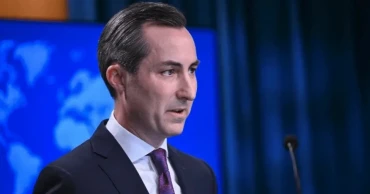
US wants full investigations into killings of civilians in recent months
The United States has reiterated its call for full investigations into the civilians who lost their life during the protests and the crackdown on the protests in recent months.
"We think there need to be full investigations into the civilians who lost their life during the protests and the crackdown on the protests in recent months," said US Department of State Spokesperson Matthew Miller.
Responding to a question at a regular media briefing on Monday (September 30), Miller also said there needs to be full accountability for anyone responsible.
On a media specific question, the spokesperson said they want to see press freedoms upheld in Bangladesh and of course across the world.
1 year ago
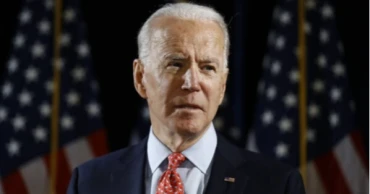
US sets refugee admissions target at 125,000 for FY 2025
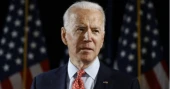
US President Joe Biden has signed the presidential determination on "Refugee Admissions" for fiscal year 2025, again setting the refugee admissions target at 125,000 for the upcoming fiscal year—as they have for each year of this Administration.
"Building on the US Administration’s efforts to strengthen refugee resettlement and the generous support from Americans across the country, the refugee admissions target of 125,000 ensures the United States will continue to be a global leader in providing safety and opportunity for those facing persecution around the world, said US Secretary of State Antony J Blinken in a press statement on September 30.
Over a 15-year period, refugees contributed almost $124 billion to the U.S. economy, he said.
And resettlement offers the unique opportunity of a better life to some of the world’s most vulnerable people, at a time of historic global levels of displacement, Secretary Blinken said.
Since 2010, the United States has resettled more than 17,000 Rohingyas from the region, including 2,800 this fiscal year so far, says a spokesperson at the US Embassy in Dhaka.
“The United States will continue to consider for resettlement all UNHCR referrals of Rohingya refugees in the region to the U.S. Refugee Admissions Program,” he told UNB while responding to a question recently.
The Biden administration remains focused on expanding the resettlement of key populations of concern, including Rohingya, he said.
Seven years ago, on 25 August 2017, some 700,000 Rohingya men, women, and children were forced to flee Myanmar and seek protection in Bangladesh.
Bangladesh is currently hosting over 1.2 million Rohingyas in Cox’s Bazar and Bhasan Char.
Refugee resettlement exemplifies the generosity that has always been at the core of the American spirit and reflects the critical role of the United States as a global leader in providing refuge to people fleeing persecution overseas, Blinken said.
In Fiscal Year 2024, the US resettled 100,000 refugees, the largest annual number in three decades.
"This is a testament to our successful work to rebuild the U.S. Refugee Admissions Program with help from partners around the world and thousands of Americans across the country who have stepped up to sponsor refugees through the Welcome Corps," Bl8nken said in his press statement.
Refugee resettlement is orderly, subject to rigorous vetting, and benefits and enriches American communities.
"In cities and towns throughout America, refugees contribute to urban revitalization, add to the vibrancy of local communities, and drive America’s competitiveness and innovation on the global stage," Blinken8 said.
1 year ago
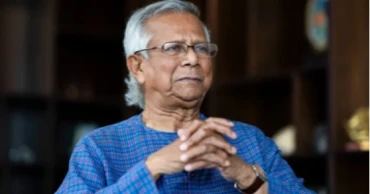
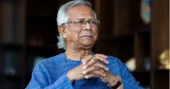
15 years of grievances can't be solved in 15 days: Prof Yunus tells National Public Radio
Seeking some time to address people's long grievances, Chief Adviser Prof Muhammad Yunus has said they have to resolve it systematically overcoming the difficult situation.
"Look this is 15 years of your grievances. We cannot solve it in 15 days. Give us some time so that we can go back. You have a very difficult situation and we have to resolve it so that it's done systematically," he told NPR in an exclusive interview.
National Public Radio (NPR, stylized as npr) is an American public broadcasting organisation headquartered in Washington, D.C., with its NPR West headquarters in Culver City,
Asked whether he can redirect people to focus on reform rather than revenge, the Nobel Peace laureate said revenge period was only a couple of weeks maybe.
"But then normalcy started coming back so we are running the country. But there are demonstrations, not revenge demonstrations," he said.
The chief adviser said most of the demonstrations are about demanding their pay rises, demanding their jobs, which they were fired from before by the regime.
"So they said, we are mistreated by the past government and we lost our jobs for nothing – because we happened to belong to another political party," he said, adding that everybody is trying to settle their scores because they were deprived.
"We were trying to convince them," Prof Yunus said.
Asked about different options on election time frame, the chief adviser said people are throwing out these numbers - how many months, how many years as they feel are needed.
"Some say it should be done quickly because if you go longer and longer, you'll be so unpopular and everything will be messed up. Some say no, you have to finish the reform. So you stay this long period because we don't want to get to Bangladesh 2.0 without fixing everything. So this is the debate going on," he said.
The questioner said it is almost like he is talking about an entire rebuilding of civil society.
In reply Prof Yunus said, "That’s precisely what version 2 means. We don't want to go back to the old style. Then what is the meaning of giving all these lives? It has no meaning because everything that we did, we destroyed everything. So we have to begin to build a new one."
Prof Yunus also said it is very exciting. "You look at the negative. I look at it in a very positive way. I said this is the greatest opportunity this nation got. Never, ever, all these people, the country is unified on one thing: We need change."
Asked whether he will see Bangladesh become the country that he hoped it will be in his lifetime, Prof Yunus said, "Not the ultimate. But I will be very happy, it’s on the way. Institutions are right. Policies are right."
He said young people are committed to changing the world that they belong to and they play a role within the country and a global role.
"When we talk about climate change, we are the victims of climate change. But we have to work together," Prof Yunus said.
The chief adviser said he always gives importance to the youth because they are the ones who will be building the future and they should be in the leadership position anyway, because this is the planet they have to inherit.
"You mentioned I'm 84. I don't have a long part ahead of me, but they have their whole life ahead of them," he told the interviewer.
Prof Yunus saw the trajectory of his life change after student-led protests this summer resulted in his installation as the interim leader of Bangladesh.
Former Prime Minister Sheikh Hasina fled to India in early August, as tens of thousands of demonstrators stormed her residence protesting against her leadership and a job quota system that favoured certain groups.
Yunus saw these events unfolding from about 5,000 miles away in Paris, where he was attending the summer Olympics.
Hours after Hasina’s ouster on August 5, Prof Yunus received a phone call. He was asked to serve as chief adviser to the interim government.
It was a “very strange turn of events,” he told NPR in New York City. After Yunus spoke at the UN General Assembly, he sat down with NPR’s Michel Martin.
Prof Yunus is known for founding Grameen Bank and pioneering small loans for low income people as a way to fight poverty.
The following is rest of the interview.
NPR: When we talked this past summer, you were on trial on corruption charges, and now here you are representing Bangladesh on the world stage. That is some turn of events. Are you surprised to find yourself in this position?
Prof Yunus: A very strange turn of events. Before I was sworn in as a chief adviser, I was in Paris trying to see if I go back, I'll be arrested, because she(Hasina) will be angry at me and put me in jail. So I was thinking of delaying my return. And suddenly I got a phone call from Bangladesh that now she has left. We want you to be the head of the government. That was a big surprise.
NPR: What went through your mind when you got that phone call?
Prof Yunus: Whether I should get involved in running the country at all. It’s a very difficult political situation. But when the students called me up and explained what the situation is, finally I said, “Yes, you have given lives for this. If you can give lives, I can remove all my other considerations. I can be of your service. I'll do that.”
NPR: And when you say you've given life, you were not exaggerating and it was not a metaphor.
Prof Yunus: No, it’s not a metaphor. People die. Nearly a thousand young people died, stood in front of the gun to take bullets. Literally, young people came and sacrificed themselves. When they are coming out of their homes to join the demonstrations, they’re saying goodbye to their parents. They're saying goodbye to their siblings; ‘I may not come back.’ That's the spirit in which the whole thing happened. And finally, it was so unbelievable. The Prime Minister decides to leave the country because the whole mob is coming towards her home.
NPR: On the one hand, these demonstrations led to the departure of this wildly unpopular and by some accounts corrupt leader. But in those chaotic first days, there were attacks against Ahmadis and Hindus. Some of it was related to their loyalty to Sheikh Hasina’s party. Some of it seemed to be just simply attacks against minorities. Those have subsided. But since then, there have been more attacks, this time on Sufi mosques, and according to our reporting, there has been more than 20 vigilante killings, murders by mobs of people since she was ousted. Why is this happening?
Prof Yunus: People are in the mood for revolution. So this is a revolutionary situation. They were killed. So they are looking for people who made their colleagues die. So people were attacking the followers of the party headed by Sheikh Hasina. When you say minority community being attacked, that minority community, particularly Hindu community, was associated with her. So you cannot distinguish whether they were attacked because they're followers of Sheikh Hasina or they were attacked because they are Hindu. But they were attacked, that's for sure. But then we took over the government and tried to bring peace. I kept telling everybody that we may have differences of opinion. That doesn't mean we have to attack each other.
1 year ago

Malaysian PM Anwar Ibrahim due in Dhaka Oct 4 to take relations with Bangladesh to a new height
Malaysian Prime Minister Anwar Ibrahim is scheduled to pay a brief visit to Bangladesh on October 4 to take forward the relations between the two countries to next level by exploring new areas of cooperation and strengthening the ties in diverse areas.
He will be visiting Bangladesh at the invitation of Chief Adviser Prof Muhammad Yunus, an official said on Monday.
In August this year, Prof Yunus invited him to undertake a short visit to Bangladesh as soon as possible to further strengthen the brotherly relationship between the two countries.
"The visit remains confirmed as of today," a senior official at the Ministry of Foreign Affairs told UNB, adding that his stay in Dhaka is likely to last a few hours.
Malaysia is the 8th largest investor in Banglafesh, the official mentioned.
"Apart from manpower issues, other ongoing cooperation including potential areas will come up for discussion," he said.
The Malaysian prime minister will have a bilateral meeting with Chief Adviser Prof Muhammad Yunus apart from a few other engagements in Dhaka.
Meanwhile, Foreign Affairs Adviser Md Touhid Hossain on Tuesday said this will be an official visit, and the Malaysian Prime Minister will lead a 58-member delegation, including a number of Malaysian ministers.
While briefing reporters at the Ministry of Foreign Affairs, Hossain said the Malaysian PM will also meet the President.
In August, the Malaysian leader made a phone call to his old friend, Prof Muhammad Yunus, to congratulate him personally on his recent appointment as the chief adviser for the Interim government of Bangladesh.
Prof Yunus has long-standing good ties with Malaysia.
"Thus, I assured him that Malaysia stands ready to help and support the interim Government in rebuilding and restoring peace and security in Bangladesh," said the Malaysian PM.
Malaysia is going to be the next chair of ASEAN from January 2025, and the Rohingya issue will also be discussed, said the Foreign Ministry official.
At least seven Malaysian universities have Yunus Centre, promoting social business ideas he champions and his three-zero concepts.
Malaysian companies, including several owned by its sovereign funds, have invested more than $5 billion in Bangladesh and are now willing to invest more, including in education.
A second Malaysian car manufacturer has signed an agreement with a Chattogram-based company for distributing and assembling cars.
Malaysia says they could be a desired destination for medical tourism, saying the Bangladeshi people can do essential medical treatment in the country at an affordable price.
1 year ago

Bangladesh delegation in Nepal to sign contract to import 40 MW electricity
A Bangladesh delegation today (Monday) went to Nepal to sign a contract to import 40 MW of electricity from the Himalayan nation.
Senior Secretary of the Power Division Habibur Rahman will be leading the 8-member delegation where they are expected to sign the contract on October 4.
Sources at the Power Division said that there will be a tripartite agreement between Bangladesh, Nepal and India as the electricity will be imported through the Indian territories.
Earlier, Bangladesh's Cabinet Committee on Government Purchase (CCGP) approved a proposal of the state-owned Bangladesh Power Development Board (BPDB) to import the bulk electricity from Nepal.
As per the proposal, the tariff for electricity was set at 6.40 US cents per kilowatt hour (energy price at Muzaffarpur Substation, India) plus 0.0595 Indian Rupee per kilowatt hour for Indian Contractor's trading margin and also transmission charge to be fixed by the Indian Central Electricity Regulatory Commission (CERC).
Calculating such tariff structure, a top official of the BPDB said that under the proposed deal, each unit of electricity from Nepal will cost Tk 8.50.
Officials of the BPDB also mentioned that the tariff would be much lower if Bangladesh would have been able to import electricity from Nepal directly.
But instead of that direct import, Bangladesh will now have to import the electricity through an Indian trading firm NVVN and also through the Indian grid.
"There is only a 26-km transmission line that goes through Indian Territory. If Bangladesh was allowed to build this 26-km transmission line at our own cost, the tariff of Nepali electricity would be below Tk 7," he told UNB.
Bangladesh has been negotiating with Nepal for a long time to import electricity. But it took a huge time to reach an understanding between Dhaka, Kathmandu and New Delhi to sign the proposed contract.
Now the three parties--BPDB from Bangladesh, Nepal Electricity Authority (NEA) from Nepal and NTPC Vidyut Vyapar Nigam (NVVN) from India will sign the tripartite agreement in this regard.
Sources said Bangladesh had to accept all Indian conditions to import the electricity from the Himalayan nation. The Indian firm NVVN was involved as per the Indian condition.
The previous Awami League government had said that if Bangladesh signs a deal with Nepal to import 40 MW electricity, it will create an opportunity to export electricity from Bangladesh as well during the winter season when power demand remains lower in Bangladesh.
this time Bangladesh will only sign a contract to import 40 MW power from Nepal, not to export power to Nepal," said another BPDB official.Sources said the decision to start the import of 40 MW power from Nepal was finalised in a two-day meeting of the joint steering committee (JSC) and joint working committee (JWC) on Bangladesh-Nepal power and energy sector cooperation on May 14-15 in 2023 at Patuakhali in Bangladesh.
Ahead of the meeting, Nepalese Foreign Minister Narayan Prakash Saud visited Dhaka and held a meeting with Bangladeshi public and private sector officials where he urged them to invest in the hydropower sector in the Himalayan nation, holding about 60,000 MW of clean energy potentials.
In the follow-up, according to a report of the Kathmandu Post, during the Nepalese prime minister’s India visit (May 30-June 1 in 2023), India agreed to facilitate Nepal to export 40 MW electricity to Bangladesh through Indian transmission infrastructure.
Currently, Bangladesh is importing electricity from India through a similar arrangement where the Indian company NTPC Vidyut Vyapar Nigam (NVVN) is selling power to BPDB.
Sources said apart from the 40 MW import plan, Bangladesh eventually wants to import 500 MW of hydroelectricity from Nepal via India through Indian company GMR. But no progress has been made in recent days in this regard.
1 year ago
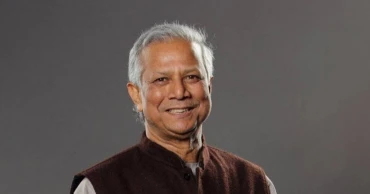
Not here to stay long; our task is to reform and hold the election: Prof Yunus
Stressing on required reforms before the next national election, Chief Adviser Prof Muhammad Yunus has said they have a very clear agenda and want to make sure that the economy, overall system and institutions function properly.
“Our job is to do it as quickly as possible because we are not here to stay long. Our task is to reform and hold the election. As soon as we are ready for that we will hold the election. This government has to succeed,” he told NHK in an exclusive interview released on Monday in multiple languages.
The chief adviser said he is a free person and all of them (advisers) are free persons and they can do what they feel is right.
He said reforms are the top most priority of the government as Bangladesh is in the deep ocean of corruption.
Paying tribute to students who sacrificed their lives, Prof Yunus said when they formed the government they thought there should not be any delinking between the government and the spirit of the young people.
The head of the interim government in Bangladesh has expressed his determination to quickly advance reform and hold an election.
The interview with NHK was done in New York, where he went to attend the United Nations General Assembly.
He became chief advisor of the interim government after the administration of Prime Minister Sheikh Hasina collapsed on August 5 after 15 years in power, following student protests.
Yunus won the Nobel Peace Prize in 2006 and is the founder of Grameen Bank, which extends small unsecured loans to underprivileged people.
In the interview, Yunus said the interim government's job is to carry out reform as quickly as possible, and that the government will hold an election as soon as it is ready. He said, "Failure is not something that we can accept."
Referring to students who played a major role in the overthrow of the Hasina government, Yunus said young people gave their lives during what he called the "revolution." He indicated his stance of including the young generation in policy making.
Yunus said Bangladesh looks forward to support from its biggest donor Japan "during this very critical period."
He emphasised that Japan's cooperation is essential in rebuilding his country's economy and helping democracy take root there.
Chief Adviser's press wing shared the link of the interview with the media.
The government has described Chief Adviser Prof Yunus' participation at the 79th United Nations General Assembly as "very successful, historic and a very positive milestone."
"It is a very successful and historic visit. I would say it was a very positive milestone for Bangladesh," Chief Adviser's Press Secretary Shafiqul Alam told reporters at a media briefing at Foreign Service Academy on Monday.
In his brief four-day stay in New York, Alam said, the chief adviser attended around 50 events including meetings with top global leaders like US President Joe Biden.
1 year ago