foreign-affairs

Mahatma Gandhi inspired anti-colonial struggles in many countries:Verma
Indian High Commissioner to Bangladesh Pranay Verma on Wednesday said Mahatma Gandhi's philosophy of coexistence with their ecology and respect for Mother Nature have great relevance in addressing some of the pressing problems of their times such as climate change and sustainable development.
High Commission of India marked the 155th birth anniversary of Mahatma Gandhi (Gandhi Jayanti) today at a commemorative event held on its premises.
Speaking on the occasion, he said that the event was a humble way to express their gratitude to Mahatma Gandhi and all those who sacrificed their lives for the cause of India’s independence from the colonial rule.
Future of Bangladesh-India relations to depend on commitment of youth: Pranay Verma
"Mahatma Gandhi not only shaped India’s freedom movement, but also inspired anti-colonial struggles in many countries across Asia and Africa," said the High Commissioner.
In his remarks, the envoy said that Gandhi's unwavering faith in peace, non-violence, tolerance and understanding as a force for change remains as relevant today as they were during India’s freedom struggle.
"It is an affirmation of the universality of Gandhiji’s ideals and values that the international community marks his birth anniversary every year as the International Day of Non-violence, further highlighting the relevance of his teachings in dealing with current global challenges such as terrorism," Verma said.
Today’s commemoration is also a strong affirmation of India’s long-standing belief that no cause can justify acts of violence and that humanism shall always prevail, he said.
END/UNB/MK/FH
1 year ago

Italy offers support for Bangladesh's police reforms, safe migration
Italian Ambassador Antonio Alessandro on Wednesday met Chief Adviser Prof Muhammad Yunus and said his country would support Bangladesh's police reforms and work together for formal migration to the country.
Safe, organised and regular migration to Italy, economic and trade cooperation, and police reforms dominated the talks during the meeting held at Chief Adviser’s Office.
"We want to protect Bangladesh migrants. We have to work for better regular migration," Ambassador Alessandro said.
The envoy praised the reform efforts of the Interim Government.
He offered Italian support for police reforms, including training for the security forces.
"Our police do it in several countries," said the Ambassador.
The meeting came a week after the Chief Adviser and Italian Prime Minister Giorgia Meloni held a one-on-one meeting at the UN Headquarters in New York.
During the UN meeting, Professor Yunus called for the large-scale formal migration from Bangladesh to Italy. Meloni said both nations should work hard to cut irregular migration.
The Ambassador hoped that bilateral trade between the two nations would "rebound soon." Currently, the bilateral trade between the two nations is around $2.5 billion.
The Italian Embassy would also hold a movie festival and a ballet soon, he said.
In the margins of the high-level week of the 79th United Nations General Assembly, the President of the Council of Ministers (Prime Minister), Giorgia Meloni expressed Italy’s support for the reform process in Bangladesh and the main goal of improving the population’s social and economic conditions.
The meeting in New York also provided an opportunity to discuss migration, with the intention being stated to strengthen cooperation on this issue, in particular by relaunching negotiations to complete a bilateral agreement to combat irregular migration flows, establish closer cooperation on returns and, at the same time, support legal paths.
1 year ago

Former US Ambassador Peter Haas joins Excelerate Energy as Strategic Adviser
Former US Ambassador (ret.) to Bangladesh Peter Haas has joined as a Strategic Adviser to Excelerate Energy, Inc, a US-based LNG company located in The Woodlands, Texas.
Haas retired from the U.S. Foreign Service on September 27 after 33 years of U.S. government service, most recently as ambassador to Bangladesh.
Excelerate Energy, Inc. (NYSE: EE) (“Excelerate” or “Company”) announced his joining with Excelerate’s Washington DC office.
Ambassador Haas’ State Department assignments also included acting Assistant Secretary of State for Economic and Business Affairs, Consul General in Mumbai, India, and Deputy Permanent Representative to the Organization for Economic Cooperation and Development (OECD).
Earlier in his foreign service career, Haas was posted to U.S. embassies in London, Rabat, Berlin, and Port-au-Prince.
“I am pleased to have Peter Haas join the Excelerate team. Over the course of his State Department career, he has been a tireless advocate for U.S. businesses and commercial interests,” said Steven Kobos, President and CEO of Excelerate.
“Peter understands the intersection of geopolitics and markets, and I am confident that his leadership and experience will strengthen our global team and help us deliver energy security for our customers around the world.”
“I am excited to join Excelerate Energy in its mission to deliver innovative LNG solutions that drive economic growth and improve lives around the world,” said Ambassador Haas.
“This is a company that demonstrates operational excellence, integrity, and strong partnership in the communities it serves.”
1 year ago

5 more envoys asked to return, inc. from Delhi
As part of ongoing changes in Bangladesh Missions abroad, the government has asked its envoys stationed in New Delhi, Brussels, Canberra, Lisbon and Bangladesh Permanent Mission to the UN in New York to return to Dhaka immediately.
The Ministry of Foreign Affairs asked them to relinquish their current responsibilities and return to the headquarters in Dhaka immediately in a notice served separately to each of them.
The ambassadors/high commissioners who have been asked to report to headquarters are: Mustafizur Rahman, High Commissioner of Bangladesh to India; Muhammad Abdul Muhith, Ambassador and Permanent Representative of Bangladesh to the United Nations (UN) in New York; Mahbub Hassan Saleh, ambassador of Bangladesh to Belgium; M Allama Siddiqui, Bangladesh High Commissioner to Australia; and Rezina Ahmed, Ambassador of Bangladesh to Portugal.
"You have been requested to return to Dhaka, leaving your current responsibility immediately," the notification regarding the decision to transfer reads.
Earlier, Bangladesh High Commissioner to the United Kingdom (UK) Saida Muna Tasneem was asked to return to Dhaka immediately.
1 year ago
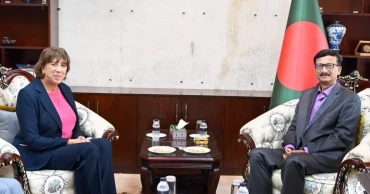
Dutch Ambassador reaffirms support for Bangladesh’s development
Ambassador of the Netherlands to Bangladesh Irma van Dueren paid her maiden courtesy call on Foreign Affairs Adviser Md. Touhid Hossain at the latter’s office on Tuesday.
During the meeting, the ambassador reaffirmed continued Dutch support to Bangladesh’s development journey.
Acknowledging the longstanding bilateral relations between the two friendly nations, she referred to the recent fruitful bilateral meeting between the Prime Minister of the Netherlands and the Chief Adviser Prof Muhammad Yunus in New York on the sidelines of the 79th United Nations General Assembly (UNGA).
The Foreign Affairs Adviser underlined the Bangladesh-Netherlands collaboration over the last five decades, particularly in the water sector and termed the Netherlands as a very important country for Bangladesh as it is a major destination for exports and a top source country for FDI.
As Bangladesh and the Netherlands are similar deltas, the adviser and the Dutch ambassador stressed on robust collaboration between the two countries in sustainable delta management, water management, climate change, renewable energy, agriculture and maritime sectors.
Touhid Hossain assured of better business climate for further strengthening trade and investment ties between the two countries.
He thanked the Dutch government for its continued humanitarian support to the Rohingyas in Bangladesh and reiterated that the only solution to the Rohingya crisis lies in their return to Myanmar with rights and security.
1 year ago

Dhaka, Delhi agree to establish good ties: Foreign Adviser
Foreign Affairs Adviser Md Touhid Hossain on Tuesday said Bangladesh and India agreed that there is a need for establishing good relations with each other.
On the sidelines of the United Nations General Assembly in New York, he held a meeting with Indian External Affairs Minister Dr S Jaishankar and discussed issues of mutual interest.
While briefing the media at the Ministry of Foreign Affairs, Hossain said they talked about the current situation and they both agreed that they need to establish good relations with each other for their own interests.
“Both Bangladesh and India have their respective interests. So, we spoke on this line,” said the Adviser.
He said there have been some discussions about security but the security situation has improved a lot and they have not received any complaints from the foreigners recently.
The Adviser said many of the officials from the Indian visa centres have moved and their centres are not yet fully operational.
“It is expected to be launched in a few days. Now only probably a health visa is being given,” Hossain added.
Foreign Secretary Md Jashim Uddin and Director General (Public Diplomacy Wing) Toufique Hasan were also present.
1 year ago

Want better ties with Pakistan not overlooking ‘71: Foreign Adviser
Foreign Affairs Adviser Md Touhid Hossain on Tuesday said the current government did not give any impression at all to Pakistan that Bangladesh is willing to build good relations leaving aside the 1971 issue.
“We have not seen any words coming from Pakistan. I personally think the relations will be easier if they (Pak government) show the courage to refer to what happened in 1971 and say that they are sincerely seeking apology,” he told reporters while responding to a question at a media briefing.
Bangladesh wants Pakistan to seek apology publicly with a formal announcement for the atrocities it perpetrated against unarmed Bangalees in 1971.
“Everything doesn’t go by the law”: Foreign Adviser on Hasina’s stay in India
Bangladesh Chief Adviser Prof Muhammad Yunus called for the revival of Saarc as a top platform for regional cooperation in South Asia when he met Pakistani Prime Minister Shehbaz Sharif on the sidelines of the UN General Assembly at the UN headquarters.
“It was entirely a courtesy meeting. We don’t raise difficult issues in such courtesy meetings. When we will sit down for discussion, we will raise such difficult issues,” said the Foreign Adviser.
He said they will try to maintain good relations with Pakistan but 1971 issues will be there. “1971 is always in our hearts.”
During his meeting with Chief Adviser Prof Yunus, Pakistan’s PM Sharif said Bangladesh and Pakistan should open a “new page” in their relations to enhance cooperation in various aspects. “It’s essential we revive our relations,” he said.
Foreign Secretary Md Jashim Uddin and Director General (Public Diplomacy Wing) Toufique Hasan were also present.
1 year ago
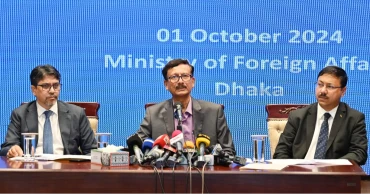
Yunus- Modi talks likely on Bimstec summit sidelines
Chief Adviser Prof Muhammad Yunus and Indian Prime Minister Narendra Modi are likely to have a meeting on the sidelines of the Bimstec Summit which is expected to take place next month in Bangkok, Thailand.
Briefing reporters at the Ministry of Foreign Affairs on current affairs on Tuesday, Foreign Affairs Adviser Md Touhid Hossain hinted at the possibility of such a development.
There was no meeting between Chief Adviser Dr Yunus and Indian Prime Minister Narendra Modi during the United Nations General Assembly (UNGA) in New York, as the two leaders' schedules did not align, officials said.
Modi left the United States before Prof Yunus’s arrival in New York.
BIMSTEC member states call for strengthening economic ties, people-to-people exchanges
The Chief Adviser was scheduled to attend the Bimstec Summit which was originally scheduled for September 4 but was later postponed.
The new date is yet to be announced but the Chief Adviser will attend the summit.
Thailand will host the next summit of the Bay of Bengal Initiative for Multi-Sectoral Technical and Economic Cooperation (Bimstec). Bangladesh will take responsibility as the next chair of BIMSTEC there.
The Bimstec member states have emphasised the importance of enhancing physical, maritime and digital linkages to strengthen economic ties and people-to-people exchanges, while also exploring opportunities for capacity building and skill development.
The support for the establishment of Bimstec Centre of Excellence was also expressed by the member states at an informal meeting of the Bimstec Foreign Ministers.
The meeting was held in New York on the sidelines of the 79th Session of the UNGA recently.
It concluded with a shared resolve to further deepen cooperation within Bimstec and prepare for the upcoming leaders' summit.
It was the first meeting of the Bimstec Foreign Ministers in New York on the sidelines of the annual Session of the UNGA.
Secretary General of the Bimstec Indra Mani Pandey has recently said the next summit will have some significant outcomes and it will set a direction for Bimstec future.
The Bimstec Secretary General hoped the upcoming summit would add a new vigour to regional cooperation within Bimstec.
"I believe Bimstec has a bright future. All the members are truly committed to making sure Bimstec becomes a success story," he said while making a presentation on Bimstec activities at its headquarters in Dhaka recently.
The summit will adopt a Bangkok Vision 2030 which would be an overarching kind of document and give direction to the organisation, he said, adding that it would be one of the significant outcomes.
Bimstec brings together seven countries in South and Southeast Asia for multifaceted cooperation.
Foreign Secretary Md Jashim Uddin and Director General (Public Diplomacy Wing) Toufique Hasan were also present.
1 year ago
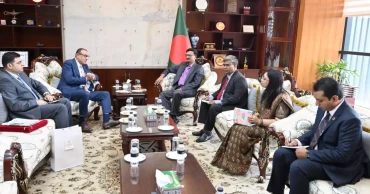
Palestinian Ambassador briefs Bangladesh’s Foreign Affairs Adviser
Palestinian Ambassador to Bangladesh Yousef S.Y. Ramadan on Tuesday met Foreign Affairs Adviser Md Touhid Hossain and briefed him on the ongoing genocide in Gaza and West Bank, especially the killing of innocent women and children.
He also focused on the growing concerns and escalation of tensions in the Middle East, resulting in widespread instability in the region and beyond.
The conversation also touched on the challenges faced by Palestinian students who have been unable to take advantage of scholarships offered by universities in Bangladesh due to the ongoing blockade in Gaza.
The Ambassador expressed deep gratitude for Bangladesh’s longstanding support to Palestine in the international platforms and sought for continued support in future, according to the Ministry of Foreign Affairs.
The Foreign Affairs Adviser reiterated Bangladesh’s steadfast support to the Palestinians and their inalienable rights to an independent and viable state based on the pre-1967 borders with East Jerusalem as its capital.
1 year ago

EBL-German Embassy partner to promote climate action
Eastern Bank PLC and the Embassy of the Federal Republic of Germany have entered into a partnership to collaborate on the EBL Climate Change Action Award.
The award will be announced annually with the aim of recognizing and celebrating the best practices by local corporations, manufacturing companies, NGOs, and climate activists who have demonstrated excellence and leadership in implementing climate projects and initiatives.
The joint declaration of intent was signed by German Ambassador Achim Tröster and Managing Director of EBL Ali Reza Iftekhar at the Embassy on Tuesday.
German Ambassador to Bangladesh Achim Tröster said mitigating climate change and adapting to it can only work if governments, private sector and civil society work hand in hand.
This effort needs leadership, innovation and mutual learning by all actors, he said.
"Thus, we very much welcome the Initiative of Eastern Bank PLC. to honor such efforts in Bangladesh. EBL is already a long-standing partner supported by German Development Cooperation´s private sector instruments with loans and technical support. We are happy to intensify this cooperation with this Joint Declaration of Intent.”
EBL’s Managing Director Ali Reza Iftekhar said, “Germany and EBL share a common goal of promoting work to combat climate change challenges impacting Bangladesh."
He said they are delighted to enter into this partnership with the Embassy of the Federal Republic of Germany on our Climate Change Action Award initiative and hope to work together closely to promote the climate cause.
"Through this award we aim to inspire and motivate more actors to join the fight against climate change in Bangladesh.”
The award categories cover a wide range of sectors and themes involving climate change challenges crucial to Bangladesh.
The winners will be selected by a panel of judges, comprised of experts from academia, civil society, media, and international partners like the German Embassy.
The nomination process for the EBL Climate Change Action Award 2024 will be announced soon through newspaper, electronic media and EBL website and social media platforms.
This was EBL’s second partnership. Earlier this year in May, EBL and the U.S. Department of State signed a partnership to collaborate on the EBL Climate Change Action Award.
1 year ago