Business

Govt giving highest priority to proper management of rawhides: Minister
Industries, Commerce, and Textiles and Jute Minister Khandaker Abdul Muqtadir on Thursday said the government is giving the highest priority to ensuring proper management of sacrificial animal hides during the Eid-ul-Azha season.
He made the remarks while visiting the leather trading centre at Amin Bazar in Dhaka to inspect the collection, preservation and marketing activities of sacrificial hides.
During the inspection, the minister spoke with rawhide buyers, sellers, warehouse owners and traders and enquired about market conditions, prices, preservation facilities and overall management activities.
“The government is working with utmost importance to ensure smooth management of sacrificial hides during the Eid season,” the minister said.
Describing the leather industry as an important sector of the country’s economy, he urged all stakeholders concerned to perform their responsibilities sincerely.
The minister also said the government remains alert to prevent any irregularities, syndicates or wastage of hides and that regular monitoring activities at the field level would continue.
Commerce Ministry Secretary (Routine Duty) Md Abdur Rahim Khan was present during the visit.
21 hours ago
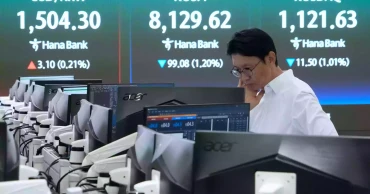
Asian markets fall, oil prices rise after fresh US strikes on Iran
Asian stock markets fell on Thursday as tensions rose following fresh US military strikes on Iran, which Washington described as defensive actions.
At the same time, oil prices climbed by more than $2 per barrel after dropping sharply in the previous session, while US futures also edged lower.
US officials said Central Command forces shot down four Iranian attack drones near the Strait of Hormuz. They also struck a drone control facility in Bandar Abbas that was preparing to launch another drone. These strikes came after earlier military actions earlier in the week.
US President Donald Trump said Iran is “negotiating on fumes” and insisted that upcoming US elections would not influence his approach to ending the ongoing conflict, now in its third month.
Asian markets under pressure
In early trading, Japan’s Nikkei 225 fell 0.4%, while South Korea’s Kospi also dropped 0.4%.
Hong Kong’s Hang Seng Index declined 1.4%, and China’s Shanghai Composite edged up slightly by 0.1%.
Australia’s S&P/ASX 200 slipped 1.4%, while Taiwan’s main index also recorded losses.
Analysts said uncertainty around US–Iran negotiations and the fragile ceasefire continued to weigh on investor confidence.
“Markets remain cautious as it is still unclear whether a lasting deal can be reached,” said Tan Boon Heng of Mizuho Bank.
He added that while both sides appear to avoid escalating tensions publicly, major disagreements remain unresolved.
Oil prices rebound
Oil prices, which had dropped sharply earlier in the week, rose again on renewed concerns over supply risks in the Middle East.
Brent crude gained more than $2 to around $94 per barrel in early trading, while US crude also moved higher.
Earlier, oil had fallen after hopes that a ceasefire between the US and Iran might hold, easing fears over disruptions in the Strait of Hormuz — a key global oil shipping route.
Wall Street at record highs
On Wednesday, US stock markets had closed slightly higher, with all three major indexes — the S&P 500, Dow Jones Industrial Average, and Nasdaq — reaching record levels.
Shares of airlines and cruise companies rose as falling oil prices earlier in the week boosted expectations of lower fuel costs.
Despite ongoing geopolitical uncertainty and inflation concerns, strong corporate earnings have helped support market gains.
Currency movements
In currency trading, the US dollar held steady against the Japanese yen, while the euro slipped slightly.
1 day ago

IMF confirms Bangladesh govt's request for new programme
The International Monetary Fund (IMF) has saidt hat the Bangladesh government has requested a new IMF supportedp rogramme as discussions continue over the country’s reform agenda and policy priorities.
In a statement, IMF Mission Chief for Bangladesh Ivo Krznar said the IMF staff are currently engaged in talks with the Bangladeshi authorities regarding the proposed programme.
“The Bangladeshi authorities have requested a new IMF supported program. IMF staff are in discussions with the authorities on their reform agenda and policy priorities,” he said.
Krznar said the IMF remains committed to supporting Bangladesh in maintaining macroeconomic and financial stability amid ongoing economic challenges.
“The IMF remains a committed partner to Bangladesh in its efforts to secure lasting macroeconomic and financial stability, strengthen resilience, and support strong, inclusive growth,” he added.
The development comes as Bangladesh continues efforts to stabilise its economy through fiscal, monetary and structural reforms while addressing pressure on foreign exchange reserves, inflation and the financial sector.
Bangladesh has been implementing various reform measures under its existing IMF loan programme approved in 2023.
2 days ago
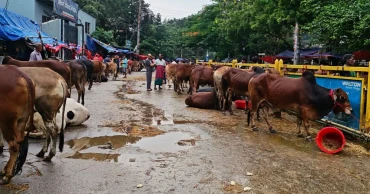
Cattle prices crash over 50% in Dhaka markets on last day
Prices of sacrificial cattle at Dhaka's makeshift markets have plummeted by more than 50 percent in the final hours before Eid-ul-Azha, with traders reporting heavy losses while buyers welcomed the sharp decline, though poor weather and soaring transport costs are dampening the overall festive mood.
Visits to several cattle markets across the capital on Wednesday revealed a dramatic single-day price drop for medium and large cattle, while smaller animals remained largely steady in price.
At the Notunbazar 100-Feet cattle market, trader Aynal, who brought 19 cattle from Chuadanga, said buyers are now offering Tk 1.20 lakh to Tk 1.50 lakh for animals he had priced at Tk 2.50 lakh.
“If I sell at these prices, I will face massive losses,” he said, adding that he managed to sell only seven animals.
Another trader, Shahin, who travelled from Jamalpur with seven cattle, sold only three. He said a cow he had refused to part with at Tk 1.80 lakh is now being offered Tk 1.20 lakh, while another priced at Tk 3 lakh is drawing bids of just Tk 1.50 lakh.
At the Aftabnagar market, buyer Raisu noted that demand for premium cattle has virtually collapsed. “No one is willing to go beyond Tk 5 lakh. Sellers asking Tk 8 to Tk 10 lakh are hearing counter-offers of Tk 3 to Tk 3.50 lakh. Those who brought high-value animals will likely return home without selling.”
At Meradiya market, Monsur, who oversees the haseel (transaction tax) booth, confirmed the price slide. “Animals that were selling for Tk 1.50 lakh are now going for Tk 70,000 to Tk 80,000,” he said, noting that transaction volumes have fallen sharply compared to last Eid.
Weather and Logistics Add to Woes
Traders and buyers alike pointed to several days of continuous rainfall as the primary driver of the market downturn, creating waterlogging at multiple venues with no drainage arrangements in sight.
Buyer Sakibul Alam at the Tejgaon cattle market said adverse weather forced him to hire a pickup truck — at twice the usual rate. “The cattle price has come down, but extra costs are being added from every direction.”
Trader Suleman from Jamalpur, selling at Aftabnagar, said rising fodder prices and higher transport costs had already squeezed his margins before reaching Dhaka. “We raise cattle for Eid expecting extra profit. But at the prices buyers are offering, selling to a butcher by the kilogram would fetch more.”
Buyer Saidul Islam at Meradiya noted that a five percent haseel charge, roughly Tk 10,000 on a Tk 2 lakh purchase, is also factored into buyers' calculations, adding further pressure on transaction prices.
Sellers are urging hat authorities to ensure proper drainage infrastructure at cattle markets in future years, warning that the combination of poor facilities and unpredictable weather is making the annual trade increasingly unviable for farmers.
2 days ago
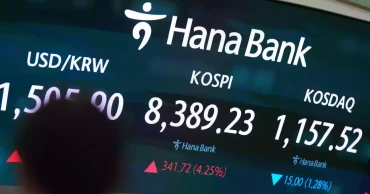
Asian shares mostly rise as Wall Street hits record highs; oil prices fall
Asian stock markets mostly advanced on Wednesday, tracking record gains on Wall Street, while global oil prices slipped amid easing market concerns.
South Korea’s Kospi index led regional gains, jumping nearly 5% to a record high as strong buying in technology and semiconductor stocks continued. Taiwan’s main index also surged, driven by optimism around artificial intelligence (AI) demand.
In Japan, the Nikkei 225 rose 1.3% to 65,816.62, briefly crossing the 66,000 mark during intraday trading for the first time. Shares of major chip-related companies such as Tokyo Electron and Advantest rose sharply.
The rally in Asian tech stocks followed a strong performance in the United States, where Micron Technology jumped nearly
2 days ago

Over 94% RMG factories pay Eid bonuses, 99% clear Apr wages: BGMEA
More than 94 percent of active ready-made garment factories in Dhaka and Chattogram have paid Eid-ul-Azha bonuses to workers ahead of the festival, according to a summary report released by the Bangladesh Garment Manufacturers and Exporters Association (BGMEA) on Monday.
The report, prepared with data as of May 23, covers a total of 2,134 operational factories across the two zones.
Of these, 2,133 factories were found active, of which 2,117 or 99.20 percent have cleared April wages, while 2,021 factories, representing 94.70 percent, have disbursed Eid bonuses.
Additionally, 767 factories, or 35.94 percent, have already paid an advance on May salaries.
In the Dhaka zone, out of 1,984 active factories, 1,983 (99.95%) paid March wages and 1,983 (99.39%) cleared April salaries. A total of 1,909 factories (95.98%) have paid Eid bonuses, while 690 factories (37.58%) have provided advance wages for May.
In Chattogram, all 380 active factories (100%) paid March salaries. Of these, 334 (98.24%) cleared April wages, 352 (91.76%) paid Eid bonuses, and 97 factories (28.53%) have paid advance wages for May.
BGMEA data also outlines a staggered worker dispersal plan from Dhaka: 108 factories (6%) released workers on May 24; 664 (37%) on May 25; 771 (43%) are set to do so on May 26; and the remaining 251 factories (14%) on May 27.
4 days ago

Gold prices rise ahead of Eid as BAJUS revises rates
Bangladesh Jewellers Association (BAJUS) has raised gold prices in the domestic market ahead of Eid, pushing the price of 22-carat gold up by Tk 2,158 per bhori to Tk 2,38,121, effective from 10:00am Monday.
The price revision comes on the back of rising pure gold (tejabi) values in the local market, BAJUS said in a statement.
Under the revised rates, 21-carat gold will now be sold at Tk 2,27,331 per bhori, 18-carat at Tk 1,94,847 and traditional-method gold at Tk 1,58,689 per bhori (1 bhori = 11.664 grams).
The latest hike reverses a cut made just two days ago.
On May 23, BAJUS had reduced the price of 22-carat gold by the same margin Tk 2,158 per bhori, setting it at Tk 2,35,963.
Gold prices in Bangladesh have now been revised 69 times so far in 2026, with 37 upward and 32 downward adjustments, reflecting the continued volatility in global bullion markets.
Silver prices have also been revised upward alongside gold. The price of 22-carat silver has been raised by Tk 117 per bhori to Tk 5,774.
Other silver rates now stand at Tk 5,540 for 21-carat, Tk 4,724 for 18-carat and Tk 3,558 per bhori for traditional-method silver.
Silver prices have seen 40 revisions in 2026, 22 increases and 18 reductions.
4 days ago

Former deputy governor Khurshid Alam appointed Islami Bank chairman
Hours after the resignation of Professor M Zubaidur Rahman, Bangladesh Bank (BB) has appointed its former Deputy Governor, Md. Khurshid Alam, as the new Chairman of Islami Bank Bangladesh PLC.
The central bank communicated the decision via an official letter sent to the private sector bank late tonight (Sunday).
Bangladesh Bank eases refinancing terms for state-owned, specialized banks to boost CMSME loans
However, the appointment has triggered deep resentment and widespread questions among Islami Bank officials over corporate governance. Officials pointed out that Alam was forced to step down from the central bank in August 2024 following pressure from central bank staff due to his controversial role during the previous Awami League regime.
"Khurshid Alam enjoyed numerous privileges during the Awami League's tenure and facilitated controversial business groups. How can the central bank ensure good governance by placing such an individual at the helm of Islami Bank?" an official questioned on condition of anonymity.
When contacted, Khurshid Alam confirmed the development, stating that he initially received a phone call from the central bank before being formally served the appointment letter.
Central bank sources revealed that the appointment was made under direct instructions from BB Governor Mostakur Rahman, following a recommendation from a certain quarter of the government.
Defending the decision, Bangladesh Bank Spokesperson Arif Hossain Khan said, "He was forced to resign back then through 'mob justice' following the regime change. However, no formal allegations orfinancial irregularities were found against him. Therefore, he has been appointed as the Chairman of Islami Bank."
Khurshid Alam was initially appointed as the Deputy Governor of Bangladesh Bank on a three-year contract in February 2024 by the then government. Following the political transition in August 2024, he, along with three other top central bank officials, was forced to resign.
Alam completed his post-graduation and MBA from the Faculty of Business Studies at the University of Dhaka and joined Bangladesh Bank as an Assistant Director in 1988.
Over his long career, he worked in vital departments of the central bank, including Banking Regulation and Policy, Bank Inspection, Financial Institutions and Markets, Off-site Supervision, and the SME & Special Programmes Department. He hails from Bancharampur upazila of Brahmanbaria district.
4 days ago
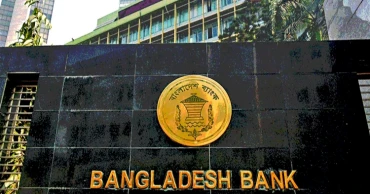
Bangladesh Bank eases refinancing terms for state-owned, specialized banks to boost CMSME loans
Bangladesh Bank (BB) has relaxed the participation criteria for state-owned commercial and specialized banks under its refinancing facilities, a move aimed at accelerating the flow of credit to the Cottage, Micro, Small, and Medium Enterprise (CMSME) sector.
The SME and Special Programmes Department of the central bank issued a circular to this effect today (Sunday).
According to the circular, the decision was taken to enhance the contribution of the CMSME sector to national economic growth and to expand employment opportunities at the grassroots level.
Bangladesh Bank unveils Tk 60,000cr stimulus package to revive economy, create 2.5m jobs
Under the new directive, state-owned commercial and specialized banks can now enlist as participating financial institutions to access the central bank's CMSME refinancing funds.
To facilitate this, the central bank has exempted these state banks from two mandatory conditions that previously restricted their eligibility.
The relaxed conditions include the obligation to maintain the non-performing loan (NPL) or classified investment ratio within a maximum cap of 20 percent, mandatory adherence to Bangladesh Bank’s prescribed Capital Adequacy Ratio (CAR), Cash Reserve Ratio (CRR), and Statutory Liquidity Ratio (SLR).
By waiving these stringent capital and asset-quality thresholds, the central bank aims to utilize the vast rural and semi-urban network of state-run banks to channel low-cost funds directly to small and marginalized entrepreneurs across the country, BB officials said.
4 days ago

Bibir Bazar land port to remain closed for 7 days over Eid
Import-export activities between Bangladesh and India through Bibir Bazar land port in Cumilla will remain suspended for seven days from Monday on the occasion of Eid-ul-Azha.
“All types of import and export activities through the port will remain closed from May 25 to May 31,” said Nirmal Pal, general secretary of the land port’s Clearing and Forwarding Agents Association.
However, movement of passport holders between the two countries will continue during the period, he said.
Business activities at the port will resume from June 1, he added.
4 days ago