Asia
More than 45 killed in Myanmar explosion
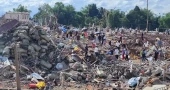
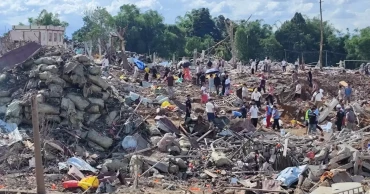
More than 45 people were killed and scores injured after a powerful explosion ripped through a building reportedly used to store mining explosives in northeastern Myanmar on Sunday, according to rescue workers and local media reports.
The blast occurred around midday in Kaungtup village of Namhkam township, near the Chinese border. The area is controlled by the Ta’ang National Liberation Army (TNLA), an ethnic armed group that has been involved in intermittent conflict with Myanmar’s military government.
A rescue worker involved in the operation said 46 bodies, including those of six children, had been recovered by Sunday evening and taken for cremation. He added that 74 injured people were transported to a local hospital, while rescue efforts continued.
Another rescuer reported that more than 100 houses near the blast site were damaged.
Independent media outlets in Myanmar estimated the death toll at between 50 and 55, publishing images and videos showing extensive destruction, smoke and debris.
China’s state broadcaster CCTV also reported multiple casualties and severe damage to residential buildings, citing preliminary findings that large quantities of mining explosives had been stored at the site.
In a statement on Telegram, the TNLA said gelignite explosives kept by its economic department for mining and stone quarrying operations were stored at the facility. The group said an investigation was underway to determine the cause of the explosion.
Gelignite is commonly used in mining and blasting activities but can become unstable if improperly stored or kept for long periods.
The TNLA, a member of the Three Brotherhood Alliance, has controlled the Namhkam area since a major offensive against Myanmar’s military in late 2023. Although the group signed a China-brokered ceasefire with the military in October last year, tensions remain high.
Myanmar has been mired in conflict since the military seized power in February 2021, triggering widespread resistance and armed insurgencies across the country.
2 months ago
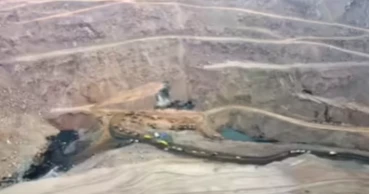
5 killed, 1 injured in collapse at illegal mine in southwest China
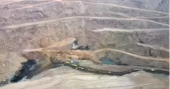
At least five people were killed and another injured after a collapse at an illegal mining site in southwest China's Yunnan province early Sunday, according to state-run news agency Xinhua.
The incident occurred around 4:30 a.m. in Baiwu village of Huize County. Authorities did not specify the type of mine involved in the accident.
Rescue teams recovered all six workers trapped at the site and rushed them to hospital. However, five later died from their injuries, while the surviving worker remains in stable condition, the report said.
Local authorities have launched an investigation to determine the cause of the collapse.
The accident comes just over a week after one of China’s deadliest mining disasters in recent years. A coal mine explosion in northern Shanxi province killed at least 82 people, prompting scrutiny of safety standards in the sector.
Officials investigating that incident said the mine operator had committed “serious violations” of regulations.
Mining accidents, though less frequent than in previous decades, continue to occur in China, where authorities have repeatedly pledged to strengthen workplace safety and crack down on illegal mining operations.
2 months ago
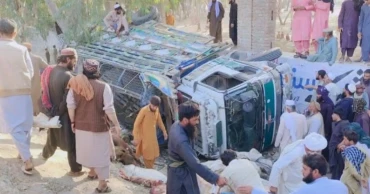
Truck Accident Kills 18 Afghan Returnees from Pakistan, Injures 35 Others
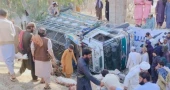
At least 18 Afghan refugees returning from Pakistan were killed and 35 others injured when a truck overturned on a highway in eastern Afghanistan on Saturday.
The accident took place in Laghman Province along the main road connecting Kabul and Nangarhar Province, according to provincial governor’s spokesperson Abdul Malik Niazai.
Officials said the victims included 10 children and five women. The injured, most of them women and children, were transported to hospitals in Nangarhar for treatment.
Taliban government spokesperson Zabihullah Mujahid expressed condolences to the families of those killed and injured in the crash.
Road accidents remain a frequent occurrence in Afghanistan due to poor road conditions and widespread disregard for traffic regulations.
The passengers were among the large number of Afghans returning from Pakistan amid an ongoing campaign against undocumented migrants launched by the Pakistani authorities in 2023. Similar expulsions have also taken place in Iran. Since then, millions of Afghans have returned from the two neighboring countries, including many who were born and raised in Pakistan and had lived there for decades.
2 months ago
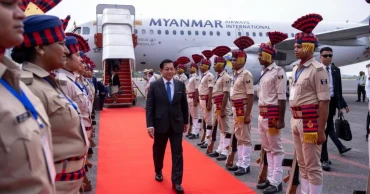
Myanmar President visits India to boost bilateral cooperation
Myanmar President Min Aung Hlaing on Saturday began an official visit to India, marking his first trip to the neighboring country since assuming the presidency in April after an election widely criticized by opponents as a move to preserve military rule.
According to Myanmar’s state-run MRTV, Min Aung Hlaing departed from Naypyitaw and arrived at Gaya International Airport in Bihar state. During the visit, he is scheduled to meet Indian President Droupadi Murmu, Prime Minister Narendra Modi, senior government officials, and business representatives.
Discussions are expected to focus on strengthening bilateral relations and expanding cooperation in economic, cultural, religious, and social sectors. The Myanmar leader, accompanied by cabinet members, will also tour key infrastructure projects in India.
India has maintained engagement with Myanmar’s military-led administration despite sanctions imposed by Western nations following the military takeover in 2021 that ousted the elected government of Aung San Suu Kyi. The coup triggered widespread unrest, armed conflict, and a prolonged humanitarian crisis.
Sharing a 1,643-kilometer border and a maritime boundary in the Bay of Bengal, India regards Myanmar as strategically important for regional security. The two countries have worked together on border management and intelligence cooperation to address insurgent activities in frontier areas.
India also hosts thousands of refugees who have fled violence in Myanmar, particularly from conflict-affected regions such as Chin state.
The visit has drawn criticism from pro-democracy activists. Justice For Myanmar spokesperson Yadanar Maung said hosting Min Aung Hlaing risks legitimizing a government accused of serious human rights violations.
In a statement issued Friday, she urged India to reconsider its support for Myanmar’s military authorities, including military cooperation and business relations, and instead back the people of Myanmar in their pursuit of federal democracy.
2 months ago
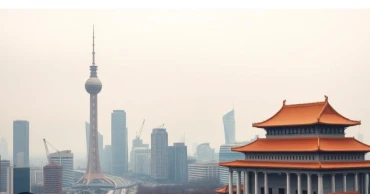
Chinese SOEs report 1.9 pc profit growth in first four months
Chinese state-owned enterprises (SOEs) and state-controlled enterprises reported combined profits of more than 1.37 trillion yuan (about 202 billion U.S. dollars) in the first four months of 2026, representing year-on-year growth of 1.9 percent, latest government data showed Friday.
During this period, Chinese SOEs' total operating revenue came in at roughly 26.27 trillion yuan, down 0.5 percent, according to data released by the Ministry of Finance.
The SOEs' debt-to-asset ratio stood at 65.5 percent at the end of April, the data revealed.
This year's government work report released in March states that the country will formulate and implement plans for further deepening SOE and state-capital reform to refine the layout of the state-owned sector and adjust its structure.
During an inspection tour last month to Qingdao, east China's Shandong Province, Chinese Vice Premier Zhang Guoqing underscored the need to unswervingly deepen the reform of SOEs to ensure that SOEs strengthen, optimize and expand their businesses.
He urged SOEs to enhance their role as major innovators and focus on tackling scientific and technological challenges in line with national strategic needs, in order to better support the development of the innovation ecosystem in the country.
2 months ago
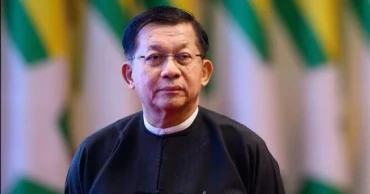
Myanmar president to lead delegation on official visit to India
President of the Republic of the Union of Myanmar, Min Aung Hlaing, will pay an official visit to India from May 30 to June 3 at the invitation of Indian Prime Minister Narendra Modi.
He will be accompanied by a high-level delegation comprising several Cabinet Ministers, senior officials and business leaders.
This will be the first visit of President Min Aung Hlaing to India in his current capacity, said the Indian Ministry of External Affairs on Thursday.
He was scheduled to visit India to participate in the International Big Cat Alliance Summit on 1 June (since deferred).
Myanmar lies at the confluence of India’s Neighborhood First, Act East and MAHASAGAR policies.
The official visit of President Min Aung Hlaing to India is expected to further strengthen and deepen the multi-faceted relations between the two countries.
During his visit to New Delhi, President Min Aung Hlaing will hold discussions with Prime Minister Narendra Modi on June 1 on further strengthening the historical and civilisational ties between the two countries. He will also participate in a business forum.
As part of the visit, President Min Aung Hlaing will also travel to Bodh Gaya on 30 May 2026 and to Mumbai on June 2 for business and industry interactions and site visits.
2 months ago
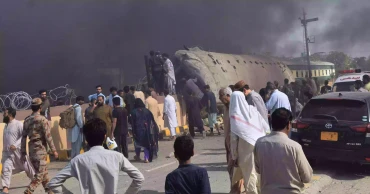
Suicide bombing in Pakistan kills at least 23
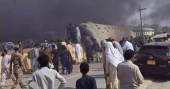
QUETTA, Pakistan (AP/UNB) — A suicide bomber detonated an explosives-laden vehicle near a railway track as a passenger train passed through the southwestern Pakistani city of Quetta on Sunday, killing at least 23 people and wounding over 70 others, officials said.
The force of the explosion caused two of the train cars to overturn and catch fire, sending thick black smoke into the air, according to footage shared online.
The attack happened in an area where security forces are usually stationed, badly damaging several nearby buildings and smashing more than a dozen vehicles parked along the road, according to witnesses and images circulating on social media.
Doctors at local hospitals said they had received the wounded, with 20 in critical condition. Three security officials told The Associated Press the bodies were transported to hospitals following the attack. The officials spoke on condition of anonymity to be able to speak to the media.
The outlawed Baloch Liberation Army, or BLA, which demands independence from Pakistan’s central government, has claimed responsibility for the attack in a statement sent to reporters. The militant group said it targeted a train carrying security personnel.
Quetta is the capital of insurgency-hit Balochistan province. The oil- and mineral-rich region has long been the scene of a low-level insurgency. The insurgents have frequently targeted security forces, government installations and civilians in the province and elsewhere in the country.
“We strongly condemn the targeting of innocent civilians and are deeply saddened by the loss of precious human lives. Terrorist elements deserve no leniency,” said Shahid Rind, Balochistan provincial government spokesman.
He said following the explosion, a medical emergency was declared at hospitals in Quetta, and an investigation has been launched.
Prime Minister Shehbaz Sharif strongly condemned the attack, calling it a “cowardly act of terrorism" in a post on X and offering condolences to the families of the victims.
Balochistan Chief Minister Sarfraz Bugti strongly condemned the attack in Quetta, saying the militants targeted “innocent civilians, including women and children,” vowing to “hunt (them down)” in a post on X.
Bugti and the federal government in Islamabad often use the phrase “Fitna al-Hindustan” to refer to the BLA, which they allege is backed by India. New Delhi denies the allegation.
Pakistan’s President Asif Ali Zardari denounced the bombing, saying militants and their backers sought to undermine Pakistan’s role in regional and international peace efforts.
The attack came a day after Pakistan said the United States and Iran were close to reaching a memorandum of understanding to end the war in the Middle East that began on Feb. 28 after the U.S. and Israel attacked the Islamic Republic, upending global travel and spiking oil prices. U.S. President Donald Trump had said a deal related to the conflict had been “largely negotiated” following calls with regional allies, including Pakistan.
Zardari promised in a statement that his country “will defeat terrorists, their facilitators, financiers and those providing them safe havens.”
Pakistan and India have long had strained relations and have fought two of their three wars over Kashmir, which is claimed by both in its entirety.
Although Pakistani authorities say they have quelled the insurgency, violence in Baluchistan has persisted.
At least 26 people, including soldiers, were killed in 2024 when a suicide bomber attacked a train station in Balochistan.
2 months ago
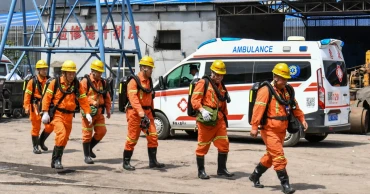
China's major coal mining disasters this century
A gas explosion at a coal mine in China’s northern province of Shanxi, the country's main coal mining province, killed at least 82 people, local officials said Saturday.
The cause of the explosion, which took place on Friday evening at the Liushenyu coal mine in the city of Changzhi, is under investigation.
With a size larger than Greece and a population of around 34 million, the province’s hundreds of thousands of miners dug 1.3 billion tons (1.17 billion metric tons) of coal last year — nearly a third of China’s total.
Mining disasters are common in China, where rapid industrialization came with intense resource exploitation, poor working conditions and a weak regulatory framework.
Mine owners and local officials are frequently blamed for putting profits ahead of safety. Underground explosions often are blamed on lack of ventilation equipment to clear gas that seeps from the coal bed. In the past two decades, the Chinese government has been making efforts to reduce mining deaths, by improving safety and closing some smaller mines.
Here are some major incidents:
2023: 53 people were killed after a collapse at an open-pit mine in northern China’s Inner Mongolia region.
2009: 108 miners died as a result of a gas explosion at the state-run Xinxing mine in Heilongjiang province near the border with Russia. State broadcaster CCTV displayed a diagram showing the miners trapped about a third of a mile underground. Footage showed one entrance was blocked and rescuers in orange suits with breathing equipment attempting to enter through another.
2005: 171 people died in a blast at the Dongfeng coal mine in Qitaihe in Heilongjiang province.
2005: 214 miners were killed following a gas explosion at the Sunjiawan coal mine in the Liaoning province in China’s northeast.
2004: 166 died in a gas explosion at the Chenjiashan coal mine in the Shaanxi province, in China's northwest.
2004: 148 people were killed in a gas explosion at the Daping coal mine in China's inland Henan province.
2000: 162 people died after an explosion at the Muchonggou coal mine in the mountainous Guizhou province in China's southwest.
2 months ago
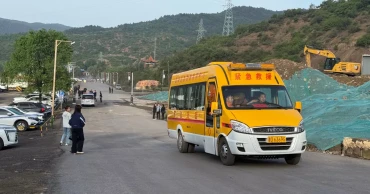
82 killed in China’s deadliest coal mine blast in years
A gas explosion at a coal mine in China’s northern Shanxi province killed at least 82 people, local officials said Saturday, in what was the country’s deadliest mining accident in recent years.
The official Xinhua News Agency said the accident at Changzhi city’s Liushenyu coal mine happened on Friday evening.
At a news conference late Saturday, local authorities said 82 were dead and that more than 120 people were hospitalized. Two were still missing. The death toll was a revised, lower number from earlier reports by state broadcaster CCTV that said 90 had died.
The scene at the coal mine was “chaotic” in the immediate aftermath of the accident, they said, and figures provided at the time were initial and not definite.
The explosion was under investigation, local officials said, adding there were “serious violations” of the law by the mine’s operator. They did not elaborate on any specific violations.
Earlier on Saturday, Xinhua reported that rescue work was pressing on a day after the accident, with hundreds of rescuers and medical personnel sent to the site. Among the injured, many were hurt by toxic gas, according to CCTV.
Chinese President Xi Jinping has called for an all-out effort to rescue the missing, Xinhua reported. Xi also called for a “thorough investigation" and accountability "in accordance with the law.”
Xinhua later reported that those responsible for the company involved in the mine accident have been "placed under control,” citing the local emergency management bureau.
An investigation team sent by China’s powerful State Council, equivalent to the country’s Cabinet, would be conducting a “rigorous and uncompromising” probe into the deadly explosion, a separate Xinhua report said following Xi’s remarks.
Wang Yong, one of the hospitalized miners, told CCTV in a video interview that he smelled sulfur “like firecrackers” and saw smoke.
“I told people to run,” he said. “As I ran, I saw people being choked by the smoke. And then I blacked out.”
The state broadcaster also reported that blueprints provided by the coal mine did not match the actual layout, hampering rescue efforts.
The coal mine, operated by the Shanxi Tongzhou Coal & Coke Group with an annual production capacity of 1.2 million tons, was placed on a national list of disaster-prone coal mines by China’s National Mine Safety Administration in 2024 for having “high gas content.”
Shanxi province is known as China’s main coal mining province. With a size larger than Greece and a population of around 34 million, the province's hundreds of thousands of miners dug 1.3 billion tons of coal last year, almost a third of China’s total.
In China, coal remains a key energy source due to its lower cost and high availability, even as the country accelerates its transition toward green energy. Mining disasters have been common although authorities had implemented measures to improve safety over the past years.
In February 2023, 53 people were killed after a collapse at an open-pit mine in northern China’s Inner Mongolia region. In November 2009, an explosion at a mine in northeastern China’s Heilongjiang province killed 108, according to state media.
2 months ago
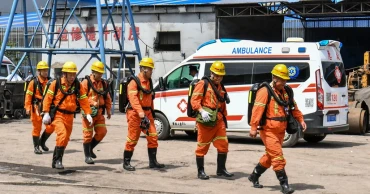
Coal mine gas explosion in China kills 90, rescue efforts continue
A gas explosion at a coal mine in China’s northern Shanxi province has killed at least 90 people, state media reported Saturday.
The accident took place on Friday evening at the Liushenyu coal mine in Changzhi city, according to the official Xinhua News Agency. About 247 workers were on duty at the time of the blast.
Xinhua initially reported early Saturday that eight people had died and 38 others were trapped underground. By Saturday afternoon, nine workers were still reported missing as rescue operations continued.
The cause of the explosion is under investigation, while emergency teams are pressing ahead with rescue work, Xinhua said. State broadcaster CCTV reported that many of the injured suffered from exposure to toxic gas.
Chinese President Xi Jinping has called for maximum efforts to rescue the missing and to determine the cause of the disaster, while ensuring those responsible are held accountable, according to Xinhua.
Shanxi province, China’s major coal-producing region, is larger than Greece and home to around 34 million people. Its vast mining industry produces hundreds of millions of tons of coal each year, accounting for nearly a third of the country’s total output.
2 months ago