Europe
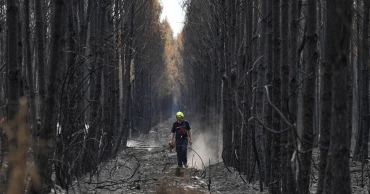
French wildfire near Bordeaux contained as firefighters battle separate blaze in Provence
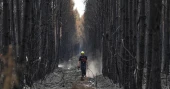
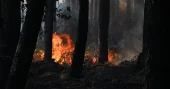
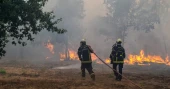
A massive wildfire near Bordeaux that burned an area four times the size of Paris and forced around 224,000 people to evacuate remained contained on Sunday, although it was still burning. Meanwhile, a separate wildfire in the Provence region stopped spreading overnight but had not yet been brought under control.
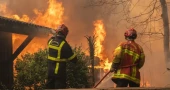
Around 3,000 firefighters were deployed across the two fire zones, working to extinguish hotspots, create firebreaks and secure burned areas as high temperatures and strong winds continued to pose the risk of flare-ups.
The wildfire in the Gironde region scorched about 420 square kilometres in just 10 days before authorities announced over the weekend that its spread had been stopped.
"The fire is now fixed, which does not mean that the fire is extinguished," the Gironde prefecture said on Sunday, using the French firefighting term for a blaze that has been contained within its perimeter.
The region remains under France's highest red forest fire alert, with dry weather, soaring temperatures and afternoon winds raising concerns that the flames could reignite.
Additional firefighting teams from Ukraine, Lithuania and French Polynesia were expected to arrive on Sunday and Monday to strengthen the response.
Scientists at World Weather Attribution said in a rapid analysis released on Thursday that human-caused climate change had doubled the likelihood of the extreme fire conditions that fueled the wildfires in France.
According to the European Union's Copernicus Climate Change Service, Europe is the fastest-warming continent, with temperatures rising at twice the global average rate since the 1980s.
The Gironde wildfire triggered one of the largest peacetime evacuations in modern French history, leaving many thousands of residents still displaced or unable to return home.
In southeastern France's Var department, nearly 1,500 firefighters continued battling another wildfire that burned around 18 square kilometres in just over a day.
Officials said the fire in the Gros Bessillon hills was stabilised on Sunday morning, meaning it had not expanded overnight. However, unlike the Gironde wildfire, it had not yet been officially declared contained.
Firefighting aircraft assisted ground crews as they worked to prevent the flames from reaching villages surrounded by vineyards, olive groves and wooded hills in the Green Provence region.
About 2,500 people were evacuated as the fire threatened nearby communities.
The latest blaze is the fourth major wildfire to hit central Var since July 19. Earlier this week, another smaller wildfire near Brignoles forced Hollywood actor George Clooney, his family and around 700 other residents to evacuate before firefighters brought it under control.
Prime Minister Sébastien Lecornu said the country's wildfires were largely under control but warned that changing weather conditions continued to pose a serious challenge.
He also announced the appointment of a national coordinator to oversee reconstruction efforts in fire-affected areas.
More than 1,170 square kilometres have been burned by wildfires across France since the beginning of the year.
1 day ago
Thousands breach Morocco-Spain border into Ceuta in ‘absolute chaos’
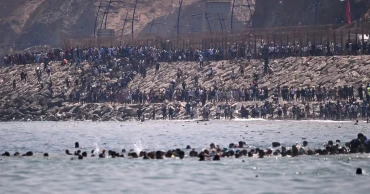
Thousands of migrants crossed into Spain’s North African enclave of Ceuta from Morocco on Thursday, prompting local authorities to call for a national emergency and military deployment to restore border control.
Spain’s Interior Ministry said it would ensure public safety and protect the country’s borders but said migration concerns did not justify declaring a national emergency.
“The situation is absolute chaos,” said Rachid Sbihi, head of the association representing Spain’s Civil Guard officers in Ceuta. He said thousands of people had crossed and the border had “totally collapsed.”
Videos showed large groups, mostly young Moroccan men but also families with women and children, entering through the Tarajal beach area. Some migrants shouted “Viva España!” as they arrived. Authorities have not yet identified the reason behind the sudden surge.
The crossings followed a sharp increase in attempts to reach Ceuta by sea on Wednesday, when at least three people died while trying to swim from Morocco. Moroccan authorities have not publicly commented on the situation.
Spain said Morocco was cooperating to stop further crossings and help return those who entered illegally. Interior Minister Fernando Grande-Marlaska is expected to visit Ceuta on Friday.
Ceuta’s regional leader Juan Jesús Vivas urged Madrid to declare a national emergency and send more police and soldiers to secure the border, saying additional forces were needed to protect residents and maintain control.
More than 1,500 migrants had entered Ceuta in the previous week, overwhelming reception facilities, officials said. Spain’s Interior Ministry said nearly 3,000 migrants had reached the territory by land or sea as of July 15.
The latest influx recalled a similar crisis in May 2021, when more than 8,000 migrants entered Ceuta over two days during a diplomatic dispute between Spain and Morocco. Ceuta, a Spanish territory on Africa’s northern coast, has long been a major entry point for migrants seeking a better life in Europe.
4 days ago
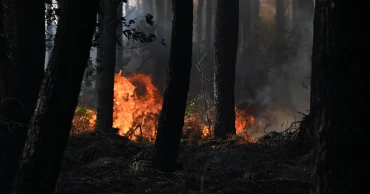
84,000 return home as France gains ground against massive wildfire
French authorities on Thursday allowed about 84,000 people evacuated by a massive wildfire in the country's southwest to return home, as cooler temperatures and improved weather conditions helped firefighters gain the upper hand against one of France's largest recent blazes.
The wildfire, which has scorched around 42,000 hectares of land in the Gironde region near Bordeaux, is no longer spreading, officials said, although firefighting operations continue to extinguish remaining hotspots.
The return of residents marks a significant step forward after about 224,000 people were forced to evacuate at the height of the crisis.
Regional authorities advised returning residents to wear gloves and face masks while cleaning ash from their homes and to remain prepared in case renewed evacuations become necessary.
The A63 motorway south of Bordeaux, a key transport route linking France and Spain, has also reopened ahead of the busy August holiday season.
More than 3,300 firefighters, supported by aircraft, helicopters and international assistance, remain engaged in containing the blaze. Crews are creating firebreaks, removing vegetation and carrying out controlled burns to prevent the fire from reigniting.
French Interior Minister Laurent Nunez said police water cannons had also been deployed to help extinguish lingering hotspots.
A drop in temperatures, higher humidity and light rainfall have provided much-needed relief after France endured its fourth heatwave of the year.
Across southern Europe, however, extreme heat continues to fuel wildfires. Firefighters remained engaged in battling blazes in Spain, Turkey, Germany and the United Kingdom, while Greece reported the deaths of three firefighters on the island of Crete.
In Romania, authorities shut down both reactors at the Cernavoda nuclear power plant because low water levels in the Danube River affected cooling operations.
Successive heatwaves and prolonged dry conditions have left much of southern Europe vulnerable to wildfires, forcing hundreds of thousands of people to flee their homes and holiday destinations in recent weeks.
4 days ago

Ukraine says it strikes major Russian oil refinery after Zelenskyy-Trump talks
Ukraine said Wednesday that its forces struck one of Russia's largest oil refineries overnight, intensifying military and economic pressure on Moscow just hours after President Volodymyr Zelenskyy met US President Donald Trump in Washington.
Ukraine's General Staff said the overnight drone strike set fire to the Ryazan oil refinery, one of Russia's largest refining facilities, with an annual processing capacity of about 17 million tons of crude oil. The plant produces gasoline, diesel, aviation fuel and other petroleum products.
The refinery is located in Russia's Ryazan region, roughly 400 kilometres from the Ukrainian border.
The latest attack is part of Ukraine's sustained campaign of long-range drone and missile strikes targeting Russia's energy infrastructure. Kyiv has increasingly relied on domestically developed weapons to hit oil depots and refineries deep inside Russian territory, seeking to disrupt fuel supplies and increase economic pressure on the Kremlin.
The strike came hours after Zelenskyy's visit to Washington, where he held talks with Trump as Ukraine seeks continued US military, financial and diplomatic support in its war against Russia.
Ryazan regional governor Pavel Malkov said six people were hospitalized following the drone attack. He said debris from downed drones caused fires at several unspecified industrial facilities but did not directly confirm damage to the refinery.
In a social media post, Zelenskyy said Russia must continue to bear increasing costs for the war.
"Russia must feel that every day of this war will only come at a higher cost for it. We need to weaken the aggressor and keep up the pressure to bring an end to this war closer," he said.
Ukraine's recent long-range strikes against Russian military and energy targets have been viewed as a demonstration of its growing domestic defense capabilities. The operations have also helped strengthen support in Washington after uncertainty earlier in Trump's second term over the future of US assistance to Kyiv.
5 days ago

Russia charges Telegram founder Pavel Durov with aiding terrorism
Russia's Federal Security Service (FSB) said Wednesday it has charged Telegram founder Pavel Durov with aiding terrorism and placed him on an international wanted list, escalating Moscow's campaign to tighten control over online platforms.
The move comes as Russian authorities continue to impose restrictions on Telegram, one of the country's most widely used messaging apps, amid a broader effort to strengthen state oversight of the internet since the start of the war in Ukraine in February 2022.
In a statement, the FSB accused Telegram's management of failing to remove numerous channels, chats and bots allegedly used by Ukrainian intelligence agencies and groups designated by Russia as terrorist or extremist organizations to coordinate acts of sabotage, terrorism, cyberfraud and other attacks that resulted in casualties.
The agency also claimed Ukrainian security services had used a Telegram-based dating chatbot to recruit Russians for sabotage and terrorist activities. According to the FSB, 46 users of the chatbot, aged between 12 and 22, have been detained across Russia since July 2025 on allegations including attacks on law enforcement officers and arson.
Earlier this year, Durov disclosed that Russian authorities had opened a criminal case against him, accusing the government of manufacturing grounds to restrict Telegram in an attempt to curb privacy and freedom of expression.
If convicted, Durov could face a maximum sentence of life imprisonment under Russian law.
Telegram did not immediately comment on the latest charges. According to the company's website, Telegram is headquartered in Dubai, where Durov—who holds French and United Arab Emirates citizenship—also resides.
Under President Vladimir Putin, Russia has steadily tightened control over the internet through restrictive legislation, website bans and technological measures aimed at monitoring online traffic. Popular platforms including Facebook, Instagram and X have been blocked, YouTube has been slowed, while Signal and Viber have been banned. Access to WhatsApp and Telegram has also been restricted.
Durov previously founded the Russian social media platform VK before launching Telegram. Russia unsuccessfully attempted to block Telegram between 2018 and 2020.
Although many users continue to bypass internet restrictions through virtual private networks (VPNs), Russian authorities have also sought to block many VPN services.
At the same time, Moscow has been promoting a state-backed messaging platform known as MAX, which officials describe as an all-in-one service for messaging, government services and digital payments. Critics, however, say the platform could facilitate government surveillance, noting that it shares user data with authorities upon request and does not provide end-to-end encryption.
Durov has also faced legal scrutiny outside Russia. In 2024, he was arrested in Paris over allegations that Telegram had been used for criminal activities, including drug trafficking and the distribution of child sexual abuse material. He later said he returned to Dubai in March 2025 after spending several months in France.
Following Durov's arrest in France, the Kremlin criticized the French authorities, describing their actions as "selective" while questioning why similar action had not been taken against other technology platform operators facing comparable allegations.
5 days ago
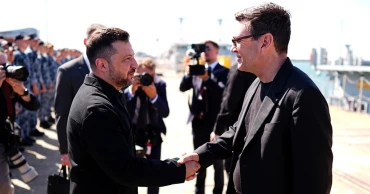
Zelenskyy, new UK leader discuss drone projects and missile defense
Ukrainian President Volodymyr Zelenskyy and new British Prime Minister Andy Burnham met Monday at a British naval base, discussing joint drone projects and Ukraine’s urgent need for ballistic missile interceptors to defend against Russian attacks.
Zelenskyy’s visit was the first by a foreign leader since Burnham took office a week ago. The prime minister said the visit demonstrated Britain’s “unwavering” support for Ukraine as it continues to defend itself against Russia’s nearly four-year-old full-scale invasion.
Burnham’s predecessor, Keir Starmer, visited Kyiv less than two weeks ago on his final foreign trip before leaving office. Burnham said he also planned to visit Ukraine soon.
Burnham is the fifth British prime minister Zelenskyy has dealt with since Russia launched its full-scale invasion in 2022.
“You are the first leader I have welcomed in person since taking office, and that is no accident,” Burnham told Zelenskyy. “It is intended to send a very clear message: we are with Ukraine 100%, I am personally with you 100%, and I will honor every commitment this country has made to Ukraine in full.”
Zelenskyy said relations between the two countries were “stronger than ever.”
The meeting took place aboard the aircraft carrier HMS Queen Elizabeth, docked at Portsmouth on England’s southern coast, a day before Zelenskyy is expected to meet US President Donald Trump in Washington.
Burnham said the two leaders had discussed Kyiv’s need for more interceptors to shoot down Russian ballistic missiles, particularly to protect Ukraine’s critical infrastructure during the winter.
“We’ve taken away some things that we will now follow up with our partners,” Burnham said after the meeting.
Russia has stepped up attacks this year on gas stations, power facilities and other infrastructure as part of a wider campaign aimed at disrupting Ukraine’s logistics and energy networks.
Zelenskyy said on X that the leaders also discussed “joint defense production.” Britain and Ukraine already have an agreement to cooperate on the development of new drones.
Before the meeting, Zelenskyy told Sky News that he hoped to establish a “big, big factory” in Britain.
The leaders also met more than 200 Ukrainian military personnel who had spent three weeks in Britain taking part in an exercise designed to strengthen their combat capabilities and improve measures to counter mines in the Black Sea, according to the UK government.
Burnham announced that Britain would provide Ukraine with the intellectual property behind its new “Stone Cloak” electronic warfare system. The technology can jam Russian air defenses and prevent drones from being detected.
Ukraine has expanded its campaign of frequent drone strikes deep inside Russia, targeting oil facilities, military factories and, most recently, logistics centers. The attacks have brought the war closer to millions of Russians and increased pressure on President Vladimir Putin.
The strikes have challenged Putin’s narrative that the war does not directly affect ordinary Russians. However, he has remained undeterred, while Russia has intensified its own aerial campaign, regularly attacking Ukraine with missiles and drones.
Russia and Ukraine exchange drone attacksRussia attacked Ukraine overnight with 147 long-range drones, according to Ukraine’s air force, which said 123 of them were intercepted or jammed.
In Zaporizhzhia, one person was killed and two others injured in overnight attacks that damaged a residential high-rise and several private homes, regional administration head Ivan Fedorov said.
A Russian strike on the town of Balakliia in the Kharkiv region killed one person and wounded eight, according to Vitalii Karabanov, head of the city’s military administration.
In the Nikopol district of the Dnipropetrovsk region, Russian strikes damaged a kindergarten, residential buildings and infrastructure, injuring a woman and a 6-year-old boy, administration head Oleksandr Hanzha said.
In the eastern Kharkiv region, regional council member Oleksandr Skoryk said Russian forces had destroyed every gas station along the highway between Kharkiv and Poltava, a route stretching about 150 kilometers (93 miles).
The highway is an important supply route connecting Kharkiv, Ukraine’s second-largest city and a regional hub near the Russian border, with central Ukraine.
Romania’s Ministry of National Defense said a drone briefly entered its airspace before crossing the river border into Ukraine, where explosions were later reported. Two F-16 fighter jets were deployed to monitor the airspace.
The incident was the fourth such incursion into Romanian airspace in four days. Romania, a NATO member, said the three previous drones were shot down.
In Moscow, Russia’s Defense Ministry said its air defenses had shot down 276 Ukrainian drones overnight.
Rostov regional Governor Yuri Slyusar said five people, including a child, were killed when a Ukrainian drone struck an apartment building in Rostov-on-Don.
Ukraine’s military General Staff said its forces had struck an export terminal in Rostov-on-Don, setting it on fire.
The Ukrainian military also said other strikes in the Russian-controlled part of the Kherson region targeted a ground relay station used to control drones and a bridge over the Henichesk Strait used by Russia for military logistics.
Russian fuel and supply depots were also targeted, it said.
In Belgorod, a city in southwestern Russia near the Ukrainian border, a Ukrainian drone attack injured 12 people, including two children, according to regional emergency officials.
Iran vows retaliation after Ukrainian strike on shipIranian Foreign Minister Abbas Araghchi said Ukraine had attacked an Iranian vessel in the Caspian Sea, killing a sailor.
In a statement on X Sunday, Araghchi condemned the attack as a “blatant U.N. Charter violation” carried out at Israel’s behest to draw Europe into its war.
He said he had made clear in phone calls with European Union foreign policy chief Kaja Kallas and Russian Foreign Minister Sergey Lavrov that the attack “can’t go unanswered.”
Zelenskyy said on X that Ukrainian long-range strikes in the Caspian Sea over the weekend achieved “very good results.” He said the targets included “vessels involved in transporting military cargo linked to Iran, as well as a warship.”
Ukrainian Foreign Minister Andrii Sybiha rejected Iran’s threats of retaliation as unjustified and baseless, saying Tehran’s weapons supplies to Russia had made it a direct accomplice in Moscow’s aggression.
“Iran has no standing to pretend to be a victim,” Sybiha posted on X, calling Tehran’s references to the UN Charter “absurd.”
Sybiha said Iran’s statements were an attempt to divert attention from Russian attacks on civilian shipping in the Black Sea, which he said would be discussed at an emergency UN Security Council meeting Monday.
7 days ago
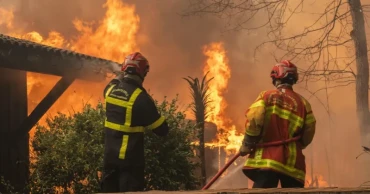
Over 300,000 evacuated as wildfires rage across France and Spain
More than 300,000 people have been forced to evacuate their homes as devastating wildfires continue to sweep through parts of France and Spain, with strong winds and scorching temperatures hampering firefighting efforts.
In southwestern France, firefighters are struggling to contain a massive blaze advancing toward the city of Bordeaux. Officials warned the fire remains far from under control, with shifting winds and extreme conditions making containment increasingly difficult.
French authorities ordered an additional 55,000 people to evacuate on Saturday, bringing the total number of evacuees in the Gironde and Landes regions to about 250,000.
Firefighter Captain Nicolas Braz said the blaze had become highly unpredictable, generating its own wind patterns and whirlwinds that were complicating firefighting operations. He warned that another difficult night lay ahead for emergency crews.
France has mobilized military personnel to assist firefighters by clearing vegetation and creating firebreaks, while additional reinforcements have been deployed to affected areas.
President Emmanuel Macron pledged government support for recovery efforts, saying France would rebuild and continue assisting affected communities for as long as necessary.
Smoke from the fires spread across Bordeaux on Saturday, leaving residents reporting a strong smell of burning in the air.
Tourists and residents described chaotic evacuation scenes as the fires approached populated areas. Some said thick smoke, ash and strong winds had made conditions increasingly hazardous.
The ongoing wildfire emergency has also disrupted sporting events. Organizers shortened Sunday's final stage of the Tour de France from 133 kilometers to 89 kilometers to allow security personnel to be redeployed to wildfire-affected regions.
French authorities said around 30 major wildfires were burning across the country, calling the situation unprecedented.
In neighboring Spain, where a state of emergency has been declared in some areas, firefighters continued battling major blazes west of Madrid despite some improvement in weather conditions.
Prime Minister Pedro Sánchez warned the country still faced "complex times ahead" even as cooler conditions offered firefighters some relief.
Authorities in the Valencia region also confirmed the death of a man believed to be in his 70s, whose body was found inside a burned vehicle after a wildfire in Manises.
Nearly 60,000 people have been evacuated from the Madrid and Ávila regions since the fires began, while more than 28,000 others remain confined to their homes, according to Spain's Interior Ministry. Additional evacuation orders were issued Saturday for several municipalities near Toledo.
Madrid regional President Isabel Díaz Ayuso described the disaster as the worst wildfire emergency in the region's history.
Sánchez said about 130,000 hectares of land have burned across Spain this year, exceeding the country's decade-long annual average of 100,000 hectares. In France, Interior Minister Laurent Nuñez said nearly 98,000 hectares have been destroyed by wildfires since the beginning of 2026.
Elsewhere in Europe, Italy has also been battling widespread fires, with more than 350 blazes, including 10 major wildfires, reported in Sicily. In Scotland, emergency services declared a major incident as firefighters continued efforts to contain a wildfire that has burned for 10 days in the Cairngorms National Park.
European Union officials warned that this year's wildfire season could surpass previous records. EU Commissioner for Crisis Management Hadja Lahbib said the fire season had started unusually early and cautioned that further outbreaks are likely as additional heatwaves are forecast.
To support affected countries, the EU has activated its Civil Protection Mechanism, deploying firefighting aircraft, helicopters and specialized personnel from several member states to assist France and Spain.
Source: BBC
8 days ago
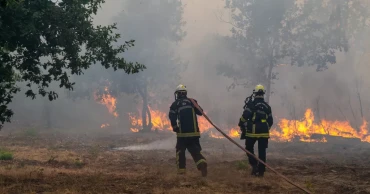
France, Spain battle wildfires as over 250,000 people forced to evacuate
France and Spain are battling massive wildfires that have forced more than 250,000 people to leave their homes, with authorities deploying thousands of firefighters and emergency personnel as extreme heat and dry conditions fuel the blazes.
In France, authorities shortened the final stage of the Tour de France on Saturday to free up security personnel for wildfire response efforts in the southwestern Gironde region, where tens of thousands of people have been evacuated, including residents from areas near the wine-producing city of Bordeaux.
A specially modified A400M military transport aircraft was deployed to drop fire retardants on a major blaze in Gironde. The Paris police department said Sunday's final stage of the race would be reduced by one-third, with riders now set to complete an 89-kilometre route inside Paris instead of the planned 133-kilometre course.
Part of the race's security force will be reassigned to support firefighting operations in affected areas, officials said.
French Interior Minister Laurent Nunez said the A400M aircraft would join 18 other firefighting planes and helicopters in what he described as a "long and very difficult" battle against the flames.
Authorities warned that shifting winds could push the fire closer to Bordeaux. Firefighters were digging containment trenches, using retardants and taking other measures to slow the spread of the blaze, which was about 30 kilometres west of the city.
The French government has mobilized soldiers and sent 1.5 million protective masks to help residents and emergency workers cope with heavy smoke. Evacuation orders were issued for areas between the fire and Bordeaux, including parts of western suburbs and nearby towns.
Prime Minister Sébastien Lecornu described the fires as unprecedented, saying the Gironde blaze had become so intense that it began creating its own wind patterns.
"Protecting human lives is our clear priority," he said, urging people to follow evacuation orders without delay.
In Spain, around 70,000 people have been evacuated as wildfires spread across several regions. The country deployed 2,600 firefighters, police officers and emergency personnel to tackle two major fires west of Madrid, supported by 19 aircraft and helicopters.
Residents described the speed and intensity of the fires as unprecedented. Javier Organista, a resident of El Tiemblo west of Madrid, said flames surrounded the area so quickly that residents had almost no escape route.
The wildfires, worsened by unusually early heat waves and the long-term effects of climate change, have overwhelmed firefighting efforts in parts of southern Europe.
Spain has recorded around 130,000 hectares of forest burned this year, exceeding the decade-long annual average of 100,000 hectares, Prime Minister Pedro Sánchez said during a visit to a fire command center.
He said improved weather conditions had created an opportunity for firefighters to contain the blazes. Several European countries, including Italy, Greece, Portugal, Croatia, the Netherlands, the Czech Republic and Slovakia, have provided or are preparing to provide firefighting aircraft and helicopters.
The Gironde fire began Wednesday near France's Atlantic coast and has grown to an "unprecedented magnitude," according to local authorities. Thousands of evacuees have been provided shelter and assistance in Bordeaux, where officials said facilities could accommodate up to 10,000 people if needed.
Authorities used emergency mobile alerts to instruct residents to leave affected areas, urging people to move quickly to safety.
9 days ago
Spain battles one of its largest wildfires as heat wave grips Mediterranean
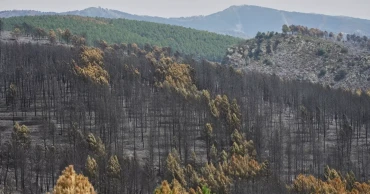
Firefighters continued battling one of Spain's largest wildfires on Wednesday as an intense heat wave spread across the Mediterranean, raising fears of more devastating blazes.
The wildfire in the rural province of Guadalajara has burned more than 32,000 hectares (79,000 acres), making it the second-largest wildfire in Spain's history after last year's 37,000-hectare blaze in the country's northwest. Authorities have evacuated 34 villages, though no deaths or serious injuries have been reported.
Prime Minister Pedro Sánchez visited the affected area and called for political unity to address climate change, saying rising temperatures and extreme weather are causing increasing destruction. He noted that Spain has already recorded 22 major forest fires this year, with more than 100,000 hectares scorched in the first half of 2026- matching the country's annual average over the past decade.
Ecological Transition Minister Sara Aagesen described the Guadalajara wildfire as the largest ever in Castilla-La Mancha and one of the country's biggest in recent history.
Regional authorities said firefighters, supported by water-dropping aircraft, have protected homes in all 40 villages within the affected area, most of which lies inside a national park. Officials hope to bring the nearly week-old blaze under control by Friday.
The fire comes less than two weeks after another deadly wildfire in southern Spain killed 13 people, including several foreigners.
Spain's weather agency warned that the current heat wave could worsen firefighting efforts, with temperatures expected to reach 40°C across much of the country and exceed 42°C in parts of Andalusia.
12 days ago
Ukraine reshuffles military leadership amid war with Russia
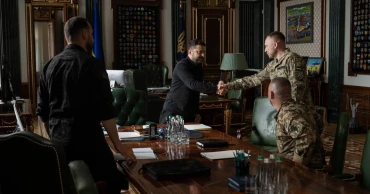
Ukraine pressed ahead with its war effort against Russia on Wednesday under a new military leadership after President Volodymyr Zelenskyy overhauled the country’s top defence command following days of political turmoil.
The changes came after Zelenskyy dismissed Commander-in-Chief Gen Oleksandr Syrskyi, responding to mounting public pressure and criticism over the military leadership. The reshuffle also saw Defence Minister Mykhailo Fedorov leave office, marking a significant overhaul of Ukraine’s defence establishment.
The leadership changes, announced late Tuesday, followed a week of political tensions that drew attention both at home and abroad, with Russian officials publicly welcoming the developments.
Maj Gen Mykhailo Drapatyi, 43, was appointed as the new commander-in-chief. Considered part of a younger generation of Ukrainian military leaders, Drapatyi first gained prominence in 2014 during Russia’s annexation of Crimea and has since built a reputation for his leadership on the battlefield.
Zelenskyy said the new military leadership has been tasked with presenting an updated defence strategy that includes continued reform of the army’s corps structure, faster delivery of weapons and drones, stronger air defence capabilities, and a clearer mobilisation plan.
The future role of former defence minister Fedorov remains uncertain.
The 35-year-old, widely credited with advancing Ukraine’s drone technology, had reportedly been at odds with Syrskyi over military reforms. His dismissal prompted protests in Kyiv and several other cities, where demonstrators demanded his reinstatement and called for Syrskyi’s removal.
Following the reshuffle, Zelenskyy said he had offered Fedorov a senior government position aimed at strengthening Ukraine’s technology sector, though it remains unclear whether the former minister has accepted the proposal.
Fedorov had earlier indicated that he had received job offers from several international defence technology companies after leaving office.
He welcomed Drapatyi’s appointment, describing it as a symbol of change and expressing hope that the new commander would strengthen Ukraine’s fight against Russian aggression.
Before his dismissal, Fedorov had publicly criticised Syrskyi, accusing him of obstructing military reforms and arguing that changes in the army’s leadership were necessary to sustain Ukraine’s resistance against Russia.
12 days ago