arts-culture
'Discovering A Doyenne': Documentary on writer Nahar Kamal Ahmed premieres in Dhaka
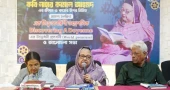
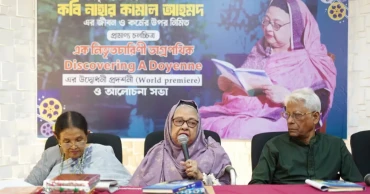
A documentary chronicling the life, literary journey and social engagement of veteran writer and social worker Nahar Kamal Ahmed premiered at Bishwa Sahitya Kendra in the capital on Thursday evening.
Titled 'Discovering A Doyenne', the 1-hour-42-minute documentary was directed by Dr Mahmud Nurul Momen. A new edition of Ahmed's book Ei Prithibi was also launched and unveiled at the event.
Prominent filmmaker Mosihuddin Shaker, director of the acclaimed film Surja Dighal Bari, attended the programme as chief guest, while Kamal Quadir, CEO of bKash, and mountaineer Nishat Mazumder, the first Bangladeshi woman to summit Mount Everest, attended as special guests.
Former Bangla Academy Director Rahima Akhter Kalpana conducted the programme.
7 hours ago
'Poet of the soil' Al Mujahidi remembered at Bangla Academy seminar
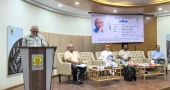
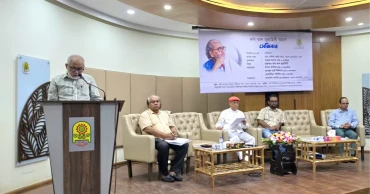
Noted poet Al Mujahidi was remembered at a seminar at the Bangla Academy on Wednesday, with speakers recalling his distinctive contribution to Bangla poetry and lifelong engagement with the soil, people and struggles of Bangladesh.
The Bangla Academy organised the seminar at 4pm at the Kobi Shamsur Rahman Seminar Room of the academy.
Bangla Academy Secretary Dr Md Selim Reza delivered the welcome address, while poet and essayist Dr Mahbub Hasan presented a paper titled ‘Mrittikar Kobi Al Mujahidi’.
National Press Club President and poet Hasan Hafiz and Dainik Jugantor Editor and poet Abdul Hai Shikder took part in the discussion. Bangla Academy Director General Professor Mohammad Azam chaired the event.
The programme began with a one-minute silence in memory of the late poet.
"Al Mujahidi is an unforgettable name in Bangla poetry. In his poems, the soil and people of this country have been illuminated with exceptional artistry," Dr Selim Reza said.
Presenting his paper, Dr Mahbub Hasan said, "One way to know Al Mujahidi is through his poetry. His inner world is reflected there, and we can experience its fragrance."
He said Al Mujahidi devoted himself to a long poetic journey through his works on Hiroshima and Nagasaki.
"It began in 1963 with ‘Kaado Hiroshima, Kaado Nagasaki’, written while he was imprisoned at Dhaka Central Jail," he said.
"From 1988 to 1999, he sharpened his pen to portray the brutality of imperialist destruction and crimes against humanity. This poetic journey proves how, with immense vitality, he used his sharp thoughts against the naked violence of human history," Dr Mahbub said.
Referring to Al Mujahidi’s widely recognised identity as the ‘poet of the soil’, Dr Mahbub said, "He created the soil in his poetry in many ways and in many forms. He felt a profound attraction towards that primordial soil from which this earth was formed, as well as towards the golden gateways of Gaur and the attics of civilisation."
"Although he sometimes spoke of living among heaps of stars, ultimately he spoke of returning to the soil," he added.
The discussants said Al Mujahidi was simultaneously a poet, translator, essayist, editor and intellectual fighter who gave Bangladesh and its people distinctive expression through his poetry.
They said he portrayed the fighting spirit and unique heritage of the people of this land throughout his literary career. As the literary editor of Dainik Ittefaq for many years, he also played a legendary role in nurturing and guiding many talented writers.
They further stated that the fearless fighter of the national liberation struggle consistently used his poetic voice to speak of peace, humanity, equality and a modernity rooted in the soil.
Poet’s daughter Paroma Al Mujahidi said, "My father always illuminated the country and its people through his poetry. Undoubtedly, his literary works will inspire the new generation in language, literature and patriotism."
Professor Mohammad Azam said, "Al Mujahidi was a unique personality in the field of poetry in Bangladesh. Alongside illuminating indigenous modernity in his poetry, he also explored foreign mythology for expressions of human fellowship."
"He left his distinctive mark through prose writings on poetry, translations of important poems from different languages into Bangla, and children’s literature," he said.
"His contribution to the history of literary magazine editing in this country can never be forgotten," Bangla Academy Director General added.
Sayera Habib, Bangla Academy Deputy Director, moderated the programme.
1 day ago
Shilpakala Academy to host training workshop on magic, followed by evening show
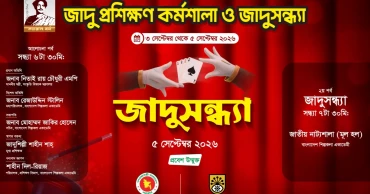
Bangladesh Shilpakala Academy (BSA) is set to organise a three-day magic training workshop and a magic evening as part of its initiatives to promote and develop magic as a performing art in the country.
The training workshop, organised by the academy’s Training Department, will be held from September 3 to 5 at Rehearsal Room 105 of the National Music, Dance and Recitation Building.
Magician Shaheen Shah will serve as the chief instructor, while Abu Sadat Md Mamun will work as an instructor and Sarmin Sultana Islam will provide training on the language and presentation style of magic.
The workshop will run from 10 am to 4 pm each day and will have 30 participants.
The three-day programme will conclude with a special event titled ‘Jadusandhya’ (Magic Evening) at the National Theatre Hall on September 5 at 6:30 pm.
Nitai Roy Chowdhury, Minister for Cultural Affairs, will attend the event as the chief guest, while Bangladesh Shilpakala Academy Director General poet Sheikh Rezauddin Ahmed (Rezauddin Stalin) will be present as the special guest. Academy Secretary Mohammad Zakir Hossain will preside over the event.
Chief instructor and magician Shaheen Shah will deliver the welcome address, while Training Department Director Shaheen Dil-Riyaz will deliver the vote of thanks.
The magic performance will remain open to all.
1 day ago
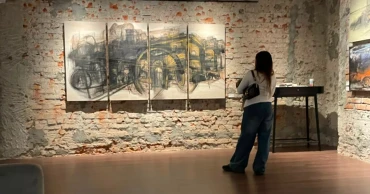
Kuntal Barai’s ‘Anatomy of Transit’ explores Dhaka’s movement and urban realities
The constant movement, congestion and psychological pressures of life in Dhaka take centre stage in contemporary artist Kuntal Barai’s upcoming solo exhibition, Anatomy of Transit, opened recently at Plat-forms Gallery in Gulshan.
The exhibition, featuring paintings, drawings and mixed-media works, explores the relationship between movement, infrastructure, urban pressure and the everyday experiences of people living in the rapidly changing metropolis.
Running from August 15 to September 5, Anatomy of Transit examines how the systems and rhythms of the city shape the ways people move, wait, negotiate and survive within its increasingly dense urban environment.
At the heart of the exhibition is Dhaka itself, portrayed not simply as a physical landscape but as a living organism in constant motion.
In Barai’s visual interpretation, roads resemble arteries, intersections function like vital organs, while vehicles become symbols of an urban body that remains perpetually active yet frequently under pressure.
Traffic, crowds, buildings, roads, bridges and fragmented spaces appear throughout the works, reflecting both the physical and psychological realities of navigating one of the world's most densely populated cities.
The artist’s compositions bring together fragments of roads, vehicles, architectural structures, human figures and abstract forms, creating layered visual narratives that capture the density and fragmentation of contemporary urban life.
While rooted in observation, Barai’s works move beyond documentary representation to explore movement as both a physical and metaphorical experience.
The exhibition considers movement as a reflection of aspiration, displacement, uncertainty, routine and the constant negotiation between individual lives and collective urban existence.
“Anatomy of Transit is not only about traffic or transportation. It is about the human condition within a city that is always moving,” according to the exhibition concept.
“The exhibition asks how we navigate spaces that are constantly changing and what happens to our sense of identity, memory and belonging within that movement.”
Through the exhibition, everyday elements of urban travel take on new meanings. A road becomes more than a route, a traffic signal represents a moment of pause, a vehicle becomes a temporary space of isolation, while an intersection turns into a point where countless individual narratives meet.
The exhibition ultimately presents Dhaka as both infrastructure and lived experience, revealing the energy, contradictions, vulnerabilities and aspirations embedded within the city's constant movement.
Kuntal Barai is a contemporary artist whose practice engages with urban environments, social realities and the visual complexities of everyday life. Through painting, drawing and mixed media, he explores the relationship between people and the rapidly transforming spaces they inhabit.
Anatomy of Transit will remain open for the visitors till September 5 from 11 am to 8 pm at Plat-forms Gallery, House 12/B, 5th Floor, Road 55, Gulshan 2, Dhaka.
2 days ago
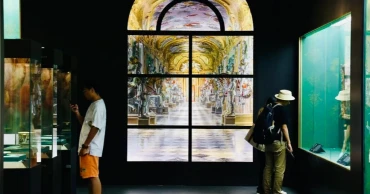
Centuries-old artefacts highlight vibrant China-Italy cultural exchanges in Tianjin
More than 150 Italian artifacts at an exhibition in Tianjin have highlighted centuries-old cultural exchanges between China and Italy, showing how Chinese silk, porcelain and decorative motifs influenced European art and tastes.
The exhibition, “Crown of Glory: 18th-Century Italian Court Treasures from the House of Savoy,” was jointly presented by the Tianjin Museum, Tianjin Digital Art Museum and Turin City Museum of Ancient Art in Palazzo Madama. It ran from Feb. 10 to Aug. 31.
Rather than focusing only on Italian royal splendor, the exhibition explored mutual influences between Chinese and European craftsmanship.
A French court gown featuring Chinese silk and embroidery reflects the popularity of “chinoiserie,” which became fashionable among European aristocrats and wealthy bourgeoisie by the mid-18th century. An ivory-colored men’s robe made with Chinese silk, weaving, block printing and hand painting also demonstrates the trend.
Chinese porcelain, silk and lacquerware became increasingly popular in Europe during the 17th and 18th centuries, influencing art, fashion and interior decoration.
3 days ago
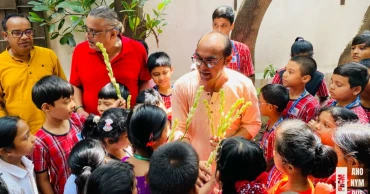
Taxila Vidyalaya celebrates children’s creativity with art festival
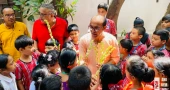
Taxila Vidyalaya hosted a colourful children’s art festival in the capital on Saturday, bringing together young artists in a celebration of creativity, imagination and self-expression.
The school campus came alive with the Art Festival 2026, themed “Culture Is the First Sunrise of Awakening”, organised by the social organisation 27 Dhanmondi in partnership with Tokshoshila School.
Parents, teachers and invited guests gathered at Tokshoshila School in the capital on Saturday to witness young minds at work.
Designed to nurture creativity, imagination and a love of the arts among children, the festival drew students from Grade One through Grade Ten, representing more than ten educational institutions across Dhaka.
5 days ago
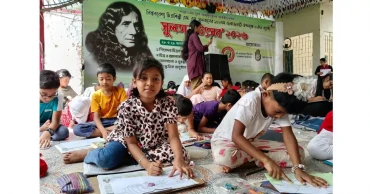
Two-day Sultan Festival begins in Narail
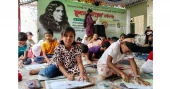
A two-day Sultan Festival began in Narail on Friday marking the birth anniversary of SM Sultan, widely regarded as one of the greatest artists of the Indian subcontinent, with more than 200 children taking part in an art competition on the opening day.
The festival has been organised by the SM Sultan Shishu Charu O Karukala Foundation on the Sultan Mancha premises of Narail Government Victoria College.
Mostafizur Rahman Alek, administrator of Narail District Council, inaugurated the festival around 10:00am.
More than 200 children participated in the art competition, depicting SM Sultan, natural landscapes, rural fairs, the Sultan Fair, the Liberation War and various other themes through their paintings.
The organisers said the event was arranged to introduce children to Sultan’s artistic vision and works and encourage them to develop an interest in art.
The festival features an exhibition of paintings by children, a discussion on Sultan’s life and works, and a cultural programme in addition to the art competition.
Among others, Narail Government Victoria College Principal Prof Haider Ali Dewan, District Primary Education Officer Md Jahangir Alam, SM Sultan Charu O Karukala Foundation President Sheikh Hanif, retired professor and artist Bimanesh Biswas of the Fine Arts Department of Khulna University, lecturer of SM Sultan Charu O Karukala College Anadi Bairagi, Sultan Memorial Museum Curator Tandra Mukherjee, Assistant Curator Mehedi Hasan Rana and Sultan admirers attended the inaugural programme.
The festival will conclude on Saturday.
The 103rd birth anniversary of internationally acclaimed painter SM Sultan was observed on August 10.
6 days ago
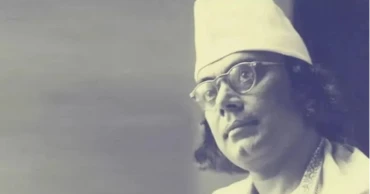
Nazrul’s 50th death anniversary observed
The 50th death anniversary of national poet Kazi Nazrul Islam was observed on Thursday.
Nazrul, revered as Bidrohi Kobi (a rebel poet) for his activism for political and social justice, breathed his last in Dhaka on 12th Bhadro of Bangla calendar year 1383 (August 29, 1976) at the age of 77. He was buried with full state honours beside the Dhaka University (DU) Central Mosque.
Nazrul produced a large volume of poetry and music with themes that included religious devotion and spiritual rebellion against all sorts of oppression.
Different socio-cultural and political organisations arranged elaborate programmes on the occasion. Television channels aired special programmes on his works and life to observe the day.
The programmes started with Qurankhwani after Fajr prayers at the DU Central Mosque by different organisations while a discussion was held at the campus.
Later, DU teachers and students and other political and socio-cultural organisations placed wreaths at the grave of the national poet in the morning.
Bangladesh Shilpakala Academy organised a two-day preogramme marking the death anniversary of the national port.
Kazi Nazrul Islam was born on May 24 in 1899 at Churulia village in Asansol subdivision of Burdwan district of West Bengal, India.
Following Bangladesh’s independence, Nazrul was brought to Dhaka with his family on May 24, 1972, with special permission from the government of India.
He was given the status of National Poet, provided with state accommodation in Dhanmondi, awarded an honorary D. Litt. by Dhaka University in 1974, and granted Bangladeshi citizenship in 1976. The same year, he was honoured with the Ekushey Padak.
Meanwhile, BNP acting Secretary General Ruhul Kabir Rizvi Ahmed on Thursday said National Poet Kazi Nazrul Islam was an inspiration behind all major movements in Bangladesh from the country’s independence war to the 2024 mass uprising.
He made the remarks after paying tribute to Kazi Nazrul Islam at the poet’s grave on the Dhaka University campus in the morning.
7 days ago
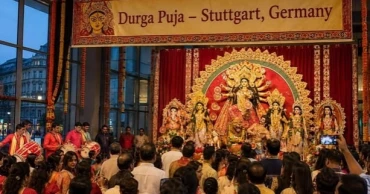
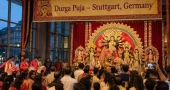
Durga Bari Stuttgart to celebrate Durga Puja 2026 in Stuttgart, Germany
Durga Bari Stuttgart, a vibrant cultural and social organisation of the Bengali community living in Stuttgart, Germany, will host its grand Durga Puja 2026 celebration from October 2026 16 to 20 at Martin-Luther-Str.
The five-day festival will feature traditional Durga Puja rituals and customary ceremonies conducted in accordance with the Hindu Panjika (almanac), alongside a colourful lineup of cultural programs, authentic Bengali cuisine and Bengali street food, said a media release on Thursday.
The popularity of Durga Puja celebration is no longer confined to Stuttgart or the federal state of Baden-Württemberg. Today it is regarded as one of the foremost annual gatherings for the Bengali diaspora across Germany.
“Dear members, guests and friends, we extend our warmest greetings to you all. Durga Bari Stuttgart is not merely an organization - it is a true home for our culture, heritage and community. Throughout the year, we organise various festivals and cultural programs that bring people together and encourage cross-cultural exchange,” said Bimal Agarwala, President, Durga Bari Stuttgart.
“Engaging the next generation is also one of our special goals - we want young people to become familiar with their cultural roots and carry that heritage forward with new-found enthusiasm. This is how we build a living bridge between the past, present and future. I warmly invite you all to join our event and celebrate the diversity of our culture together with us.”
Durga Bari Stuttgart is a vibrant organisation of the Bengali community living in Stuttgart, Germany, which nurtures the heritage and culture of Bengal through religious observances, cultural events and social gatherings, and continues its efforts to pass this legacy on to the next generation.
14 days ago

Chinese Valentine's Day rooted in legend, tradition beyond romance
Chinese Valentine's Day is about much more than flowers and chocolates. Known as Qixi, the ancient festival combines romance with legends, prayers and traditional cultural practices that continue to be observed today.
Qixi is celebrated on the seventh day of the seventh month of the Chinese lunar calendar, which fell on Aug. 19 this year. The festival is also observed in Singapore, Vietnam and several other Asian countries.
14 days ago