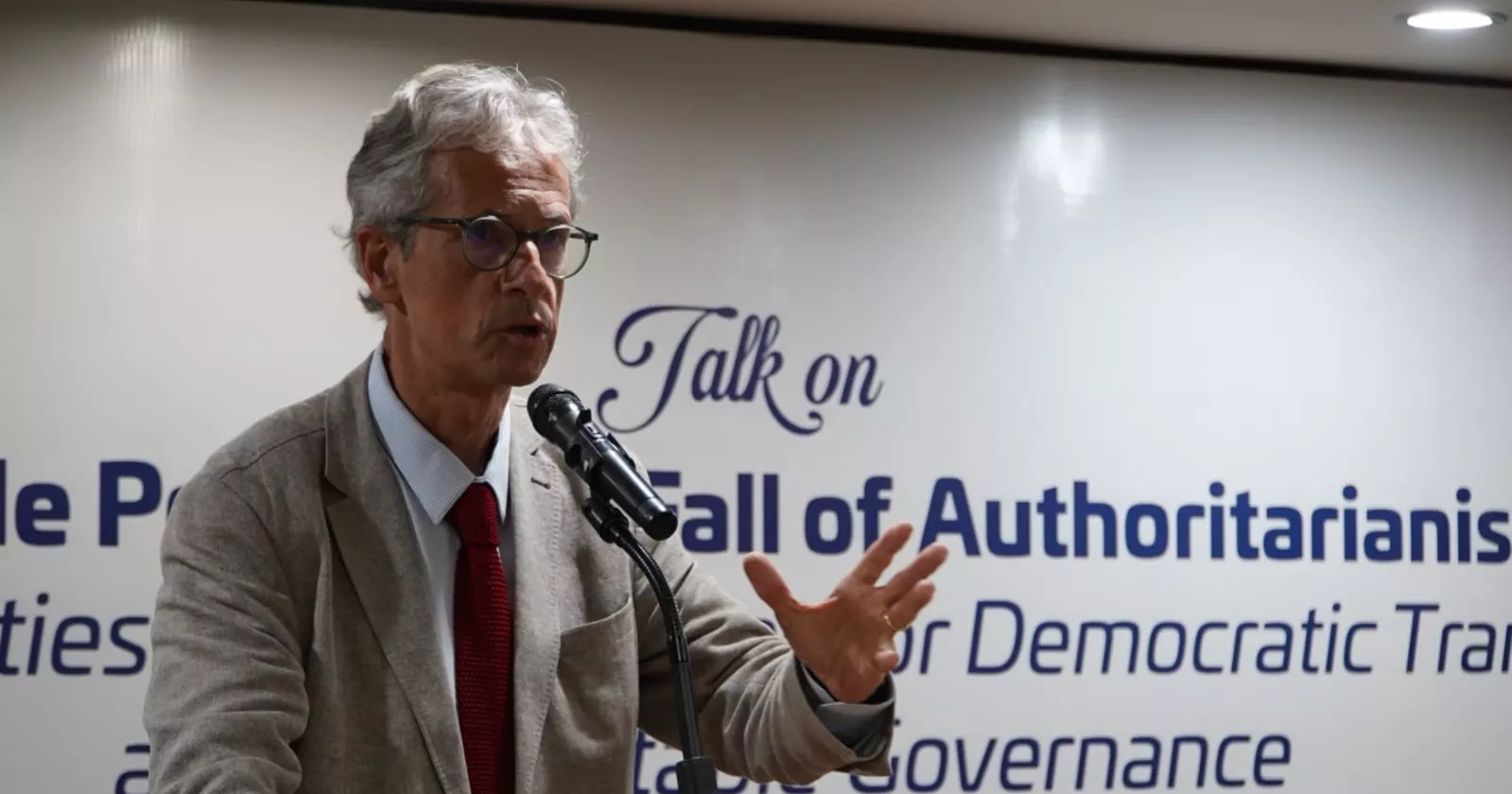
Transparency International (TI) Chair François Valérian has said Bangladesh has the historic opportunity to create a new democracy, not a democracy of the past, which in many countries consisted and still consists solely of more or less regular elections held to select those who will extract profit from power, but the democracy of the future.
He laid emphasis on the full participation of the young people, women and marginalised communities in the process, a democracy where power, in the true sense of the word, at last belongs to the people.
The TI chair talked about a kind of democracy where all the citizens are considered as who they are, - the public officials, private sector employers and political leaders are accountable, and finally, citizens have the right to know and to voice their demands and concerns about everything that may affect their lives without fear or intimidation.
As part of the concluding day of his official visit to Dhaka, Transparency International Chair François Valérian had a dinner meeting on Thursday at TIB’s Dhaka office with civil society representatives, as well as delegates from donor agencies, embassies, and other key stakeholders.
He delivered a talk on “People Power and the Fall of Authoritarianism: Opportunities and Challenges for Democratic Transition and Accountable Governance.”
He highlighted the role of citizens in resisting authoritarian practices and advancing accountable governance.
The talk was followed by an open discussion, where dignitaries shared perspectives on pressing issues such as the current political landscape, indigenous rights, corruption, people’s power, and authoritarianism.
The TI chair said what the civil society and the current authorities in Bangladesh are doing also has to be supported by the international community.
He said all countries, those where public money is stolen or where bribes are paid in the public sector, and those where stolen money is supposedly safe, have a common interest in cooperating for a world with better-being for all.
“Confrontation is never, has never been the right approach to address global challenges,” said the TI Chair.
He said Bangladesh has a historic opportunity to set an example for the world in breaking the vicious circle of authoritarianism, - where authoritarian regimes in many countries steal so much money that citizens become desperate and are still more victims of abuse of power and corruption.
In the face of a global rise of authoritarianism, Valérian said, the New Bangladesh began its journey with a dream born from unprecedented sacrifices that overthrew authoritarian rule. To fulfill that dream, it is essential to maintain the continuity of reforms.
Although corruption still exists even after the fall of the authoritarian government, the fight against it must continue, he said on the final day of his first visit to Dhaka during a ‘Meet the Press’ session with journalists from various media outlets.
The program was also attended by TIB Executive Director Dr. Iftekharuzzaman; Adviser, Executive Management Prof Dr Sumaiya Khair, and Communication & Outreach Director Mohammad Tauhidul Islam.
Transparency International Chair François Valérian due Tuesday
Reflecting on his visit to Dhaka, he also noted that had billions of dollars not been laundered abroad, Bangladesh’s GDP could have been significantly higher.
He emphasised the need for global cooperation, adequate civic space, and an independent judiciary to effectively combat corruption.
TI Chair Valérian said, “Our global movement admires what is happening in Bangladesh. We know the stakes are high and that reforms are ongoing. All these reforms must be sustained. There needs to be a sustainable effort that delves deeply into the necessary reforms of the state and into how power is exercised at every level in Bangladesh.”
Addressing the challenges faced by the Interim Government, the TI Chair said, “The challenges are high and I feel that the interim government is aware and genuinely willing to address those challenges. Corruption did not vanish from the country after fall of the authoritarian regime. But there are reforms that are being worked on. Some of them have started, some of them are being implemented and that is what counts.”
In response to a question from journalists, Valérian said, “For speaking out against corruption, TIB has always been criticized by those in power. At every government’s tenure, TIB has pointed out mistakes and shortcomings and offered criticism. Since its founding, no government has refrained from criticizing TIB. After the elections in February, the government that comes to power may also feel uncomfortable due to TIB’s watchdog role.”
Supporting Valérian’s statement, Dr Iftekharuzzaman said the average annual outflow of 16 billion dollars from Bangladesh during the rule of the fallen authoritarian government is only a partial estimate; the actual amount laundered is much higher.
Over the past 15 years, he said, more than twice the total amount of annual foreign investment—combined with foreign development aid—has been siphoned off through corruption, said Dr Iftekhar.
Closing all avenues for money laundering is therefore far more effective and important, he said. “With political will and institutional capacity, it is also a more realistic approach.”