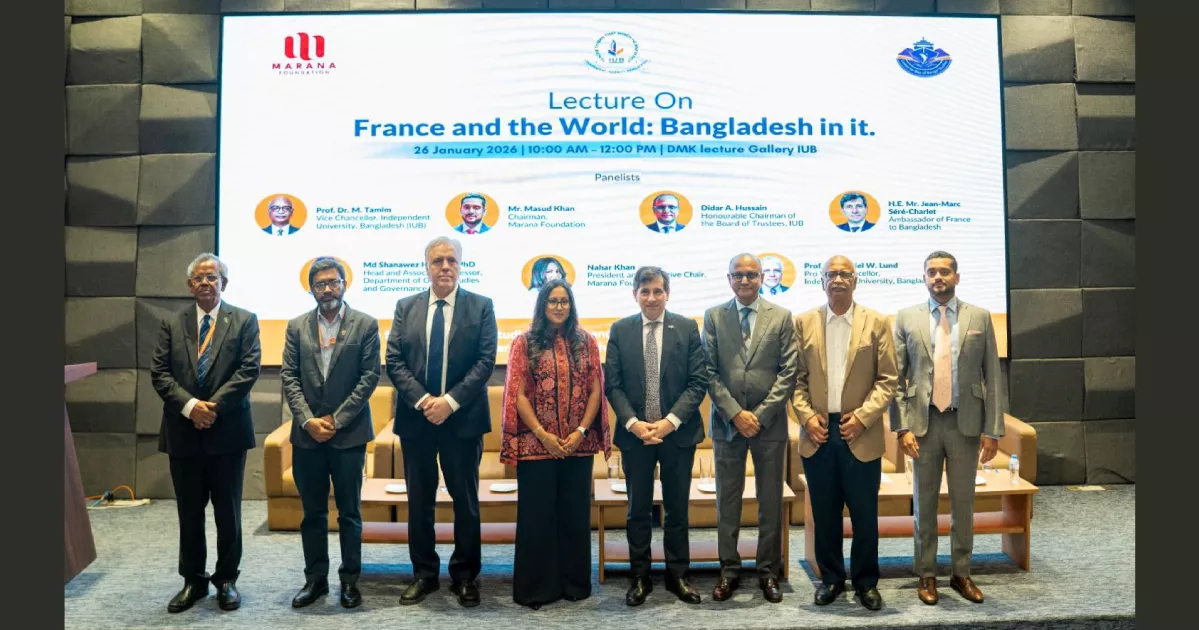
President and Executive Chair of the Marana Foundation Nahar Khan on Sunday said Bangladesh–France relations are evolving beyond traditional development cooperation, increasingly shaped by economic complementarities, shared innovation agendas and long-term strategic alignment.
She said while delivering the concluding remarks at a lectures series titled “France and the World: Bangladesh in it” jointly organised by the Center for the Bay of Bengal Studies and Marana Foundation in partnership with the Department of Global Studies and Governance of Independent University, Bangladesh.
Khan said the day-long discussion examined bilateral ties from diplomatic, strategic, environmental, economic and regional perspectives, reflecting the growing depth and maturity of the partnership.
“What emerges clearly is that this partnership is no longer defined solely by traditional development cooperation,” she said. “It is increasingly shaped by economic complementarities, shared innovation agendas and a long-term strategic alignment.”
Ambassador of France to Bangladesh Jean‑Marc Séré‑Charlet delivered the keynote speech at the event as the chief guest while chairman of the Marana Foundation Masud Khan delivered the opening speech.
Nahar noted that both countries contribute uniquely to shared global goals, citing France’s expertise in technology and sustainable development and Bangladesh’s strong economic growth, creative industries and demographic dynamism.
“We are uniquely positioned to complement and learn from one another,” Khan said, adding that sustainable partnerships are also forged through universities, research centres and dialogue platforms, where ideas are tested and future leaders are engaged.
Expressing hope for expanded cooperation, she said such exchanges could deepen collaboration in cultural diplomacy through arts and people-to-people connectivity, climate action, digital innovation, security cooperation, and ethical and inclusive frameworks for emerging technologies.
“At Marana Foundation, we believe that meaningful dialogue must go beyond statements and symbolism,” she said. “It must create space for honest discussion, mutual learning and long-term collaboration—and today’s seminar was intended to be a space just for that.”
Khan expressed gratitude to French Ambassador to Bangladesh Jean‑Marc Séré‑Charlet, saying his engagement reflected the depth and future potential of Bangladesh–France relations.
She also thanked the Centre for Bay of Bengal Studies and the Department of Global Studies and Governance at the International University of Bangladesh (IUB) for co-organising the seminar.
Acknowledging institutional leadership, Khan expressed appreciation to IUB Vice-Chancellor Professor M Tamim, Board of Trustees Chairman Didar A. Hossain, Pro-Vice-Chancellor Professor Daniel W. Lund, Rear Admiral Khurshid Ullam, Director of the Centre for Bay of Bengal Studies, and Ambassador Tariq Kareem, Advisor to the Centre, for advancing dialogue and research on regional, maritime and governance issues.
She also thanked all participants, noting that their contributions enriched the discussion and reinforced the importance of sustained Bangladesh–France engagement.