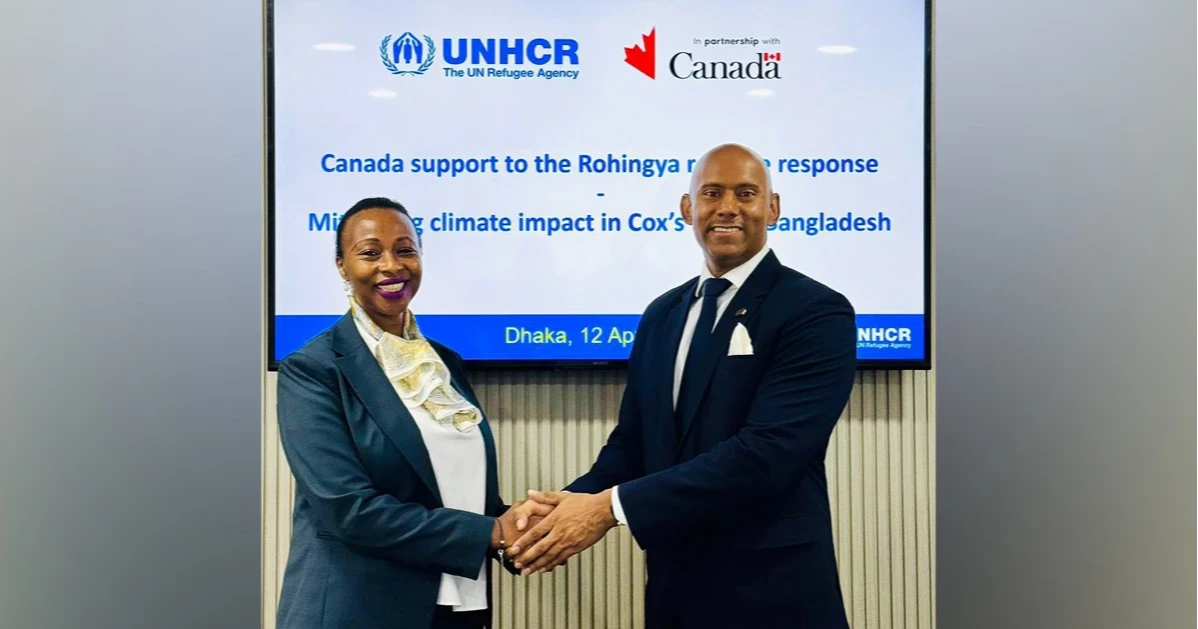
Canadian High Commissioner to Bangladesh Ajit Singh on Sunday said Canada remains a ‘longstanding and steadfast partner’ in the Rohingya crisis response and accounted CAD 10 million contributions to provide clean, safe and sustainable cooking fuel for the Rohingyas in Cox’s Bazar.
“This climate-responsive humanitarian contribution will reduce deforestation and carbon emissions in an environmentally fragile district that will benefit refugees, Bangladeshis, and the wider population,” said the High Commissioner.
He said it will also lower the risks to vulnerable people, especially women, girls, and children, including those that stem from gathering firewood.
“Canada is pleased to provide this $10 million contribution to UNHCR and IOM to strengthen environmental protection that benefits us all, as well as advance the wellbeing of vulnerable Rohingya refugees,” said the High Commissioner.
The funding to UNHCR, the UN Refugee Agency, and IOM, the International Organization for Migration, will ensure the continued provision of liquefied petroleum gas (LPG) to the Rohingya, essential for them to cook, while helping to preserve the fragile environment surrounding the camps and improve safety, health and dignity for refugees, particularly women and children, said the UN agency.
Cox’s Bazar, one of the most climate-vulnerable regions of Bangladesh, faces recurrent flooding, landslides, cyclones, fires and environmental degradation.
Since the start of LPG distribution to Rohingya refugees, the programme has reduced firewood use by 80% among refugee households, preventing an estimated 407,000t of CO₂ emissions every year.
“Nine years on, Rohingya refugees are navigating one of the world’s most difficult displacement situations – protracted crisis compounded by climate vulnerability,” said UNHCR Deputy Representative in Bangladesh Juliette Murekeyisoni.
“Canada’s support comes at a crucial time, and I am deeply grateful for it. Sustained international solidarity remains critical to ensuring that refugees can live in dignity while we work toward conditions for their voluntary, safe, and dignified return.”
Chief of Mission for IOM in Bangladesh Giuseppe Loprete said safe, reliable energy is fundamental to the well-being of families who have experienced immense hardship for the past nine years.
“We thank Canada for their generous support, which ensures that refugees can avoid dangerous firewood collection and live in healthier environments, while also protecting local forests and biodiversity.”
The provision of LPG has been central to the response since 2018. Studies have shown it has dramatically improved indoor air quality in the densely populated camps and lowered household spending on cooking fuel.
The UN refugee agency said Canada’s contribution will support LPG access for some 243,500 refugee households and help conserve up to 10,700 hectares of protected forest in Cox’s Bazar.
It also strengthens community resilience by stabilizing slopes, reducing landslide risks, and lowering human wildlife conflict around ecologically sensitive areas.