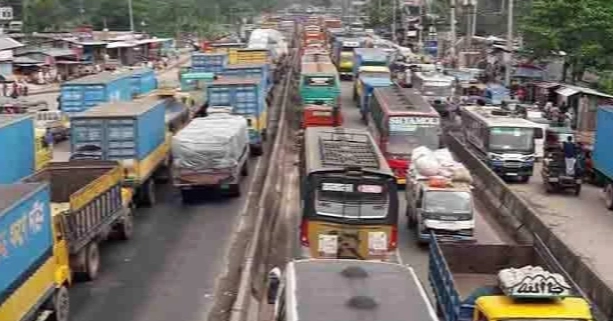
Bangladesh has a long history of poor traffic management and the situation is particularly alarming on its highways, where frequent road fatalities, disruptions and obstructions cause immense suffering to travellers, especially businesspeople.
Among the country’s highways, Dhaka-Chattogarm Highway, which is considered as a lifeline of the country’s businesses, has now turned out to be a horrific time killer.
“I had to go to Mirsarai, Chattogram on Friday (Aug 9). I started my journey at 6:30 am and was supposed to reach Mirsarai at 9:30 am. But I reached there at 1:30pm, three hours behind the schedule; really distressing!” MA Baten Khan, a businessman, told UNB.
Deeply disturbed, Baten said, “There was a journalist with me who talked to the SP concerned (Highway Police). The SP then facilitated the removal of obstructions created on the important national highway.”
Baten said he did not see any highway police vehicle patrolling the highway until Fazilpur point in Feni district where a minor accident obstructed the huge traffic flow, mostly covered vans.
The businessman said the traffic jam he first saw at Meghna Bridge point was attributed to remarkably slow toll collection at the bridge point. “I just wonder why should the toll collection process slow down the traffic? The automated toll collection system should have been in place long ago, as we are calling it ‘Digital Bangladesh’!
Talking to UNB, Md Khairul Alam, Superintendent of Police (Highway Police, Cumilla Region), said, “Every year, more and more vehicles are hitting the country’s roads, mounting the traffic pressure, but we have no adequate manpower to handle the complicated situations on national highways.”
He said the Cumilla Region covers the highway stretching from Daudkandi Bridge to Teknaf, along with highways under all districts of the Chattogram Division.
“But to cover this vast area, there are only about 700 police personnel. In comparison, a single district police unit like Chattogram District Police has around 3,000 police personnel. With such a limited force, it is extremely difficult to manage such a huge region,” he added.
Of the 700 manpower, he said, a portion of the police members are involved in guarding 22 highway police stations alongside highway police outposts and other offices. “That’s means around 400 police members are performing their duties in two shifts - -day and night.”
About the allegations that the Highway Police are seen less active since the fall of the previous government following last year’s mass upsurge in August compared to their presence before 2024, SP Khairul Alam said, “This is not true. During the July–August movement last year, about a number of vehicles, including rakers, motorcycles, and patrol cars, were torched. As a result, our patrol activities were severely disrupted. That’s why it has been difficult to reach accident spots or emergencies on time.”
He went on to say, “Despite the shortages of manpower and equipment, we are trying to manage the situation. But in the long run, reducing congestion will not be possible without infrastructural development and manpower increase.”
Businessman Baten Khan also said the Dhaka-Chattogarm Highway is a very crucial national highway and it should have been expanded long ago as the country’s businesses largely depend on it.
Everyday traffic on the highway was found to be 35,482 in 2019 which rose to 46,501 in 2024, according to Roads and Highways Department (RHD) data.
Another official of the Highway Police said overloaded vehicles also cause serious damages to the country’s roads and the government has to spend over Tk 861 crore every year to repair those.
Congestion-prone Points
The highway’s congestion-prone points are Daudkandi Toll Plaza, Gouripur Bazar, Chandina Bus Stand, Madhaiya Bazar, Nimsar Bazar, Cantonment area, Alekharchar (Bishwa Road U-turn), Suagazi Bazar, Mia Bazar and Chauddagram Bazar in Cumilla district.
Feni’s Lalpol, Bhatiari Point, Faujdarhat U-turn, Barbakunda Bazar, Chhota Kumira, KDS intersection, and Sitakunda bus stand are also known for traffic jams.
Padua Bazar Problem
Padua Bazar, where the Dhaka–Chattogram and Cumilla–Noakhali highways meet, serves as a crucial bypass for traffic moving through six southeastern districts. But with construction of the planned loop stalled, vehicles are forced to rely on risky crossings, as the U-turn needed to access connecting routes remains incomplete.
According to UNB’s Cumilla correspondent, a 105-kilometre stretch from Chauddagram to Daudkandi in Comilla is in an alarming state, with key sections in Chauddagram upazila, including Noapara, caving in.
As some 80% of Bangladesh’s international trade flows through this route, experts say authorities must prioritise the Dhaka–Chattogram Highway without further delay.