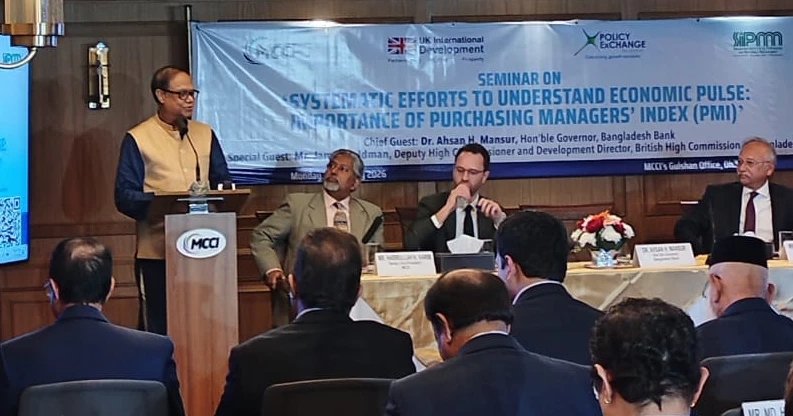
Bangladesh’s economy has not suffered any adverse impact despite the delay in receiving the sixth tranche of the International Monetary Fund (IMF) loan, Bangladesh Bank Governor Ahsan H Mansur said on Monday, stressing that the country has managed the economic challenges on its own strength.
Speaking at a seminar titled 'Systematic Efforts to Understand Economic Pulse: Importance of Purchasing Managers’ Index (PMI)', organised by the Metropolitan Chamber of Commerce and Industry (MCCI), the governor said Bangladesh Bank has purchased around $3.7 billion from local banks, an amount significantly higher than the pending IMF tranche.
“By making the taka attractive rather than weakening it, banks have voluntarily sold dollars to Bangladesh Bank,” he said, adding that as a result, Tk 45 billion has been injected into the domestic market in exchange for foreign currency.
Referring to the recent liquidity stress in the banking sector, Dr Mansur said the situation has started to ease, with deposits picking up at a satisfactory pace.
“Liquidity is the oxygen of the economy. For a long time, the market was suffocating due to a lack of oxygen. That phase is gradually ending and the situation is returning to normal,” he said.
The governor reiterated that the central bank aims to bring inflation below 5 percent, noting that any decision to reduce the policy rate would depend on trends in global commodity prices and domestic supply conditions.
“Once inflation comes down, the policy rate will also be reduced,” he said adding that Bangladesh Bank is considering a 2 percent policy rate concession for prime and creditworthy borrowers.
Confidence in banking sector only partly restored: Bangladesh Bank Governor
He, however, cautioned that the central bank would not abruptly cut rates in a way that could shock the market.
Dr Mansur also expressed confidence that the country’s foreign exchange reserves would cross $35 billion within the current fiscal year. “We will very comfortably achieve the targeted reserve level. Bangladesh Bank is currently in surplus in terms of balance of payments.”
Highlighting the central bank’s liberal economic approach, the governor said Bangladesh Bank does not discriminate on political or other considerations when extending support to businesses.
“We assist institutions that are currently in trouble but have the potential to recover. We have supported companies such as Gazi Tyre, Bashundhara and Monno Ceramics. We operate in a colour-blind, liberal manner, " he said.
On PMI data, the governor said Bangladesh Bank has no objection to the private sector being responsible for generating the data, but advised maintaining regularity in publication to ensure credibility.
He expressed optimism that Bangladesh’s economy would gain fresh momentum after the election, with improvements in the money market and an increase in large-scale investments.
At the event, British Deputy High Commissioner and Development Director to Bangladesh
James Goldman said the UK looks forward to continuing its cooperation with Bangladesh, particularly by maintaining trade preferences in the UK market for a certain period after Bangladesh’s graduation from the LDC category.
Bringing back laundered funds may take 4–5 years: BB governor
MCCI President Kamran T Rahman described PMI as an effective real-time economic index, calling it one of the best tools for navigating complex economic conditions and achieving evidence-based outcomes.