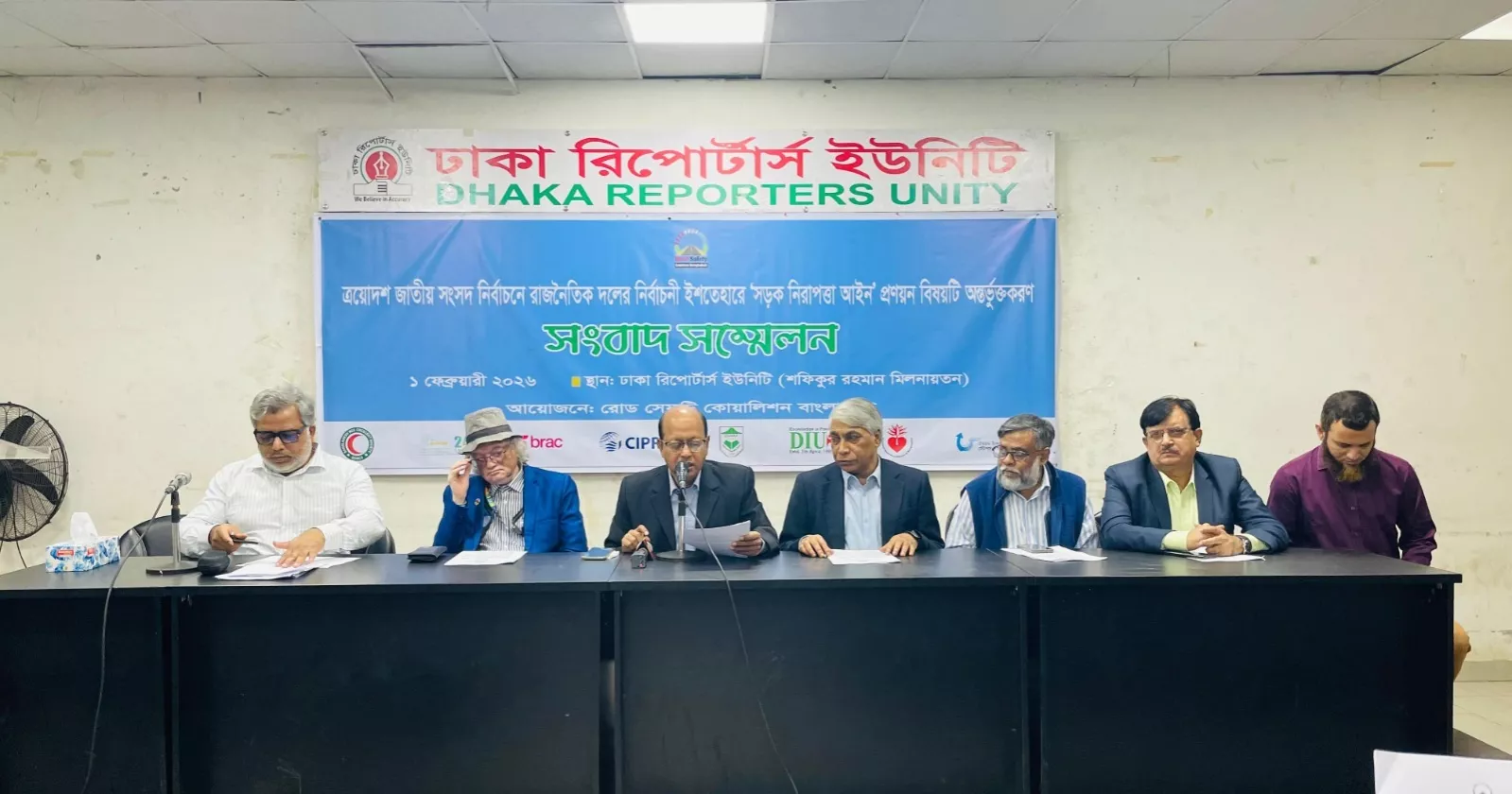
Road safety campaigners on Sunday urged major political parties to include a clear commitment to enact a separate and comprehensive Road Safety Law in their election manifestos ahead of the 13th national parliamentary election.
The call came at a press conference organised by Road Safety Coalition Bangladesh at Dhaka Reporters Unity.
They said the existing legal framework is inadequate to curb the country’s growing number of road crash deaths.
Road safety expert M Khalid Mahmud read out a written statement at the press conference.
Speakers recalled that Bangladesh’s first transport-related law, the Motor Vehicles Ordinance of 1983, lacked essential road safety provisions, resulting in long-standing legal and enforcement gaps.
Although a draft Road Transport and Road Safety Act was finalised in 2016 it was not enacted at the time.
Following the 2018 student-led movement sparked by the deaths of two students of Shaheed Ramizuddin Cantonment College, the government repealed the 1983 ordinance and enacted the Road Transport Act, 2018 but many critical road safety components were omitted.
They noted that implementation of the law was further delayed due to the absence of rules until the Road Transport Rules, 2022 were issued on December 27, 2022.
Even then, road safety issues were addressed only briefly, leaving major legal ambiguities unresolved.
Road crashes remain one of the leading causes of death and injury in Bangladesh, speakers said.
Official data from agencies such as the BRTA and Bangladesh Police show that around 5,000 people die and more than 10,000 are injured every year.
However, estimates from the World Health Organization, non-governmental organisations and media reports suggest the actual figures are several times higher.
Read More: 7,359 people killed in road accidents in 2025: Road Safety Foundation's count almost static
The coalition said Bangladesh continues to lag behind global best practices and the UN Decade of Action for Road Safety 2021–2030, as the current law focuses mainly on transport regulation rather than comprehensive safety measures.
They highlighted major gaps, including inadequate attention to risky road user behaviour, insufficient protection for vulnerable road users such as pedestrians, cyclists, children, women, the elderly and persons with disabilities, the absence of a standardised crash investigation and data system, and the lack of a legally recognised lead agency to coordinate multi-sectoral road safety efforts.
Calling for adoption of the UN-endorsed Safe System Approach, speakers said a separate Road Safety Law is essential to ensure safer speeds, roads, vehicles and road users, along with effective post-crash response. They noted that many countries have significantly reduced road fatalities by implementing this science-based approach.
The event was moderated by Kazi Borhan Uddin, Road Safety Project Manager at the Centre for Injury Prevention and Research, Bangladesh.
Among the speakers were Dr Md Shariful Alam, Country Coordinator of the Global Health Advocacy Incubator; Ranjan Karmakar, Executive Director of Steps Towards Development; AHM Bazlur Rahman, CEO of BNNRC; Dr Mahfuzur Rahman, Programme Director at the National Heart Foundation of Bangladesh; Md Sharafat-e-Alam of the Bangladesh Red Crescent Society; Sharmin Rahman of Dhaka Ahsania Mission; and Swarnil Mondal of Dhaka International University, along with other coalition leaders.