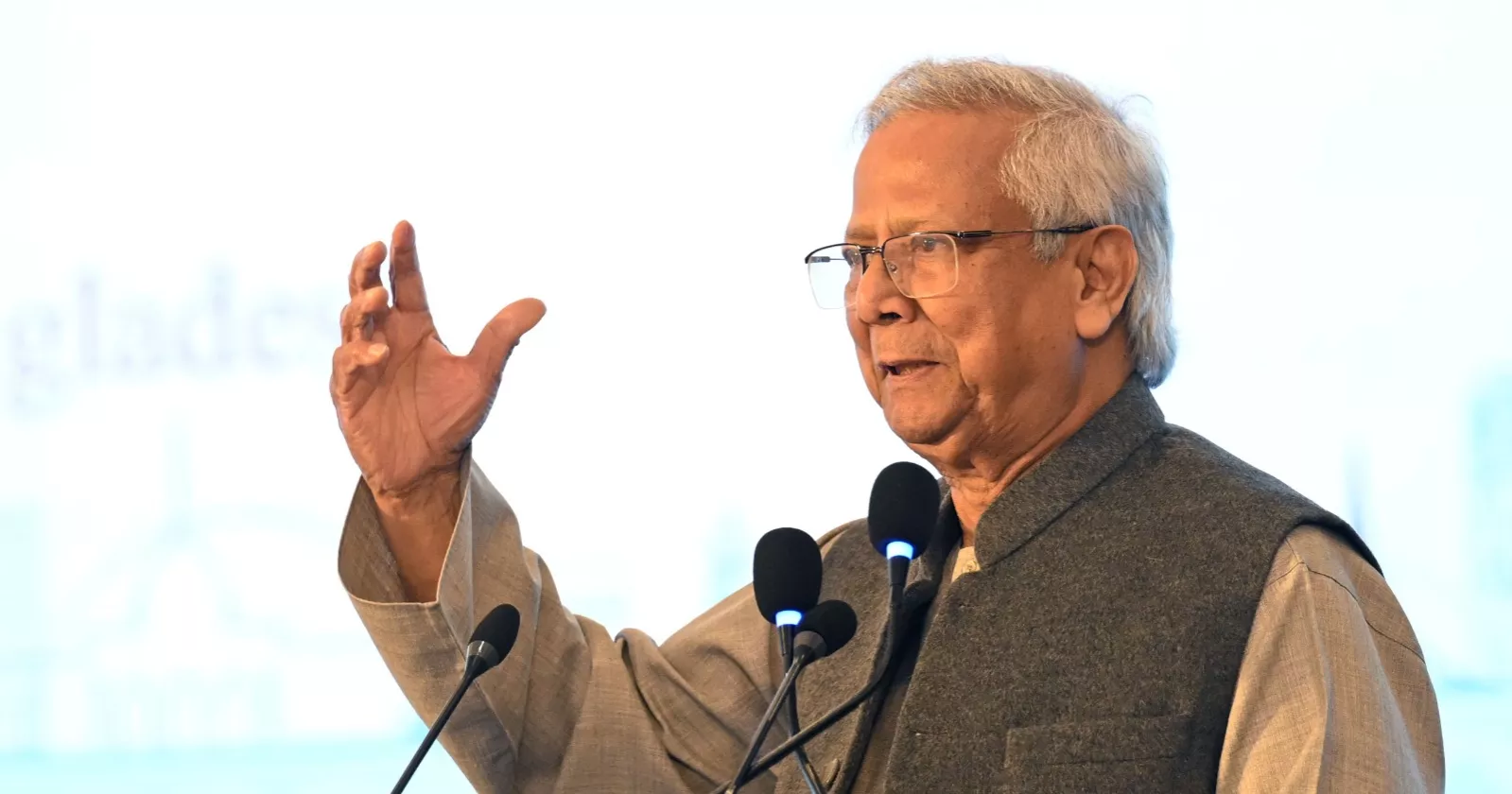
Chief Adviser Prof Muhammad Yunus on Tuesday described South Asia as ‘one family’ and urged countries in the region to work together and learn from each other, calling upon all to come out from the education system which is mostly job oriented.
"So, you're in the right place and see what it means to our region. Our region is a one totality. It's not a piece that doesn't fit into the picture. It is a one whole picture. We work together. We learn from each other. We are a family," he said.
"So, we have to rediscover ourselves. I hope it will mean something to you," he said while speaking as the chief guest at the inaugural session of the three-day 'South Asian Regional Conference on State of Higher Education and Future Pathway' in Dhaka.
Prof Yunus said the education system in this region is job-oriented. "If he or she (student) fails to take a job, we think failure on the part of the student, not us."
"Why would you design a job-oriented education? That you have to have a degree to go to the job market?"
Prof Yunus said his position has always been that human beings are not born as slaves and each human being is a free person.
"Job comes from the tradition of slavery. You slave for somebody. You don't like the job but you do it because they pay you. That's slavery. My lonely voice says that human beings are born as creative beings. That's why we survived on this planet as a creative being. From the very day we are born, we are creative. Even as a baby, we are creative. Creativity is the essence of human beings," said the Chief Adviser.
Read More: Australian Education Expo 2026 held in Dhaka
Prof Yunus said a job takes away creativity. "You take orders. That's slavery."
These young people who marched on the street,they refused to be slaves and refused to take orders, he said, noting that "And that's where the conflict began."
"So, what kind of education will you be giving?" Prof Yunus asked.
"You may dismiss it. You may pause for a while. But this is my point. Should we continue this education to create slaves? Turning creative beings into slaves? That's a criminal job," Prof Yunus said.
So, Prof Yunus said, he translated that creativity into entrepreneurship.
"Entrepreneurship is a creative thing. Why can’t we teach entrepreneurs rather than job seekers? Tell young people you are not job seekers, you are job creators. You are agents of change. You create things the way you imagine," he said, adding that imagination is the essence of human beings.
Prof Yunus said human beings are not born to be practical but they are born with an enormous power of imagination.
"That's what drives them, makes them fall crazy. That's why they gave lives to imagination. They had nothing on the street. They had an imagination. We want to build a new Bangladesh. That's our slogan. And they were committed to it, and didn't give up."
The Chief Adviser urged the academics to align the education system with the youths’ expectations and aspirations.
He stressed on revival of the SAARC to enhance regional academic cooperation.
Organizing such gatherings was part of the responsibility under the South Asian Association for Regional Cooperation (SAARC), the Chief Adviser said.
"SAARC as a word has been forgotten and that's a shame on us," Prof Yunus said.
“I am repeatedly reminding that we must get back to SAARC. That's where our family belongs. And I will not give up repeating that appeal to the governments of the region,” Prof Yunus said.
Speaking about the upcoming national elections and the referendum on February 12, he said the uprising tore everything apart and the young people created their own July Charter to undo what the country was stuck with.
Read More: Infrastructure, education projects worth over Tk 190cr get govt nod
The Chief Adviser said there would be a referendum to decide what the future constitution of Bangladesh should be, because they believed the root of the problems lay in the constitution.
He noted that these issues were not taught in classrooms and questioned where universities stood in this reality.
“Today, I feel very excited that academics at the highest level could get together in Dhaka. It's important that this is Dhaka. I hope you will have a chance to kind of review the things that have happened in Dhaka in the past few months,” he said, referring to post 2024 July Uprising events in Bangladesh.
Prof Yunus said review of those events will clarify what university education and education as a whole are really about adding, this should be the core subject of discussion at the gathering.
Highlighting the role of students in the 2024uprising, he said, “Who are these young people that we are dealing with? They have their own mind. They stood up and raised their voices and brought down the ugliest fascist regime you could ever think of given their lives”.
“It would be a missed opportunity if you don’t spend some time on understanding what they did a few months back in this very city. What was their expectation? What was their aspiration? Why did they standup in front of guns and give their lives knowingly it will happen,” the Chief Adviser said.
To reflect the students’ motivation behind joining the uprising, he referred to school student Shaheed Shahriar Khan Anas’s letter, which he wrote to his mother before embracing the martyrdom, it was his duty to take the street with his friends who were subjected to state-sponsored crackdown.
Noting that the event was not a sudden outburst, Prof Yunus said it happened in Sri Lanka and in Nepal, but it happened in a big way in Dhaka.
Speaking about the conference, he thanked the World Bank for organising the gathering, saying, “This was our responsibility to organise, but we failed. The World Bank has to step in to make it happen”.
He called on educators to reflect on what education and university education should be in this very different world, warning that old ways of doing things are self-destructing and that change must happen quickly, just as the youth acted quickly during the July and August uprising.
“So this is one issue, I hope this will be taken up seriously in this gathering in this discussion where we are, what is being missed, how we can run and be in the front, rather than falling behind,” the Chief Adviser said.
A total of 30 international representatives, including delegates from the United Kingdom, the Maldives, Malaysia, Nepal, Pakistan and Sri Lanka as well as representatives from the World Bank are participating in the event.
The conference is being organised under the Bangladesh government and World Bank funded Higher Education Acceleration and Transformation (HEAT) Project of the University Grants Commission (UGC) of Bangladesh.
Education Adviser Dr CR Abrar addressed the inaugural ceremony as special guest with UGC Chairman Prof Dr SMAFaiz in the chair.
Secondary and Higher Education Division Secretary Rehana Perven and World Bank Division Director Jean Pesme spoke at the function as guests of honor while UGC Member Professor Dr Mohammad Tanzimuddin Khan delivered the welcome address.