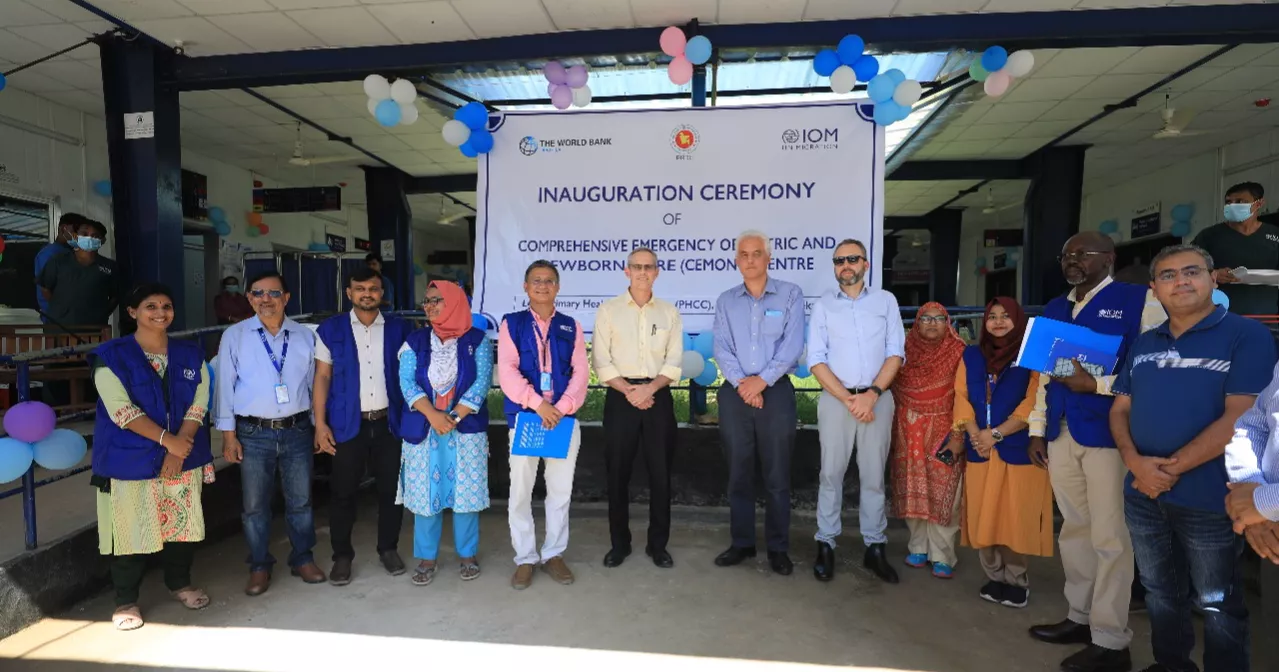
The International Organization for Migration (IOM) has launched the first-ever Comprehensive Emergency Obstetric and Newborn Care (CEmONC) services in the Rohingya camps of Cox’s Bazar, marking a historic step in advancing maternal and newborn healthcare for both refugees and host communities in Teknaf upazila.
With the addition of CEmONC services, the IOM-run Primary Health Centre (PHC) in Rohingya Camp-24, Leda, Teknaf, now offers secondary medical services similar to a fully-fledged field hospital.
The health centre is equipped with a modern operation theatre, specialist doctors in obstetrics and anaesthesia, blood transfusion services with 24/7 power backup, and strict protocols for emergency response.
It offers safe emergency childbirth, urgent surgical procedures, treatment of broken bones, and lifesaving blood transfusions. Initially operating during daytime hours, the centre will gradually scale up to full 24/7 coverage.
The newly transformed health centre was inaugurated with an opening event, attended by Xavier Devictor, global senior FCV Advisor of the World Bank, Lance Bonneau, chief of mission of IOM Bangladesh and Dr. Murad Khan, medical officer of Cox’s Bazar Civil Surgeon office.
Teknaf upazila, home to over 300,000 Bangladeshis and hosting more than 161,000 Rohingya refugees, has long struggled with limited access to emergency medical care.
Mothers in the refugee camps face a maternal death rate of 161 per 100,000 live births — around 2.5 times higher than the national target in the Sustainable Development Goal on health and well-being.
The absence of emergency maternity and newborn services has meant that many lives have been lost due to preventable complications.
Accurate, timely migration data central to effective migration governance: IOM
“The launching of these lifesaving services is a turning point for the health sector in Teknaf,” said Lance Bonneau, IOM’s Chief of Mission. “For the first time, mothers and newborns here have access to comprehensive emergency care that can prevent needless deaths. This facility will bring relief and hope to thousands of families who have long been underserved.”
By bringing the first-ever CEmONC services to the Rohingya camps, IOM is closing a critical healthcare gap and ensuring that vulnerable families — both refugees and host community members — have access to the urgent, lifesaving care they deserve.
The IOM said the launch of these services in the Rohingya camps has been made possible with the support of the World Bank and the collaboration of the Government of Bangladesh and other partners.