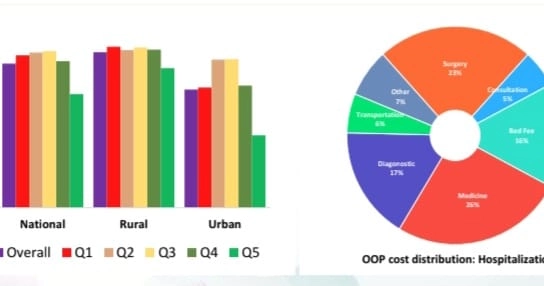
A significant portion of Bangladesh’s population continues to face unmet healthcare needs, driven largely by rising out-of-pocket (OOP) expenditures, according to a study of Bangladesh Institute of Development Studies (BIDS).
Although unmet healthcare needs persist across all segments of society, the financial burden falls disproportionately on the poor, it showed.
The research by Dr Abdur Razzaque Sarker of BIDS underscored that OOP spending remains the dominant mode of healthcare financing in the country, with its share reaching an alarming 79 percent in 2024.
The study titled “Re-thinking unmet healthcare needs and dynamics of out-of-pocket (OOP) expenditure in Bangladesh,” was conducted under BIDS’ Population Studies Division.
The study utilised data from the latest Household Income and Expenditure Survey (HIES) 2022, comprising 14,400 households and 62,387 individuals where descriptive statistics were employed to analyses and summaries the percentage of unmet need, service utilisation across providers.
The distribution of benefits from public spending and progressivity/regressivity is assessed using Benefit and Financing Incidence Analysis.
The findings revealed that around 22 percent of the population reported a need for healthcare services on a monthly basis. Among them, 15 percent experienced unmet healthcare needs, accounting for 65 percent of the total need.
Unmet needs were found to be significantly higher in rural areas compared to urban centres—68 percent versus 59 percent. Regionally, the highest levels of unmet need were recorded in Narail (81 percent) and Habiganj (80 percent), while the lowest was observed in Feni (18 percent).
Healthcare spending and inequality
On average, Bangladeshi households spend TK 3,454 per month on healthcare, representing about 11 percent of total household expenditure. Medicines and diagnostic services were identified as the primary cost drivers.
The study noted that while public healthcare services are relatively equitably utilised, private healthcare services remain disproportionately concentrated among wealthier groups.
Despite higher absolute spending among the rich, poorer households bear a significantly heavier financial burden.
Healthcare expenses account for about 35 percent of total income for the poorest households, compared to just 5 percent for the wealthiest, indicating a regressive healthcare financing system.
The heavy reliance on OOP payments often leads to catastrophic health expenditures, limiting access to necessary care and pushing vulnerable households further into poverty.
The study concluded that although unmet healthcare needs persist across all segments of society, the financial burden falls disproportionately on the poor.
To address these challenges, the researcher recommended urgent reforms in healthcare financing, particularly the development and implementation of risk-pooling mechanisms such as social health insurance.
Such measures, the study suggested, are essential for reducing inequality in healthcare access and achieving Universal Health Coverage (UHC) in Bangladesh.