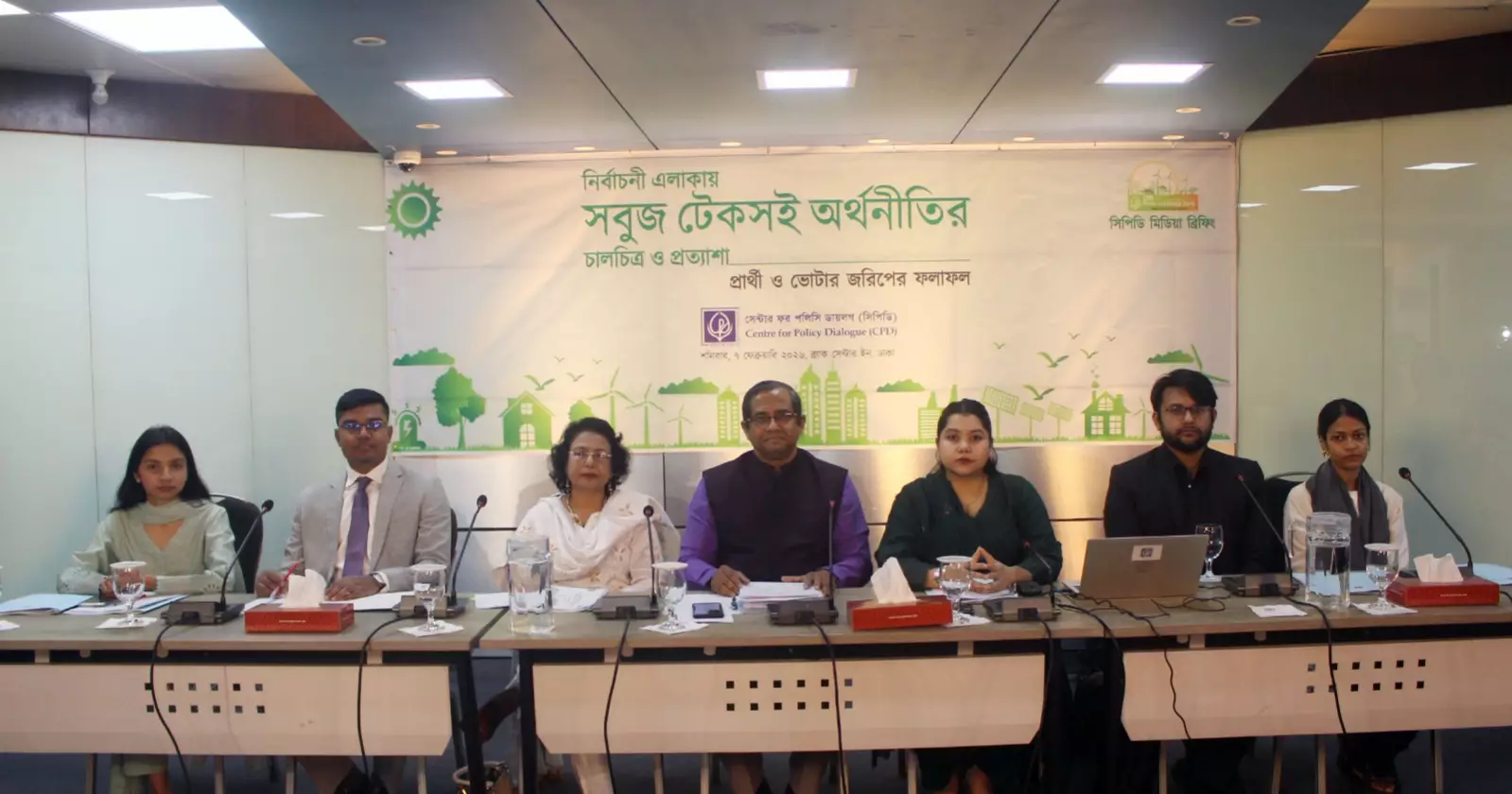
A nationwide survey by Centre for Policy Dialogue (CPD) has found a significant gap between voters’ expectations and political parties’ priorities in building a green and sustainable society, even as environmental concerns increasingly shape public aspirations ahead of the national election.
The study titled ‘State of and Expectations on ‘Green and Sustainable Economy’ in Electoral Constituencies: Survey Findings on Voters and Candidates’ was released on Saturday. CPD Research Director Khondaker Golam Moazzem presented it at the BRAC Centre in the capital.
Conducted in 150 environmentally vulnerable constituencies, the study found that voters overwhelmingly prioritise cleaner air, safe drinking water and stronger environmental protection.
Political parties, however, continue to frame development largely around traditional infrastructure such as roads and bridges, paying limited attention to structural green reforms.
The findings are based on interviews with 1,200 voters and 450 political party representatives across all eight divisions, focusing on perceptions of environmental, economic and social dimensions of a green society.
According to the survey, environmental degradation is already a lived reality for voters in climate hotspot areas.
More than 73 percent of voters identified air pollution as a major problem, followed by flooding and cyclones.
In drought-prone Barind regions, 81 percent of voters reported rising temperatures, while 90 percent of voters in haor areas cited worsening air quality.
River erosion, groundwater depletion and frequent health problems were also reported widely, particularly in areas exposed to overlapping climate risks such as river systems combined with urban or coastal features.
Political party representatives broadly acknowledged these challenges, especially air pollution and health impacts.
But, sharp mismatches emerged in northern drought-prone areas, where only about one-third of party respondents recognised rising temperatures as a serious concern, despite overwhelming voter consensus.
Around 61 percent of voters consider environmental restoration to be highly important in their localities. Tree plantation and reducing plastic use were identified by both voters and party representatives as the main tools for restoration.
CPD researchers, however, noted a clear disconnect between diagnosed problems and proposed solutions. While air pollution and rising temperatures were identified as the most pressing issues, both voters and candidates showed limited emphasis on fossil fuel phase-out, emissions control or cleaner energy transitions.
The survey also revealed low confidence in environmental governance. More than 70 percent of voters said existing environmental laws and regulations are insufficient, while nearly two-thirds believe the government is not doing enough to protect the environment.
Political party respondents expressed similar dissatisfaction, pointing to weak enforcement and excessive centralisation.
Nearly half of voters described themselves as moderately aware of renewable energy, with awareness higher among younger age groups. Political party representatives showed comparable levels of awareness, particularly among major parties, and largely agreed that renewable energy is important for Bangladesh’s development.
Despite this, renewable energy was rarely linked to environmental restoration or green behaviour. Instead, voters and parties alike associated green behaviour mainly with tree planting, conserving water and electricity, and reducing plastic use.
When asked to choose between environmental protection and economic growth, more than 93 percent of voters said environmental protection should be prioritised. However, most were unwilling to place it above traditional infrastructure projects such as bridges and roads, a position mirrored by political parties.
While nearly 80 percent of voters said they prefer sustainable economic growth over traditional growth, their understanding of development remains heavily infrastructure-focused. More than three-quarters equated development with building roads and bridges, followed closely by employment generation.
Political parties showed slightly greater emphasis on human capital, identifying quality education and healthcare as key elements of sustainable growth. Voters, by contrast, placed stronger weight on poverty reduction and immediate economic relief.
Bangladesh edging towards ‘debt trap’, warns CPD’s Mustafizur Rahman
Both groups agreed that eco-friendly practices could reduce long-term costs, but were reluctant to absorb short-term increases in expenses associated with green transitions.
The social dimension of a green society emerged as the least developed in public perception. Voters identified poverty, low income and lack of education and skills as the main barriers to a green transition. Political parties, meanwhile, placed greater emphasis on people’s mindset and resistance to change.
Gender inequality was ranked as a relatively minor obstacle by both groups, a finding CPD described as concerning given the role of women’s participation in sustainable development.
Community engagement on environmental and social issues was reported as fragmented, with more than 60 percent of both voters and party representatives saying there are not enough awareness programmes at the local level.
Looking ahead, voters expressed clear aspirations for environmental improvement. About 61 percent said improving air quality should be the top priority, followed by ensuring clean drinking water. These preferences remained consistent across regions and age groups, suggesting a demand for basic environmental improvements rather than location-specific solutions.
Voters also expect Members of Parliament to lead environmental restoration through policy formulation, budget prioritisation and stronger monitoring and accountability.
On the economic front, investment in renewable energy emerged as the most frequently cited priority for the next government, alongside sustainable agriculture, job creation and SME development.
The CPD study concludes that although environmental awareness among voters is rising, electoral politics remains anchored in conventional development narratives.
The mismatch between voter aspirations and party priorities, particularly on clean energy, governance reform and social inclusion, risks weakening the credibility of green commitments in election manifestos.
The think tank recommended that political parties integrate clearer, cost and locally relevant green policies into their programmes, strengthen local government capacity and align development promises with the lived environmental realities of voters.