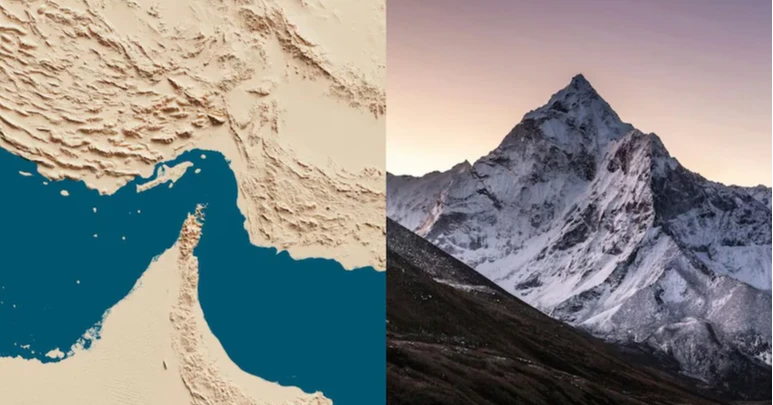
The Strait of Hormuz has been drawing global attention due to rising tensions that have disrupted shipping along one of the world’s most important oil routes. This narrow waterway carries a large share of global energy supplies, meaning any disruption quickly affects oil prices and international politics.
But scientists say the existence of this critical passage is linked to an ocean that vanished millions of years ago, known as the Tethys Sea.
Around 250 million years ago, Earth looked very different, with two massive landmasses, Laurasia in the north and Gondwana in the south, separated by the Tethys Sea. Over time, shifting tectonic plates reshaped the planet.
The Arabian Plate gradually moved north and collided with the Eurasian Plate, causing parts of the Tethys Sea to shrink. This collision formed the Zagros Mountains in present-day Iran and squeezed the remaining water into a narrow channel, now known as the Strait of Hormuz. Today, the strait stands as a remnant of that ancient ocean, linking the Persian Gulf with the Arabian Sea.
The same ocean also played a key role in forming the Himalayas, located thousands of kilometres to the east.
About 50 to 40 million years ago, the Indian Plate collided with the Eurasian Plate. Instead of one plate sliding beneath the other, both crumpled due to their thickness. Sediments from the floor of the Tethys Sea, including limestone and marine deposits, were pushed upward over time, creating the Himalayan mountain range.
This is why marine fossils can still be found high in the Himalayas, including near the summit of Mount Everest, showing that these rocks were once part of an ocean floor.
Experts say the Tethys Sea disappeared gradually over millions of years, but left behind very different features. In the west, it formed the narrow and strategically important Strait of Hormuz, while in the east, it gave rise to the world’s highest mountain range.
Despite their distance, both the strait and the Himalayas share a common geological origin rooted in the same ancient ocean.
With inputs from NDTV