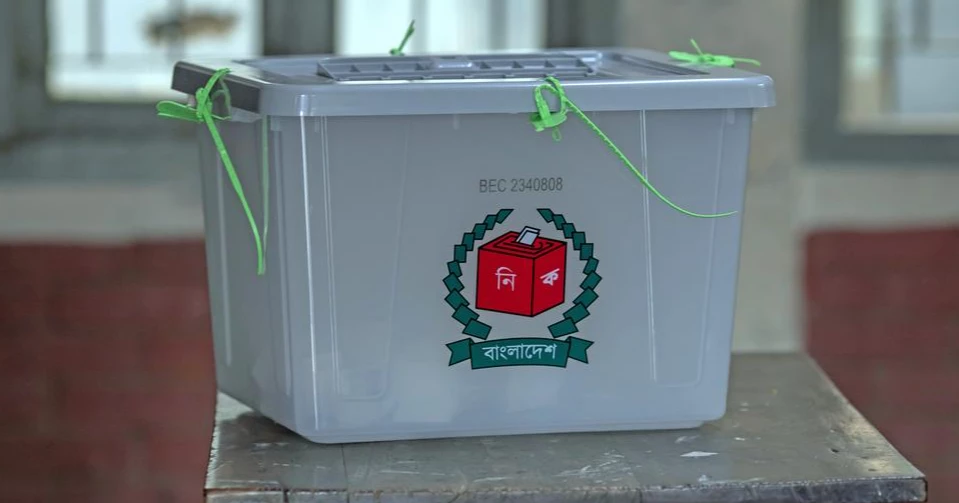
In what is being hailed as the country's most significant democratic exercise in decades, Bangladesh is set to hold its 13th parliamentary election on Thursday.
People are going to place their hopes on a fair and competitive election that could restore true democracy, choose the country’s leaders for the next five years and give them a strong public mandate to reform long-criticised systems.
The voting will be held from 7:30am to 4:30pm without any break at 42,659 polling stations in 299 out of 300 constituencies across the country amid the presence of nearly one million security personnel and another one million polling staff.
The election to Sherpur-3 constituency was cancelled following the death of a contesting candidate.
The voters would choose 299 public representatives out of 2,028 candidates on Thursday from 299 constituencies, including nominees of 50 political parties and independent contenders, in the 13th national election.
In a brief televised address to the nation aired on Bangladesh Television (BTV), Chief Election Commissioner (CEC) AMM Nasir Uddin on Wednesday called upon the nation to extend full cooperation and maintain a spirit of harmony to ensure a free, fair and peaceful election.
A total of 127,298,522 voters (in 299 constituencies) are eligible to cast their ballots in Thursday’s elections. Of them, 64,620,077 are male voters, 62,677,232 are female voters and 1,213 are third-gender voters.
The country has a total of 127,711,899 voters in 300 constituencies.
Two major political parties – BNP and Bangladesh Jamaat-e-Islami— are in the electoral race seeking public mandate to govern the country for the next five years. But Awami League is not in the electoral race this time after 30 years as the party boycotted the 15th February election held in 1996.
Chief Election Commissioner AMM Nasir Uddin on Wednesday reaffirmed their unwavering commitment to delivering a peaceful, credible and participatory election.
“I wish to reaffirm the election commission's unwavering commitment to delivering a peaceful, credible and participatory election,” he said while briefing international election observers and foreign journalists in the city.
The briefing was arranged at a city hotel on the eve of the Referendum 2026 and 13th Parliamentary Election to be held on Thursday (Feb 12).
The CEC said transparency in the voting and counting process will be ensured. “Voters irrespective of gender, age or background are encouraged to participate freely,” he said.
The CEC said ballots are issued only after proper identification and voting is conducted in secrecy in accordance with the prescribed rules. Any electoral dispute will be addressed strictly in accordance with established legal and constitutional procedures, he added.
“Transparency remains a cornerstone of our election management,” he said, adding that approximately 330 international observers and more than 160 international journalists are independently covering the elections.
Noting that special emphasis was placed on voter registration, he said, “Through a nationwide voter list update, approximately 4.5 million new voters have been enrolled, including 2.7 million women, bringing the total number of registered voters to over 127 million with a high level of data accuracy.”
About the postal balloting system, Nasir Uddin said for the first time, the commission has introduced out of country voting through it supported postal ballots for Bangladesh diaspora voters.
“Despite a limited preparation and outreach period, the response has been encouraging with approximately 0.8 million expatriate voters completing registration,” he said.
At the same time, in-country postal voting has been undertaken for eligible categories of voters, he added.
Explaining the polling process, he said the presiding officers assisted by assistant presiding officers and polling officers will manage polling operations and vote-counting at the polling stations in the presence of candidates or their authorized agents as well as accredited observers and journalists.
After the close of polling, counting will be conducted at the polling stations under the supervision of the presiding officers, he said.
“Results will be announced at the polling stations upon completion of counting and subsequently compiled and publicly declared by the returning officers,” Nasir Uddin said.
Candidates
A total of 50 political parties out of 59 registered ones are in the electoral race, while 2,028 candidates are contesting from 299 constituencies, including 1,755 nominated by political parties and 273 independent candidates.
Of the contestants, only 81 are women, as some 30 political parties, including Jamaat-e-Islami, did not field a single female candidate in the polls.
The highest number of candidates—291—are from BNP, while the party supports its electoral partners’ contenders in eight other constituencies. Jamaat candidates are running in 228 constituencies, while the party supports candidates nominated by its electoral allies in the remaining constituencies.
Besides, 253 candidates are from Islami Andolan Bangladesh, 192 from Jatiya Party, 90 from Ganaodhikar Parishad and 32 from the youth-led newly formed National Citizen Party (NCP).
Thursday’s elections will be unique with several new features. A referendum—the fourth in the country’s electoral history—is being held simultaneously with a national election for the first time.
Besides, an IT-supported hybrid postal balloting system, combining digital registration and postal ballots, has been introduced alongside the manual balloting system for the first time in the country’s electoral history.
Besides, the in-person voting period will be nine hours instead of eight hours, army personnel with magistracy power have been deployed on election duty, voter slips with candidate names or symbols can be distributed, and EC officials—three regional election officers—are acting as returning officers for the first time alongside 66 others, including Dhaka and Chattogram divisional commissioners and 64 district deputy commissioners.
CCTV cameras, body-worn cameras and drones are also being used at polling stations to monitor the balloting on Thursday.
Security Personnel
Nearly 958,000 members of law enforcement agencies are on the electoral duty across all 299 constituencies and beyond. In addition, around 2,100 executive magistrates and 657 judicial magistrates are engaged on election duties to ensure the electoral code is maintained.
The security personnel include 100,000 Army personnel, 5,000 Navy personnel, 3,730 Air Force members, 37,453 BGB personnel, 3,585 Coast Guard members, 187,603 police members, 9,349 RAB members and 570,000 Ansar and VDP members.
The armed forces, BGB, Coast Guard, RAB, police, Armed Police Battalion (APBn) and Ansar Battalions work as mobile and striking forces to maintain peace and order in the election areas, while BGB, RAB, APBn and Ansar battalions operate on district, upazila and thana levels as well as the Coast Guard are in coastal areas.
Outside the metropolitan areas, a team of 16–17 police and Ansar members are deployed at each normal polling station, while 17–18 personnel are at every vulnerable polling station.
In metropolitan areas, 16 security personnel –police and ansar members-- are at a normal polling station and 17 personnel at each vulnerable polling station.
In remote areas of 25 districts, a team of 16–18 police and Ansar members are at each polling station.
Election Commissioner Brig Gen (retd) Abul Fazal Md Sanaullah on Tuesday shared a statistics with journalists that from December 13 to date, law enforcement agencies have recovered around 850 weapons across the country. “The prima facie of bringing these arms, we believe, to be misused during the elections.
He said, vested quarters want to carry out violence and they have not stopped their activities. But we’re aware of it.... here we can appreciate our law enforcement agencies for what they have done till now.”
Sanaullah, however, said the EC is satisfied with the overall law and order situation so far, describing it as better than at any previous time, despite a few isolated incidents.
“The Election Commission is satisfied with the law and order situation we have so far. It would have been better if the isolated incidents that have occurred had not happened. We are in a better situation than at any time in the past,” he said.
Vehicle Movement
The movement of five types of vehicles — motorcycles, trucks, microbuses, taxi-cab and motorcycles — will remain suspended on Election Day. Of these, movement of motorcycles would be restricted for midnight on February 10 until midnight on February 13,
Postal Voting, Observers, Journalists
More than one million people, including half a million expatriates from more than 120 countries across the world, have already cast their votes through postal ballots.
Regarding postal voting, as of Wednesday afternoon (3:40pm), 1138,192 voters cast votes including 526,376 expatriates through the postal ballots. Of them, 963,318 postal ballots have already reached the returning officers. The remaining ballots are currently in transit. If any postal ballot would not be reached by 4:30pm Thursday, the ballot won’t be counted.
The people who already voted through the postal ballots also include 611,816 government employees working outside their constituencies, polling officials and prisoners.
Polling Staff
A total of 69 returning officers, 958 assistant returning officers, 43,078 presiding officers, 247,862 assistant presiding officers and more than half a million polling officers are engaged in election duties.
In-person voting will be conducted at 42,659 polling stations, while counting of postal ballots will take place at 299 other stations. Altogether, there are 42,958 polling stations in 299 constituencies.
Of the in-person polling stations, around 50 percent are treated as general centres, while the remaining 50 percent are being marked as vulnerable centres.
The progress reports on polling will be shared at regular intervals, with results expected to be announced in phases. Counting of votes for both the parliamentary election and the referendum will begin simultaneously at the polling stations to avoid confusion or unrest.
The EC expects most results are likely to be available by midnight, except for a few distant polling stations.