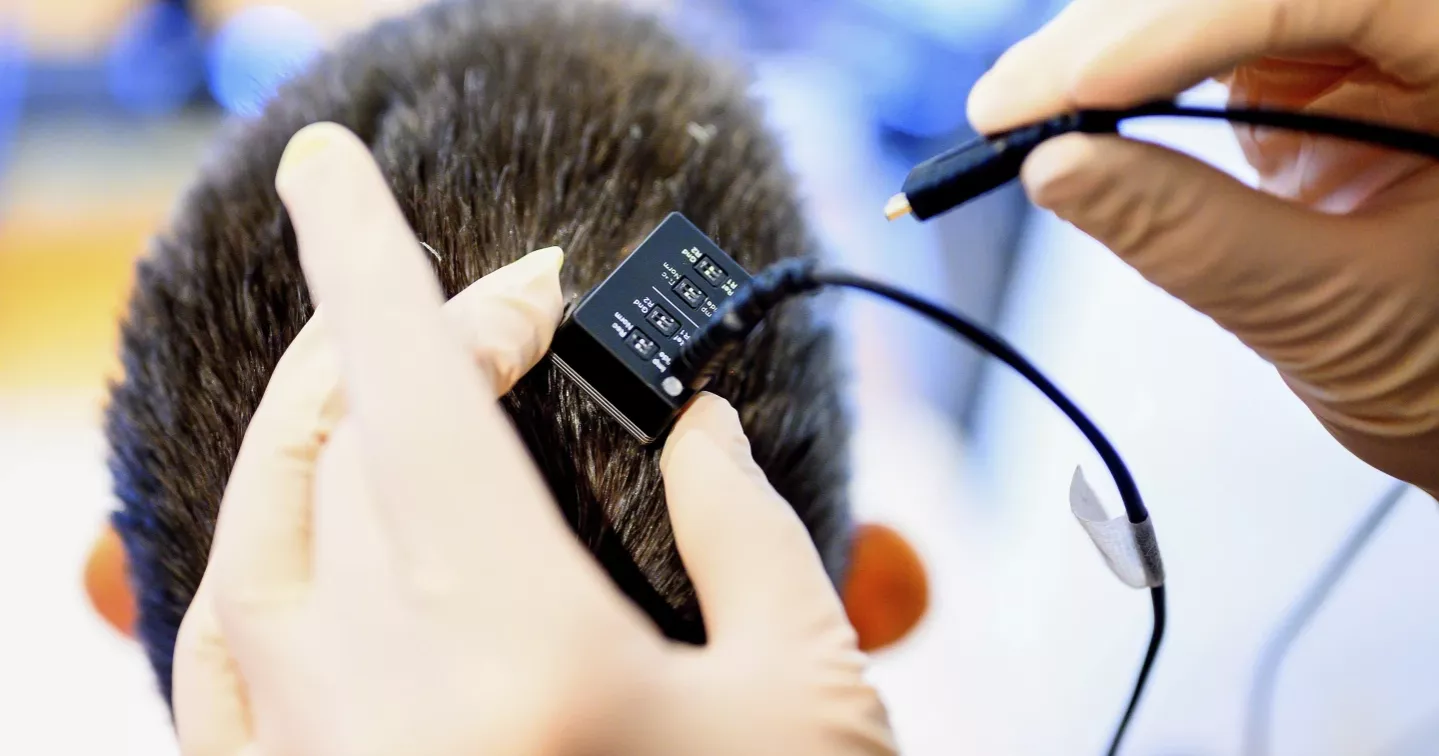
INBRAIN Neuroelectronics has announced promising interim results from the world’s first human clinical study of its graphene-based brain-computer interface (BCI), marking a major leap forward in real-time, precision neurology.
The study, conducted at the Manchester Centre for Clinical Neurosciences (Northern Care Alliance NHS Foundation Trust) and sponsored by the University of Manchester, is assessing the safety and performance of INBRAIN’s BCI technology during brain tumor surgeries.
Interim findings from the first four patients in the 8–10 patient trial show no device-related adverse events, affirming the primary safety goal. The ultra-thin, flexible graphene electrodes successfully recorded high-resolution neural signals during awake brain surgery, identifying distinct gamma activity linked to phonemes — the building blocks of speech.
“This technology could be transformative,” said Mr. David Coope, Chief Investigator and Consultant Neurosurgeon. “It opens new possibilities for understanding brain-tumor interactions and broader brain function in neuro-related disorders.”
Superior Surgical Precision with Graphene
Graphene electrodes offer unmatched spatial and temporal resolution. Unlike conventional platinum electrodes, INBRAIN’s BCI — powered by thin-film semiconductors and reduced graphene oxide matrices — enhances precision, especially in complex areas such as the walls of tumor resection cavities. The BCI remained stable and accurate throughout surgery, functioning alongside standard monitoring tools.
NIH funding cuts threaten patients with experimental brain implants
“This milestone proves that graphene-based BCIs can function in real-time in an operating room, delivering neural fidelity far beyond what traditional materials offer,” said Carolina Aguilar, CEO and Co-Founder of INBRAIN.
The interface’s ability to detect high-frequency brain activity (80–130 Hz) critical for speech and cognition — with statistical significance — sets the stage for future applications in neurosurgical planning, brain mapping, and potentially, long-term treatment of conditions like Parkinson’s disease, epilepsy, and stroke.
Next-Generation Therapeutics in Development
“This isn’t just incremental innovation,” said Prof. Kostas Kostarelos, Co-Founder and Chief Scientific Investigator. “This is a convergence of advanced materials science, neuroscience, and AI — shaping the future of precision neurology.”
The clinical study, listed under NCT06368310, aims to pave the way for BCI therapeutic systems that offer adaptive, AI-powered neuromodulation based on real-time brain data, promising personalized interventions with fewer side effects.
US fertility rate hits record low in 2024, CDC reports
INBRAIN is also extending its neurotech applications to peripheral nerves and systemic diseases through its subsidiary INNERVIA Bioelectronics, in partnership with Merck KGaA.
Source: Agency