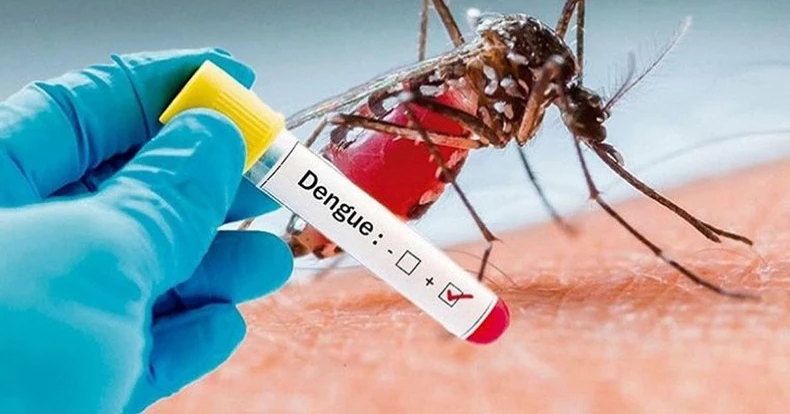
Bangladesh continued to log one of the world’s worst case fatality rates during dengue outbreaks, apparently almost throughout the last two decades, underscoring the strain put on the country’s already fragile healthcare system and the people, particularly the poor.
The case fatality rate represents the percentage of people dying out of the total infected population.
Often called the CFR, the rate stood at 0.4 per cent until September 13, with 147 deaths recorded against the total dengue cases of 37,206. The current CFR is one of the highest in the world.
Bangladesh has constantly produced very high CFR, which even exceeded 2 per cent in 2003 and was above 1.5 per cent in 2000, 2001, and 2010. Over the last five years, the rate remained about 0.5 per cent.
In 2023, Bangladesh experienced its worst dengue outbreak, resulting in 1,705 deaths from the mosquito-borne viral disease. It was the highest number of deaths in the world that year. The CFR reached 0.5 per cent, also the highest in the world.
“High death rate implies a high number of critical cases,” said epidemiologist Mohammad Mushtuq Husain, an adviser to the Institute of Epidemiology, Disease Control, and Research (IEDCR).
Dengue claims 5 more lives in 24 hours, 622 hospitalised
While the changing climate is increasing the virulence of the dengue virus and facilitating its vector’s population growth, it is also ensuring a relentless supply of vulnerable people, evicted from their homes by natural disasters, who mostly constitute critical cases.
Bulu’s Nightmare and Others
After spending Tk 14,000 for the treatment during the 24 bedridden days of his sickness from dengue fever, the only choice Muhammad Bulu had to deal with his many debtors was to sell his three-wheeler van, the source of his income.
Bulu represents hundreds of thousands of people displaced frequently by natural disasters before they end up in slums of cities and towns, in search of a place to live and a livelihood. Bulu had come to the Begunbari slum in Tejgaon one and a half decades ago after river erosion took away most of his ancestral land.
Spending in a stupor after being struck by the fever, Bulu had realized he had no place in the city to seek treatment or care. With a high fever, he headed back to his village home in Lalmonirhat, where his wife and parents live.
“The fear of catching the disease again haunts me everywhere,” said Bulu, constantly waving his hand to scare away groups of mosquitoes teasing him from all around at a tea stall near Begun Bari in the afternoon of September 11.
Dengue claims 1 more life; 665 hospitalised in 24hrs
“I am already broke. Getting the disease again would be like getting a death sentence,” he said, resting a vacant look onto a nearby waste pile, littered with things perfectly positioned to hold freshwater during rains, a prerequisite for Aedes mosquito population expansion.
Bulu is in his 30s. Historically, most dengue cases concerned people in the age group of 18-30. Children and elderly people also get frequently infected and are considered highly vulnerable.
“More children from villages are now getting infected with the disease,” said Mohammed Hanif, a pediatrician based in Dhaka.
The spread of dengue among children in rural areas indicates that the disease is getting out of hand, he said.
Obese children and elderly people with comorbidities are most exposed to dengue fatality, he explained.
Children accounted for nearly 7,500 of the total 37,200 cases reported so far this year. They also accounted for 24 of the total 147 deaths this year.
Public health under strain
Epidemiologist Mohammad Mushtuq Husain, who is also an adviser to the IEDCR, explained that the high case fatality rate underscored late hospitalisation of dengue patients, mainly due to the unavailability of primary healthcare services in most of Bangladesh.
“Poor people can’t afford timely dengue diagnosis. They come for the treatment only when their condition is bad,” said Mushtuq.
Primary healthcare is almost non-existent across rural Bangladesh.
Someone suffering from dengue fever must travel to the upazila level to get tested for dengue, mostly in private clinics, often involving an inconvenient journey.
Dengue outbreak worsens: 5 dead, 636 hospitalised in 24 hours
But patients often do not get the desired treatment at upazilas either, mostly depending on private medical facilities for dengue diagnosis. District government hospitals tend to refer serious dengue cases to Dhaka to reduce strain on their limited resources.
Many dengue deaths occur while patients are on the way to Dhaka.
Mushtuq emphasized the need to decentralize the health service to reduce the number of critical cases and deaths.
Experts have long called for an early dengue warning system. Sending mobile laboratories to poor communities could also be a way of fighting the disease by its early detection.
“Public healthcare service needs expansion,” said Mushtuq.
AM Zakir Hussain, a former director of the IEDCR, explained factors increasing the vulnerability of the poor to Aedes mosquitoes, the vector of the disease.
“People living in high-rise buildings are well outside mosquitoes' reach, for they cannot fly very high,” he said.
A study by the Bangladesh Institute of Development Studies on the 2019 dengue outbreak reported higher dengue infections among people who could not afford mosquito nets or mosquito repellents.
Dengue outbreak worsens: 5 dead, 636 hospitalised in 24 hours
The study also found that dengue cases were higher where wastes were dumped. Millions live in sprawling Dhaka city slums, mostly sitting on the city’s waste dumps.
The Economic Burden
A 2021 BIDS study revealed that the average economic cost of treating a dengue patient was Tk 33,817 during Bangladesh’s worst outbreak of the disease in 2019. In public hospitals, the cost was around Tk 22,000. The cost of the treatment was Tk 47,230 in private hospitals.
Another independent study revealed that the average income of a fourth of the studied dengue patients, treated at public hospitals in 2019, was Tk 10,000 per month.
A 2023 study estimated that the annual economic cost of dengue disease in India in 2016 was about US$ 5.71 billion.
The Climate Connection
The year of the worst dengue outbreak, 2023, witnessed an unprecedented shift in rainfall with a substantial wet spell beginning in the last month of the winter season—February.
Provided with an abundant supply of fresh water, just ahead of the temperature rising in pre-monsoon months, Aedes mosquitoes had a great opportunity to boom its population, epidemiologists said.
A World Bank report published in October 2021 said that Bangladesh marked a seasonal shift over the past 44 years following a 0.5°C temperature increase. The dengue season stretched because of the change, the report said.
"The number of cases of dengue fever, which is spread by mosquitoes, recorded annually has doubled every decade since 1990, and one of the potential factors that contributed to this increase is climate change," read a line of the WB report.
The report revealed that dengue cases increase in the range of 25°C to 35°C, with a peak at 32°C. The capacity of mosquitoes to transmit dengue fever has increased by up to 9.5 per cent globally, compared with 1950, the report said.
Bangladesh’s first report of a dengue outbreak dates back to 1964. There were only sporadic outbreaks of the disease until the 1990s.
“There is a marked shift in rainfall pattern and this will continue in the years ahead,” said AKM Saiful Islam, a lead author on the IPCC's sixth assessment report.
“We need to invest more in research to study the changing climate and develop our capacity to predict its potential consequences, such as a surge in dengue cases,” he said.