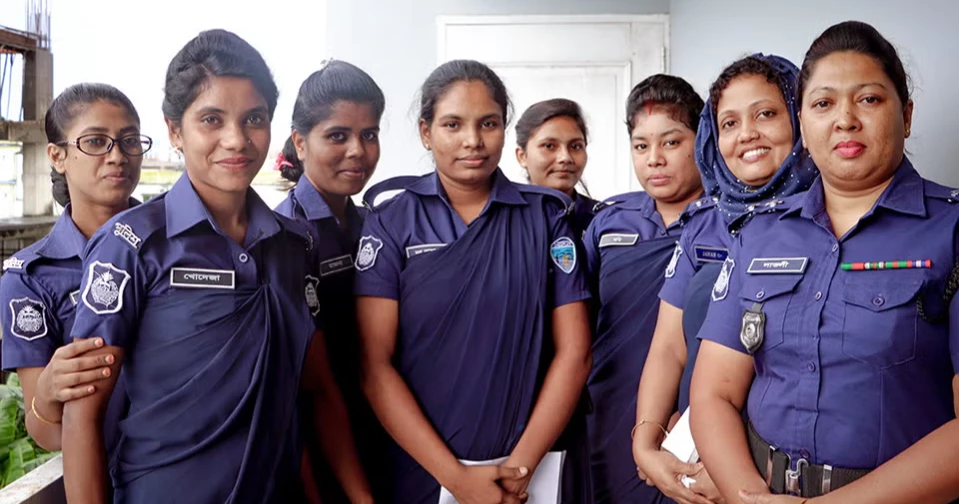
Policing is more than just a profession—it is a role synonymous with responsibility.
It is a career fraught with challenges, and for women in Bangladesh, those challenges are often doubled.
Conversations with female officers across various ranks within the police department reveal both the progress made and the persistent struggles women in uniform continue to face.
The Challenge of the Badge
Farhana Yasmin, Deputy Commissioner (Women & Investigation), explains that policing, by its very nature, is a physically demanding occupation—unlike desk-based roles, it demands immediate action, unpredictable hours, and continuous duty.
“I have been working around 17 years in policing,” she shares.
“There are no time bounds, no fixed job descriptions,” she says. “If I’m told to go somewhere, even if it’s overnight duty from 7 PM to 7 AM, I have to do it—no questions asked. This applies from constables to officers. Family considerations don’t count. Unless you’re severely ill or hospitalised, you can’t say no. We’re told, ‘You joined knowing the challenges—so you must face them."
This rigid expectation, she explains, disproportionately affects women. “In our social structure, a man’s primary role is seen as earning, and a woman’s as maintaining the family. So if a woman prioritises her profession, it often creates tension at home. We’re seeing more female officers experiencing family breakdowns as a result.”
Speakers call for urgent police reform to create public-friendly policing
She said, “We don’t recruit policemen from outside the country; they come from the same society where such treatment of women is normalised. So what happens to women in other offices, happens here too.”
Daycare and Basic Facilities Still Missing
One of the most pressing concerns for police mothers is the absence of daycare facilities. “We spend most of our time on the field, and many of us have young children at home. We’re constantly stressed—how they’re doing, what they’re eating,” Farhana said.
“For working mothers everywhere this is a challenge, but in policing, where there are no fixed hours, it’s even worse,” she said.
Another glaring gap is the lack of access to proper toilet facilities during long hours on duty. “Male officers can manage. For women, it’s much harder. Public restrooms aren’t always usable or safe,” she added.
Nasrin Sultana, Additional Deputy Commissioner of the Media & Public Relations Division of DMP, echoed the same concerns.
Stop moral policing and injustice against artists: cultural activists
She said, “The lack of daycare facilities is a major issue for us. I’ve been in the police force for eight years. I initially worked at the CID Headquarters and later went on a peacekeeping mission.
She went on to say, "During the mission, we were trained on how to conduct joint patrols, how to collaborate with local forces, and how to maintain liaison—these were key learning areas. Policing is undoubtedly challenging for women in Bangladesh. However, facing these challenges hasn’t been too difficult for me, as joining the police had always been my ambition.”
Finding Purpose Amid Pressure
Despite the difficulties, Farhana highlights the positives. “There are many opportunities to explore and contribute. We get to work in different locations through transfers, gain diverse experiences, and ultimately, serve the people of our country. That gives me peace of mind.”
The Numbers Behind the Uniforms
According to the latest data from Police Headquarters, there are 17,276 women in the Bangladesh Police.
This includes 14,021 constables, 399 Nayeks, 1,344 Assistant Sub-Inspectors (ASI), 980 Sub-Inspectors (SI), 93 Sergeants, 130 Inspectors, and 309 officers ranging from ASP to Investigation roles.
Speed up implementation of beat policing: DMP Commissioner
While the presence of women in policing continues to grow, it is evident that systemic changes—in infrastructure, policy, and mindset—are necessary to ensure their strength and service receive the support they truly deserve.