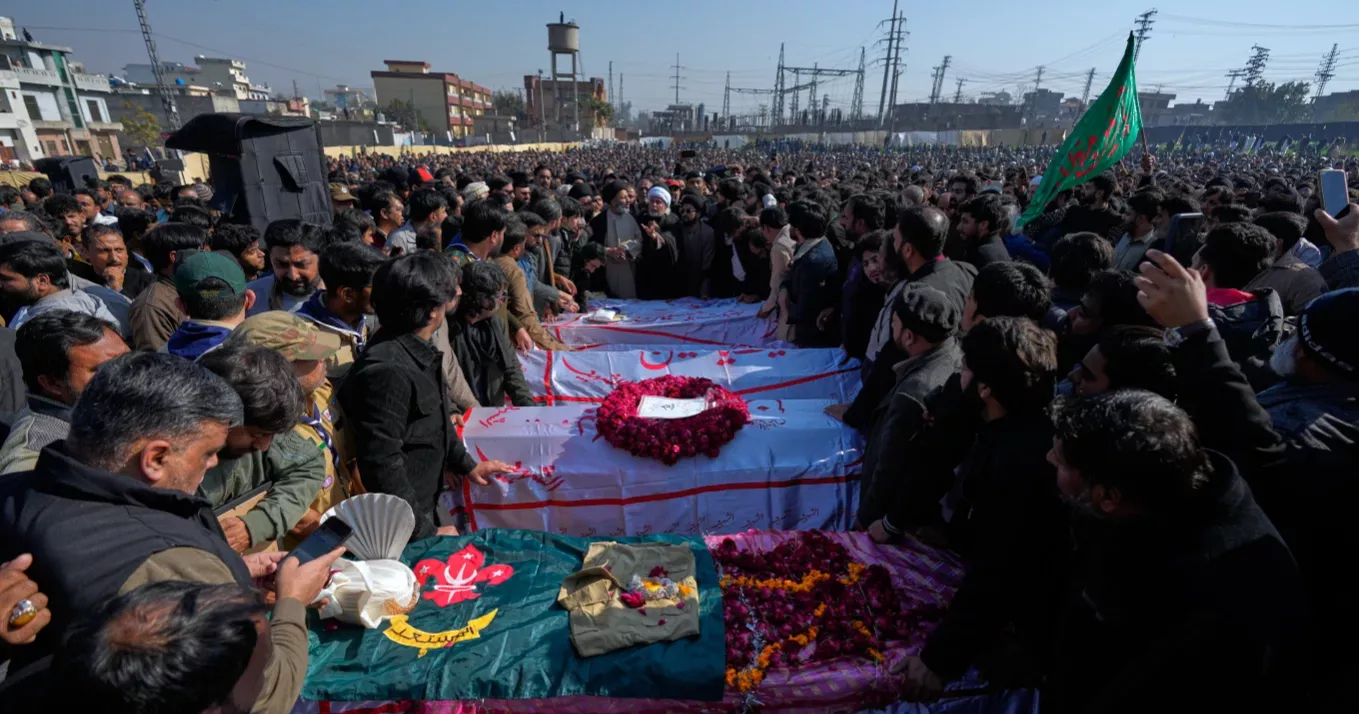
An affiliate of the Islamic State group has claimed responsibility for a deadly suicide bombing at a Shiite mosque on the outskirts of Pakistan’s capital that killed at least 31 people and injured 169 others.
The claim was made overnight by Islamic State in Pakistan through a statement on its Amaq News Agency. Authorities said the bomber has been identified, his facilitators traced and the alleged mastermind arrested.
According to the claim, the attacker opened fire on security guards at the mosque’s main gate before detonating his explosive vest inside the mosque compound. The group again described Pakistan’s Shiite community as a target, using sectarian language to justify the attack.
Saturday, heavy security was deployed as funerals were held at the same mosque for several victims. More than 2,000 mourners attended, including Shiite leaders and senior government officials. Other victims were buried in their home towns.
The attack was the deadliest in Islamabad since the 2008 suicide bombing at the Marriott Hotel. It comes amid a sharp rise in militant violence across Pakistan.
Authorities said the attacker was a Pakistani national who had recently traveled to Afghanistan. Several suspects, including close relatives of the bomber, were arrested during overnight raids in Islamabad and northwestern Pakistan. A police officer was killed during one of the operations.
State-run Pakistan Television reported the arrest of an alleged Afghan national linked to Islamic State, who is suspected of planning the attack. It said the bombing was coordinated from Afghanistan. Kabul has not commented on the claim.
Islamic State, a Sunni militant group, has repeatedly targeted Pakistan’s Shiite minority in past attacks aimed at fueling sectarian tensions. In 2022, the group claimed responsibility for a suicide bombing at a Shiite mosque in Peshawar that killed dozens.
Pakistan’s Defense Minister Khawaja Mohammad Asif said the attack showed that militants based in Afghanistan could strike even in the capital. His comments were strongly rejected by Afghanistan’s Taliban government, which condemned the attack but accused Pakistan of making irresponsible claims. Kabul has consistently denied sheltering militants.
The bombing drew condemnation from the United States, Russia and the European Union.
Prime Minister Shehbaz Sharif thanked the international community for messages of support and said those responsible would be brought to justice. He stressed that global cooperation remains vital for Pakistan’s counterterrorism efforts.
Although Islamabad has seen fewer attacks than other parts of the country, Pakistan has recently faced growing militant violence, much of it linked to separatist groups and the Pakistani Taliban, which is allied with Afghanistan’s Taliban.