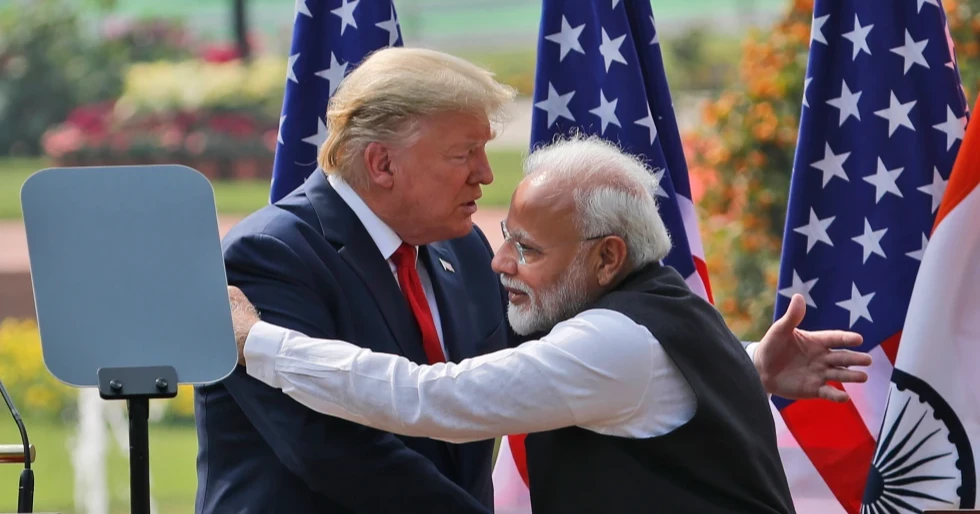
Indian lawmakers from Prime Minister Narendra Modi’s ruling coalition lauded him Tuesday for reaching a trade deal with the United States aimed at reducing tariffs on Indian goods, while opposition parties questioned its impact on sensitive sectors such as agriculture.
The deal follows U.S. President Donald Trump’s announcement Monday that he would cut import tariffs on India from 25% to 18%, six months after imposing steep duties to penalize New Delhi for continuing purchases of Russian oil, which Washington said fueled Moscow’s war against Ukraine. In exchange, Trump said Modi had agreed to halt Russian crude imports, although the Indian government has not publicly confirmed this.
Trump also said India would reduce import taxes on U.S. products to zero and commit to purchasing $500 billion worth of American goods. “This will help end the war in Ukraine, which is taking place right now, with thousands of people dying each and every week,” Trump wrote on social media. Modi responded on X, expressing that he was “delighted” with the tariff reduction and calling Trump’s “leadership vital for global peace, stability, and prosperity.”
The announcement effectively removes the penal tariff imposed on Indian exports, providing relief for exporters who had been facing combined duties as high as 50%. India had emerged as a major buyer of discounted Russian Urals, raising tensions with Washington.
In Parliament, opposition parties disrupted proceedings Tuesday, demanding clarity on the deal’s implications for agriculture, a key sector employing millions of Indians. While the U.S. seeks greater market access and zero tariffs on most of its exports, India has historically protected sectors such as agriculture and dairy from full liberalization.
U.S. Secretary of Agriculture Brooker Rollings said the deal would help American farmers export more products to India, boosting rural incomes. In 2024, the U.S. faced a $1.3 billion agricultural trade deficit with India. Indian Trade Minister Piyush Goyal assured that sensitive sectors, including agriculture and dairy, have been protected. “India has got the best deal in comparison to the countries in the neighborhood. This will strengthen U.S.-India relations while protecting the interests of all 1.4 billion Indians,” he said.
Analysts urged caution, noting that details such as timelines, tariff reductions, and coverage of sensitive sectors remain unclear. Achieving $500 billion in U.S. imports would take decades, given current imports of around $50 billion, said trade analyst Ajay Srivastava. A senior Finance Ministry official, Arvind Shrivastava, said the deal could expand trade, create opportunities for India’s labor-intensive and manufacturing sectors in the U.S., and boost collaboration in advanced technology.