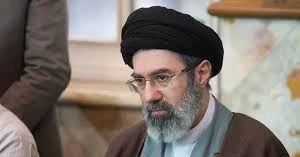
Mojtaba Khamenei, the second son of Iran’s late leader Ayatollah Ali Khamenei, has been chosen as the new supreme leader of Iran amid the ongoing war involving the United States and Israel, according to state media reports.
Ali Khamenei was killed on the first day of the war when attacks targeted his compound in Tehran. The strike also killed Mojtaba’s mother, wife and one of his sisters. The 56-year-old cleric was reportedly not present at the time and survived the bombing.
Iran’s Assembly of Experts, the 88-member clerical body responsible for selecting the country’s supreme leader, confirmed his appointment and called for national unity. In a statement carried by state media on Sunday, the assembly said Mojtaba Khamenei was chosen through a “decisive vote”.
The body urged Iranians, “especially the elites and intellectuals of the seminaries and universities”, to “pledge allegiance to the leadership and maintain unity”.
Although he has never run for public office or faced a nationwide vote, Mojtaba Khamenei has long been considered an influential figure within the inner circle of Iran’s leadership. Over the years he developed strong connections with the powerful Islamic Revolutionary Guard Corps and its affiliated paramilitary forces.
His rise to the top position suggests that hardline factions within Iran’s political establishment continue to hold significant influence, potentially signalling limited willingness by Tehran to enter negotiations in the near future.
For years Mojtaba Khamenei had been mentioned as a likely successor to his father, who served nearly eight years as president and then ruled as supreme leader for more than three decades before his death.
However, the new leader has largely kept a low public profile. He rarely gives speeches or public lectures, and many Iranians have never heard his voice despite his long-standing influence within the ruling establishment.
His possible succession had long been considered sensitive because it could resemble a hereditary transfer of power similar to the monarchy that ruled Iran before the Iranian Revolution.
Allegations over protest crackdowns
For nearly two decades, critics inside and outside Iran have linked Mojtaba Khamenei to the suppression of anti-government protests.
Reformist figures first accused him of influencing the disputed 2009 presidential election that returned Mahmoud Ahmadinejad to power. The election triggered mass demonstrations known as the Green Movement.
Opposition groups claimed that the paramilitary Basij force, which operates under the Revolutionary Guard, was used to crack down on protesters.
The Basij has since played a central role in suppressing several waves of nationwide demonstrations, including recent protests in which international organisations and the United Nations said thousands of people were killed during security operations earlier this year.
Iranian authorities have repeatedly blamed the unrest on “terrorists” and “rioters” allegedly supported by the United States and Israel.
Military ties and economic influence
Mojtaba Khamenei built close links with the Revolutionary Guard during the 1980s when he served in its Habib Battalion during the Iran–Iraq War. Many of his former comrades later secured influential positions in Iran’s security and intelligence institutions.
Western governments have imposed sanctions on him, and media reports have alleged that he controls a large financial network spanning several countries.
According to reports cited by Bloomberg, he has been linked to Iranian businessman Ali Ansari, whose Bank Ayandeh collapsed last year after heavy debts and controversial loans to insiders. The bank’s dissolution reportedly worsened Iran’s inflation as some losses were covered using public funds.
Neither Khamenei nor Ansari has publicly responded to the allegations.
Questions over religious credentials
Another issue surrounding Mojtaba Khamenei’s leadership is his clerical rank. He holds the title of hojatoleslam, a mid-ranking position within the Shiite clerical hierarchy, rather than the higher title of ayatollah traditionally associated with the supreme leadership.
However, his father was also not an ayatollah when he assumed the role in 1989, and Iran’s laws were later adjusted to accommodate his leadership. A similar arrangement could again be made if needed.
With heavy bombing continuing across Iran and authorities imposing widespread internet restrictions, it remains unclear when the government will formally announce the next steps in its leadership transition.
With inputs from Al Jazeera