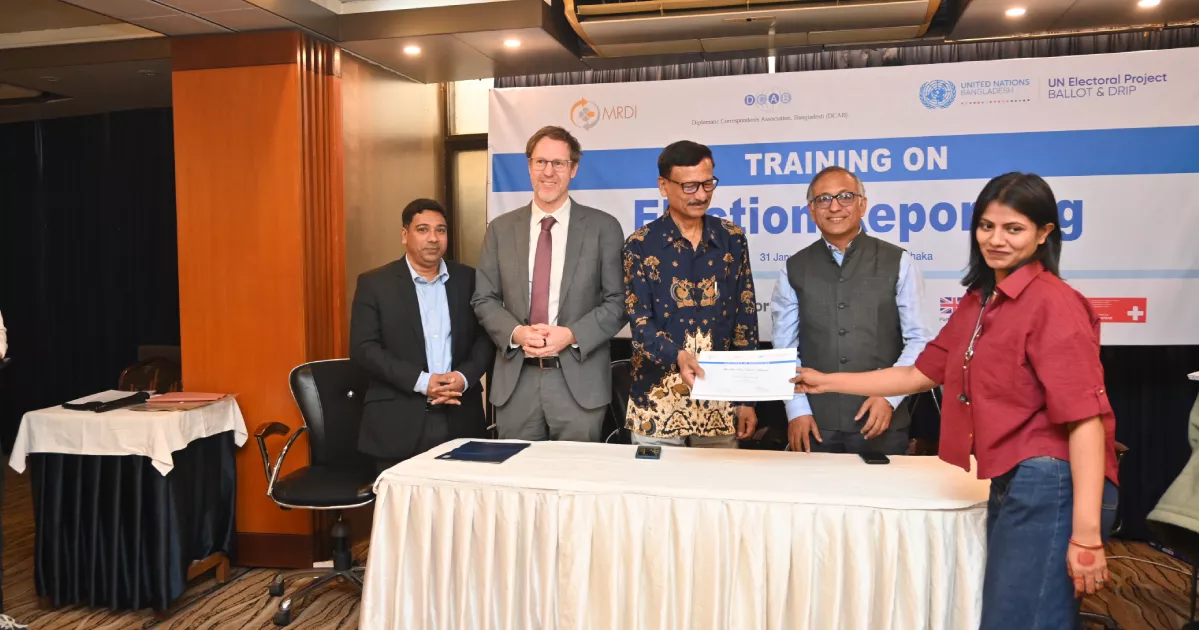
Foreign Affairs Adviser Md Touhid Hossain on Sunday said the forthcoming twin elections – national election and referendum – will be largely peaceful with an opportunity for people to express their will for a representative government, as no election in Bangladesh was fully peaceful.
“Let us hope that the elections will be held peacefully and people will have the opportunity to express their will and we shall have a representative government after the elections are held,” he said while speaking as the chief guest at the closing session of training on election reporting.
Diplomatic Correspondents Association, Bangladesh (DCAB) in cooperation with the UNDP and Media Resources Development Initiative (MRDI) hosted the training where former Bangladesh Bureau Chief of the Associated Press (AP) Farid Hossain was the facilitator of the two-day session.
UNDP Resident Representative in Bangladesh Stefan Liller, MRDI Executive Director Hasibur Rahman and DCAB President AKM Moinuddin also spoke at the event conducted by DCAB General Secretary Emrul Kayesh.
Bangladesh’s election narratives can influence global confidence: Stefan Liller
Speaking at the event, the Adviser, however, did not completely rule out the possibility of some violence during the elections and said the important thing is that the elections - by and large - must be peaceful.
He said the authorities, the Election Commission and the law enforcement authorities must take immediate steps so that these do not go out of hand.
Hossain said some incidents happened at night but that should be very limited and immediate actions need to be taken.
He said the media during the elections will play a very important role and noted that it is an extremely important event in national life as people have not been able to cast their votes for a long time.
The Adviser said steps are being taken so that the people really have the opportunity to go to the polling centers, and cast their votes without fear and without any disturbance.
“I'm sure this election will definitely reflect the will of the people even if there are small aberrations here and there. I am saying this because traditionally, we have seen that in each and every election scene - some undesired incidents do take place,” he said, adding, “I wish all of you a very vibrant day of reporting on that day.”
As Bangladesh approaches an important electoral milestone, Liller said, the role of journalists is both demanding and indispensable. “Democracy is sustained not only by laws and institutions, but by informed citizens. Journalists are central to that process.”
Liller, who is responsible for UNDP’s activities in the country, said electoral developments must be situated within Bangladesh’s constitutional and legal frameworks, as well as within its international commitments under the United Nations Charter, international human rights instruments and the Sustainable Development Goals, particularly Goal 16 on peace, justice and strong institutions.
He said responsible reporting helps ensure that moments of political contestation are understood internationally as part of a lawful, rules-based democratic process.
Liller said electoral processes are among the most technically and politically sensitive elements of democratic governance. “They involve complex legal frameworks, electoral codes of conduct, voter and candidate regulations, results tabulation systems, and complaints and dispute resolution mechanisms.”
In this context, the international development professional with over 20 years of experience said, journalists serve as a critical bridge between institutions and citizens.
When electoral processes are reported clearly, accurately and responsibly, Liller said, citizens are better able to understand not only what is happening.
He said at moments of heightened political competition, professional and ethical reporting contributes directly to public trust, democratic legitimacy and social cohesion.
Conversely, Liller said, misinformation or imprecise reporting can unintentionally amplify tensions and undermine confidence in electoral outcomes.