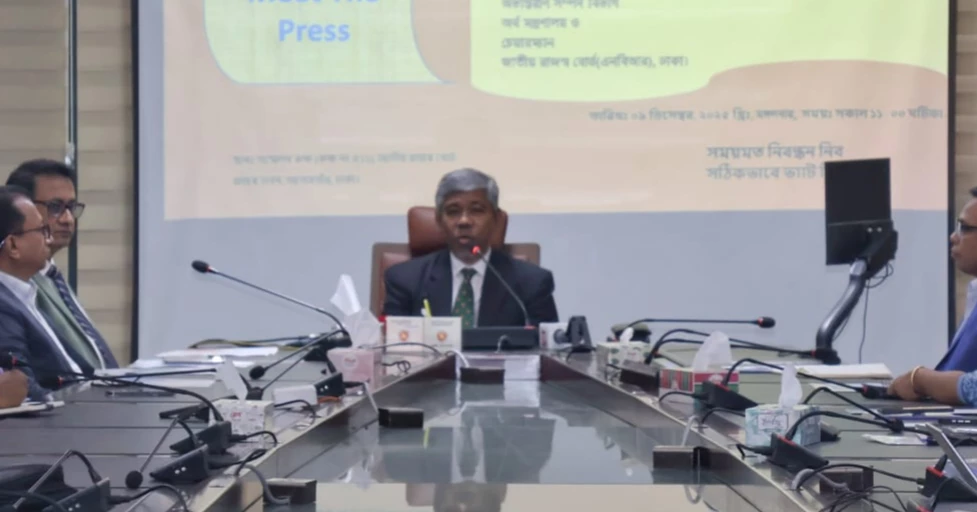
National Board of Revenue (NBR) Chairman Md Abdur Rahman Khan on Tuesday (December 09, 2025) underscored the urgent need to expand the country’s VAT and income tax base to reduce reliance on import-based revenue, strengthen fiscal stability, and support Bangladesh’s development ambitions.
“Development goals and essential public services cannot be delivered unless adequate revenue is mobilised,” he said at a “Meet the Press” event ahead of VAT Day and VAT Week held at the Revenue Building in the capital.
He said Bangladesh’s progress and day-to-day administrative functions depend heavily on revenue collected by the state.
Bangladesh relied overwhelmingly on import duties in the early years of independence, with nearly 90 percent of revenue collected at the import stage, he said.
Read more: NBR to develop automated system linking return submission with banks: Chairman
He said such a structure places the same tax burden on the rich and poor alike and is neither sustainable nor equitable. “Over time, VAT and income tax have emerged as the principal pillars of domestic resource mobilisation, with VAT alone contributing 38 percent of total revenue in the last fiscal year.”
VAT collections grew by 22 percent in the July–November period, demonstrating significant potential for further expansion, said the NBR cheif.
He expressed concern that only about 644,000 entities are registered for VAT, a figure far below the actual number of businesses operating across the country. “The authority aims to bring at least 100,000 new businesses under the VAT system during December.”
He reiterated the need to establish a single VAT rate across the board and to enforce a fully functional input credit system at every stage of production and distribution.
Read more: NBR uncovers Tk 9 crore revenue evasion by United Tobacco
A unified rate, he said, would make automation easier and eliminate distortions that undermine fair competition.
Khan highlighted a common misconception that businesses “pay” VAT.
He said businesses merely collect VAT on behalf of the government, while the final burden ultimately falls on consumers.
Distortions in compliance, he added, create an uneven playing field in the market.
To ease compliance for small and cottage businesses, NBR is planning sector-specific VAT systems that will allow users to record receipts and payments and automatically generate VAT returns.
Read more: How to Submit Zero Income Tax Return Online in Bangladesh
He said NBR will bear all system development and maintenance costs, including hosting and cloud services, to support smaller businesses that cannot afford specialised software or consultants.
Khan also emphasised ongoing efforts to modernise VAT and income tax audits.
He said various intelligence units including VAT, customs, central, and tax intelligence agencies have strengthened their operations, allowing NBR to recover significant amounts of evaded revenue.
Updated figures will be shared soon, he added.
Khan acknowledged several challenges affecting revenue collection this year, including weak corporate tax receipts from the banking sector, reduced capital expenditure due to a contractionary budget, and slower implementation of development projects. Major business groups have also faced financial stress, he said.
Read more: Railway exempted from submitting proof of income tax return filing
Khan said Bangladesh’s tax-GDP ratio remains low, and more research is needed to identify why certain segments of the economy remain untaxed.
As the country prepares for LDC graduation, import duties will inevitably decline due to global trade obligations, making a stronger domestic tax base essential, he added.
He said the long-delayed, World Bank-funded automation project for NBR will soon begin, and the authority intends to automate all of its internal processes under the initiative.
He highlighted the need to better utilise existing automated systems such as ASYCUDA World, which is used globally but has not been fully leveraged in Bangladesh.
The NBR chairman also sought for cooperation from businesses and the media to help simplify tax laws, expand the tax base, strengthen compliance, and build a fairer and more efficient revenue system.