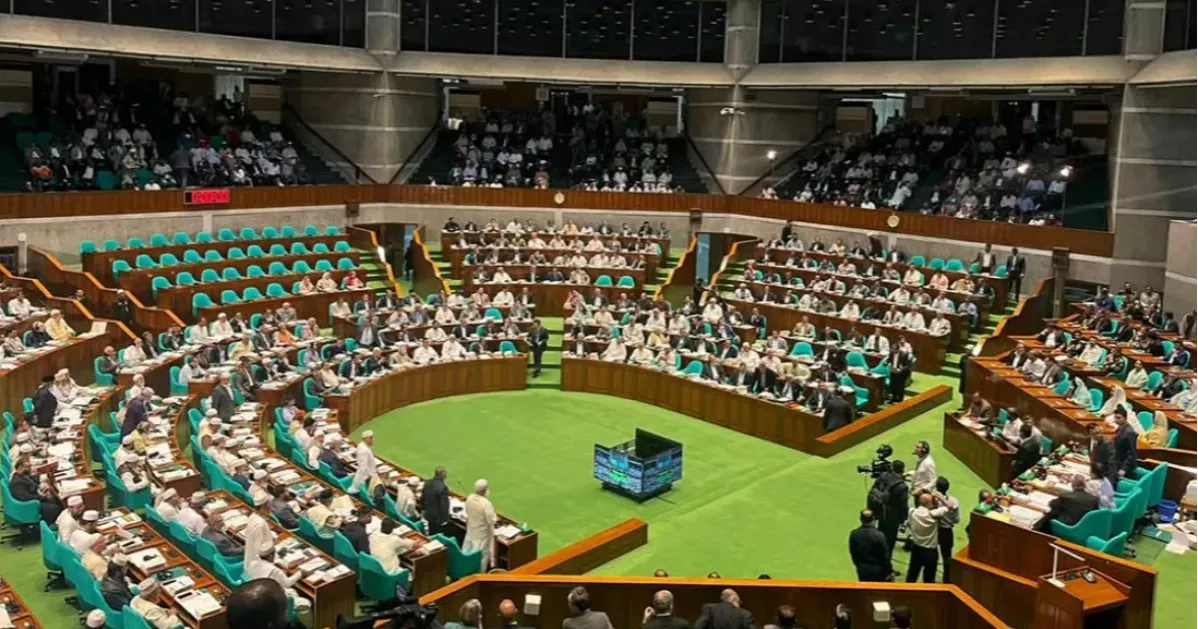
Parliament on Thursday passed the National Human Rights Commission (Repeal and Re-enactment) Bill, 2026, restoring the 2009 law despite strong objections from opposition lawmakers.
The bill reinstates the National Human Rights Commission Act, 2009 enacted during the Awami League government by repealing an ordinance promulgated under the interim government.
However, actions taken under the repealed ordinance will remain valid.
The bill was passed by voice vote.
Earlier, an objection raised by NCP lawmaker from Cumilla-4, Hasnat Abdullah, was rejected through a voice vote.
Opposition members argued that reviving the 2009 law could reopen the door to using the commission as a tool for political repression.
They claimed that before the political changes of July 2024, even many ruling party members would have opposed reinstating the earlier framework.
NCP leader Hasnat Abdullah warned that the move could push the country backwards, citing past allegations that the commission had been used to suppress dissent and opposition parties particularly BNP.
He alleged that the commission earlier legitimised actions against opposition activists and questioned the neutrality of investigations under the 2009 law which requires prior government approval to probe security forces.
He also linked the issue to other ordinances including those related to enforced disappearances and indemnity provisions following the July uprising, suggesting that repealing the 2025 ordinance would weaken those frameworks.
Hasnat further criticised the structure of the selection committee under the 2009 law, claiming it was dominated by ruling party members, thereby undermining the independence of the commission.
In response, Law Minister Asaduzzaman dismissed the opposition’s concerns, saying the remarks were more suited to political rallies than parliamentary debate.
He argued that the 2025 ordinance contained significant ambiguities and provisions that could undermine victims’ rights, including Section 16, which he described as problematic.
The minister said the ordinance required extensive review and consultation with stakeholders before it could be enacted into law.
He warned that leaving the ordinance in its current form could weaken related legal frameworks, including laws concerning enforced disappearances.
To avoid a vacuum in the country’s human rights oversight, the government opted to temporarily reinstate the 2009 law, he said.
Asaduzzaman emphasised that the earlier law provides for an independent commission with enhanced authority and insisted there was no reason for concern.
He also proposed forming a special parliamentary committee to consider constitutional amendments and broader human rights reforms, including consultations with victims and marginalised communities.
Highlighting the government’s record, the minister claimed that no incidents of crossfire or enforced disappearances had occurred during the current administration’s 42 days in office, signalling its commitment to human rights protections.
He further said members of the current ruling side had themselves been victims of human rights violations over the past 17 years, particularly citing the BNP and the Zia family, and pledged that the government would not pursue politics of revenge.