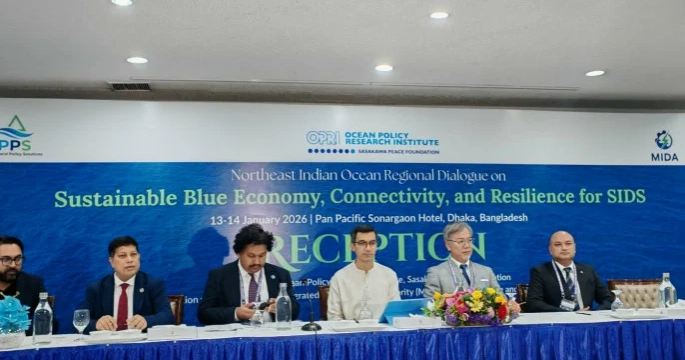
A two-day regional dialogue titled "Northeast Indian Ocean Regional Dialogue on Sustainable Blue Economy, connectivity, and resilience" officially commenced today (January 13), at a hotel in Dhaka.
The high-level event brings together senior policymakers, maritime experts, and development partners from Bangladesh, India (Andaman & Nicobar Islands), Sri Lanka, and the Maldives. Jointly organized by the Sasakawa Peace Foundation (Japan), the Moheshkhali Integrated Development Authority (MIDA), and Peace and Policy Solutions (Bangladesh), the dialogue aims to establish a unified roadmap for ocean-based economic growth.
The primary objective of the summit is to draft the “Dhaka Statement,” a shared regional position that will serve as a strategic guide for upcoming inter-regional and global dialogues.
Professor Mitsutaku Makino, President of the Ocean Policy Research Institute (OPRI) at the Sasakawa Peace Foundation, emphasized the strategic importance of the Indian Ocean as a "Great Middle Bay" connecting three billion people.
He noted that for Japan, the region is a critical maritime corridor that facilitates nearly 78 percent of its energy imports.
Speaking as the Chief Guest, Ashik Chowdhury (Chowdhury Ashik Mahmud Bin Harun), Executive Chairman of MIDA, BIDA, and BEZA, highlighted the untapped potential of the Bay of Bengal.
Experts call for national coordinating authority to develop blue economy
"The Bay of Bengal is the world’s largest bay, where resources, commerce, and connectivity converge," Chowdhury said. "For Bangladesh to harness its full maritime potential, we must elevate our actions and forge robust partnerships."
He announced that MIDA will collaborate with the Sasakawa Peace Foundation to implement modern maritime strategies across 20 government ministries and departments.