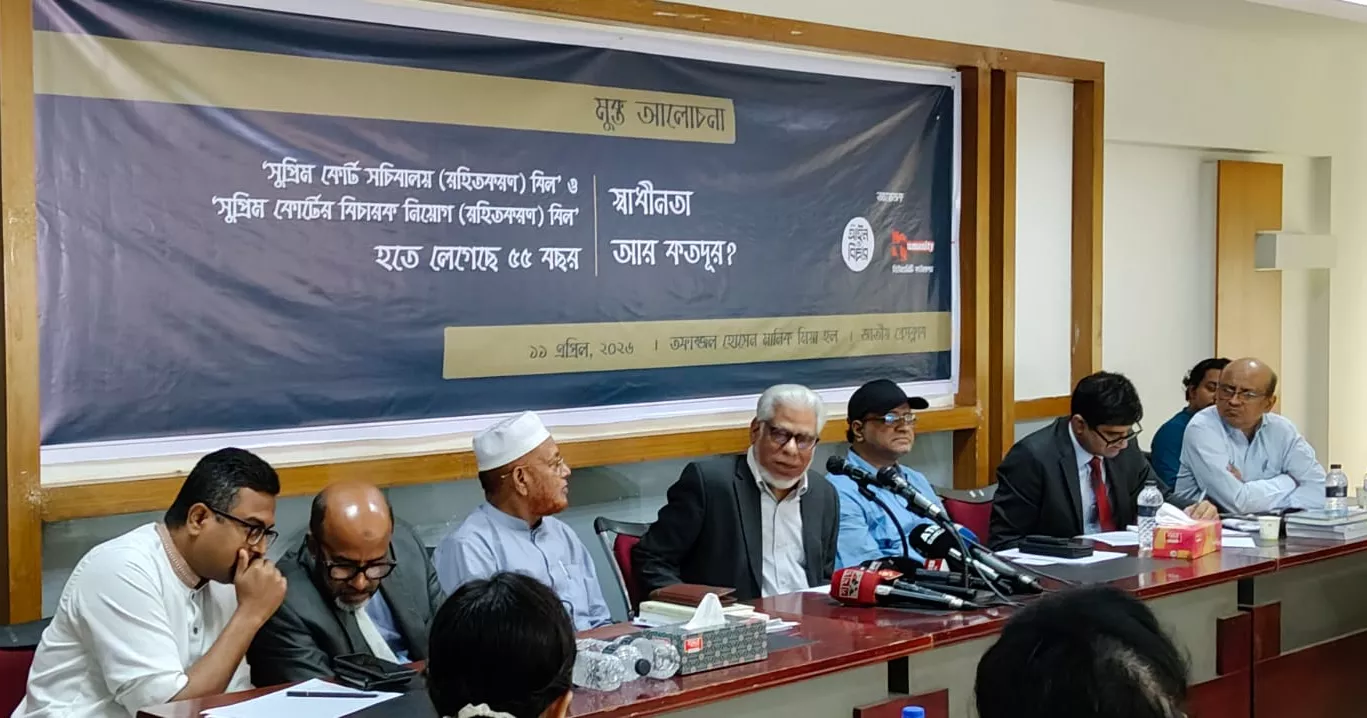
Speakers at a discussion on Saturday warned that the situation created by the repeal of the Supreme Court Secretariat (Repeal) Bill and the Judicial Appointment (Repeal) Bill could push the country towards a “dangerous situation.”
They made the remarks at a free discussion titled “55 years since the repeal of the Supreme Court Secretariat (Repeal) Bill and Judicial Appointment (Repeal) Bill: How far is independence?” held at the Tafazzal Hossain Manik Mia Hall of the Jatiya Press Club.
The event was jointly organised by the human rights organisation Humanity Foundation and the law journal Ain O Bichar. It was chaired and moderated by Humanity Foundation founder chairperson and Ain O Bichar editor Muhammad Shafiqur Rahman.
Speaking as chief guest, Appellate Division Judge Justice Abdul Matin said that the extent of amendments made to the Constitution made reforms unavoidable. He argued that if the July uprising is not recognised as legitimate, then decisions taken during the interim government would lose validity, and even the current government’s legitimacy could be questioned.
He said discussions on judicial independence date back to the United Front government in 1954, stressing that the demand is not limited to 55 years but is universal and timeless. He also said the ordinances’ repeal effectively goes against what he referred to as the “July Charter,” calling it a “self-destructive” step.
He criticised recent administrative actions, including show-cause notices issued to 28 judicial officers, and questioned the legality of restrictions on speaking about judicial matters. He also said that if the president claimed he had been forced into signing decisions, he should resign and could be impeachable.
Former District Judge Masdar Hossain said the repeal of the bills was a step backward when legal frameworks should instead be strengthened. He said Parliament was often dominated by individuals acting with arrogance, while the judiciary had long been treated unfairly. He added that courts had increasingly become places of oppression rather than justice, and warned that political influence over judicial appointments could return.
Senior lawyer Barrister Ehsan A. Siddiq said the repeal could lead the country towards a difficult future and accused the government of abusing power. He said hopes for a fully independent judiciary remained uncertain.
Senior lawyer Hasan Tariq Chowdhury alleged that both past and present governments prefer a controlled judiciary, and said bureaucratic control over judicial promotions and transfers undermines independence.
Barrister Omar Faruq said the repeal could have serious long-term consequences and questioned the justification of the move. He warned that political interference in the judiciary could worsen governance challenges.
Former Joint District Judge Dr Md Sajjad Hossain said the decision could backfire on the government and claimed that political cultures influenced institutional independence, calling for continued struggle for judicial reform.
Arif Sohel, representing the July student movement and “Gonobiplobi Udyog,” said the judiciary had shown contradictory behaviour and remained influenced by the executive, adding that the repeal went against the spirit of the July uprising.
July uprising aimed at inclusive, new Bangladesh, not just govt change: Rumeen Farhana
In his presidential remarks, Muhammad Shafiqur Rahman said the repeal could hinder democratic development, increase authoritarian tendencies, and weaken judicial independence. He warned it could allow misuse of courts for political purposes, increase bureaucratic interference in judicial processes, and erode public trust in the justice system.