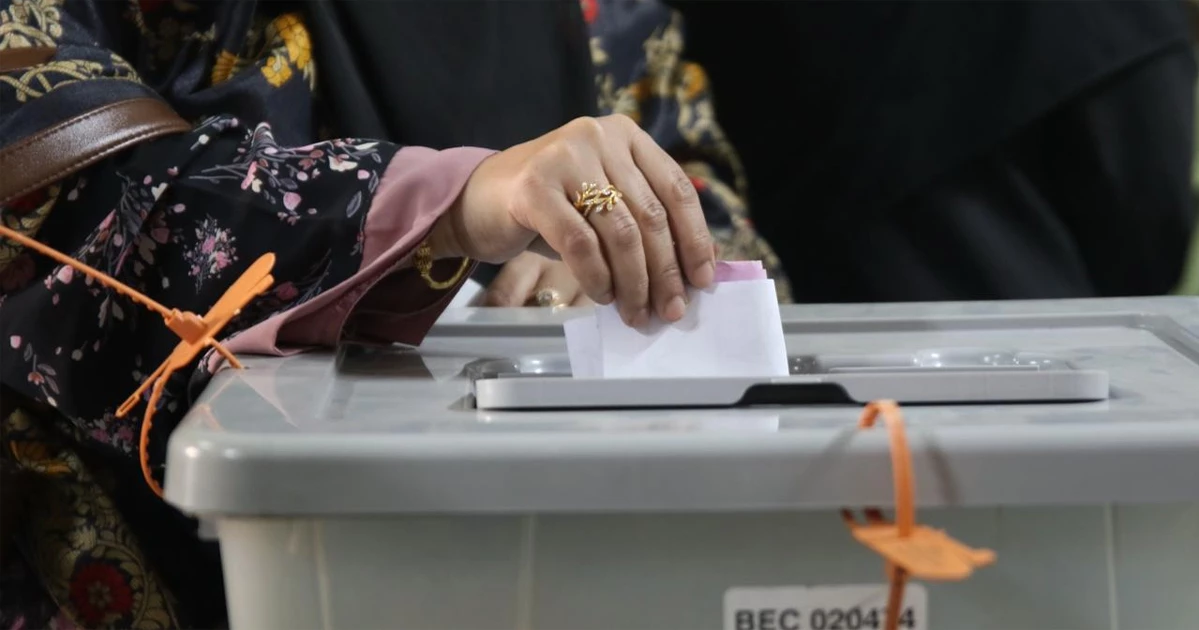
Voting in Bangladesh’s national election concluded on Thursday in a largely peaceful atmosphere, with high hopes of restoring genuine democracy and securing a strong mandate for national reforms.
The polling began at 7:30am and continued until 4:30pm without interruption at 42,659 polling stations in 299 out of 300 constituencies, amid the deployment of nearly one million security personnel and another one million polling staff.
Alongside the parliamentary election, voters also participated in a referendum to express their views through ‘Yes’ or ‘No’ votes on proposals for several constitutional amendments.
In the capital, voters began arriving at polling centres early in the morning. As the day progressed, voter presence steadily increased, creating an atmosphere of festivity among those casting their ballots.
According to Election Commission (EC) data, the voter turnout nationwide was 47.91 percent by 2:00pm, midway through the nine-hour balloting for the parliamentary election and referendum.
“We’ve gathered data from 32,789 out of 42,651 polling stations. According to this data, voter turnout stands at 32.88 percent,” said EC Senior Secretary Akhtar Ahmed while briefing reporters at 1:10pm at the city’s Nirbachan Bhaban.
Bangladesh Polls: EC reports about 33% turnout by noon
Chief Adviser Prof Muhammad Yunus cast his vote at the Gulshan Model School and College centre in Dhaka. BNP Chairman Tarique Rahman voted at the same centre around 9:40am, while Bangladesh Jamaat-e-Islami Ameer Dr Shafiqur Rahman cast his ballot at 8:15am at Monipur High School (Boys’ Branch).
BNP Secretary General Mirza Fakhrul Islam Alamgir voted at Thakurgaon Government Girls’ High School around 7:40am.
The election in Sherpur-3 constituency was postponed due to the death of a contesting candidate.
Voters cast ballots to choose 299 public representatives from a total of 2,028 candidates, including nominees of 50 political parties and independent contenders.
A total of 127,298,522 voters in 299 constituencies were eligible to vote, comprising 64,620,077 male voters, 62,677,232 female voters, and 1,213 third-gender voters. The country’s total electorate across 300 constituencies is 127,711,899.
Two major political parties—the BNP and Bangladesh Jamaat-e-Islami—are contesting the election, seeking a public mandate to govern for the next five years. The ousted Awami League, however, is absent from the race this time, having boycotted the 15th February 1996 election after 30 years in the political arena.
Of the 59 registered political parties, 50 are participating in the elections. Among the 2,028 candidates contesting from 299 constituencies, 1,755 were nominated by political parties, while 273 are independent candidates.