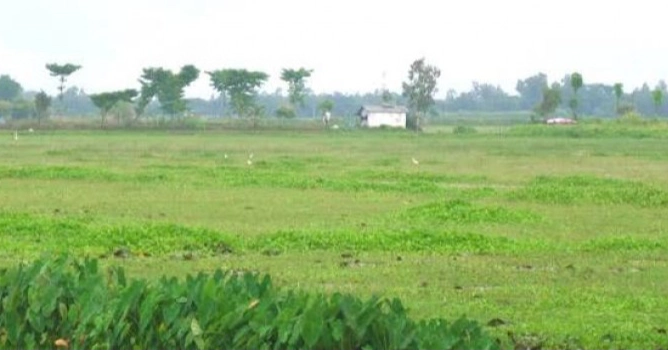
Bangladesh has embarked on a landmark agricultural initiative aimed at converting vast stretches of fallow haor lands into cultivable fields, in a project valued at approximately Tk 500 crore.
The five-year programme, spearheaded by the Bangladesh Agricultural Development Corporation (BADC), is set to run through 2029 across four districts of the Sylhet division, including Sunamganj, Sylhet, Moulvibazar and Habiganj, officials said.
They said the ambitious project focuses on enhanced surface water management to boost irrigation and agricultural productivity.
It encompasses excavation of canals and hill streams, construction of permanent causeways, flood control measures, farmer training, and other interventions designed to increase resilience against climate impacts.
Dilapidated relics cast a long shadow over justice at Amtali court
Once fully implemented, officials estimate the programme will bring 17,019 hectares of fallow land under irrigation, generating an additional 51,058 metric tonnes of food grains.
Farmers in the region will receive hands-on training between 2025 and 2029 to improve water-use efficiency and adapt to climate challenges, potentially increasing rice and other crop yields. Fish production is also expected to rise following the excavation of canals and hill streams.
“Work has already started. We are keeping a strict watch to ensure that there is no irregularity or mismanagement in the project,” said Project Director Engineer Pranjit Kumar Deb.
Construction of reinforced concrete causeways—considered one of the most critical components—is underway, facilitating the easier transportation of Boro paddy by boat and vehicle, saving time and money for farmers. Nearly 10,000 hectares of fallow land in the haor districts are expected to be brought under cultivation during the project’s five-year span.
Planned works include the excavation of 70 kilometres of canals and hill streams, installation of 10 deep tube wells, renovation of 30 old irrigation schemes, construction of 15 culverts, two sluice gates, four causeways, and drainage improvement over nearly three kilometres.
Palm trees under the axe; Naogaon bypass pays an environmental price
Across the four districts, 221 kilometres of canals and hill streams will be excavated and 105 kilometres renovated. Enhanced water retention will allow flood and rainwater to be stored for supplementary irrigation during Aman and Robi seasons, benefiting 2,681 hectares.
Re-excavation and renovation efforts will also help protect roughly 7,900 hectares from early flooding caused by sudden hill runoff. Five kilometres of buried pipelines are expected to permanently remove waterlogging from 167 hectares, protecting crops worth approximately 24,200 metric tonnes on 8,067 hectares of Boro land.
Modern irrigation infrastructure, including low-lift pumps, force-mode pumps, artesian tube wells, sprinkler systems, and 367.6 kilometres of underground channels, will bring 10,032 hectares under advanced irrigation, while renovation of 180 old schemes aims to prevent water loss.
Small and medium irrigation infrastructure such as water passes, cattle crossings, footbridges, pipe sluices, regulators, and submerged weirs, cross dams, siphons, and conduits are also planned, alongside 10 kilometres of causeways to aid crop transportation.
Approximately 900 mechanics, managers, operators, field staff, farmers, and women farmers will receive training on irrigation management, equipment maintenance, crop and seed production, processing, and vegetable cultivation.
The initiative has been welcomed by haor movement leaders and farmers, though they have urged rigorous monitoring to prevent mismanagement.
“BADC is a pioneering institution in agricultural development, and this project could bring meaningful change if closely monitored,” said Saiful Alam Sadrul, a labour movement leader in Sunamganj.
Endless delay pushes Barui Para Bridge cost to Tk 136cr; frustration grows
Prof Chittaranjan Talukder, a leader of the Haor Bachao Andolon, said that while permanent causeways would ease crop transport, caution is needed in canal excavation and construction works.
The project’s launch follows nearly five years of preparatory work, marking a significant step in transforming Bangladesh’s haor regions into productive agricultural landscapes.