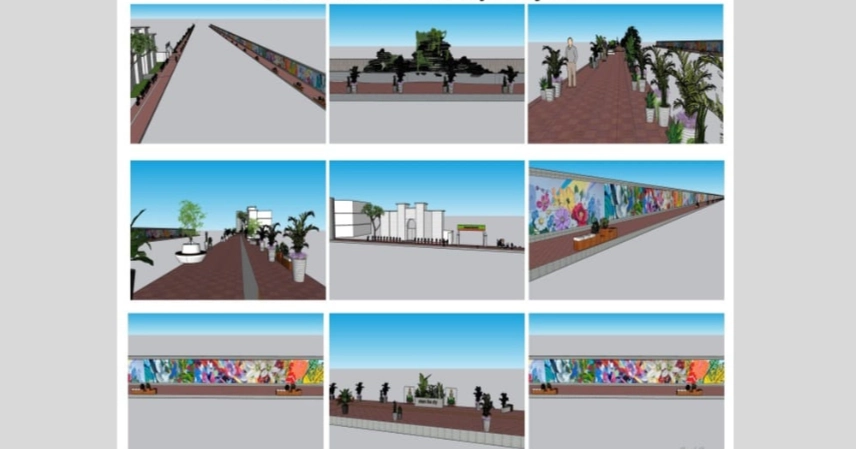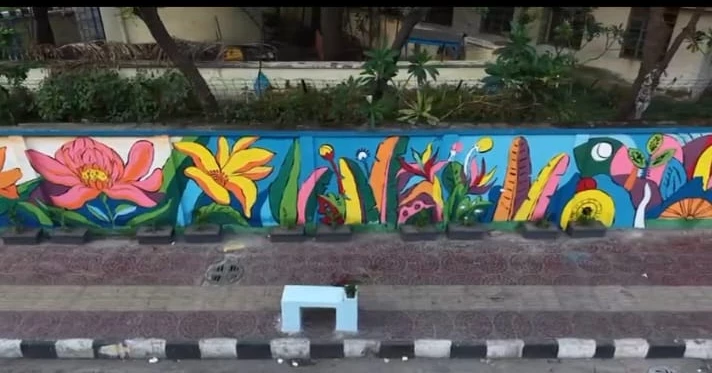
The once-congested and unhygienic road in front of Dhaka Medical College Hospital (DMCH) has undergone a striking transformation, offering a visually appealing and pedestrian-friendly environment on the occasion of Pahela Baishakh.
Where rows of makeshift shops once occupied the footpath, accompanied by piles of waste and foul odours, the stretch from Central Shaheed Minar to the hospital gate has now been redesigned with flower tubs, seating arrangements and vibrant murals.
The boundary walls of the hospital, long hidden behind shops and neglect, have now emerged as a large canvas of artistic expression. Colourful folk motifs and traditional designs now adorn the walls, bringing life to one of the capital’s busiest footpaths.
Locals say even a few months ago, walking through this area was difficult. Due to illegal shops, waste and an unhygienic environment, pedestrians often had to cover their noses while passing through.
A regular commuter Jamir, said the place previously suffered from severe sanitation issues.
“People used to use the place as a public toilet. The smell was unbearable. Now, with flower tubs, benches, and colourful walls—the environment feels much more pleasant,” he said.
Another attendant of the patient who visited the emergency department of the hospital shared his feeling with UNB that it is really a new experience, as he had never seen this scenic view here before. “It will be an example if authorities can continue to monitor the place,” he said.
DSCC Chief Waste Management Officer Air Commodore Md. Mahabubur Rahman Talukdar said the initiative aims to provide a sense of relief to patients, attendants, and visitors amid the pressure of the hospital environment.
“We want people—especially patients and their families—to find a moment of peace here. They should be able to sit, walk, and feel mentally relaxed despite their situation,” he said.
The initiative, taken by Dhaka South City Corporation, is being implemented as a pilot project. Authorities aim to transform the surrounding hospital environment into a cleaner, greener, and more welcoming public space.