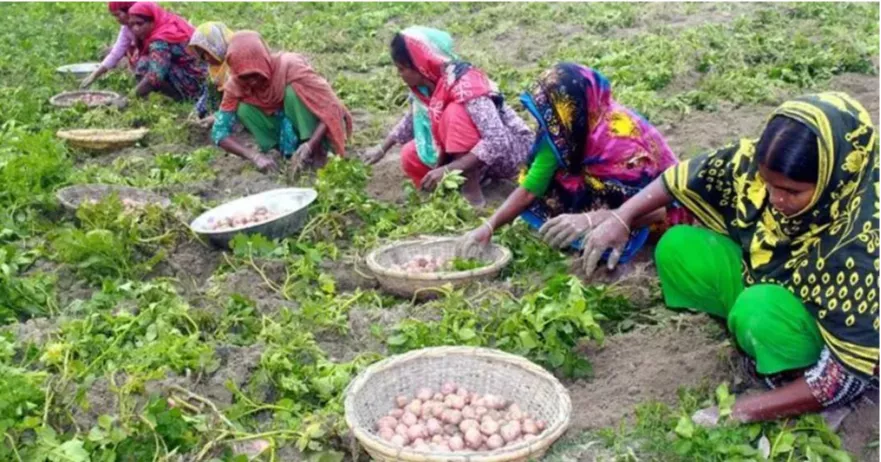
A sharp fall in potato prices at the start of the harvesting season has plunged farmers in the northern region into deep uncertainty, with many forced to sell their produce at rates lower than production costs.
Growers say the situation has left them counting losses instead of profits as market prices fail to cover rising expenses for seeds, fertilisers, irrigation, labour and transportation.
In Rangpur City Market on Sunday, potatoes were retailing at Tk 10–12 per kilogram while production costs range between Tk 14 and Tk 22 per kilogram.
Farmers claim they are incurring losses of Tk 2–3 per kg on average, with wholesale prices hovering at Tk 15–17 per kg.
According to the Department of Agricultural Extension (DAE), Bangladesh produced 1.15 crore tonnes of potatoes in the 2024–25 fiscal year, of which 87 lakh tonnes came from Rajshahi and Rangpur divisions.
The production target for the current season stands at around 84 lakh tonnes.
Farmers in major potato-producing districts such as Rajshahi, Bogura, Rangpur and Pabna said input costs have surged compared to last year, pushing overall production expenses to Tk 18–22 per kg.
Sujan Rahman, a farmer from Gangachara upazila in Rangpur, said he cultivated potatoes this season hoping to offset last year’s losses.
“But the market price is so low that I cannot even recover my costs,” he lamented.
Mizanur Rahman of Kaunia upazila said early-season planting is usually aimed at securing better prices.
“However, unsold potatoes from last year are still in the market, reducing demand for new crops,” he said.
In Lalmonirhat’s Kaliganj upazila, Hasim Mia cultivated Cardinal potatoes on 18 bighas of land at a cost of Tk 22 per kg.
BGMEA thanks govt for releasing Tk 2,500 crore in export incentives
“Now I can only sell them at Tk 15–18 per kg,” he said expressing frustration over mounting losses.
Farmers attribute the price slump to leftover stock from the previous season, weak market management and a lack of adequate cold storage facilities.
They also allege that syndicate dominance and excess production have compounded the crisis.
Market insiders said traders are reluctant to procure potatoes in bulk due to limited export opportunities and high storage costs.
As a result, supply continues to outpace demand, driving prices further down.
Shahin Mia, deputy director of the Department of Agricultural Marketing in Rangpur Division, said potato cultivation has slightly decreased compared to last year, which may help stabilise supply and prices later in the season.
However, Sirajul Islam, additional director of the DAE in Rangpur, said cultivation this year exceeded the target by about 25,000 hectares, contributing to the oversupply.
Agricultural experts warn that unless export markets are expanded and better market management ensured, potato growers will continue to suffer recurring losses.
They urged the government to take urgent, farmer-friendly measures to protect the sector and safeguard the livelihoods of thousands of farming families dependent on potato cultivation in the north.