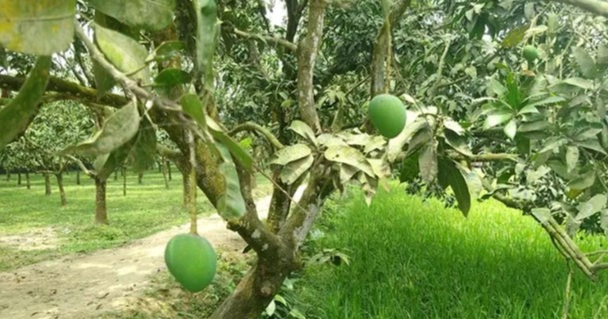
Haribhanga mango is expected to generate trade worth over Tk 250 crore this season, as the harvest of Rangpur’s signature fruit is set to begin in mid-June, agriculture officials said.
The Haribhanga mango, a Geographical Indication (GI) product of Bangladesh, is widely known for its distinctive taste, aroma and premium market value, making it one of the most commercially important fruits in northern Bangladesh.
Agriculture officials say if weather conditions remain favourable, the current season could generate business worth more than Tk 250 crore from this mango alone.
“We are expecting trade of over Tk 250 crore from Haribhanga mango this year,” said Md Sirazul Islam, Additional Director of the Department of Agricultural Extension (DAE), Rangpur division.
According to the DAE, more than 3,000 hectares of land in Rangpur district have been brought under Haribhanga mango cultivation this year.
Recent rainfall has supported fruit growth and improved juiciness, although some areas experienced minor damage due to hailstorms and strong winds. Overall, officials expect a better yield than last year.
Agricultural experts say Haribhanga mango follows a natural alternate bearing cycle – known locally as “on year” and “off year”— and this season is considered an “on year,” meaning trees are bearing significantly more fruit than usual.
The mango is typically harvested in mid-June when it reaches full maturity, although early market arrivals often include unripe fruit sold at higher prices by some traders.
Data from agriculture offices shows that mango buds began appearing in December and harvesting is expected to begin on schedule this year.
Haribhanga mango is known for being fiberless, sweet and highly aromatic, with a thin skin, small seed, and an average weight of 200-300 grams.
Farmers estimate an average yield of 10-12 tonnes per hectare. With cultivation spanning over 3,000 hectares, total production value is projected to exceed Tk 250 crore.
However, farmers remain cautious about weather risks.
“Some of my orchards have been damaged by storms and further bad weather could cause losses,” said Nazmul Islam, a mango grower from Padaganj in Mithapukur, who cultivates mangoes on over 12 acres of land.
Despite minor damage from recent hail and wind, growers remain optimistic about a strong harvest if conditions remain stable.
Local wholesalers say demand is already building ahead of the season. “Buyers from Dhaka, Chattogram and Sylhet have started contacting us. We expect both price and demand to be strong this year,” said Abdul Malek, a trader.
Experts note that Haribhanga mango is no longer limited to the domestic market. It is exported to countries, including Malaysia and Singapore, while direct sales through social media and e-commerce platforms have increased significantly in recent years. Its GI status has further strengthened brand value and pricing.
Fakhrul Anam Benju, President of the Rangpur chapter of Shushashoner Jonno Nagorik (SHUJAN), said the mango’s commercial reach is expanding rapidly but challenges remain.
“Despite its huge potential, farmers are concerned about the lack of cold storage and modern preservation facilities. Since Haribhanga is highly perishable, special transport arrangements such as dedicated trains or faster logistics should be introduced,” he said.
DAE’s Sirazul Islam said the crop is in its peak “on-year” cycle and that they are actively supporting farmers with technical guidance.
On February 12, 2024, Haribhanga mango received official recognition as a Geographical Indication (GI) product of Bangladesh.