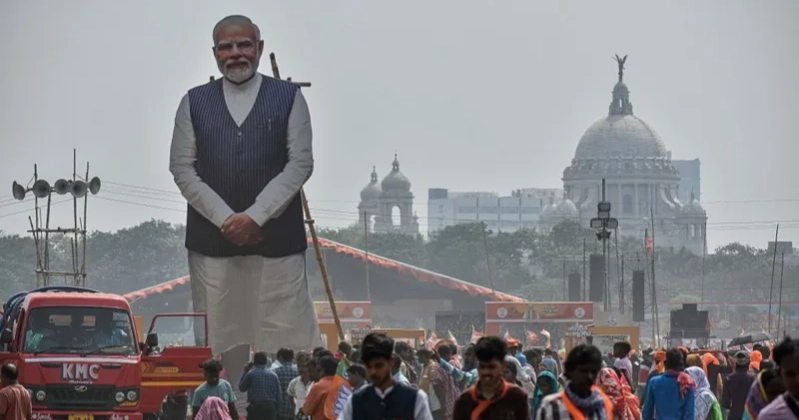
Early indications show Indian Prime Minister Narendra Modi’s BJP leading in Assam and West Bengal, with its alliance also on course to form the government again in Puducherry.
In West Bengal, sitting Chief Minister Mamata Banerjee appears to be heading toward an unexpected loss after three consecutive terms in office.
Here is a state-wise summary of the trends:
West Bengal: The BJP is leading in more than 140 seats, while the Trinamool Congress (TMC) is ahead in 73 constituencies. The state has 294 assembly seats, with 148 required for a majority.
Tamil Nadu: Vijay’s TVK is leading in about 109 seats. The AIADMK is ahead in nearly 63 seats, while the ruling DMK is leading in around 39 constituencies. Tamil Nadu has 234 seats, and 118 are needed to form the government.
Assam: The BJP is ahead by a large margin with over 79 seats, while the Congress is leading in around 24 seats. The state has 126 assembly seats, with 64 needed for a majority.
Kerala: The Congress-led alliance is leading in over 80 seats, while the CPI(M)-led ruling coalition is ahead in about 46 constituencies. Kerala has 140 seats, and 71 are needed to form the government.
Puducherry: The BJP-led alliance is leading in 11 seats, while the Congress-led alliance is ahead in seven. The Union Territory has 33 seats, including three nominated members, with 17 needed for a majority.
At the BJP headquarters in Kolkata, celebrations have already started as early trends suggest a possible win in West Bengal. Party workers are seen distributing sweets, and slogans of “Jai Shri Ram” are being raised, reports BBC.
However, senior leaders are also urging caution, saying it is still too early to celebrate. Despite this, they remain confident about defeating the TMC and Chief Minister Mamata Banerjee.
West Bengal has long been a challenging state for the BJP. The party emerged as a strong competitor in the 2021 assembly elections but was defeated by the TMC, which secured a two-thirds majority. This time, the BJP has focused its campaign on development, law and order, and identity politics, arguing that the state’s progress requires the same party to be in power both at the state and national levels.