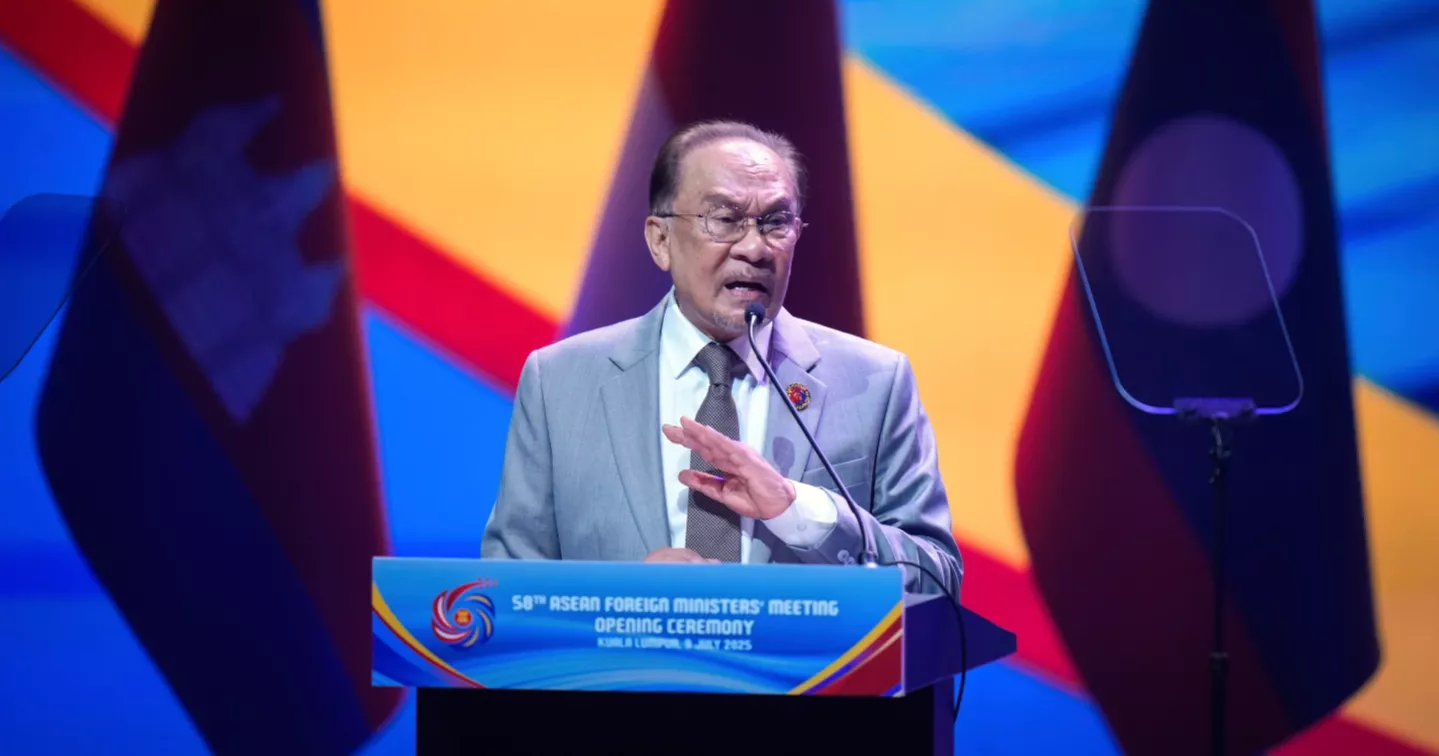
Malaysian Prime Minister Anwar Ibrahim on Wednesday warned that global trade is being weaponized, as foreign ministers from the Association of Southeast Asian Nations (ASEAN) convened their annual meeting amid rising fears over impending U.S. trade tariffs.
Anwar’s warning came as concerns mount across the 10-nation ASEAN bloc, many of whose economies are heavily reliant on exports. Six member states are among 14 countries facing steep new U.S. tariffs—ranging from 25% to 40%—scheduled to take effect on August 1 unless agreements are reached.
Opening the meeting, Anwar said the world is witnessing a time when “power unsettles principle” and economic tools once meant to foster growth are now being used “to pressure, isolate and contain.” Without naming the United States, he urged ASEAN to forge a united response to emerging trade threats.
China ready to work with UN to strengthen more just and equitable int'l order: Premier Li
“Our cohesion must not end at declarations,” he said, calling on the group to strengthen intra-ASEAN trade, advance regional integration, and reduce strategic dependencies on major external powers. “This is no passing storm. It is the new weather of our time.”
U.S. President Donald Trump initially announced the tariff measures in April but delayed them by 90 days for negotiations. On Tuesday, he reintroduced the tariffs, which will apply to 14 countries unless deals are finalized by August. He also warned of even higher tariffs should any country retaliate.
So far, Vietnam is the only ASEAN member to have secured a deal, which reduced its tariffs from 46% to 20%. The new tariff rates include 36% for Thailand and Cambodia, 32% for Indonesia, 25% for Malaysia, and 40% for both Laos and Myanmar.
Several ASEAN countries have initiated bilateral discussions with Washington and plan to hold a regional summit with the U.S. later this year to adopt a unified approach.
Responding to the economic uncertainty, Malaysia’s central bank on Wednesday cut its benchmark interest rate for the first time in five years.
Meanwhile, Malaysian Trade Minister Zafrul Aziz stated that while Kuala Lumpur will continue talks with the U.S., it will not agree to any terms that compromise national interest or sovereignty.
He referenced American demands concerning government procurement policies, halal certification, medical regulations, and digital tax policies but did not elaborate. “It has to be fair ... if the deal does not benefit Malaysia, we should not have a deal,” he emphasized.
Beyond trade tensions, the ASEAN bloc is grappling with internal crises, including the ongoing civil war in Myanmar and a simmering border dispute between Thailand and Cambodia.
The foreign ministers' meeting in Malaysia will be followed by high-level talks on Thursday and Friday with key external partners including the United States, China, Japan, India, Russia, and the European Union.
U.S. Secretary of State Marco Rubio is set to arrive Thursday for his first visit to Asia. His trip follows the cancellation of planned stops in Japan and South Korea last week. Other prominent attendees include Chinese Foreign Minister Wang Yi and Russian Foreign Minister Sergei Lavrov.
Analysts say these upcoming talks will be a critical test of ASEAN’s ability to maintain its independence and uphold a rules-based trade framework amid intensifying global geopolitical rivalry.
“ASEAN must be among those who choose to stand for rules, even when others choose retreat,” Anwar said, with officials confirming he will meet Rubio to address the tariff concerns directly.
Russia becomes first state to recognise Afghanistan's Taliban government
Commentators see Rubio’s presence as a sign of Washington’s renewed engagement with Southeast Asia. Collins Chong Yew Keat, a foreign affairs and security analyst at Universiti Malaya, noted that the U.S. still offers ASEAN significant military and economic advantages but now expects more alignment.
“Trump’s administration, while still offering the strongest military deterrence and market access, expects ASEAN to stop exploiting this security umbrella while cozying up economically to China,” he said.