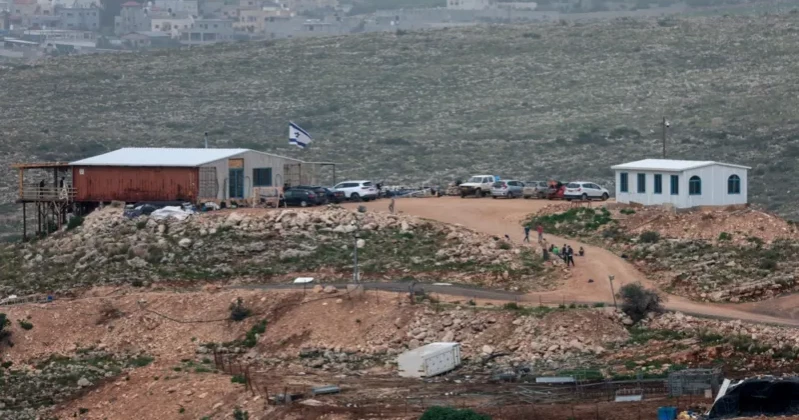
Palestinians, several Arab countries, Israeli anti-occupation groups and the United Kingdom have strongly condemned newly approved Israeli measures in the occupied West Bank, warning that the steps amount to a de facto annexation of Palestinian land.
The measures were announced by far-right Israeli Finance Minister Bezalel Smotrich following approval by Israel’s security cabinet. Smotrich said the decisions would make it easier for Jewish settlers to take over land in the West Bank and declared that Israel would continue efforts to block the creation of a Palestinian state.
All Israeli settlements in the occupied West Bank are regarded as illegal under international law.
The new steps, which are expected to receive final approval from Israel’s top military commander in the West Bank, are designed to expand Israeli control over land administration, including property law, planning, licensing and enforcement.
The announcement came just days before a scheduled meeting in Washington between Israeli Prime Minister Benjamin Netanyahu and US President Donald Trump.
According to the United Nations, settlement expansion in the West Bank reached its fastest pace on record last year.
Among the measures is the removal of a long-standing ban on the direct sale of West Bank land to Jewish buyers and the declassification of local land registry records. Until now, settlers were generally limited to purchasing property through registered companies on land administered by the Israeli state.
Israeli ministers described the move as a step to increase transparency and facilitate land acquisition. Israel’s foreign ministry later said the changes corrected what it called discriminatory rules that restricted property purchases by non-Arabs in what Israel refers to as Judea and Samaria.
The cabinet also voted to repeal a requirement for special transaction permits for real estate purchases, a mechanism previously used to maintain oversight and prevent fraud.
Palestinians expressed fears that the changes would intensify pressure on landowners to sell and could lead to forgery and deception.
Palestinian President Mahmoud Abbas described the measures as dangerous, calling them an open attempt to legalise settlement expansion, land confiscation and the demolition of Palestinian property, including in areas under Palestinian Authority administration. He urged the United States and the UN Security Council to intervene immediately.
The Israeli rights group Peace Now warned that the decisions could destabilise the Palestinian Authority and effectively cancel existing agreements, accusing the government of paving the way for widespread land seizure and de facto annexation.
The United Kingdom said it strongly condemned the move and called on Israel to reverse the decision, warning that any unilateral action altering the geographic or demographic character of Palestinian territory would violate international law.
Foreign ministers from Egypt, Jordan, the United Arab Emirates, Indonesia, Pakistan, Turkey, Saudi Arabia and Qatar also issued a joint statement condemning the measures. They said the decisions accelerated illegal annexation efforts and the displacement of Palestinians, warning that such policies would fuel further violence and instability.
Additional steps announced by Smotrich and Defence Minister Israel Katz include transferring building and licensing authority at sensitive religious sites in Hebron exclusively to Israeli bodies. These include areas surrounding the Cave of the Patriarchs, also known as the Ibrahimi Mosque, one of the holiest sites in both Judaism and Islam.
Israeli authorities would also be granted enforcement powers over environmental and archaeological matters in areas administered by the Palestinian Authority. A committee would be revived to allow the Israeli state to make what it described as proactive land purchases in the West Bank to secure land for future settlements.
Under the 1993 Oslo Accords, the Palestinian Authority was given full control over major Palestinian urban areas, known as Area A, which make up about 20 percent of the West Bank. Israel retained full administrative and security control over Area C, which covers about 60 percent of the territory and contains most Israeli settlements.
More than 700,000 Israeli settlers currently live in the occupied West Bank and Israeli-annexed East Jerusalem, territories captured by Israel in the 1967 Middle East war. Palestinians seek these areas for a future independent state along with the Gaza Strip.
While the Trump administration has ruled out formal annexation of the West Bank, it has not moved to halt Israel’s rapid settlement expansion.
Smotrich, himself a settler and leader of a pro-settler party, has pledged to double the settler population. In December, Israel’s cabinet approved plans for 19 new settlements and is preparing to advance construction of the controversial E1 settlement project near Jerusalem, a move that would effectively split the West Bank in two.
The United Nations says more than 37,000 Palestinians were displaced in 2025 alone, alongside record levels of settler violence.
Netanyahu’s governing coalition includes strong pro-settler factions that openly support annexation. The prime minister, who faces elections later this year, has repeatedly said he would not allow the establishment of a Palestinian state, describing it as a security threat.
In 2024, the International Court of Justice issued a non-binding advisory opinion stating that Israel’s occupation of Palestinian territories is illegal and should be brought to an end.
With inputs from BBC