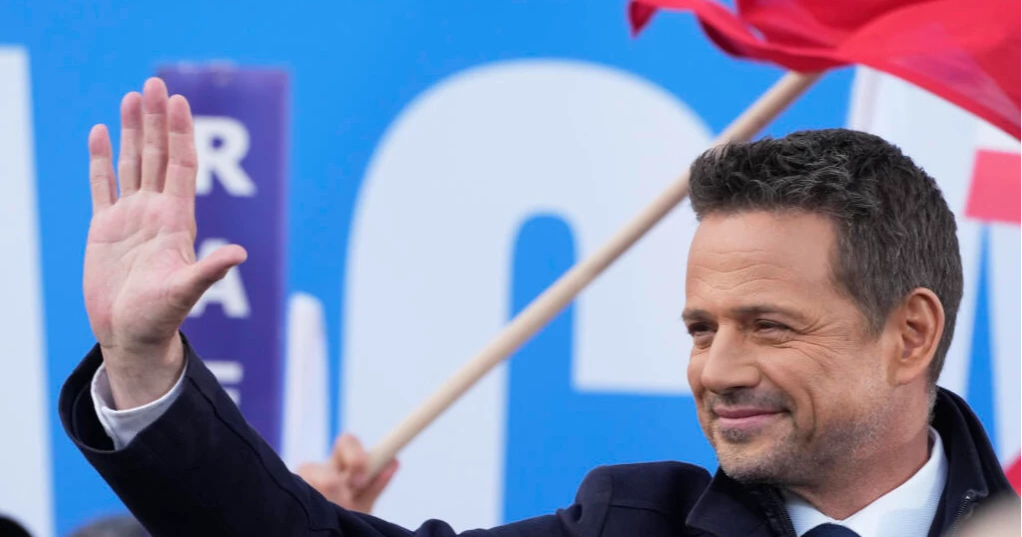
With war raging next door in Ukraine, rising migration pressure on its borders, Russian sabotage in the region, and growing uncertainty over the United States' long-term commitment to European security, Poland heads to the polls Sunday for a pivotal presidential election.
Voters will not only be choosing a new head of state, but also weighing in on the strength of Poland's democracy and its role within the European Union. A key responsibility for the next president will be preserving close ties with the U.S., seen by many as vital to Poland’s stability in an increasingly turbulent geopolitical environment.
Crowded Field Points to Likely Runoff
The election is taking place in a Central European nation of 38 million, as conservative incumbent Andrzej Duda prepares to leave office at the end of his second and final five-year term in August.
With 13 candidates in the running, a clear winner in the first round appears unlikely. Some contenders have drawn criticism for extreme or unserious positions, including openly pro-Putin or antisemitic rhetoric. A recent televised debate lasted nearly four hours, prompting calls for stricter rules to enter the race.
Polls suggest a likely runoff on June 1 between two frontrunners: Rafał Trzaskowski, the liberal mayor of Warsaw, and Karol Nawrocki, a conservative historian backed by the Law and Justice party, which ruled Poland from 2015 to 2023.
A nation at the front line
Poland’s geography gives the election added importance. Bordering Russia’s Kaliningrad exclave, Belarus and war-torn Ukraine — as well as several Western allies — Poland occupies a critical position along NATO’s eastern flank and serves as a key logistics hub for military aid to Ukraine.
There are growing fears that if Russia prevails in its full-scale invasion of Ukraine, it could target other countries that freed themselves from Moscow’s control some 35 years ago. Against that backdrop, the election will shape Warsaw’s foreign policy at a moment of mounting strain on trans-Atlantic unity and European defense.
Both leading candidates support continued U.S. military engagement in Europe. Trzaskowski puts greater emphasis on deepening ties with the European Union, while Nawrocki is more skeptical of Brussels and promotes a nationalist agenda.
When Law and Justice held power, it repeatedly clashed with EU institutions over judicial independence, media freedom and migration.
Why the presidency matters
While Poland is a parliamentary democracy, the presidency wields significant influence. The president serves as commander-in-chief of the armed forces, holds veto power, shapes foreign policy and plays a symbolic role in national discourse.
Under Duda, the office largely advanced the conservative agenda of Law and Justice. Since Prime Minister Donald Tusk’s centrist coalition came to power in late 2023, Duda has blocked key reforms aimed at restoring judicial independence and repairing relations with the EU.
India cuts ties with Turkey amid growing boycott calls over Pakistan row
“The stakes are enormous for the ruling coalition and for those concerned with the future of Polish democracy,” said Jacek Kucharczyk, president of the Institute of Public Affairs, a Warsaw think tank. “This is about democratic reform and restoring the rule of law — and that can only happen with cooperation from the next president.”
The election is also pivotal for Law and Justice, Kucharczyk noted: “Its future as a dominant political force may hinge on the outcome.”
Two visions for Poland
Both Trzaskowski and Nawrocki have pledged to support Ukraine and maintain strong defense ties, but their visions for Poland diverge sharply on the role of the EU and domestic social policy.
Trzaskowski, 52, is a former presidential contender and a senior figure in Civic Platform, the centrist party led by Tusk. He is running on a pro-European platform and has pledged to defend judicial independence and rebuild democratic institutions.
Supporters describe him as a modernizer who represents a cosmopolitan, outward-facing Poland. He speaks foreign languages, has marched in LGBTQ+ parades and appeals to younger, urban voters. Trzaskowski’s progressive views highlight an evolution of the once more conservative Civic Platform.
Nawrocki, 42, represents how the party backing him, Law and Justice, is turning further to the right as support for the hard right grows.
Nawrocki, who is not a Law and Justice party member, heads the state-backed Institute of National Remembrance, which investigates Nazi and communist-era crimes. He has drawn praise from conservatives for dismantling Soviet monuments and promoting patriotic education, but he faces criticism for inexperience and playing on anti-German and other resentments. He has also been embroiled in some scandals.
Earlier this month, Nawrocki met with U.S. President Donald Trump at the White House — a symbolic moment welcomed by Law and Justice-friendly media as proof that he would be the best man for keeping the relationship with the United States strong. Critics viewed it as interference by Trump’s administration.
This week Nawrocki was joined on the campaign trail by Romanian nationalist George Simion, who faces a runoff vote for the presidency on Sunday. Simion is viewed by critics as pro-Russian, leading Tusk to tweet: “Russia is pleased. Nawrocki and his pro-Russian Romanian counterpart George Simion on the same stage five days before the presidential elections in Poland and Romania. Everything is clear.“