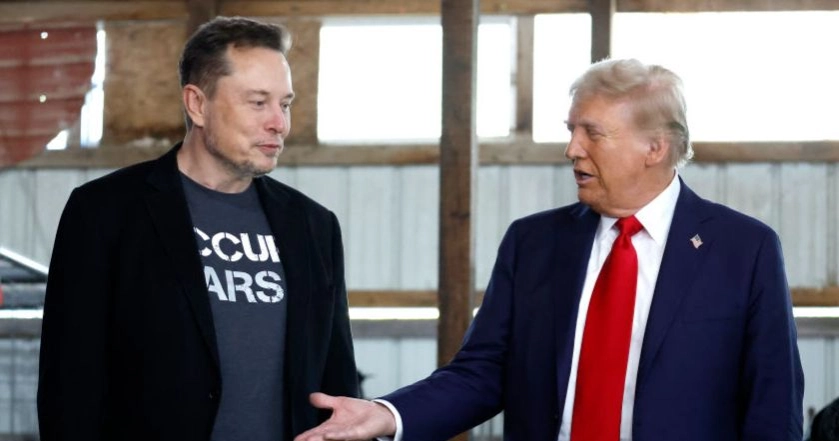
A new administration has entered Washington with promises of dramatic reforms, leveraging business strategies and technological advancements to overhaul federal operations. It has offered buyouts to government employees and aggressively reduced expenses in an effort to balance the budget.
While this may resemble billionaire Elon Musk’s cost-cutting measures under Republican President Donald Trump, the largest effort to revamp the federal government in modern history actually took place three decades ago. In the 1990s, Democratic President Bill Clinton launched the "Reinventing Government" initiative, led by Vice President Al Gore, with a focus on efficiency and modernization.
Musk himself has drawn parallels between his current efforts and the Clinton-era reforms. "What @DOGE is doing is similar to Clinton/Gore Dem policies of the 1990s," he wrote on his platform X, referring to the Department of Government Efficiency (DOGE), which is spearheading the recent cuts.
However, experts who worked on or observed the Clinton initiative argue that it was vastly different from Musk’s approach. Unlike the abrupt and chaotic downsizing seen today, Reinventing Government was a structured, bipartisan effort, unfolding over several years with input from federal employees.
“A Thoughtful Overhaul vs. Rapid Cuts”
Max Stier, president of the Partnership for Public Service, emphasized the careful planning behind Clinton’s initiative. "A great deal of effort was put into understanding what changes were necessary," he said. "What’s happening now is actually a step backward."
In contrast, Musk and Trump’s approach has been marked by sudden layoffs of thousands of federal workers, some through a controversial "deferred resignation" program that lacks congressional approval. Their administration has also pushed cost-cutting measures without the necessary legislative backing, sometimes facing judicial intervention. Musk has pledged to cut trillions in government spending, though experts question the feasibility of such savings.
Elaine Kamarck, a former senior adviser to Gore who led the Reinventing Government initiative, said their goal was to make the government "work better for less," rather than pursuing cuts for their own sake. "We didn’t trigger a constitutional crisis," she noted. "Unlike Musk and Trump, we knew there weren’t vast trillions in efficiencies."
Trump criticises USAID funding for India, sparks diplomatic tensions
The Clinton administration assembled a 400-member team, drawing from existing federal employees, to redesign government processes with a focus on efficiency and customer service. The initiative also introduced performance metrics and encouraged employees to adopt emerging technologies—pioneering services like online tax filing.
Gore famously demonstrated his commitment to cutting waste by smashing a government ashtray on the David Letterman Show, symbolizing his drive to eliminate unnecessary bureaucracy. The administration also introduced the "Hammer Award", recognizing employees who successfully streamlined operations.
“A Different View of Federal Employees”
Don Kettl, an emeritus professor at the University of Maryland, highlighted a key distinction between the two efforts: attitudes toward government workers. "The Clinton administration saw federal employees as partners in reform, while the Trump administration treats them as obstacles," he said.
The Clinton team also worked with Congress to offer $25,000 buyouts to federal employees, ultimately reducing the workforce by over 400,000 positions between 1993 and 2000. This was achieved largely through voluntary departures and attrition, with minimal layoffs.
However, Kettl pointed out that the cost savings were limited, as the government had to hire contractors to fill critical roles left vacant—an issue that may resurface under Musk and Trump’s aggressive downsizing.
Chris Edwards, editor of DownsizingGovernment.org at the Cato Institute, emphasized that Clinton’s efforts were more effective because they involved Congress. The current Republican-controlled Congress has largely allowed Musk to proceed unchecked, even though the Constitution requires legislative approval for federal spending. Without congressional backing, Edwards warns, "none of these DOGE changes will be permanent."
Few Republican lawmakers have pushed back. Sen. Lisa Murkowski (R-Alaska) noted, "It takes courage to stand up and say, ‘That’s unlawful, that exceeds executive authority.’"
"Lessons from the Past"
Kamarck estimated the total savings from Reinventing Government at $146 billion, a substantial sum but still a small fraction of the federal budget. She contrasted her team’s methodical and collaborative approach with Musk’s rapid, top-down restructuring, led by a team of outsiders unfamiliar with government operations.
Unlike the Clinton administration, which prioritized minimizing disruptions, Musk’s strategy appears more focused on speed than stability. Kamarck worries that this approach risks undermining essential government functions.
"The consequences of government failure are far greater than in the private sector," she warned. "We were careful not to break the system. I don’t think Musk and Trump share that concern—and it could be their downfall."